2026 Ford Bronco for Daily Driving and Weekend Off-Road Use: Which Trim Fits Kansas City Drivers?
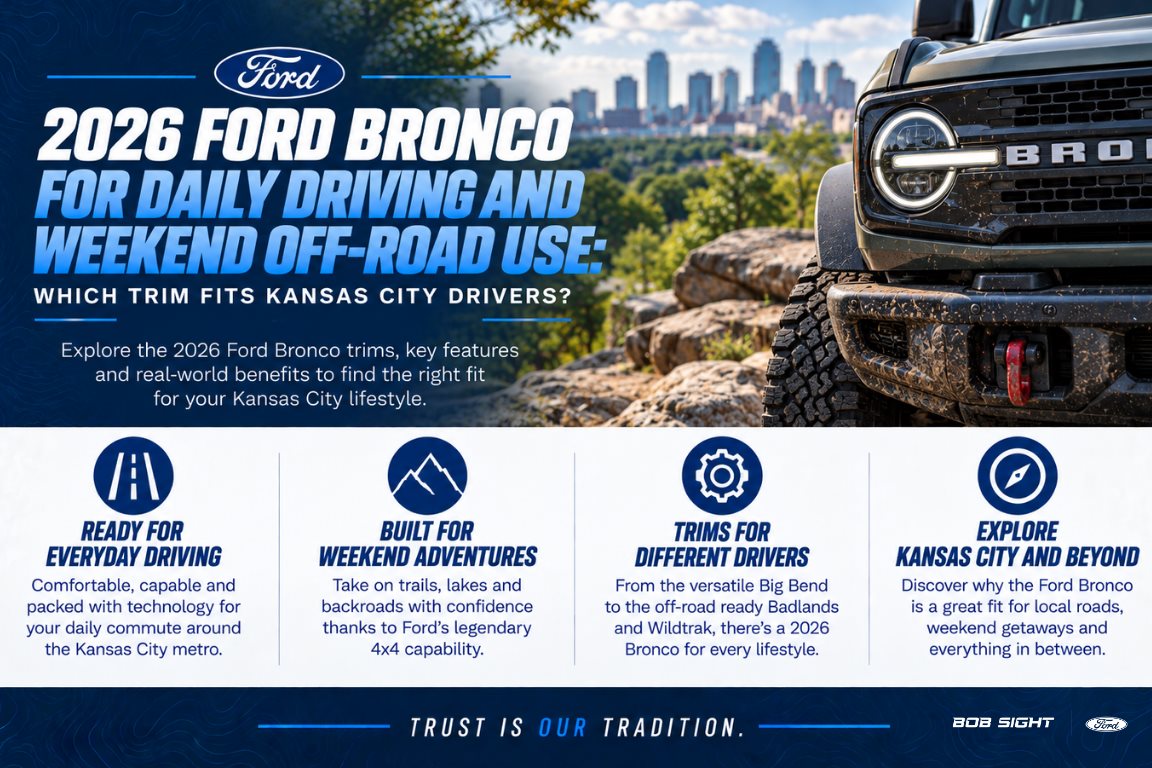
The 2026 Ford Bronco can serve as both a daily driver and a weekend trail vehicle when Kansas City shoppers choose the trim, body style, tires, suspension, roof, and powertrain around their real routine. Drivers commuting through Lee’s Summit, Blue Springs, Independence, Raytown, Grain Valley, Belton, and the greater Kansas City Metro may prioritize comfort and highway manners during the week while still wanting four-wheel-drive capability for camping, fishing, gravel roads, or off-road recreation. Bob Sight Ford helps shoppers compare Bronco configurations without assuming the most aggressive setup is automatically the best choice.
The 2026 Bronco lineup includes Base, Big Bend®, Outer Banks®, Badlands®, Heritage Edition, Stroppe Edition, and Raptor® models. Equipment ranges from practical everyday features to specialized systems such as HOSS suspension, available Sasquatch® hardware, full-vehicle steel bash plates, a front stabilizer bar disconnect, and up to seven G.O.A.T. Modes®. Choosing the right Bronco begins with deciding how much time the vehicle will spend on pavement, how difficult the planned trails are, and which comfort features matter during normal Kansas City travel.
Explore 2026 Ford Bronco inventory near Kansas City
In This Guide You'll Learn
This guide explains how to choose a 2026 Ford Bronco for commuting, weekend recreation, or a realistic combination of both. It focuses on use cases rather than comparing the Bronco against another automotive brand. That keeps the information centered on the Ford equipment shoppers need to understand before selecting a trim.
- Which Bronco trims lean toward daily comfort or off-road capability
- How two-door and four-door models fit different lifestyles
- What HOSS suspension and G.O.A.T. Modes mean
- When the Sasquatch Package may fit a driver’s needs
- How tires and ground clearance affect road manners
- What to consider about removable roofs and doors
- How to test drive a Bronco for Kansas City ownership
The best Bronco is not necessarily the model with the greatest ground clearance, largest tires, or highest-output engine. A commuter who visits maintained trails a few times each year may need a different configuration than someone who regularly tackles rough terrain. Matching the vehicle to recurring use helps preserve daily comfort while still providing meaningful capability.
Quick Facts About the 2026 Ford Bronco
The 2026 Ford Bronco offers two-door and four-door configurations, three turbocharged engine choices, standard four-wheel-drive capability, removable roof options, and multiple levels of HOSS suspension. Exact equipment varies by trim, package, body style, transmission, and inventory vehicle. Shoppers should review the window sticker rather than assuming every Bronco has the same trail hardware.
- The standard 2.3-liter EcoBoost® four-cylinder produces 300 horsepower.
- An available 2.7-liter EcoBoost V6 produces up to 330 horsepower.
- The Bronco Raptor uses a 3.0-liter EcoBoost V6 producing 418 horsepower.
- A seven-speed manual or ten-speed automatic transmission is offered in qualifying configurations.
- The Base, Badlands, and selected other models offer two-door or four-door availability.
- The Big Bend and Outer Banks are offered as four-door models for 2026.
- G.O.A.T. Modes stands for Goes Over Any Type of Terrain.
- The lineup offers up to seven selectable G.O.A.T. Modes.
- Maximum available ground clearance reaches 13.1 inches on the Bronco Raptor.
- Most properly equipped Bronco models can tow up to 3,500 pounds, while Raptor reaches up to 4,500 pounds.
Maximum figures describe specific configurations rather than every Bronco. Ground clearance, water-fording capability, power, towing, and drive modes vary across the lineup. Drivers should use the ratings and instructions for the exact vehicle when planning any trail, water crossing, or towing activity.
| 2026 Bronco Trim | Primary Character | Daily-Driving Fit | Off-Road Focus |
|---|---|---|---|
| Base | Essential Bronco capability | Practical for drivers who want a simpler configuration | Available Sasquatch Package |
| Big Bend | Everyday versatility | Strong commuter and lifestyle balance | Available Black Diamond Package |
| Outer Banks | Comfort and appearance | Well suited to frequent paved-road use | Trail capability with comfort emphasis |
| Badlands | Technical trail capability | Usable daily with more specialized hardware | HOSS 2.0 and stabilizer-bar disconnect |
| Heritage Edition | Distinctive styling and capability | Lifestyle-focused four-door configuration | Standard 35-inch tires |
| Stroppe Edition | Performance-oriented off-road design | More specialized for daily commuting | HOSS 3.0 and advanced trail equipment |
| Raptor | High-performance off-road capability | Largest and most specialized daily experience | HOSS 4.0, 37-inch tires, and 418 horsepower |
Which Bronco Trims Fit Daily Driving Best?
The Big Bend and Outer Banks generally provide the most direct balance for Kansas City drivers who spend most of the week on pavement and use trails occasionally. The Base can also serve as a practical daily driver for shoppers who prefer simpler equipment. The correct choice depends on desired comfort, technology, body style, appearance, and trail plans.
The Big Bend is offered as a four-door model for 2026 and builds on the Base with features such as privacy glass, a leather-wrapped steering wheel, and upgraded appearance details. It retains HOSS 1.0 suspension and five G.O.A.T. Modes. An available Black Diamond Package can add capability for shoppers who want more trail-oriented equipment without moving directly into Badlands. This makes Big Bend adaptable for families and commuters.
Outer Banks emphasizes comfort and style while preserving Bronco capability. It includes power-adjustable front seating and offers the Lux Package, depending on the individual configuration. Its 18-inch wheels and available body-color hardtop options provide a more road-focused presentation. An available 2.7-liter EcoBoost V6 can add stronger performance for drivers who value highway acceleration.
The Base offers two-door or four-door availability, a 300-horsepower 2.3-liter EcoBoost engine, five G.O.A.T. Modes, and available Sasquatch equipment. Its simpler feature set may appeal to drivers who want a foundation for outdoor use without additional luxury content. A Base model can still deliver substantial capability when properly configured. Shoppers should compare the actual vehicle because packages can change its character.
A daily commute through the I-470 and US-50 split places a premium on predictable steering, comfortable seating, manageable tire noise, and useful technology. A trim that performs well on a difficult trail may include tires or suspension tuning that feels more specialized on pavement. Kansas City shoppers should test drive the Bronco in routine traffic before choosing based mainly on weekend plans.
Which Bronco Trims Fit Frequent Off-Road Use?
The 2026 Bronco Badlands, Stroppe Edition, and Raptor provide the most specialized off-road hardware for drivers who expect to use challenging terrain regularly. These models add suspension, protection, traction, or performance systems beyond what most commuters require. Their benefits are most meaningful when the owner has the experience and access to use them responsibly.
Badlands includes HOSS 2.0 with Bilstein® position-sensitive dampers, seven G.O.A.T. Modes, a front stabilizer-bar disconnect, full-vehicle steel bash plates, marine-grade vinyl seating surfaces, and washout-capable flooring. The stabilizer-bar disconnect can increase wheel articulation in appropriate low-speed trail conditions. It should be used only according to Ford instructions. Available Sasquatch equipment can increase tire size and capability further.
The Stroppe Edition uses a 330-horsepower 2.7-liter EcoBoost V6 and HOSS 3.0 with FOX™ internal bypass dampers. It also includes seven G.O.A.T. Modes and a front stabilizer-bar disconnect. This configuration is designed around a more performance-oriented off-road experience. Its specialized equipment may be more than a driver needs for maintained gravel roads or occasional camping access.
The Bronco Raptor is the most extreme factory configuration in the 2026 lineup. Its 3.0-liter EcoBoost V6 produces 418 horsepower, while HOSS 4.0 uses FOX Live Valve semi-active dampers. It offers up to 13.1 inches of ground clearance, 37-inch tires, and heavy-duty full-vehicle steel bash plates. Those features create substantial capability but also produce a wider, taller, and more specialized vehicle for normal commuting.
Drivers should distinguish off-road appearance from off-road need. A weekend trip to a maintained campsite does not demand the same equipment as repeated travel over rocks, ruts, mud, or steep terrain. Buying capability that will not be used can introduce larger tires, higher step-in height, and different ride behavior. The ideal Bronco provides a comfortable margin for planned recreation without overwhelming everyday use.
Two-Door Versus Four-Door Bronco for Kansas City Life
A two-door Bronco favors compact proportions and a more traditional off-road profile, while a four-door Bronco provides easier passenger access and more practical space for daily life. Both body styles can be capable, but they support different routines. Availability also depends on trim.
The two-door body can be appealing for drivers who usually travel alone or with one passenger. Its shorter wheelbase can help maneuverability in certain trail situations and makes the Bronco feel more compact. The smaller cabin and rear-seat access require compromises for families or frequent passengers. Cargo planning also becomes more important during longer trips.
The four-door Bronco provides conventional rear-door access, easier child-seat loading, and more room for passengers and gear. It may be the stronger fit for school runs, commuting, pet travel, and weekend equipment. The longer wheelbase changes breakover geometry compared with a shorter two-door configuration, but it can contribute to a more settled feel during highway travel. Actual ride character still depends on tires, suspension, and trim.
Parking needs should be evaluated in person. A four-door Bronco remains manageable for many Lee’s Summit shopping areas, but a Raptor or Sasquatch-equipped model can be wide and tall. Drivers should measure garage openings, parking structures, and storage spaces. Roof racks and accessories can increase overall height beyond the base vehicle dimensions.
- List how many passengers travel in the Bronco during a normal week.
- Evaluate child-seat, pet, or rear-passenger access needs.
- Measure the cargo used for work and recreation.
- Compare garage and parking-space dimensions.
- Test drive two-door and four-door models when available.
- Choose the body style that works on ordinary days, not only trail days.
Shoppers can review available Ford Bronco models at Bob Sight Ford to compare actual body styles and equipment. Inventory can vary, so the window sticker should confirm the exact trim, roof, packages, engine, and transmission.
How Tires and Suspension Affect the Daily Drive
Bronco tires and suspension have a major effect on steering, ride comfort, road noise, braking feel, fuel use, and trail performance. Larger, more aggressive tires can add ground clearance and loose-surface traction while creating different behavior on pavement. HOSS suspension levels are designed for different degrees of off-road demand.
HOSS stands for High-Performance Off-Road Stability Suspension. The 2026 Bronco lineup progresses from HOSS 1.0 on road-friendly trims to HOSS 2.0 on Badlands and Heritage Edition, HOSS 3.0 on Stroppe Edition, and HOSS 4.0 on Raptor. Each system includes different hardware and tuning. A higher number does not automatically mean a better daily-driving match.
Tire tread influences the ownership experience every mile. A more aggressive all-terrain tire may provide useful traction on dirt, gravel, mud, or snow, but it can produce more sound or firmer responses on paved roads. Michelin, Goodyear, Continental, and other manufacturers offer different designs, though the factory-required size, load rating, speed rating, and application remain essential. Tire choice should reflect where the Bronco actually travels.
Larger tires also add rotating and unsprung mass. That can influence acceleration, braking response, steering effort, and fuel efficiency. The Sasquatch Package provides a coordinated factory approach to larger tires and related off-road equipment, making it different from adding oversized aftermarket tires without considering the full system. Shoppers should verify what the package includes on the exact model year and trim.
Road conditions around Jackson County make a realistic test drive useful. Potholes along Highway 50 can reveal how a configuration handles sharp impacts, while highway pavement can expose tire noise and steering response. Drivers who commute long distances should spend time at normal highway speeds before deciding. Trail hardware should enhance planned recreation without creating an unacceptable weekday compromise.
Ground Clearance, G.O.A.T. Modes, and Trail Equipment
Ground clearance and G.O.A.T. Modes help the Bronco adapt to terrain, but responsible off-road use still requires route knowledge, driver judgment, and an understanding of the vehicle’s dimensions. Electronic modes do not remove physical limits. Tires, traction, approach angle, breakover angle, departure angle, and obstacle placement all matter.
Ground clearance is the distance between the ground and a specified low point under the vehicle. More clearance can help a Bronco pass over rocks, ruts, and uneven surfaces, but higher configurations may affect entry height and the center of gravity. Ford lists up to 13.1 inches of ground clearance for the Bronco Raptor. Base, Big Bend, and other configurations offer lower maximums that may still exceed what many recreational routes require.
G.O.A.T. Modes adjust vehicle settings for different driving conditions. Mode availability varies by trim, with up to seven modes offered in the 2026 lineup. The system may change throttle response, transmission behavior, traction controls, steering, or four-wheel-drive operation depending on the selected mode. Drivers should read the owner’s manual before using specialized settings.
Badlands, Stroppe Edition, and Raptor include a front stabilizer-bar disconnect for increased articulation under appropriate conditions. Bash plates can help protect important underbody areas, while tow hooks provide designated recovery connection points when used correctly. These features do not make every obstacle safe. Recovery procedures and equipment require training because stored energy and improper attachment can create serious hazards.
Ford provides eligible new Bronco owners and lessees access to Bronco Off-Roadeo® experiences, subject to current program terms. Professional instruction can help owners understand four-wheel-drive systems, trail spotting, line selection, vehicle dimensions, and recovery fundamentals. Training adds practical value that a feature list cannot provide. Off-road travel should also respect land access rules and local regulations.
Removable Roof and Door Ownership
The Bronco’s removable roof and doors create an open-air experience, but owners should plan for weather, storage, reinstallation, security, and changing road conditions. These features can make weekend travel memorable while adding tasks that a fixed-roof SUV does not require. Following Ford procedures protects components and supports correct operation.
Hardtop and soft-top availability varies by body style and configuration. A soft top can make open-air transitions convenient, while a hardtop may appeal to drivers who prioritize a more enclosed experience during winter and highway commuting. Roof panels require secure storage where seals and finished surfaces will not be damaged. The owner’s manual provides the correct removal and installation sequence.
Door removal changes mirror placement, electrical connections, storage needs, and occupant exposure. Owners should follow every Ford instruction and applicable law. Removed doors must be stored safely, and hardware should remain organized. The Bronco should never be driven with components partly attached or improperly secured.
Kansas City weather can change quickly, making forecast awareness important. A clear morning in Lee’s Summit can become a stormy afternoon, and highway wind can make open-air driving different from a slow trip around town. Owners should consider where roof panels or doors will be stored if weather changes away from home. Drainable flooring does not eliminate the need to protect electronics and interior materials.
Open-air capability may matter greatly to a recreation-focused shopper and very little to someone who plans to keep the roof installed year-round. Test the latches, storage process, cabin noise, and rear cargo access before selecting a roof. A feature is valuable only when the owner is comfortable using and maintaining it.
How to Choose a Bronco Trim for Your Routine
Choose a Bronco trim by matching weekday mileage, passenger needs, parking, desired comfort, trail difficulty, and maintenance expectations. Start with recurring use and add capability where a real need exists. Avoid selecting a specialized model mainly because its maximum specifications sound impressive.
A driver who commutes daily and visits maintained recreation areas may find Base, Big Bend, or Outer Banks appropriate. These trims provide authentic Bronco design and four-wheel-drive capability without requiring the most specialized suspension. Big Bend can add capability through available packages, while Outer Banks leans toward comfort and appearance. Exact configurations should be compared individually.
A driver who regularly tackles demanding trails may prefer Badlands for its HOSS 2.0 suspension, seven G.O.A.T. Modes, stabilizer-bar disconnect, bash plates, and washout-capable interior. Stroppe Edition and Raptor serve more specialized performance goals. Their added hardware becomes meaningful when the owner understands and uses it. Otherwise, the larger tires and more aggressive setup may create daily compromises without practical benefit.
- Estimate the percentage of annual driving that occurs on pavement.
- Describe the most difficult terrain the Bronco will realistically encounter.
- Choose two-door or four-door based on passenger and cargo use.
- Decide whether comfort or trail hardware receives priority.
- Compare tire sizes and suspension systems.
- Review roof, seat material, flooring, and technology needs.
- Test drive the final configurations on familiar roads.
Current eligible shoppers can review Ford Employee Pricing details in Kansas City when applicable. Program terms and vehicle eligibility can change, so details should be verified directly. The Bronco’s trim and configuration should still be selected according to long-term fit.
How to Test Drive a 2026 Bronco
A useful Bronco test drive should evaluate seating, visibility, steering, braking, tire noise, roof noise, parking, highway behavior, and low-speed control. The goal is to understand how the exact configuration behaves during normal Kansas City travel. A quick drive on smooth streets may not reveal meaningful differences among trims.
Begin by checking step-in height and passenger access. Sasquatch, Badlands, Stroppe Edition, and Raptor configurations can sit higher than road-oriented models. Families should test child-seat access, while shorter passengers should evaluate available steps or running boards. Confirm that entry remains practical for everyday use.
Drive through lower-speed streets and make several controlled turns. Notice steering effort, turning radius, forward visibility, and body movement. Test parking and reversing with available camera systems. A four-door Raptor will feel different in a narrow space than a Base two-door.
Use an appropriate highway route to evaluate acceleration, tracking, wind noise, tire sound, and seat comfort. The 2.3-liter and 2.7-liter EcoBoost engines provide different power delivery, while the 3.0-liter Raptor powertrain serves a much more specialized purpose. Manual and automatic transmissions also create distinct driving experiences. Shoppers should test the transmission they intend to own.
Ask for a demonstration of four-wheel-drive controls and G.O.A.T. Modes while the vehicle is stationary or in a suitable setting. Do not attempt technical off-road maneuvers on public roads or dealership property. The explanation should cover when each setting is appropriate and which features require particular conditions. Understanding controls before ownership supports safer use later.
Shoppers can use the Bob Sight Ford test-drive resources to prepare for their visit. Comparing a road-friendly Bronco with a Badlands or Sasquatch-equipped model back to back can make tire and suspension differences easier to understand.
Ownership Planning
Bronco ownership planning should account for routine Ford maintenance, tire care, removable-component upkeep, off-road inspections, and seasonal Missouri conditions. A Bronco used only on pavement has different demands than one regularly exposed to mud, water, dust, rocks, and uneven terrain. Owners should tell the service advisor how the vehicle is used.
Engine oil must meet the viscosity and Ford specification required for the exact EcoBoost engine. Tires should be maintained at the cold pressure listed for the vehicle and inspected for tread wear, cuts, punctures, and sidewall damage. Off-road use can introduce debris around suspension, brakes, steering, and underbody protection. Cleaning the vehicle makes post-trip inspection more effective.
After trail use, inspect tires, wheels, skid plates, tow hooks, suspension, visible hoses, and fluid areas. Listen for new noises or vibration during the return trip. Mud can hide damage or hold moisture against components. Deep-water travel requires strict adherence to Ford limits and procedures because water depth, speed, bottom conditions, current, and vehicle setup all influence risk.
Roof and door seals should remain clean and correctly positioned. Panels and doors need protected storage, while bolts and tools should stay organized. Owners should never force latches or continue driving with a component that appears improperly secured. Water leaks, wind noise changes, or damaged seals deserve inspection.
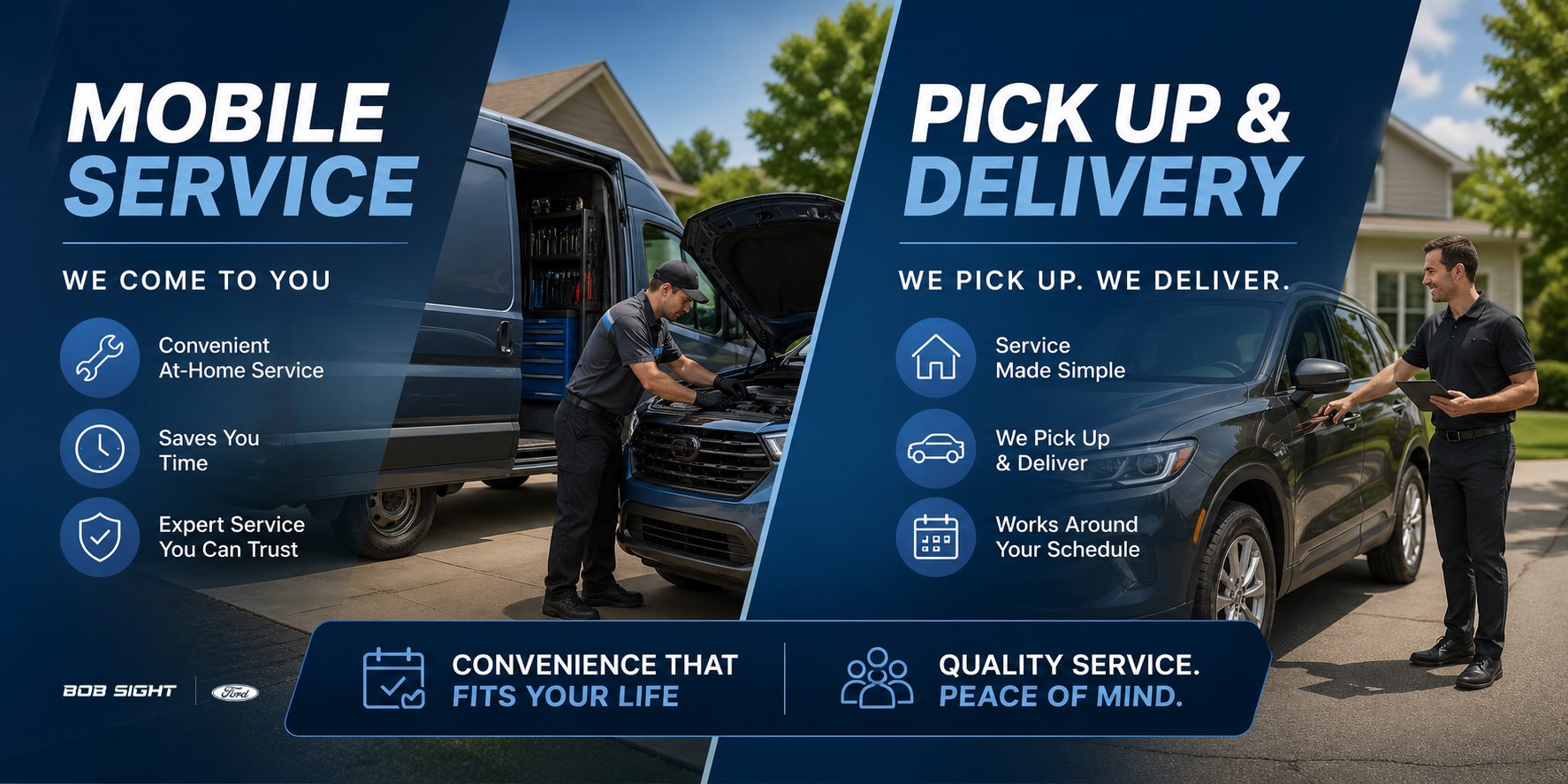
Drivers can schedule Ford Bronco service in Lee’s Summit for vehicle-specific maintenance. Bob Sight Ford also provides information about Ford Pickup and Delivery for qualifying service needs. Availability and eligibility should be confirmed when scheduling.
Frequently Asked Questions
These answers address common questions Kansas City shoppers ask when choosing a 2026 Ford Bronco for commuting and weekend recreation. Equipment and specifications vary by trim and package. The individual window sticker and Ford instructions should guide the final decision.
Is the 2026 Ford Bronco comfortable for daily driving?
The 2026 Bronco can be comfortable for daily driving, but ride quality, noise, access, and steering feel vary by tires, suspension, roof, body style, and trim. Big Bend and Outer Banks generally lean toward a more everyday-focused balance. Base can also serve commuters who prefer simpler equipment. More aggressive configurations create a different road experience.
Larger all-terrain tires can increase road sound and change steering response. Removable roofs may allow more environmental noise than a conventional fixed-roof SUV. Seat materials and power adjustments also vary across the lineup. Shoppers should test the exact Bronco rather than relying on a general review.
A Kansas City commuter should drive at highway speed, park in a typical space, and travel over uneven pavement. The vehicle should feel predictable through the I-470 and US-50 area and manageable near busy Lee’s Summit shopping areas. Passenger access and garage clearance also matter. Daily comfort is determined by the complete routine.
Which 2026 Bronco trim is best for occasional off-road use?
Big Bend can be a strong choice for occasional off-road use because it balances everyday equipment with available capability packages. Base may also fit drivers who want essential Bronco hardware, while Outer Banks supports lighter recreation with greater comfort emphasis. The trail itself should determine how much equipment is needed.
An available Black Diamond Package can increase Big Bend capability, while the Sasquatch Package is available on selected configurations. Badlands provides more specialized equipment for drivers who expect harder terrain. Choosing Badlands solely for occasional gravel travel may add hardware the owner rarely uses. A realistic route assessment prevents overbuying.
Missouri recreation can range from maintained campground roads to mud, ruts, rocks, and steep surfaces. Ask where the Bronco will travel, how often, and under what weather conditions. Proper tires, recovery preparation, and driver training remain important at every trim level. Bronco Off-Roadeo can provide valuable instruction for eligible owners.
Is the Bronco Badlands practical for commuting?
The Bronco Badlands can be used for commuting, but its specialized off-road equipment should provide meaningful value to the owner. HOSS 2.0 suspension, Bilstein dampers, bash plates, seven G.O.A.T. Modes, and a stabilizer-bar disconnect support demanding trail use. Marine-grade vinyl and washout-capable flooring are also designed around outdoor activity. These features create a more capability-focused configuration.
Road comfort depends partly on tire selection and whether the Bronco includes the Sasquatch Package. Larger tires and additional ground clearance can affect noise, entry height, steering, and fuel use. Some drivers accept those differences because they use the capability regularly. Others may prefer Big Bend or Outer Banks for weekday travel.
A driver commuting from Independence to Lee’s Summit should compare Badlands with a less aggressive trim on the same route. Highway behavior, parking, seat comfort, and cabin noise should all be evaluated. If the Badlands equipment serves frequent recreation, the compromise may feel worthwhile. If it remains unused, another trim may fit better.
Should I choose a two-door or four-door Ford Bronco?
Choose a two-door Bronco for a more compact footprint and traditional profile, or a four-door Bronco for easier passenger access and greater everyday versatility. Neither body style is universally better. Passenger count, child seats, pets, cargo, garage space, and trail goals should guide the decision.
The two-door can be appealing for drivers who travel alone or with one passenger and value shorter proportions. Rear-seat access and cargo room require more planning. The four-door makes family and group travel easier while providing more flexible cargo capacity. Its longer wheelbase changes trail geometry and road behavior.
Kansas City shoppers should test both body styles when available. Load the equipment used for work or recreation and confirm garage fit. Drive both on local streets and highway pavement. The body style should work during the majority of ownership days.
Does the Bronco Sasquatch Package make sense for daily driving?
The Sasquatch Package can work for daily driving, but it makes the most sense for owners who value its larger tires, ground clearance, stance, and added trail capability. Factory integration helps coordinate the major components. The package still creates practical differences compared with a road-oriented Bronco. Those differences should be experienced before purchase.
Larger tires can influence road noise, step-in height, braking feel, acceleration, steering, and fuel use. Parking height and garage clearance should also be checked. Drivers should not assume that capability automatically improves every type of travel. Highway commuters may prioritize a quieter or less aggressive setup.
A shopper who regularly visits challenging terrain outside the Kansas City Metro may find the package worthwhile. Someone who mainly travels paved roads and occasional maintained gravel routes may not need it. Compare a Sasquatch-equipped Bronco with a standard configuration during the same visit. Real driving makes the tradeoffs easier to understand.
Find Your 2026 Ford Bronco at Bob Sight Ford
Bob Sight Ford helps Kansas City Metro shoppers choose a 2026 Bronco trim that fits weekday commuting and realistic weekend recreation. Drivers can compare Base, Big Bend, Outer Banks, Badlands, Heritage Edition, Stroppe Edition, and Raptor configurations based on body style, powertrain, suspension, tires, roof, comfort, and trail hardware. The right choice balances both parts of the ownership plan.
Shoppers visiting from Blue Springs, Independence, Raytown, Grain Valley, Belton, and surrounding Jackson County communities can test Bronco configurations in Lee’s Summit. Bring passenger, cargo, garage, and recreation requirements to the appointment. Those details help the team identify useful equipment without defaulting to the most specialized model.
Bob Sight Ford also supports Bronco owners with Ford-Certified Technicians, Motorcraft parts, maintenance scheduling, and qualifying convenience options. A capable vehicle still depends on proper tires, routine maintenance, responsible loading, trail preparation, and informed driving. Trust Is Our Tradition.
Helpful Links
Use these Bob Sight Ford resources to explore Bronco inventory, prepare for a test drive, and plan ownership.
Proud to be part of the Bob Sight Auto Group
Bob Sight Ford is proud to be part of the Bob Sight Auto Group, helping drivers throughout Lee’s Summit, Lawrence, Independence, and the Kansas City Metro. Our family of automotive locations supports local shoppers and owners with vehicle research, maintenance resources, collision assistance, and long-term care. Each location shares a commitment to clear guidance, trusted relationships, and useful automotive support.