Best Ford Truck for Towing Boats in Missouri
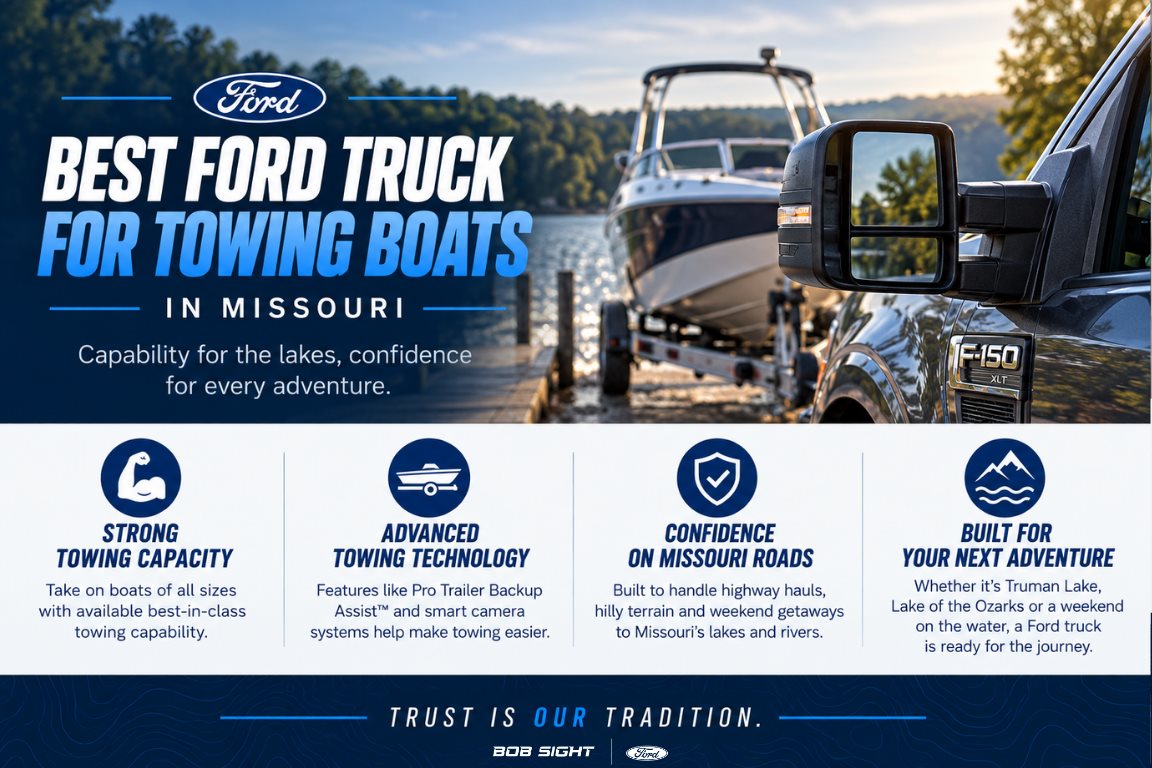
Explore Ford F-150 Inventory Near Kansas City
The Ford F-150 is the best Ford truck for towing boats for many Missouri drivers because it combines substantial available towing capacity, useful trailering technology, manageable everyday driving, and multiple powertrain choices. The 2026 Ford F-150 can tow up to 13,500 pounds when properly configured, giving it the range to handle many fishing boats, ski boats, wake boats, and family runabouts. Missouri boat owners with a smaller personal watercraft or aluminum fishing boat may prefer the maneuverability of a Ford Maverick or Ranger, while owners of very large boats and heavy trailers may need the capability of a Ford Super Duty.
Selecting the right truck requires more than comparing maximum towing numbers. The complete weight of the boat, trailer, fuel, batteries, gear, coolers, water, passengers, cargo, and hitch equipment must fit within the truck’s individual ratings. Trailer tongue weight also counts against the truck’s payload capacity, so a truck can reach its payload limit before reaching its advertised maximum trailer rating.
Missouri boat owners regularly travel to destinations such as Lake of the Ozarks, Truman Lake, Smithville Lake, Longview Lake, Blue Springs Lake, and Lake Jacomo. Those trips may involve highway speeds, steep boat ramps, wet pavement, crosswinds, traffic, and long grades. This guide explains how the Ford Maverick, Ranger, F-150, and Super Duty fit different boating needs for drivers in Lee’s Summit and throughout the Greater Kansas City Metro.
In This Guide You’ll Learn
This guide helps Missouri boat owners match a Ford truck to the complete weight, dimensions, and travel demands of a boat-and-trailer combination. It also explains towing terminology, payload limits, hitch setup, ramp considerations, trailering technology, and long-term maintenance.
- Why the Ford F-150 is the best all-around Ford truck for towing many boats
- When a Ford Maverick or Ranger may provide enough capability
- When a Ford Super Duty becomes the more appropriate choice
- How to calculate loaded boat and trailer weight
- Why payload and tongue weight matter as much as towing capacity
- Which Ford trailering technologies can help at the ramp
- How to prepare a truck and trailer before towing across Missouri
Published maximum towing ratings apply only to properly configured vehicles. Engine, cab, bed length, drivetrain, axle ratio, wheelbase, equipment, passengers, cargo, hitch type, and towing package can all change the rating. Always verify the ratings on the exact truck and compare them with the fully loaded trailer before towing.
Which Ford Truck Is Best for Towing Boats in Missouri?
The Ford F-150 is the best all-around Ford truck for towing boats in Missouri because it covers a broad range of trailer weights without requiring most owners to move into a heavy-duty truck. Its available maximum towing capacity of 13,500 pounds exceeds the needs of many recreational boat-and-trailer combinations. It also offers features that can simplify hitching, reversing, launching, and highway travel.
The F-150 works well for Missouri drivers who need one vehicle for commuting, family transportation, home projects, and weekend lake trips. Its lineup includes several engines, cab styles, bed lengths, drivetrains, and towing configurations. That flexibility allows a buyer to choose capability based on the actual boat rather than purchasing more truck than the owner will regularly use.
The available 3.5-liter EcoBoost® V6 produces 400 horsepower and 500 pound-feet of torque in the 2026 F-150. It supports the truck’s maximum available tow rating when combined with the required configuration. The available 3.5-liter PowerBoost® Full Hybrid V6 produces 430 horsepower and 578 pound-feet of torque and can tow up to 11,600 pounds when properly equipped.
Available Pro Trailer Hitch Assist™ can help control steering, braking, and acceleration while the truck reverses toward a compatible trailer coupler. Available Pro Trailer Backup Assist™ lets the driver direct a compatible trailer while the system helps manage steering inputs. These tools do not replace the driver, but they can reduce some of the stress associated with lining up a hitch or backing toward a crowded Missouri boat ramp.
Imagine towing a wake boat from Lee’s Summit toward Lake of the Ozarks. The route may include highway merging, rolling grades, crosswinds, traffic, and a busy launch area. An appropriately configured F-150 provides a balance of tow rating, torque, wheelbase, braking support, camera visibility, and everyday comfort that fits this type of trip.
The F-150 is not automatically correct for every boat. A lighter fishing boat may fit comfortably behind a Ranger, while a much heavier cruiser may require a Super Duty. The best truck is always the properly equipped model with sufficient towing capacity, payload capacity, axle ratings, and hitch capability for the fully loaded trailer.
Ford Truck Towing Capacity Comparison
Ford truck towing capacity ranges from up to 4,000 pounds in a properly equipped Maverick to far higher heavy-duty limits in the Super Duty lineup. The 2026 Ranger can tow up to 7,500 pounds, and the 2026 F-150 can tow up to 13,500 pounds when properly configured. These maximums provide useful starting points, but they are not universal ratings for every truck bearing the same model name.
| Ford Truck | Maximum Available Towing Capacity | Potential Boat-Towing Fit |
|---|---|---|
| 2026 Ford Maverick | Up to 4,000 pounds with the available 4K Tow Package | Personal watercraft, lightweight aluminum fishing boats, and other small combinations within ratings |
| 2026 Ford Ranger | Up to 7,500 pounds with the available Trailer Tow Package | Many bass boats, fishing boats, smaller pontoons, and runabouts within ratings |
| 2026 Ford F-150 | Up to 13,500 pounds when properly configured | Many fishing boats, ski boats, wake boats, pontoons, and larger recreational boats |
| Ford Super Duty | Varies significantly by model, engine, hitch type, and configuration | Very heavy boats, large trailers, commercial use, or owners needing greater capacity margin |
The Maverick has a standard towing capacity of 2,000 pounds and reaches its 4,000-pound maximum only with the appropriate available equipment. The Ranger XLT reaches its 7,500-pound maximum with the available Trailer Tow Package. The F-150 maximum requires a specific configuration that may include the appropriate engine, axle ratio, drivetrain, cab, wheelbase, and towing equipment.
Super Duty ratings require even closer examination because the lineup includes F-250, F-350, and F-450 models with gas and diesel powertrains, single or dual rear wheels, and multiple hitch types. A headline maximum associated with a gooseneck configuration should not be used as the rating for a conventional boat trailer. Boat owners must verify the conventional towing rating for the exact truck.
A family towing a fishing boat from Blue Springs to Truman Lake may not need the same truck as an owner moving a heavy cabin cruiser across Missouri. Buying too little capacity can create a safety and durability problem. Buying far more truck than needed may add size and operating considerations that do not improve the owner’s normal towing experience.
Use the comparison table to narrow the field, then move to the truck’s individual labels and Ford towing information. The final decision should be based on real loaded weights, not an estimate based only on boat length or an empty trailer specification.
How to Calculate the Loaded Weight of Your Boat and Trailer
Calculate the loaded trailer weight by adding the boat, engine, trailer, fuel, batteries, water, accessories, safety equipment, fishing gear, coolers, and every other item carried on the trailer. The dry weight published by a boat manufacturer usually does not represent the complete weight leaving your driveway. A certified scale provides a more reliable measurement than assumptions.
- Find the boat’s published dry weight. Confirm whether the stated figure includes the engine, batteries, factory-installed options, or fluids.
- Add the trailer weight. Use the trailer’s actual or documented empty weight, including installed spare tires, winches, bunks, rollers, and accessories.
- Add fuel. Gasoline weighs roughly six pounds per gallon, so a large fuel tank can add several hundred pounds when filled.
- Add batteries and equipment. Trolling-motor batteries, anchors, electronics, life jackets, fishing tackle, coolers, covers, and tools contribute to trailer weight.
- Add water where applicable. Freshwater tanks, livewells, ballast systems, and retained water can materially change the load.
- Measure the loaded combination. Use an appropriate certified scale to confirm the trailer’s actual weight and weight distribution.
- Compare every applicable rating. Check the truck’s trailer rating, payload capacity, Gross Vehicle Weight Rating, Gross Combined Weight Rating, axle ratings, hitch rating, and the trailer’s ratings.
Gross Trailer Weight is the total weight of the loaded trailer. Gross Combined Weight Rating, often shortened to GCWR, is the maximum allowable combined weight of the loaded truck and loaded trailer as specified by the manufacturer. Gross Vehicle Weight Rating, or GVWR, is the maximum allowable weight of the loaded truck itself.
Suppose a boat is advertised with a dry weight that seems suitable for a Ranger. After adding the trailer, outboard motor, fuel, multiple batteries, fishing equipment, and supplies, the complete combination may be much heavier than the original number. That added weight could move the owner closer to the Ranger’s limits or make an F-150 a more comfortable match.
Weigh the truck as it will actually travel. Passengers, luggage, bed cargo, tools, hitch equipment, and trailer tongue weight all add to the truck’s load. A tow rating cannot be considered independently from payload and axle ratings.
Missouri boat owners who travel long distances along US-50, Interstate 70, or winding lake roads should build their decisions around verified weights. Accurate numbers create a stronger foundation for choosing the correct Ford truck, hitch equipment, brake controller settings, and travel plan.
Why Payload and Tongue Weight Matter for Boat Towing
Payload capacity matters because trailer tongue weight, passengers, cargo, and hitch equipment all place weight on the truck. A Ford truck may have enough advertised towing capacity for a boat while lacking sufficient remaining payload for the people and gear traveling with it. Both limits must be respected.
Payload is the amount of weight the truck can carry, based on its individual configuration and labels. It includes occupants, items in the cab, cargo in the bed, aftermarket accessories, the hitch, and the portion of trailer weight pressing on the hitch. The payload number for a specific truck may differ from a maximum figure advertised for the model line.
Tongue weight is the downward force the trailer applies to the hitch. Proper tongue weight supports trailer stability, while too little can contribute to sway and too much can overload the truck, hitch, or rear axle. Boat-trailer design and loading can differ from other trailer types, so owners should follow the boat and trailer manufacturers’ guidance.
A crew traveling from Lee’s Summit to Smithville Lake might place five passengers in the truck, load coolers and supplies in the bed, and connect a loaded boat trailer. Every part of that load uses payload capacity. If the truck begins the trip with a low available payload margin, the combined load may exceed a rating even if the boat appears to fall below the maximum tow number.
The truck’s Tire and Loading Information label provides vehicle-specific information that should be reviewed before towing. Additional certification labels and Ford towing resources help identify Gross Vehicle Weight Rating and axle limits. Never substitute a different truck’s rating or a general online number for the data that applies to your vehicle.
Payload is one reason the F-150 makes sense for many boat owners. Its available maximum payload reaches 2,440 pounds in the 2026 lineup, although the actual rating varies by configuration. Buyers should select an F-150 based on both the boat trailer and the people, equipment, and cargo that will accompany it.
Ford Maverick for Towing Small Boats and Personal Watercraft
The Ford Maverick can be a practical choice for small boats and personal watercraft when the complete loaded trailer remains within the truck’s individual ratings. The 2026 Maverick can tow up to 4,000 pounds with the available 4K Tow Package, while standard towing capacity is 2,000 pounds. It offers compact dimensions that can simplify parking, commuting, and maneuvering at smaller launch areas.
Maverick shoppers must verify that the truck includes the equipment required for the higher rating. A standard Maverick should not be assumed to have the 4,000-pound capability. Powertrain, drivetrain, trim, and package availability can affect the final configuration.
This truck may fit an owner towing a single personal watercraft, a pair of lightweight watercraft on an appropriate trailer, a small jon boat, or a compact aluminum fishing boat. The actual combination must be weighed because engines, batteries, fuel, fishing equipment, and trailer accessories can quickly raise the total.
For an owner living near downtown Lee’s Summit who commutes throughout the week and launches a lightweight fishing boat at Lake Jacomo on weekends, the Maverick can provide an appealing balance. Its smaller footprint may be easier to maneuver through parking areas and residential streets than a full-size truck. Available all-wheel drive can also support traction on wet pavement, though it does not increase the truck’s published towing rating by itself.
Boat ramps introduce a traction challenge because the rear tires may be positioned on a wet, algae-covered, or gravelly surface. Drivers should inspect the ramp, use the correct launch technique, and avoid placing the truck too far into the water. All-wheel drive may help distribute torque, but tire condition and ramp surface remain important.
The Maverick is not the right answer when the loaded combination approaches or exceeds its rating. Owners planning to move into a heavier boat should consider future needs before choosing a truck. A Ranger or F-150 may provide more room for changing equipment, additional cargo, and a larger trailer.
Ford Ranger for Bass Boats, Fishing Boats, and Smaller Pontoons
The Ford Ranger is a strong midsize option for many bass boats, fishing boats, smaller pontoons, and recreational runabouts that remain within its ratings. The 2026 Ranger XLT can tow up to 7,500 pounds when equipped with the available Trailer Tow Package. This gives it more towing range than the Maverick while retaining a smaller footprint than the F-150.
The Ranger offers a standard 2.3-liter EcoBoost engine and an available 2.7-liter EcoBoost engine on applicable configurations. Four-wheel drive is available, which can be useful for boat owners launching from wet or uneven ramps. The drivetrain choice does not remove the need to verify the truck’s exact towing and payload ratings.
A bass-boat owner traveling from Independence to Truman Lake may find the Ranger’s dimensions useful at crowded ramps and tight parking areas. The truck can be easier to position than a longer full-size configuration, and its available towing capacity covers many common fishing-boat combinations. The loaded trailer must still be measured rather than estimated.
The Ranger can also make sense for owners who travel on gravel access roads or launch at smaller Missouri lakes. Available camera technology may improve awareness around the truck, trailer, and surrounding obstacles. Cameras should be kept clean and used together with mirrors and direct observation.
As a trailer approaches the Ranger’s upper range, buyers should evaluate payload, wheelbase, cargo, passenger weight, and travel distance. A combination that falls below the maximum rating may still feel different during highway travel than a lighter load. Crosswinds, passing trucks, steep grades, and emergency maneuvering all deserve consideration.
The Ranger is the middle ground in the Ford truck lineup. It provides more capability than the Maverick for many boat owners without moving directly to a full-size truck. If the boat, trailer, and equipment leave limited capacity for passengers or future upgrades, the F-150 may be the better long-term choice.
Ford F-150 for Wake Boats, Pontoons, and Larger Recreational Boats
The Ford F-150 is the most versatile Ford truck for towing many wake boats, pontoons, ski boats, and larger recreational boats in Missouri. Its maximum available towing capacity of 13,500 pounds provides a substantial capability range, while its powertrain and cab choices allow owners to balance towing, passenger space, efficiency, and everyday comfort.
The available 3.5-liter EcoBoost V6 is the engine associated with the F-150’s maximum available tow rating. Its 500 pound-feet of torque can support confident acceleration when the truck is correctly configured and loaded. Owners should not assume that every F-150 with this engine reaches the maximum because cab, bed, axle, drivetrain, and package choices also matter.
The available PowerBoost Full Hybrid V6 offers up to 11,600 pounds of towing capability when properly equipped. It also includes Pro Power Onboard™, which can provide electrical output for compatible equipment at a campsite, marina, or staging area. The owner must follow system instructions and keep electrical equipment clear of water and unsafe conditions.
Available Pro Trailer Hitch Assist can help position the truck near a compatible trailer coupler. Available Pro Trailer Backup Assist can help the driver manage trailer direction while reversing. An available 360-Degree Camera can provide multiple views around the truck, which may be useful when lining up at a congested launch area.
At a busy Lake of the Ozarks ramp, the driver may need to reverse down a narrow lane while monitoring other vehicles, docks, pedestrians, and changing pavement angles. Trailering technology can improve awareness and reduce steering confusion, but a spotter remains valuable. The driver is responsible for confirming that the path is clear.
The F-150 also provides passenger-friendly options for families traveling from Kansas City with boating gear. A suitable SuperCrew configuration can provide rear-seat space, while the bed keeps wet or bulky equipment outside the cabin. Payload calculations must include every passenger and item.
When a Ford Super Duty Is the Better Boat-Towing Choice
A Ford Super Duty is the better choice when a large boat-and-trailer combination exceeds the practical or legal ratings of an appropriately configured F-150. It may also suit owners who tow very heavy loads frequently, carry substantial cargo, or need greater conventional towing and payload capability. The exact F-250, F-350, or F-450 configuration must be matched to the trailer.
Boat trailers typically connect through a conventional receiver hitch rather than a fifth-wheel or gooseneck system. This distinction is critical because the highest Super Duty towing figure may be associated with a gooseneck configuration that does not apply to a conventional boat trailer. Buyers should verify the conventional towing rating rather than relying on the lineup’s headline maximum.
Super Duty models offer gas and Power Stroke® diesel engine options, depending on model year and configuration. Diesel torque can be useful for heavy loads and demanding grades, while gas engines may fit other ownership preferences. Engine choice affects ratings, truck weight, payload, maintenance, and driving characteristics.
A large boat being transported between the Kansas City Metro and a marina several hours away can create different demands than a lightweight fishing boat used locally. Trailer length, frontal area, weight distribution, crosswind exposure, braking requirements, and highway speed all affect the towing experience. A heavier truck with suitable wheelbase and ratings may provide the appropriate foundation.
Super Duty size should also be considered. Longer wheelbases and larger turning circles may require more planning in residential driveways, marina parking areas, fuel stations, and tight launch lanes. The additional capability is valuable when it is required, but it should be matched to actual use.
Bob Sight Ford can help shoppers compare Ford truck configurations, but the owner remains responsible for accurate trailer information. Bring the boat and trailer specifications, actual loaded weight if available, tongue weight, hitch details, and a realistic list of passengers and cargo. Complete information leads to a better truck recommendation.
How Ford Towing Technology Helps at Missouri Boat Ramps
Ford towing technology can assist with hitch alignment, reversing, camera visibility, trailer-brake management, and driving information, making boat towing easier to manage. Feature availability varies by truck, trim, package, and model year. These systems assist the driver but do not replace mirrors, spotters, careful setup, or safe judgment.
| Available Ford Feature | What It Does | Potential Boat-Towing Benefit |
|---|---|---|
| Pro Trailer Hitch Assist | Helps control the truck while reversing toward a compatible hitch | Can simplify alignment during trailer connection |
| Pro Trailer Backup Assist | Helps translate driver input into trailer direction | Can reduce steering confusion while backing toward a ramp |
| 360-Degree Camera | Provides available views around the truck | Can improve low-speed awareness near docks, trailers, and parking lines |
| Integrated Trailer Brake Controller | Manages compatible electric or electric-over-hydraulic trailer brakes | Supports coordinated braking when properly adjusted |
| Tow/Haul Mode | Adjusts transmission behavior for towing conditions | Can support power delivery and grade management |
Trailer brakes may be required or appropriate based on trailer weight, equipment, and applicable law. The brake controller must be set correctly for the loaded trailer and road conditions. Too little trailer braking can place excessive demand on the truck, while too much can cause the trailer brakes to lock or respond abruptly.
Camera lenses can become covered by dust, rain, road grime, or water spray. Clean them before backing toward the water. A camera view may also distort distance, so use mirrors, direct observation, and a spotter when available.
At Longview Lake, a driver may encounter a line of trailers waiting to launch. Prepare straps, drain-plug procedures, lines, safety equipment, and passengers away from the active ramp so the truck spends less time blocking access. Technology works best when paired with an organized launch routine.
Practice backing in an open area before visiting a crowded ramp. Learn how the trailer responds to small steering inputs and how quickly it changes direction. The goal is not speed; it is smooth, controlled positioning with constant awareness of people and obstacles.
How to Prepare for a Safe Missouri Boat-Towing Trip
Prepare for a boat-towing trip by inspecting the truck, hitch, trailer, tires, brakes, lights, safety chains, load distribution, and launch equipment before leaving. A complete walkaround can identify problems while the combination is still parked rather than after it reaches US-50 or a steep ramp. Repeat key checks after stops.
- Confirm loaded weights and ratings. Verify that the truck, trailer, hitch, axles, tires, and combined load remain within their limits.
- Inspect the coupler and hitch. Confirm that the coupler is seated, latched, secured, and matched to the correct hitch-ball size.
- Cross the safety chains. Attach them to the approved points without allowing them to drag or restrict normal turning.
- Connect the breakaway system. Verify correct attachment and operation according to the trailer manufacturer’s instructions.
- Test trailer lights and brakes. Check running lights, turn signals, brake lights, reverse functions where equipped, and trailer-brake response.
- Inspect all tires. Check pressure, tread, sidewalls, valve stems, and the trailer spare while the tires are cold.
- Secure the boat and gear. Confirm the bow connection, transom straps, covers, equipment, motor position, and loose items.
- Adjust mirrors and controller settings. Make sure the driver can monitor the trailer and that compatible braking equipment is properly configured.
- Plan the route and fuel stops. Account for construction, grades, weather, parking space, and trailer-friendly access.
Wheel bearings deserve attention because boat trailers are regularly backed near or into water. Follow the trailer manufacturer’s inspection and lubrication guidance. Hot hubs, unusual noise, looseness, leaking seals, or uneven tire wear can signal a problem that should be addressed before travel.
Missouri summer heat can increase stress on trailer tires, while spring storms may create strong crosswinds and standing water. Reduce speed when conditions change and avoid abrupt steering or braking. Trailer sway should be treated seriously rather than corrected with aggressive inputs.
When descending toward a ramp, maintain a controlled pace and keep unnecessary people away from the truck’s path. Confirm traction conditions before the rear tires reach the wet portion. Do not enter water deeper than the vehicle and trailer procedures require.
After retrieving the boat, move away from the active ramp before organizing gear. Recheck tie-downs, lights, coupler security, safety chains, and any equipment that may have shifted. A second inspection can catch problems before the highway trip home.
Quick Facts About Ford Trucks for Towing Boats
The F-150 is the best all-around Ford boat-towing truck, while Maverick, Ranger, and Super Duty models serve lighter or heavier towing needs. The correct choice depends on the fully loaded combination and the ratings of the exact truck.
- The 2026 Ford Maverick can tow up to 4,000 pounds with the available 4K Tow Package.
- The 2026 Ford Ranger can tow up to 7,500 pounds when properly equipped.
- The 2026 Ford F-150 can tow up to 13,500 pounds when properly configured.
- The F-150 PowerBoost Full Hybrid V6 can tow up to 11,600 pounds when properly equipped.
- Maximum model-line ratings do not apply to every truck in the lineup.
- Boat dry weight is not the same as loaded trailer weight.
- Trailer tongue weight counts against truck payload capacity.
- Passengers, bed cargo, hitch equipment, and accessories also use payload.
- Super Duty gooseneck maximums should not be confused with conventional boat-trailer ratings.
- Available Ford trailering technology can assist, but the driver remains responsible.
These figures should be used to begin the selection process, not to approve a particular towing combination. Review Ford towing information, vehicle labels, trailer ratings, hitch ratings, and actual scale measurements. Use the lowest applicable rating as the controlling limit.
Missouri boat owners should also consider where they launch and how far they travel. A short trip to Blue Springs Lake creates different demands than a fully loaded trip to Table Rock Lake. Highway distance, grades, wind, ramp conditions, and cargo all belong in the decision.
Ownership Planning for a Ford Boat-Towing Truck
Long-term ownership planning should include more frequent inspections of tires, brakes, fluids, cooling components, suspension, hitch equipment, and driveline systems when a Ford truck regularly tows a boat. Towing adds load and heat, so maintenance should reflect how the truck is actually used. Follow the owner’s manual and vehicle-specific maintenance information.
Engine oil, transmission fluid, coolant, transfer-case fluid, axle lubricant, and brake fluid perform important jobs under towing conditions. Required specifications and service intervals vary by truck and powertrain. Do not assume that an F-150, Ranger, Maverick, and Super Duty use the same fluids or maintenance schedule.
Inspect the hitch receiver, ball mount, hitch ball, wiring connector, safety-chain attachment points, and trailer-brake components regularly. Corrosion and wear can develop when equipment is exposed to water, humidity, road salt, and outdoor storage. Replace damaged components with properly rated parts.
Tire rotation and pressure checks are important because towing can reveal or accelerate uneven wear. Use the cold-pressure specification for the truck and trailer. Do not inflate a tire only according to the maximum pressure molded into its sidewall without following the applicable vehicle and tire guidance.
A Ford truck traveling between Lee’s Summit and Missouri lakes may experience highway towing, gravel access roads, wet ramps, summer heat, and winter storage. Seasonal inspections help owners prepare for the next boating period. Test the battery, inspect wipers and lights, and address warning messages before a planned trip.
Bob Sight Ford offers Ford service scheduling for truck owners throughout the Kansas City Metro. Eligible customers may also ask about Ford Pickup & Delivery for qualifying maintenance. Keeping the truck ready between lake trips supports safer, more dependable towing.
Frequently Asked Questions About Ford Trucks and Boat Towing
Is the Ford F-150 good for towing a boat?
The Ford F-150 is an excellent choice for towing many boats because it offers up to 13,500 pounds of available towing capacity when properly configured. Its range of engines, cab styles, beds, and trailering technologies allows Missouri buyers to select a truck that matches both boating and daily-driving needs.
The maximum rating does not apply to every F-150. The specific engine, cab, bed, drivetrain, axle ratio, towing package, payload rating, and other equipment determine what an individual truck can tow. Verify the actual vehicle before connecting a trailer.
For a family towing a wake boat from Lee’s Summit to Lake of the Ozarks, a properly selected F-150 may provide the right balance of capability and passenger comfort. The boat, trailer, fuel, gear, passengers, and cargo must all be included in the calculations.
Can a Ford Ranger tow a bass boat?
A properly equipped Ford Ranger can tow many bass boats when the complete loaded combination remains within the truck’s ratings. The 2026 Ranger offers up to 7,500 pounds of towing capacity with the required available Trailer Tow Package.
Do not compare the rating only with the boat’s dry weight. Add the trailer, outboard motor if not included, fuel, batteries, trolling motor, electronics, fishing gear, anchors, coolers, and other equipment. Measure the loaded trailer when possible.
The Ranger’s midsize footprint can be useful at smaller Missouri ramps and crowded parking areas. Available four-wheel drive may help on wet or loose surfaces, but careful launch technique and suitable tires remain necessary.
Can a Ford Maverick tow a fishing boat?
A Ford Maverick can tow certain lightweight fishing boats when properly equipped and kept within its individual ratings. The 2026 Maverick has a standard 2,000-pound towing capacity and can reach 4,000 pounds with the available 4K Tow Package.
Many boat packages become heavier after adding the trailer, motor, batteries, fuel, safety equipment, and fishing supplies. A combination advertised as lightweight should still be calculated and weighed. The truck’s payload must also accommodate tongue weight and occupants.
A Maverick may be a practical option for a Lee’s Summit owner towing a compact aluminum boat to Lake Jacomo. If the owner expects to upgrade to a larger boat, a Ranger or F-150 may provide more long-term flexibility.
Do I need four-wheel drive to launch a boat?
Four-wheel drive is not required for every boat launch, but it can provide useful traction on wet, steep, gravelly, or algae-covered ramps. Truck configuration, tire condition, trailer weight, ramp design, and surface conditions all influence traction.
Two-wheel-drive trucks can successfully launch many boats on maintained ramps. However, rear tires may lose traction when the ramp is slick or the trailer places a heavy load on the truck. Four-wheel drive can distribute torque to additional wheels when used according to manufacturer instructions.
Inspect unfamiliar Missouri ramps before backing down. Avoid placing the truck farther into the water than necessary, keep movements smooth, and stop if the surface appears unsafe. Four-wheel drive supports traction but does not eliminate ramp hazards.
How much extra towing capacity should I have for a boat?
Your loaded boat trailer must remain within every applicable rating, and choosing a truck with additional usable capacity can help accommodate passengers, cargo, equipment, and future changes. There is no single percentage that replaces the manufacturer’s ratings or a complete weight calculation.
Capacity margin can be useful because actual boat weight may differ from a dry specification. Fuel, water, batteries, gear, trailer accessories, and modifications add weight. Payload and axle ratings may become limiting factors before maximum towing capacity.
A Missouri owner who frequently travels long distances, encounters steep grades, or plans to purchase a larger boat may prefer an F-150 over a Ranger even when the current trailer technically fits within Ranger ratings. The decision should be based on verified weights, usage, and the exact truck configuration.
Find the Right Ford Truck for Missouri Boat Towing
The Ford F-150 is the best Ford truck for towing boats for many Missouri owners because it combines strong available capacity, useful trailering technology, multiple powertrains, and everyday versatility. The Ranger is a capable midsize alternative for many fishing boats and smaller recreational boats, while the Maverick can support appropriately lightweight combinations. Super Duty models serve owners whose heavy boats require greater capacity.
Choosing locally gives you an opportunity to discuss the boat, trailer, passengers, equipment, destinations, and driving conditions that shape your towing needs. A truck for weekend trips to Longview Lake may differ from one used for frequent travel to Lake of the Ozarks or Table Rock Lake. Bob Sight Ford can help shoppers compare available Ford truck configurations in Lee’s Summit.
Bring accurate information when you shop. Document the boat, engine, trailer, loaded weight, tongue weight, hitch type, number of passengers, bed cargo, and future boating plans. This allows you to evaluate more than a headline towing number.
Bob Sight Ford serves truck shoppers from Lee’s Summit, Blue Springs, Independence, Raytown, Grandview, Belton, Liberty, Grain Valley, Overland Park, Olathe, and surrounding Kansas City Metro communities. Explore available Ford trucks, compare towing equipment, and choose a configuration built around the way you use your boat.
Helpful Links
- Browse Ford F-150 Inventory
- Browse Ford Ranger Inventory
- Browse Ford Maverick Inventory
- Explore New Ford Inventory
- Value Your Trade
Proud to Be Part of the Bob Sight Auto Group
Bob Sight Ford in Lee’s Summit is proud to be part of the Bob Sight Auto Group, serving drivers throughout the Kansas City Metro and Northeast Kansas. The group connects shoppers and owners with vehicle sales, service, financing assistance, parts support, and collision repair. Each location serves its own community while carrying forward the Bob Sight commitment to helpful automotive guidance.
Ford truck shoppers can compare capable towing options at Bob Sight Ford, while drivers interested in other brands can visit Bob Sight Honda, Bob Sight CDJR, or Bob Sight Kia. The Bob Sight Collision Center provides a local resource when a vehicle requires professional collision repair. Together, these locations support area drivers throughout vehicle shopping, ownership, maintenance, and repair.