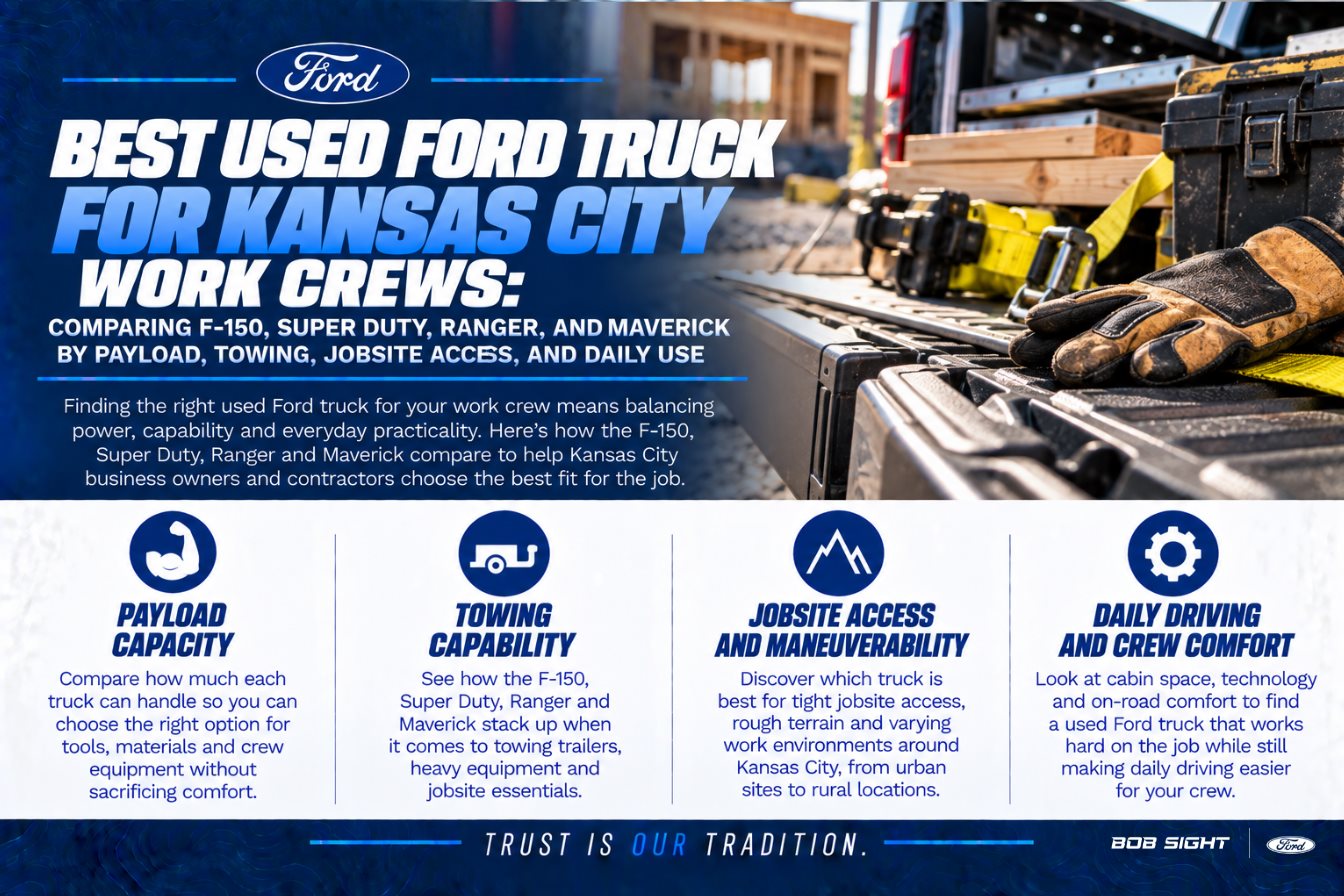
Best Used Ford Truck for Kansas City Work Crews: Comparing F-150, Super Duty, Ranger, and Maverick by Payload, Towing, Jobsite Access, and Daily Use
Shop Used Ford Trucks at Bob Sight Ford
The best used Ford truck for a Kansas City work crew depends on what the truck actually carries, what it tows, how many workers ride in it, and where it needs to operate each day. A used Ford F-150 can provide a strong balance for many contractors and service crews, while a Super Duty may make more sense for heavier trailers and equipment. Ranger and Maverick can be practical alternatives when maneuverability, lighter-duty hauling, parking, and daily driving are bigger priorities. For businesses and independent contractors in Lee’s Summit, Blue Springs, Independence, Raytown, Grandview, Belton, and across the Kansas City Metro, matching the truck to the work is more useful than simply choosing the largest pickup available.
In This Guide You’ll Learn
This guide approaches used Ford truck shopping from a work-crew perspective, helping Kansas City buyers determine which truck category fits the equipment, people, routes, and jobs they handle regularly.
- How the Ford Maverick, Ranger, F-150, and Super Duty fit different types of work
- Why payload is just as important as towing capacity for many crews
- How passengers, tools, accessories, and trailer tongue weight affect usable capacity
- When an F-150 may be a better work-truck fit than a heavier Super Duty
- When a Ranger or Maverick can make more sense for urban and suburban job routes
- What Kansas City contractors should inspect before buying a used Ford truck
- How cab, bed, drivetrain, engine, and towing equipment affect work-truck suitability
Which Used Ford Truck Makes the Most Sense for a Work Crew?
For many general work crews, a used Ford F-150 offers the broadest balance of passenger space, bed utility, towing capability, payload potential, and everyday drivability, but Ranger, Maverick, and Super Duty models each serve distinctly different workloads. Maverick can work well for lighter equipment and dense daily routes, Ranger adds midsize truck capability without the footprint of a full-size pickup, F-150 covers a wide range of general contracting and towing needs, and Super Duty moves into substantially heavier hauling and trailer applications.
The important word is “workload.” A roofing crew pulling a loaded dump trailer has different requirements from an HVAC technician carrying parts and hand tools. A landscaping company moving equipment between Lee’s Summit and Blue Springs may have different needs from a property-management crew making dozens of stops around the Kansas City Metro. Buying more truck than the job requires can add size and maneuverability considerations, while buying too little truck can create payload or towing limitations.
Payload is particularly important for crew vehicles because people count toward the truck’s load. Tools, toolboxes, bed caps, accessories, supplies, and trailer tongue weight can also consume available payload. A truck that appears capable based on an advertised maximum towing figure may not be properly configured for a particular real-world combination of workers, cargo, accessories, and trailer weight.
Used-truck shoppers should therefore identify their normal workday before comparing inventory. Write down the number of workers who typically ride in the truck, the approximate weight of permanently installed accessories, the tools and materials commonly carried, the type of trailer used, and the expected loaded trailer weight. That information gives you a much better starting point for choosing between Maverick, Ranger, F-150, and Super Duty.
| Used Ford Truck | Work-Crew Strength | Consider It For |
|---|---|---|
| Ford Maverick | Compact footprint and flexible light-duty utility | Service calls, inspections, small tools, parts, property management |
| Ford Ranger | Midsize maneuverability with stronger truck capability | Field service, smaller trailers, equipment, construction support |
| Ford F-150 | Broad balance of towing, payload, cab space, and bed utility | Contractors, landscaping, construction, maintenance, general work crews |
| Ford Super Duty | Heavy towing and hauling capability | Heavy equipment, larger trailers, demanding commercial workloads |
Why Should Work Crews Compare Payload Before Towing Capacity?
Payload matters because every worker, tool, accessory, material, and portion of trailer tongue weight carried by the truck uses some of its available carrying capacity. For many Kansas City work crews, payload can become a practical limitation before the trailer reaches the truck’s advertised maximum towing capability. This makes the doorjamb payload information on the individual used truck extremely important.
Payload is the weight a vehicle can carry rather than pull. That includes occupants and cargo in or on the truck. If a contractor installs a toolbox, carries several workers, loads equipment in the bed, and then connects a trailer, those items all need to be considered. Trailer tongue weight applies downward force at the hitch and must be included when determining whether the truck remains within its applicable ratings.
Ford specifically advises owners to use the Safety Compliance Certification Label and vehicle-specific information when evaluating payload and towing. Maximum ratings vary by configuration, accessories, drivetrain, cab, engine, axle ratio, and other equipment. That is particularly relevant to used trucks because two F-150s sitting next to each other can have meaningfully different capabilities.
Imagine a landscaping crew leaving Lee’s Summit with four workers, equipment secured in the bed, a crossover toolbox, and a trailer carrying commercial mowers. Looking only at an F-150’s maximum advertised towing capability would not answer whether that particular truck is correctly configured for the loaded combination. The crew needs to account for occupants, cargo, accessories, trailer tongue weight, GVWR, GCWR, and the specific truck’s payload rating.
- Find the payload and weight information for the specific truck.
- Estimate the combined weight of the driver and crew members.
- Account for tools, materials, equipment, and permanently installed accessories.
- Determine the loaded trailer weight rather than using the trailer’s empty weight.
- Account for trailer tongue weight.
- Confirm the truck’s towing equipment and configuration.
- Verify that applicable GVWR, GAWR, GCWR, payload, hitch, and towing limits are not exceeded.
When Is a Used Ford F-150 a Strong Fit for Kansas City Work Crews?
A used Ford F-150 is a strong work-crew candidate when a business needs meaningful towing and hauling capability but still wants a truck that works well for everyday travel, crew transportation, jobsite visits, and mixed suburban driving. Its wide range of engines, cab configurations, bed choices, drivetrains, and towing equipment means used F-150 capability can vary substantially, making configuration more important than the F-150 badge alone.
For perspective on the capability range of the current truck family, the 2026 F-150 can be configured for up to 13,500 pounds of maximum available towing and up to 2,440 pounds of maximum available payload when properly equipped. Those figures should not be applied to an older used F-150 automatically. They illustrate why the F-150 occupies such a broad middle ground in Ford’s truck lineup. Model year, engine, axle ratio, cab, bed, drivetrain, packages, and options must be checked on the actual used vehicle.
An F-150 can make sense for construction supervisors, electricians, landscapers, remodeling companies, maintenance crews, and other businesses whose trucks move between worksites and regular roads every day. A crew might leave a shop in Lee’s Summit, travel US-50 toward a project in Jackson County, make a supply stop, tow equipment to another site, and still use the same truck for normal commuting. That mixed-use pattern is where a full-size light-duty truck can be particularly versatile.
Crew size matters when shopping used. A SuperCrew configuration may be more practical when several adults regularly ride together, while another cab configuration may work for a driver who primarily carries equipment. Bed length can matter just as much. A contractor carrying long materials has different needs from a technician whose equipment is organized into a toolbox and smaller storage system.
Used shoppers should also identify towing equipment rather than assuming every F-150 was ordered for the same job. Hitch equipment, trailer brake controls, axle ratios, towing packages, and other configuration details can affect capability. When towing is a major part of the truck’s job, verify the original configuration and the ratings for that specific model year before purchase.
When Should a Work Crew Step Up to a Used Ford Super Duty?
A used Ford Super Duty becomes more relevant when the job consistently involves heavier trailers, substantial bed loads, commercial equipment, or workloads that exceed what an appropriately configured F-150 can support. F-250 and F-350 models are designed for heavier-duty applications, but choosing a Super Duty should still be based on actual trailer and payload requirements rather than assuming bigger is automatically better.
The capability difference can be substantial. As a current-line reference, Ford lists the 2026 Super Duty family at up to 40,000 pounds of maximum available gooseneck towing and up to 8,000 pounds of maximum available payload in specific configurations. Conventional, fifth-wheel, and gooseneck ratings vary significantly by model and configuration. Those current maximums should not be assigned to a used F-250 or F-350 without checking its model-year towing guide and vehicle-specific ratings.
Super Duty may be appropriate for companies regularly moving skid steers, larger equipment trailers, heavy material loads, or other demanding combinations. A construction crew working throughout Lee’s Summit, Independence, Blue Springs, and surrounding areas might benefit from the additional capability if heavy towing is part of the truck’s normal schedule rather than an occasional event.
There are tradeoffs to consider. A heavy-duty pickup has a larger footprint and may be less convenient in tight parking areas, crowded residential jobsites, parking garages, or locations where a smaller turning footprint matters. If the truck spends most of its time carrying a few toolboxes and driving between service calls, Super Duty capability may exceed the actual workload.
Gas versus diesel is another used-truck consideration. Ford Super Duty has been offered with gas and Power Stroke diesel powertrains, with exact availability depending on model year. Diesel can be relevant to demanding towing applications, but shoppers should evaluate maintenance history, intended use, operating patterns, and the specific truck rather than assuming a diesel is necessary for every crew.
Could a Used Ford Ranger Be Better for Smaller Jobsites?
A used Ford Ranger can be a practical work truck for crews that need a traditional pickup bed and meaningful towing capability but want a smaller footprint than an F-150. This can be useful for field-service businesses, maintenance teams, contractors working on residential properties, and crews that frequently navigate tighter lots or urban and suburban jobsites around Kansas City.
The Ranger sits between Maverick and F-150 in Ford’s truck range. As a current capability reference, the 2026 Ranger offers up to 7,500 pounds of maximum available towing and up to 1,767 pounds of maximum available payload when properly configured. Again, those are current-model reference figures rather than universal specifications for every used Ranger. Used buyers need to check the ratings and equipment for the exact model year and vehicle.
That middle position can work well for businesses whose equipment does not require full-size truck capacity. A crew might carry power tools, repair equipment, parts, ladders, or jobsite supplies while towing a moderate trailer when properly equipped. At the same time, the Ranger’s dimensions can make it easier to maneuver through residential streets, smaller parking areas, and jobsites where space is limited.
Consider a maintenance company with service calls in downtown Lee’s Summit, apartment communities in Independence, and residential properties in Blue Springs. If the truck rarely carries a large crew or pulls a heavy equipment trailer, a midsize truck may provide the utility the business needs without moving into a larger platform. The correct answer still depends on actual cargo and trailer weights.
Used Ranger shoppers should verify drivetrain, engine, trailer equipment, cab configuration, and payload. On current Rangers, towing equipment such as the available Trailer Tow Package can be required to reach higher trailer ratings. Older model years have their own specifications and requirements, so a used Ranger should always be evaluated according to its VIN, model year, configuration, and applicable Ford towing documentation.
Can a Used Ford Maverick Work as a Business Truck?
A used Ford Maverick can make sense for light-duty business use when maneuverability, everyday driving, parts transport, small tools, and frequent service calls matter more than heavy towing or large payload requirements. It should not be treated as a substitute for an F-150 or Super Duty when the workload requires their capacity, but not every work crew needs a full-size truck.
Maverick can fit businesses such as property-management companies, estimators, inspection teams, mobile service providers, sales representatives, facilities personnel, and tradespeople whose daily cargo is relatively light. Its compact footprint can also be helpful for businesses that spend substantial time in parking lots, residential neighborhoods, commercial developments, and dense job locations.
Current Maverick capability shows how much utility can fit into the compact truck category. The 2026 Maverick can tow up to 4,000 pounds when properly equipped with the available 4K Tow Package in eligible configurations, while standard maximum towing is 2,000 pounds. Ford lists up to 1,500 pounds of maximum payload for certain 2026 Maverick configurations. Used Maverick specifications vary by model year, drivetrain, powertrain, package, and equipment.
Picture a property-maintenance employee starting in Raytown, visiting several buildings in Kansas City, and finishing the day at a property in Grandview. The truck may carry hand tools, replacement parts, small equipment, and supplies but never pull a large construction trailer. For that work pattern, maximizing heavy-duty capability may provide little practical benefit compared with choosing a truck that fits the route.
Maverick can also be useful when a business wants a pickup bed without a larger full-size footprint. The key is discipline about the workload. If equipment, crew weight, trailer requirements, or material loads routinely approach the truck’s limits, moving to Ranger, F-150, or Super Duty should be evaluated instead.
How Should Contractors Match a Used Ford Truck to Their Actual Work?
Contractors should choose a used Ford truck by documenting their heaviest normal workload, not by choosing a model first and trying to make the job fit afterward. Crew size, payload, trailer weight, bed requirements, cab configuration, parking conditions, annual mileage, and jobsite access should all be considered before narrowing the search to Maverick, Ranger, F-150, or Super Duty.
Start with the equipment that moves every day. A plumbing company might carry pipe, fittings, power tools, storage systems, and multiple technicians. A landscaping business may carry fuel cans, blowers, trimmers, hand tools, and a trailer loaded with mowers. A remodeling crew might prioritize cab space and enclosed tool storage. A concrete or excavation contractor may have much heavier trailer requirements.
Then consider the roads and jobsites. Kansas City Metro work can include interstate driving, suburban neighborhoods, rural properties, commercial lots, and congested construction areas in the same week. A truck that spends most of its time on I-470 and US-50 has a different use pattern from one constantly backing into narrow residential driveways or navigating packed commercial parking areas.
Finally, plan for normal growth without dramatically overestimating future requirements. If the company expects to add a somewhat larger trailer soon, that should be considered. But buying a heavy-duty platform solely because a much heavier workload might appear years later can result in a truck that does not match current daily use.
- List the people who normally ride in the truck.
- Estimate the weight of tools and materials carried every day.
- Identify permanent accessories such as toolboxes, racks, caps, and equipment.
- Record the loaded weight of trailers the truck needs to pull.
- Determine how frequently towing occurs.
- Decide how much cab and bed space the crew actually uses.
- Consider parking, garages, residential jobsites, and other space constraints.
- Compare those requirements with the ratings of individual used trucks.
- Leave reasonable capacity for changing workloads without exceeding vehicle limits.
What Should You Inspect Before Buying a Used Ford Work Truck?
A used Ford work truck should be evaluated for condition, maintenance history, configuration, towing equipment, modifications, tires, suspension, brakes, drivetrain operation, and evidence of how it may have been used previously. Work trucks can lead demanding lives, so a careful inspection is more important than simply comparing mileage and appearance.
Begin by verifying what the truck actually is. Confirm the model year, engine, drivetrain, cab, bed, axle information, and installed equipment. Look at the doorjamb labels and use model-year-specific Ford documentation when evaluating payload and towing. If a seller states that a truck has a certain towing package, verify the equipment rather than relying only on the description.
Maintenance records can provide valuable context. Regular oil changes, fluid services, brake maintenance, tire replacement, and other documented work can help explain how the vehicle was maintained. Diesel Super Duty models may have additional maintenance considerations, while a gasoline F-150, Ranger, or Maverick will have requirements based on its specific powertrain and model year.
Inspect modifications carefully as well. Lift kits, oversized tires, aftermarket suspension components, bumpers, toolboxes, racks, auxiliary equipment, and other additions can affect weight, operation, and how the truck should be evaluated. A modified truck is not automatically unsuitable for work, but buyers should understand what has changed and whether the modifications fit their intended use.
A contractor from Liberty or Belton who expects to tow regularly should pay particular attention to the hitch area, trailer wiring, brake controller equipment, cooling system condition, brakes, tires, and drivetrain behavior. A service company buying a Ranger or Maverick may place more emphasis on bed condition, interior wear, storage usability, and signs of frequent stop-and-go use. The inspection should match the job the truck will perform next.
Quick Facts for Comparing Used Ford Work Trucks
Used Ford work trucks should be compared by vehicle-specific capability and actual job requirements rather than by model reputation or maximum advertised ratings alone. The exact configuration matters because payload and towing can change with model year, cab, bed, engine, drivetrain, axle ratio, packages, options, accessories, passengers, and cargo.
- Maverick can suit light-duty service routes, property management, inspections, and smaller equipment loads.
- Ranger can provide midsize maneuverability with greater traditional truck capability.
- F-150 can fit a broad range of general contracting, landscaping, maintenance, and crew applications.
- Super Duty is designed for heavier towing and hauling requirements.
- Payload includes occupants, cargo, tools, accessories, and applicable trailer tongue weight carried by the truck.
- Maximum advertised towing does not mean every truck of that model can tow that amount.
- Cab configuration affects passenger space and can affect vehicle ratings.
- Bed configuration affects cargo utility and may affect truck specifications.
- Towing packages and equipment should be verified on the actual used truck.
- Aftermarket accessories add weight and may affect available payload.
- The truck’s doorjamb information is important when determining vehicle-specific carrying capacity.
- Ford publishes towing guides for current and previous model years that can help used buyers verify specifications.
For Kansas City businesses, the practical goal is not to find the truck with the largest number on a specification sheet. It is to find a used Ford truck with the appropriate capacity, configuration, condition, and dimensions for the work it will perform repeatedly. That approach can narrow the search much faster than treating every used pickup as interchangeable.
How Should Businesses Plan for Long-Term Used Ford Truck Ownership?
Long-term work-truck planning should account for mileage, maintenance, downtime, tires, brakes, towing frequency, payload demands, seasonal conditions, and how the truck’s responsibilities may change as the business grows. A used truck becomes a business tool, so its usefulness depends on more than whether it can complete the first job after purchase.
Kansas City work trucks can accumulate mileage quickly. A crew based in Lee’s Summit might travel to Blue Springs in the morning, Independence after lunch, and another project across Jackson County before returning to the shop. Frequent starts, idling, loaded driving, trailer use, construction areas, and stop-and-go routes can create a very different duty cycle from a personal truck driven primarily for commuting.
Maintenance should reflect the vehicle and how it is used. Follow the applicable Ford owner information and maintenance guidance for the specific model year and powertrain. Trucks exposed to frequent towing, heavy loads, dusty jobsites, extensive idling, or other demanding operating conditions may have different maintenance considerations than vehicles used primarily for ordinary highway driving.
Tires deserve particular attention on a working pickup. Load requirements, tread condition, inflation, seasonal weather, and jobsite surfaces can all affect performance. Missouri winters can add cold temperatures, snow, ice, slush, and potholes to a truck that already spends the workweek carrying people and equipment. Tire selection and condition should match the truck’s intended workload and environment.
Businesses should also consider downtime. A truck that is critical to a crew’s daily operation needs consistent maintenance planning rather than waiting for a problem to interrupt the schedule. Bob Sight Ford offers online Ford service scheduling in Lee’s Summit, along with Ford Pickup & Delivery availability that can help eligible owners explore more convenient service arrangements.
Frequently Asked Questions About Used Ford Trucks for Work Crews
Is a used Ford F-150 a good truck for contractors?
A used Ford F-150 can be a strong contractor truck because the lineup offers a wide range of cab, bed, engine, drivetrain, towing, and payload configurations. It can fit businesses that need to transport workers and equipment while also towing trailers or carrying jobsite materials. The specific configuration determines whether an individual F-150 fits the workload.
Contractors should not assume that all used F-150s have the same capability. Engine, axle ratio, drivetrain, cab, bed, towing equipment, options, and model year can change the ratings. Accessories and passengers also affect how much capacity remains for tools, materials, and trailer tongue weight.
For contractors working throughout Lee’s Summit and the Kansas City Metro, F-150 can be useful because it combines full-size pickup capability with everyday road use. The right used F-150 should still be selected by comparing the actual truck’s specifications against the crew’s normal workload.
When does a work crew need a Ford Super Duty instead of an F-150?
A work crew should consider Super Duty when its normal towing or hauling requirements exceed the capabilities of an appropriately configured F-150 or when heavier-duty equipment is central to the truck’s job. F-250 and F-350 models are built for substantially more demanding applications and offer configurations designed for heavier trailers and loads.
The decision should be based on loaded trailer weight, tongue or kingpin weight, payload requirements, crew weight, equipment, and applicable vehicle ratings. A company pulling a substantial equipment trailer regularly may have very different requirements from a contractor pulling a small utility trailer occasionally.
Kansas City businesses should also consider maneuverability and daily use. If the truck frequently works in tight residential neighborhoods around Raytown, Independence, or Lee’s Summit, the larger dimensions of a Super Duty may matter. The right truck balances required capability with the environment where it operates.
Is a Ford Ranger large enough for a work crew?
A Ford Ranger can be large enough for certain work crews when the passenger, payload, bed, and towing requirements fit the specifications of the individual truck. It is particularly relevant to smaller crews and businesses that need pickup utility while frequently operating in tighter spaces.
Ranger can fit field-service work, maintenance, smaller construction support, parts transport, and moderate towing when properly equipped. The current Ranger family demonstrates meaningful midsize capability, but used Ranger specifications must be verified according to model year and configuration.
For businesses moving between jobsites in Blue Springs, Independence, Lee’s Summit, and Kansas City, the smaller footprint may be useful when parking and maneuverability are daily concerns. A crew carrying heavy materials or towing large equipment should compare its requirements with F-150 or Super Duty instead.
Can a Ford Maverick be used as a work truck?
A Ford Maverick can function as a work truck for lighter-duty applications that prioritize a pickup bed, maneuverability, daily driving, and transportation of smaller tools or supplies. Property management, inspections, estimates, facilities work, and certain mobile service businesses are examples where a compact truck may fit the job.
The key is staying within the ratings of the specific Maverick. Crew members, cargo, accessories, and trailer tongue weight all matter when evaluating payload. Towing capacity also varies by powertrain, drivetrain, package, and model year.
A business that rarely tows heavy equipment may find a smaller pickup better aligned with frequent Kansas City service calls. If the workload grows to include heavier trailers, larger crews, or substantial bed loads, Ranger, F-150, or Super Duty may provide a more appropriate capability range.
What should I check before buying a used Ford work truck near Kansas City?
Before buying a used Ford work truck, verify its configuration and ratings, inspect its mechanical condition, review available maintenance history, and determine whether its payload and towing capabilities fit your actual workload. Do not rely solely on the model badge, mileage, or an advertised maximum capability.
Check the truck’s cab, bed, engine, drivetrain, towing equipment, tires, brakes, suspension, hitch components, trailer wiring, and modifications. Review the doorjamb labels and model-year towing information when capacity matters. If the truck will tow frequently, confirm the configuration before putting it into service.
Shoppers from Lee’s Summit, Blue Springs, Independence, Grandview, Belton, Liberty, and across the Kansas City Metro can browse used inventory at Bob Sight Ford as part of their research. Comparing each truck against a written list of crew, cargo, towing, and route requirements can help narrow the choices efficiently.
Find a Used Ford Truck That Fits the Work Your Crew Actually Does
The best used Ford work truck is the one whose configuration, capacity, size, and condition match the jobs your crew performs repeatedly. Maverick can be useful for light-duty routes, Ranger provides a midsize option for crews that need more traditional pickup capability, F-150 covers a wide range of general work applications, and Super Duty is available for substantially heavier towing and hauling requirements.
For Kansas City contractors, landscapers, maintenance teams, property managers, construction crews, and other businesses, the buying process should begin with the workload rather than the truck name. Calculate the people and equipment that travel in the vehicle, determine realistic trailer weights, consider jobsite dimensions, and decide how much of the truck’s life will be spent towing versus commuting between jobs.
Then evaluate individual used trucks rather than broad model maximums. A particular F-150 may have a different payload rating and towing configuration from another F-150. The same principle applies to Ranger, Maverick, F-250, and F-350. Model year, equipment, condition, accessories, and original configuration matter when a truck is being selected as a working asset.
Bob Sight Ford in Lee’s Summit serves used-truck shoppers from Blue Springs, Independence, Raytown, Grandview, Belton, Liberty, Overland Park, Olathe, and communities throughout the Kansas City Metro. Whether your crew needs a maneuverable truck for frequent service calls or a heavier platform for equipment trailers, defining the job first can help you focus on used Ford trucks that actually fit the work.
Helpful Links
- Shop Used Vehicles
- Shop Pre-Owned Vehicles Under $15K
- Value Your Trade
- Ford Finance Department
- Schedule Ford Service
Proud to Be Part of the Bob Sight Auto Group
Bob Sight Ford is proud to be part of the Bob Sight Auto Group, serving drivers and businesses throughout the Kansas City Metro and surrounding communities with automotive sales, financing, service, parts, and collision repair resources. Our dealerships include Bob Sight Ford in Lee’s Summit, Bob Sight Kia in Independence, Bob Sight Honda in Lawrence, Bob Sight CDJR in Lawrence, and the Bob Sight Collision Center in Lee’s Summit. Whether you are comparing used Ford trucks for a growing work crew or maintaining vehicles already in your business, the Bob Sight Auto Group provides local automotive resources throughout the ownership journey.