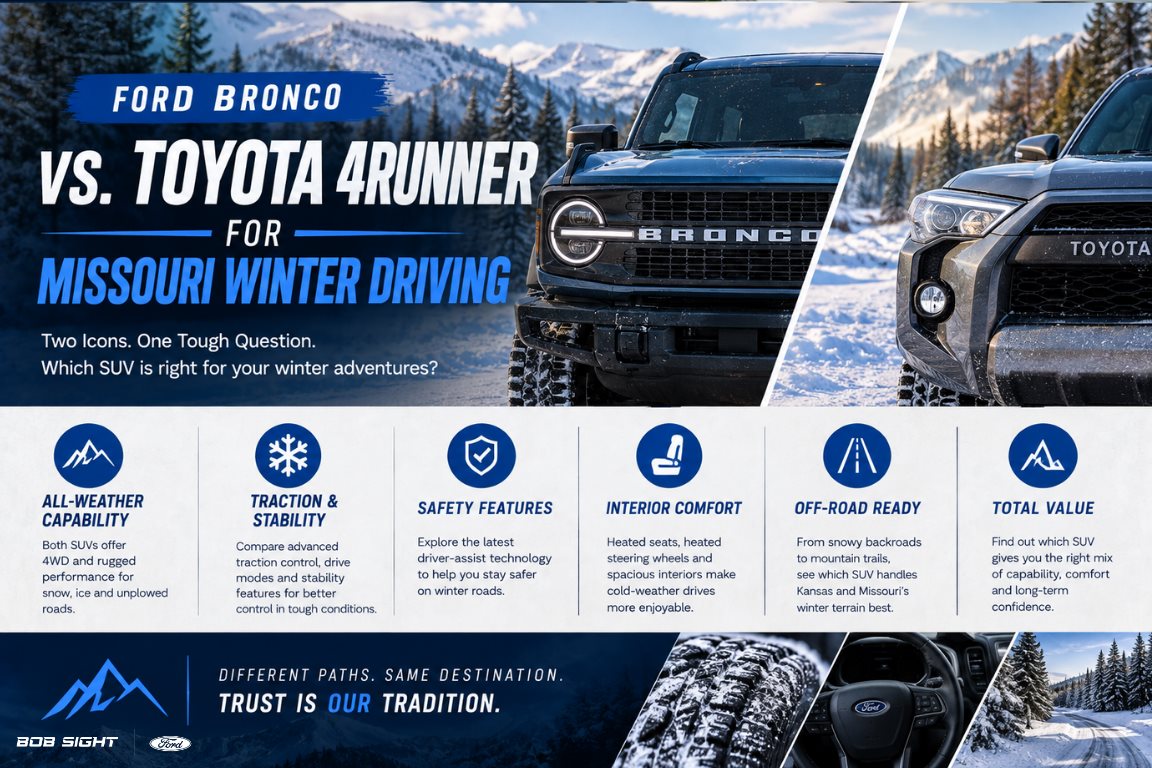
Ford Bronco vs. Toyota 4Runner for Missouri Winter Driving
Explore New Ford Bronco Inventory Near Kansas City
The Ford Bronco and Toyota 4Runner are both capable body-on-frame SUVs, but the Bronco offers a stronger combination of standard 4x4 capability, selectable G.O.A.T. Modes®, available winter-ready equipment, and configuration choices for many Missouri drivers. For shoppers navigating snow-covered neighborhood streets in Lee’s Summit, icy bridges around the Kansas City Metro, or slushy highways across Jackson County, the right choice depends on more than the badge on the grille. Tires, drivetrain configuration, ground clearance, visibility, driving habits, passenger needs, and cold-weather preparation all affect how an SUV performs when temperatures drop.
The 2026 Ford Bronco lineup includes standard four-wheel drive, multiple available HOSS suspension systems, up to seven selectable G.O.A.T. Modes, and available configurations designed for demanding terrain. The 2026 Toyota 4Runner offers available part-time or full-time four-wheel drive, available Multi-Terrain Select, and rugged body-on-frame construction. Both can be well equipped for winter, but their features, drivetrains, trim strategies, and everyday personalities are different.
This comparison focuses on real Missouri winter driving rather than controlled off-road demonstrations. That means considering packed snow near residential streets, freezing rain around the I-470 and US-50 interchange, black ice on shaded bridges, cold starts after work, and wet slush during a Kansas City commute. Understanding how each SUV approaches those conditions can help you choose a vehicle that fits your actual winter routine.
In This Guide You’ll Learn
This Ford Bronco vs. Toyota 4Runner comparison examines the winter-driving features that matter most to Missouri SUV shoppers. It covers drivetrain design, terrain modes, tires, ground clearance, powertrains, comfort, maintenance, and everyday usability around Lee’s Summit and the Greater Kansas City Metro.
- How Bronco and 4Runner four-wheel-drive systems support winter traction
- Why tires can matter more than horsepower on snow and ice
- How G.O.A.T. Modes and Multi-Terrain Select differ
- Which SUV offers more useful ground clearance for deep snow
- How body design and seating affect family use
- Which configurations make sense for Missouri winter conditions
- How to prepare either SUV before cold weather arrives
Features and specifications can vary by model year, trim, package, drivetrain, and equipment. This guide uses the 2026 Bronco and 2026 4Runner as current reference points while focusing on ownership factors that remain useful beyond one model year. Shoppers should verify the exact equipment on any vehicle they consider.
Ford Bronco vs. Toyota 4Runner: Which Is Better for Missouri Winter Driving?
The Ford Bronco is the stronger choice for Missouri drivers who prioritize standard 4x4 capability, selectable terrain modes, available ground clearance, and a wide range of configurations. The Toyota 4Runner remains a capable winter SUV when equipped with the appropriate four-wheel-drive system and tires, but not every 4Runner configuration includes four-wheel drive. That distinction matters when comparing vehicles for regular snow, slush, and changing road conditions.
The 2026 Bronco comes with four-wheel drive across the lineup and offers five or seven G.O.A.T. Modes, depending on configuration. G.O.A.T. stands for Goes Over Any Type of Terrain, and the available modes can adjust vehicle systems for different surfaces and driving conditions. Depending on equipment, the mode selection may include settings intended for slippery surfaces, mud, sand, rocks, or performance driving.
The 2026 4Runner is available with rear-wheel drive, part-time four-wheel drive, or full-time four-wheel drive, depending on trim. A properly equipped 4Runner can provide strong winter traction, but shoppers must look closely at the drivetrain listed on the specific vehicle. Assuming every 4Runner has the same four-wheel-drive hardware could lead to an inaccurate comparison.
For a driver leaving a neighborhood near Raintree Lake after overnight snowfall, the Bronco’s standard 4x4 foundation can provide reassurance that the SUV was configured with four-wheel traction in mind. A 4Runner with four-wheel drive may handle the same route confidently, but a two-wheel-drive version will distribute power differently. In either SUV, acceleration capability does not eliminate the need for careful braking, smooth steering, and additional following distance.
The best answer also depends on how the vehicle will be used outside winter. Bronco shoppers may value open-air driving, removable roof and door configurations, trail equipment, and a broad selection of off-road packages. 4Runner shoppers may prioritize available seating for up to seven, enclosed-SUV practicality, and its available hybrid powertrain. For winter-focused capability with standard 4x4 across the lineup, the Bronco has the clearer advantage.
How Do the Bronco and 4Runner Four-Wheel-Drive Systems Compare?
The Bronco provides four-wheel drive as standard equipment, while the 4Runner offers different two-wheel-drive and four-wheel-drive configurations depending on trim. This gives the Bronco a simpler starting point for shoppers who want a winter-capable drivetrain without first ruling out rear-wheel-drive models. The exact Bronco transfer case and 4Runner drivetrain still depend on the selected configuration.
Four-wheel drive sends engine torque to all four wheels through a transfer case. This can help an SUV begin moving when snow or loose material reduces traction at one axle. Some systems allow the driver to select different operating ranges, while more advanced configurations may automatically manage power distribution or provide specialized low-range capability.
Part-time four-wheel drive is typically selected by the driver when conditions call for additional traction. It is designed for appropriate low-traction surfaces rather than continuous use on dry pavement. Full-time four-wheel drive can remain engaged across a broader range of conditions because the system is designed to accommodate differences in wheel speed during turns. Owners should follow the instructions for their exact vehicle rather than applying a general rule to every 4x4 system.
Missouri winters often create mixed road surfaces during the same trip. A driver may leave a plowed street in Blue Springs, encounter wet pavement along US-40, cross a shaded overpass with ice, and reach a snow-covered parking lot in Lee’s Summit. A drivetrain that is easy to understand and use correctly can be more valuable than a long feature list that the owner never learns.
Neither four-wheel-drive system changes the fundamental physics of stopping. Four-wheel drive can improve the ability to move forward, but every vehicle still relies on tire grip when braking and turning. A Bronco or 4Runner can accelerate confidently and still slide if the driver carries too much speed into a curve or follows another vehicle too closely.
Before buying, ask for an explanation of the exact drivetrain, transfer case, drive modes, and engagement procedures on the SUV you are considering. At Bob Sight Ford, shoppers can explore Bronco configurations and learn how their systems operate before a test drive. Understanding the controls before the first winter storm is more useful than experimenting with them on an icy road.
How Do G.O.A.T. Modes and Multi-Terrain Select Help in Winter?
Bronco G.O.A.T. Modes and Toyota Multi-Terrain Select can adjust vehicle responses for challenging surfaces, but the available settings and system behavior depend on trim and equipment. The Bronco can offer up to seven G.O.A.T. Modes, while certain 4Runner trims include Multi-Terrain Select and Crawl Control. These systems support the driver but cannot create traction that the tires do not have.
A selectable drive mode may adjust throttle response, transmission behavior, traction control, stability control, steering feel, four-wheel-drive engagement, or other vehicle settings. On a slippery surface, gentler accelerator response can make it easier to apply torque without abruptly spinning the tires. The vehicle may also manage wheel slip differently to help maintain progress.
The Bronco’s G.O.A.T. Mode system is integrated into its broader off-road identity. Depending on configuration, drivers may have access to modes suited to slippery conditions and other terrain types. The system provides a centralized way to configure multiple vehicle settings instead of requiring the driver to adjust each one independently.
Toyota’s available Multi-Terrain Select is included on certain 4Runner off-road trims and works with the vehicle’s traction systems to manage different surfaces. Crawl Control is designed primarily for low-speed off-road situations rather than ordinary highway travel. Missouri shoppers should distinguish between a feature that helps on a slow trail and one intended for a snowy commute.
A driver traveling over the hills near Raytown during light snowfall may benefit from a controlled throttle response and properly selected drivetrain mode. However, changing modes does not make it safe to maintain dry-road speeds. Drive modes should be paired with slower inputs, more following distance, gradual braking, and awareness of changing road conditions.
The best time to learn either system is before winter. Read the owner’s manual, identify which modes your vehicle includes, and understand when four-wheel-drive high or low range may be appropriate. A mode labeled for slippery conditions can be useful, but correct selection depends on the road surface, vehicle speed, and manufacturer instructions.
Why Winter Tires Matter More Than the SUV Badge
Winter tires can have a greater effect on snow and ice performance than choosing between the Bronco and 4Runner alone. Four-wheel drive helps distribute power, but the tires create the contact with the road that allows the vehicle to accelerate, turn, and stop. A well-equipped SUV on unsuitable or worn tires may perform worse than a less aggressive vehicle on tires designed for the conditions.
All-season tires are designed to balance performance across multiple temperatures and weather conditions. All-terrain tires emphasize durability and traction on loose surfaces, but their winter performance varies by tread design and rubber compound. Dedicated winter tires use compounds intended to remain more flexible in cold temperatures and tread patterns designed to manage snow, slush, and ice.
Drivers comparing tire options should look for the Three-Peak Mountain Snowflake symbol. This marking indicates that a tire met a defined snow-traction performance standard. It does not mean the tire will stop safely at any speed or eliminate sliding on ice, but it offers more useful winter information than an aggressive-looking sidewall alone.
| Tire Type | Primary Strength | Missouri Winter Consideration |
|---|---|---|
| All-season | Balanced year-round convenience | Performance varies as temperatures drop and tread wears |
| All-weather | Year-round use with enhanced snow capability | Look for the Three-Peak Mountain Snowflake symbol |
| All-terrain | Loose-surface traction and durability | Snow and ice performance varies significantly by model |
| Dedicated winter | Cold-temperature, snow, slush, and ice performance | Requires seasonal installation and storage planning |
The 2026 Bronco is available with different tire sizes and types, including aggressive equipment associated with off-road packages. The 2026 4Runner TRD Pro and Trailhunter use 33-inch Toyo® Open Country A/T III tires. Those factory details matter, but shoppers should still evaluate how a particular tire is rated for the winter driving they expect to encounter.
A Bronco traveling through slush near Independence Center needs tread depth and channels capable of moving water and snow away from the contact patch. A 4Runner descending a slick neighborhood hill in Grandview faces the same tire-grip limits. Vehicle weight, braking inputs, road slope, and surface temperature all influence the result.
Tire pressure also drops as outside temperatures fall. Check pressure when the tires are cold and use the specification listed for the vehicle rather than the maximum pressure molded into the tire sidewall. Bob Sight Ford can inspect tread condition, tire pressure, wear patterns, and available tire options before Missouri winter weather arrives.
Ground Clearance and Deep-Snow Capability
The Ford Bronco offers greater maximum available ground clearance than the Toyota 4Runner, which can be useful in deeper snow or on unplowed surfaces. The 2026 Bronco provides up to 13.1 inches of available ground clearance in Bronco Raptor configuration, while other Bronco models can offer up to approximately 11.5 or 11.6 inches depending on equipment. The 2026 4Runner offers up to 10.1 inches of ground clearance.
Ground clearance is the distance between the ground and a designated low point beneath the vehicle. More clearance can help reduce contact with packed snow, frozen ruts, or obstacles beneath the vehicle. It does not automatically improve grip, braking, or stability, and the maximum published figure may apply only to a particular trim, tire, or package.
Deep snow is different from the thin accumulation most Kansas City Metro drivers encounter on treated highways. When snow builds on a rural driveway near Grain Valley or remains unplowed on a side street, additional clearance may help the vehicle avoid pushing snow beneath the chassis. The Bronco’s available clearance gives it an advantage for owners who regularly travel beyond well-maintained urban routes.
Approach, breakover, and departure angles are also important on uneven terrain. These measurements describe how steeply a vehicle can approach, pass over, or leave an obstacle without body contact. The 2026 Bronco offers maximum available angles of 43.2 degrees for approach, 29 degrees for breakover, and 37.2 degrees for departure in its most capable configuration.
Those figures are impressive, but most Missouri winter commuters will gain more from suitable tires, predictable control inputs, and strong visibility than extreme off-road geometry. A tall SUV can still lose traction on polished ice. Increased ride height can also raise the vehicle’s center of gravity, making abrupt maneuvers less forgiving.
Shoppers should compare the ground clearance of the actual Bronco or 4Runner configuration rather than comparing maximum advertised numbers across the entire lineups. Wheel size, tire diameter, suspension equipment, and trim can change the result. The Bronco has the higher capability ceiling, while both SUVs provide useful clearance for common winter conditions when properly configured.
Powertrain Performance in Cold Missouri Weather
Both SUVs offer turbocharged four-cylinder power, while the Bronco also offers turbocharged V6 engines and the 4Runner offers an available hybrid system. Winter suitability depends less on maximum horsepower and more on smooth torque delivery, correct fluids, a healthy battery, suitable tires, and disciplined accelerator use. High output cannot overcome limited traction.
The 2026 Bronco Base and Big Bend use a 2.3-liter EcoBoost® inline-four rated at 300 horsepower, while an available 2.7-liter EcoBoost V6 produces up to 330 horsepower in applicable models. Bronco Raptor uses a 3.0-liter EcoBoost V6 rated at 418 horsepower. Transmission availability includes a seven-speed manual or ten-speed automatic on certain Bronco configurations.
The 2026 4Runner offers an i-FORCE turbocharged engine rated at 278 horsepower and 317 pound-feet of torque. Its available i-FORCE MAX hybrid powertrain produces up to 326 net combined horsepower and 465 pound-feet of torque. These figures make the 4Runner hybrid a strong option for drivers interested in low-speed torque and an electrified powertrain.
| 2026 Powertrain Reference | Published Output | Winter-Driving Perspective |
|---|---|---|
| Bronco 2.3L EcoBoost I-4 | 300 horsepower | Strong everyday output with available manual or automatic transmission |
| Bronco 2.7L EcoBoost V6 | Up to 330 horsepower | Additional power for selected Bronco configurations |
| Bronco Raptor 3.0L EcoBoost V6 | 418 horsepower | High-performance output that still requires careful winter inputs |
| 4Runner i-FORCE | 278 horsepower and 317 lb.-ft. of torque | Turbocharged power for daily driving and utility |
| 4Runner i-FORCE MAX Hybrid | Up to 326 horsepower and 465 lb.-ft. of torque | Strong available torque with hybrid assistance |
Cold weather affects more than engine output. Battery chemistry becomes less efficient at low temperatures, engine oil flows differently before reaching operating temperature, and tire pressure changes with ambient temperature. Modern engine-management systems compensate for many conditions, but routine maintenance remains important.
A driver merging onto I-470 after a cold start should use smooth accelerator inputs rather than treating power as the solution to every traction problem. Sudden torque can cause wheel slip even with four-wheel drive. Allowing the vehicle to complete its normal startup process and driving moderately as components reach operating temperature supports smoother cold-weather operation.
Daily Comfort, Visibility, and Family Usability
The 4Runner may appeal to shoppers who want available seating for up to seven, while the Bronco offers distinctive open-air flexibility and a more specialized adventure-focused design. For winter use, drivers should compare visibility, seating, cargo access, climate features, roof configuration, and the needs of everyone who will ride in the SUV. Capability is only valuable if the vehicle also works for daily life.
The 2026 4Runner offers available third-row seating in certain configurations. That can matter for a Lee’s Summit family transporting children, relatives, or friends. However, shoppers should confirm how much cargo room remains when every seating position is occupied and whether the selected powertrain or trim can be combined with the desired seating layout.
The Bronco is offered in two-door and four-door body styles, although not every trim is available in both forms. The four-door Bronco provides easier second-row access and greater everyday flexibility for families. The two-door version may appeal to shoppers who prioritize maneuverability, style, or a more compact footprint.
Available heated seats, heated steering wheels, remote-start capability, automatic climate control, defrosters, heated mirrors, and windshield-wiper features can make cold mornings more manageable. Feature availability varies, so shoppers should verify equipment on the specific vehicle. A winter comfort feature shown on a higher trim may not be standard across the lineup.
Visibility deserves close attention during a test drive. Thick roof pillars, rear-mounted spare tires, head restraints, passenger placement, snow buildup, and winter road spray can affect sightlines. Camera systems can help at low speeds, but lenses may become covered by salt or slush and should not replace direct observation.
A family leaving a school activity near downtown Lee’s Summit after freezing rain may care more about quick defrosting, clear mirrors, accessible controls, and predictable handling than maximum suspension travel. An outdoor-focused owner heading toward rural property may place more value on clearance, washable surfaces, recovery points, and tire capability. Bronco offers broader adventure-oriented flexibility, while 4Runner may better fit shoppers who need an available third row.
How to Choose the Right Winter SUV Configuration
The right configuration combines four-wheel drive, appropriate tires, needed passenger space, useful comfort features, and capability that matches your real driving conditions. Shoppers should compare complete vehicles rather than choosing based only on the Bronco or 4Runner name. Trim, package, tires, drivetrain, and options can substantially change winter performance and daily usability.
- Define your winter routes. List the roads you use before they are fully plowed, including neighborhood hills, rural driveways, highways, jobsite access roads, and school routes.
- Choose the correct drivetrain. Every Bronco includes 4x4, while 4Runner drivetrain availability varies. Confirm the exact system and learn how it operates.
- Evaluate the installed tires. Check tire type, size, tread pattern, winter rating, tread depth, and replacement availability.
- Compare ground clearance honestly. Use the specification for the exact trim and package rather than the lineup’s maximum number.
- Review passenger and cargo needs. Decide whether you need two doors, four doors, an available third row, room for winter gear, or space for work equipment.
- Identify must-have cold-weather features. Consider heated seating, a heated steering wheel, remote start, mirror defrosting, climate controls, and lighting.
- Test the controls. Make sure drive modes, four-wheel-drive selections, camera views, defrosters, and other winter-related features are easy to understand.
A commuter who travels from Overland Park to Lee’s Summit may spend more time on treated highways than on deep snow. That shopper may prioritize road manners, comfort, visibility, and suitable all-weather tires. A property owner near the edge of Jackson County may place more emphasis on clearance, low-range gearing, recovery points, and aggressive winter-rated tires.
Do not buy the most extreme configuration simply because it has the largest tires or highest clearance. Large off-road tires can affect road noise, steering response, fuel use, replacement cost, and braking feel. The best vehicle is not automatically the one with the highest capability figure; it is the one whose capability aligns with how and where you drive.
When comparing a Bronco with a 4Runner, drive both under normal conditions and pay attention to seating position, steering, brake feel, outward visibility, entry height, cargo access, and control layout. Then examine the actual equipment sticker or vehicle description. Bob Sight Ford can help Bronco shoppers identify which available configurations match their Missouri winter priorities.
Missouri Winter Preparation for a Bronco or 4Runner
Preparing either SUV for winter requires checking tires, battery condition, fluids, brakes, lights, wipers, heating systems, and emergency supplies before severe weather arrives. Four-wheel drive should be treated as one part of winter readiness rather than a substitute for maintenance. A capable drivetrain cannot compensate for worn tires, poor visibility, or a weak battery.
- Inspect all four tires. Check tread depth, damage, uneven wear, cold tire pressure, and the tire’s suitability for expected snow and ice.
- Test the battery and charging system. A battery weakened by summer heat may struggle when temperatures drop across Missouri.
- Check the cooling system. Confirm proper coolant condition and protection using the manufacturer-recommended specification.
- Inspect brakes. Review pad, rotor, fluid, and system condition so braking performance remains predictable.
- Replace worn wiper blades. Use the correct washer fluid and keep the reservoir filled for road-salt spray and slush.
- Test lights and defrosters. Verify that exterior lighting, cabin heat, mirror functions, and windshield defrosting operate correctly.
- Pack emergency supplies. Carry warm clothing, gloves, a flashlight, phone charger, traction aid, basic tools, water, and other items appropriate for your route.
Missouri’s freeze-thaw cycles can create rapidly changing pavement conditions. Snow may melt during the afternoon and refreeze after sunset, creating ice on bridges, ramps, shaded roads, and untreated parking areas. A clear-looking surface may still have limited traction.
Road salt and winter grime can also collect beneath the vehicle and around cameras, lamps, sensors, hinges, and body seams. Routine cleaning can help remove buildup, but owners should follow manufacturer guidance for removable-roof seals, door hardware, cameras, sensors, and underbody components. Bronco owners who use removable doors or roof panels should inspect and maintain seals so the cabin remains protected from winter moisture.
Schedule preventive service before the first major cold-weather rush. Bob Sight Ford offers Ford Pickup & Delivery for eligible appointments, helping local owners complete maintenance without personally making the dealership round trip. Availability and service-area criteria should be confirmed when scheduling.
Quick Facts About the Bronco and 4Runner in Winter
The Bronco has standard 4x4 and a higher available ground-clearance ceiling, while the 4Runner offers multiple drivetrain choices and available seating for up to seven. Both SUVs require suitable tires and responsible driving to perform well during Missouri winter weather.
- The 2026 Ford Bronco includes four-wheel drive across the lineup.
- The 2026 Toyota 4Runner offers rear-wheel drive, part-time four-wheel drive, or full-time four-wheel drive depending on configuration.
- The Bronco offers up to seven available G.O.A.T. Modes.
- Certain 4Runner trims include Multi-Terrain Select and Crawl Control.
- The Bronco provides up to 13.1 inches of available ground clearance in its highest-clearance configuration.
- The 4Runner offers up to 10.1 inches of ground clearance.
- The Bronco offers two-door and four-door configurations.
- The 4Runner offers available seating for up to seven.
- Four-wheel drive improves the ability to accelerate but does not shorten every stop.
- Winter-rated tires can be more important than maximum horsepower on snow and ice.
Published maximum specifications represent particular configurations and should not be applied to every vehicle in the lineup. A Bronco without the equipment that produces maximum clearance will have a different measurement, just as 4Runner drivetrain and terrain-control features vary by trim. Always compare the exact vehicles available.
Missouri shoppers should also remember that most winter trips involve changing conditions rather than continuous deep snow. Wet pavement, road spray, slush, freezing rain, and isolated ice may all appear during one commute. Predictable controls and good tires matter every mile.
Ownership Planning for Missouri Winter Driving
The Bronco is a compelling long-term choice for Missouri drivers who want standard 4x4 capability and configurable off-road equipment, but ownership planning should include tires, maintenance, seasonal inspections, and equipment knowledge. The 4Runner can also be a capable winter vehicle when selected with the correct drivetrain and features. The purchase decision should account for the full ownership routine rather than one snowy test drive.
Start by planning for tire replacement. Large all-terrain tires may cost more to replace than smaller standard tires, and matching size, load rating, speed rating, and performance characteristics matters. Owners who use dedicated winter tires also need suitable wheels, seasonal storage, and timely installation.
Maintenance needs can change with use. A Bronco driven primarily on paved streets around Lee’s Summit may have a different service pattern than one used on muddy trails, gravel roads, or water crossings. The owner’s manual includes guidance for normal and more demanding operating conditions. Frequent off-road driving may require additional inspection of suspension, steering, brakes, driveline components, filters, and underbody protection.
Winter use also supports a consistent cleaning and inspection routine. Road treatment materials can remain on the underbody, wheels, and body components after a storm. Washing the vehicle when weather permits and inspecting vulnerable areas can help owners identify damage, buildup, or wear before it becomes more difficult to address.
Keep maintenance records and document installed tires, rotations, alignments, battery tests, and seasonal inspections. These records make future service planning easier and can provide useful ownership history. If your needs eventually change, you can use the Bob Sight Ford trade-in value tool to begin evaluating your current vehicle.
Convenience can make maintenance easier to complete. Eligible Ford owners may use Pickup & Delivery for qualifying service appointments, while the Bob Sight Ford service department can provide model-specific guidance. A planned approach helps protect winter readiness throughout ownership.
Frequently Asked Questions About the Bronco vs. 4Runner
Is the Ford Bronco better than the Toyota 4Runner in snow?
The Ford Bronco has a winter-capability advantage because four-wheel drive is standard and selectable G.O.A.T. Modes are available across its configuration strategy. The Bronco also offers more maximum ground clearance than the 4Runner. Those features make it a strong choice for snow-covered streets, unplowed roads, and changing Missouri conditions.
A four-wheel-drive 4Runner with appropriate tires can also perform confidently in snow. However, the 4Runner is offered with different drivetrains, including two-wheel drive, so shoppers must confirm the exact configuration. Comparing a Bronco against a rear-wheel-drive 4Runner is different from comparing it against a full-time four-wheel-drive 4Runner.
For a Lee’s Summit driver who wants a simple starting point, every new Bronco includes 4x4. The final result still depends heavily on tires, speed, visibility, and driver behavior. No drivetrain makes an SUV immune to black ice or excessive stopping distance.
Does four-wheel drive help a Bronco stop faster on ice?
Four-wheel drive does not guarantee that a Bronco will stop faster on ice. Braking and turning depend on the grip available between all four tires and the road. Four-wheel drive primarily helps distribute propulsion torque when the driver accelerates.
Anti-lock brakes can help prevent wheel lock during hard braking, while stability-control systems may help the driver maintain directional control within physical limits. These systems cannot create friction on a surface with very little grip. Tire compound, tread condition, vehicle speed, temperature, and road surface remain critical.
When approaching an icy bridge on I-470, reduce speed before reaching the slick section, leave generous following distance, and avoid abrupt steering or braking. A Bronco with high-clearance off-road equipment still follows the same traction principles as other vehicles. Smooth inputs remain essential.
Which Bronco trim is best for Missouri winter driving?
The best Bronco trim for Missouri winter driving is the one with the tires, comfort features, drivetrain equipment, and everyday usability that fit the owner’s routes. Many drivers do not need the most extreme Bronco configuration to navigate plowed streets and occasional snowfall. Standard 4x4 gives every Bronco a capable foundation.
A Big Bend or Outer Banks configuration may appeal to drivers balancing commuting, comfort, and winter traction. Badlands and Sasquatch-equipped models add more aggressive capability for owners who regularly encounter deeper snow, rural roads, or off-road conditions. Bronco Raptor offers the lineup’s highest capability figures but may exceed the needs of a typical daily commuter.
Talk through your routes before choosing. A driver commuting from Blue Springs to Lee’s Summit may value heated features and winter-rated tires more than maximum ground clearance. A rural property owner may make a different decision based on snow depth, terrain, and access-road conditions.
Are all-terrain tires good enough for Kansas City winters?
Some all-terrain tires perform well in snow, but not every all-terrain tire provides the same cold-weather or ice capability. Review the tire’s ratings, tread design, compound, and Three-Peak Mountain Snowflake status. An aggressive appearance does not prove strong winter performance.
All-terrain tires are designed to balance pavement use with traction on gravel, dirt, mud, or other loose surfaces. Dedicated winter tires focus more directly on low-temperature flexibility and winter traction. All-weather tires can provide another year-round option for drivers who want enhanced snow capability without a seasonal tire change.
Kansas City winters can include dry cold, rain, sleet, slush, snow, and ice within a short period. Choose tires for the complete range of conditions you drive through, not only deep snow. A tire professional can help verify sizing and suitability for your exact Bronco.
Should I buy a Bronco or 4Runner for family winter travel?
Choose the Bronco if standard 4x4, terrain modes, open-air flexibility, and available off-road capability are the priorities, while the 4Runner may fit families that require available seating for up to seven. Passenger count and seating layout can be the deciding factors before capability specifications are compared.
A four-door Bronco offers easier rear-seat access than a two-door model and provides useful room for family gear. The 4Runner’s available third row may accommodate a larger group, but shoppers should evaluate cargo room with that row in use. Child-seat access, step-in height, visibility, and winter clothing should also be tested.
For family trips from Lee’s Summit across the Kansas City Metro, prioritize suitable tires, cabin heating, defrosting, lighting, emergency supplies, and comfortable seating. Both SUVs can support winter travel when configured correctly. The Bronco offers the clearer standard 4x4 advantage, while the 4Runner provides a seating option the Bronco does not.
Choose a Winter-Ready Ford Bronco Near Kansas City
The Ford Bronco stands out for Missouri winter driving with standard 4x4, selectable G.O.A.T. Modes, available high-clearance configurations, and a broad range of trims and packages. The Toyota 4Runner is a capable alternative with available four-wheel-drive systems, rugged body-on-frame construction, and available third-row seating. For shoppers placing winter capability and configuration flexibility near the top of the list, the Bronco earns the advantage.
Buying locally gives Kansas City Metro shoppers an opportunity to discuss the conditions they encounter instead of selecting features from a generic checklist. Drivers near Lee’s Summit may deal with hills, highway ramps, stop-and-go traffic, untreated neighborhood streets, and freeze-thaw cycles. Those details help determine which Bronco equipment will provide useful everyday value.
Bob Sight Ford serves Bronco shoppers from Lee’s Summit, Blue Springs, Independence, Raytown, Grandview, Belton, Liberty, Grain Valley, Overland Park, Olathe, and surrounding communities. The team can help you compare available Bronco configurations, understand four-wheel-drive controls, evaluate passenger needs, and identify features that support Missouri winter driving.
Before deciding, compare the actual equipment on each SUV, inspect the installed tires, and take a test drive that reflects your daily routine. A capable winter vehicle should feel understandable, comfortable, and predictable. When the configuration fits the driver, the Bronco can deliver year-round versatility that extends far beyond the first snowfall.
Helpful Links
- Browse New Ford Bronco Inventory
- Explore New Ford Inventory
- View New Ford Special Offers
- Value Your Trade
- Schedule a Ford Test Drive
Proud to Be Part of the Bob Sight Auto Group
Bob Sight Ford in Lee’s Summit is proud to be part of the Bob Sight Auto Group, serving drivers throughout the Kansas City Metro and Northeast Kansas. The group connects local shoppers and owners with vehicle sales, maintenance, financing support, parts assistance, and collision repair. Each location supports its surrounding community while continuing the Bob Sight tradition of helpful automotive service.
Ford shoppers can explore capable SUVs such as the Bronco at Bob Sight Ford, while drivers interested in other brands can visit Bob Sight Honda, Bob Sight CDJR, or Bob Sight Kia. The Bob Sight Collision Center provides another local resource when a vehicle requires professional collision repair. Together, these locations help area drivers through different stages of shopping, ownership, maintenance, and repair.