Ford Edge vs Escape: Which SUV Fits Your Lifestyle Better?
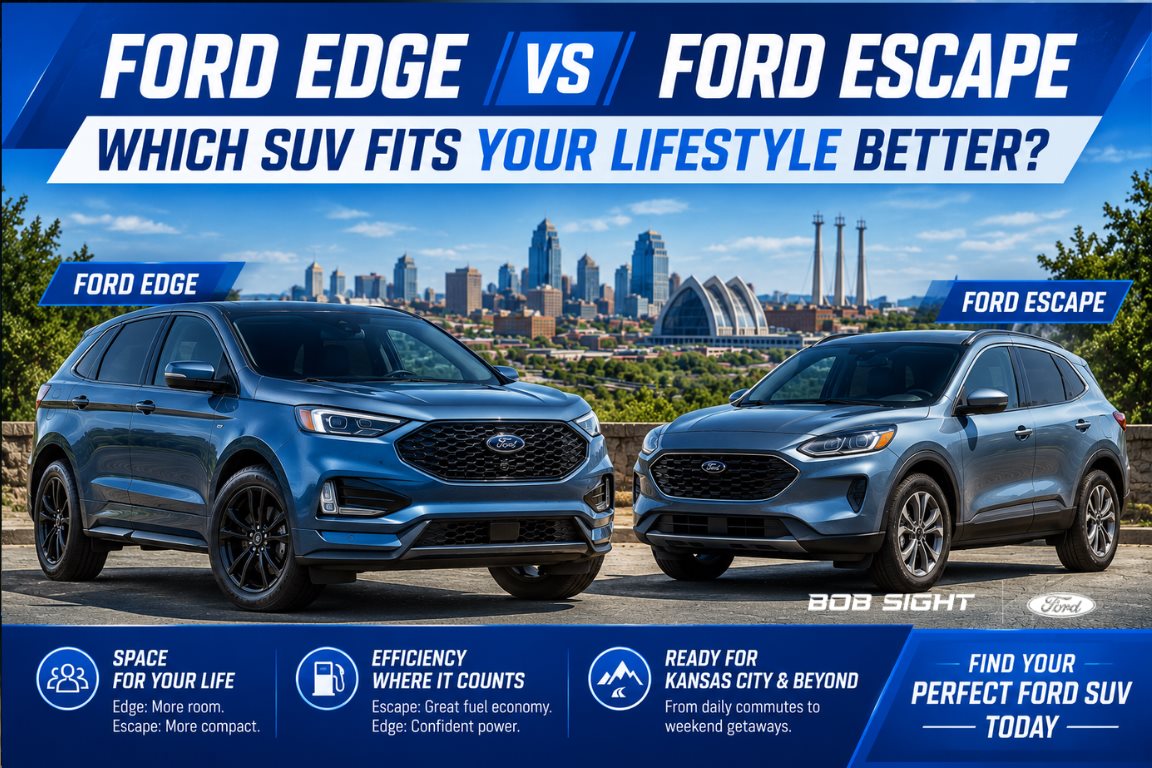
At Bob Sight Ford in Lee's Summit, Missouri, we help drivers across the Kansas City Metro determine whether the compact Ford Escape or the midsize Ford Edge best suits their commuting and family travel needs. Choosing between two exceptional two-row SUVs requires comparing interior cabin dimensions, cargo volume, EcoBoost engine choices, fuel efficiency, and drivetrain capabilities. Whether you navigate tight parking spaces near the Summit Fair shopping area, commute daily along Interstate 470, or take weekend road trips across Jackson County, selecting the ideal utility vehicle ensures long-term comfort and satisfaction. In this comprehensive comparison guide, our automotive specialists break down performance metrics, technological features, ownership costs, and real-world driving scenarios to help you make a confident decision.
In this guide you will learn:
- The primary structural and cabin dimension differences between the compact Ford Escape and midsize Ford Edge.
- How EcoBoost gas powertrains and hybrid efficiency options compare across daily Kansas City commute routes.
- Key operational advantages of standard Intelligent All-Wheel Drive versus available front-wheel-drive configurations.
- Step-by-step instructions for evaluating your household utility needs and passenger requirements before shopping.
- Clear, plain-language definitions of crucial dealership terms including residual value, trade-in equity, and gross capitalized cost.
- How proactive maintenance strategies and Motorcraft service keep both utility models running reliably on Missouri highways.
Comparing Ford Edge and Ford Escape Core Dimensions and Cabin Space
The primary difference between the Ford Edge and Ford Escape lies in their chassis size, with the midsize Edge providing a wider cabin and greater overall cargo volume than the compact Escape. Drivers who prioritize maximum shoulder room, expansive second-row hip space, and a plush highway ride often lean toward the midsize Ford Edge. Conversely, shoppers who want an agile footprint that fits effortlessly into tight residential garages or urban parking spots in downtown Kansas City typically prefer the nimble design of the compact Ford Escape. Evaluating how each vehicle handles daily passenger loads helps narrow your choice quickly.
Inside the cabin, both utility models offer impressive versatility and modern ergonomic layouts designed for long-distance comfort. The Ford Escape features an innovative sliding second-row seat that moves forward or backward up to 5.9 inches, allowing owners to customize the balance between rear passenger legroom and rear cargo space. Slipping into the driver seat of the Ford Edge reveals a noticeably wider center console, thicker acoustic glass, and premium seating materials that dampen wind and tire noise during high-speed highway travel along US-50 or I-70 near Blue Springs.
Cargo volume is another critical consideration for active households in Lee's Summit. The Ford Escape provides approximately 37.5 cubic feet of cargo space behind the second row, expanding to 65.4 cubic feet when rear seats are folded flat. The larger Ford Edge offers 39.2 cubic feet of cargo room behind the rear seats and expands to a generous 73.4 cubic feet of total utility space. Whether you are loading sports gear for games near the Truman Sports Complex or packing camping equipment for a weekend trip to Lake Jacomo, understanding these dimensional differences ensures your SUV meets your lifestyle demands.
Powertrain Options, EcoBoost Performance, and Fuel Efficiency Compared
The Ford Escape emphasizes fuel efficiency with available hybrid powertrains and nimble EcoBoost engines, while the Ford Edge delivers higher horsepower and standard all-wheel-drive capability. Powertrain selection directly impacts your monthly fuel budget and passing performance on local highways. Understanding the mechanical differences between these two lineups allows drivers to balance daily fuel economy against robust acceleration.
To help you compare performance metrics across both model lineups, review the technical specifications listed in the comparison table below:
| Specification / Feature | Ford Escape SUV | Ford Edge SUV |
|---|---|---|
| Vehicle Category | Compact 2-Row Crossover | Midsize 2-Row Utility Vehicle |
| Standard Powertrain | 1.5L EcoBoost I-3 (180 hp / 199 lb-ft) | 2.0L Twin-Scroll EcoBoost I-4 (250 hp / 280 lb-ft) |
| Available Performance Engine | 2.0L EcoBoost I-4 (250 hp / 280 lb-ft) | 2.7L Twin-Turbo EcoBoost V6 (335 hp / 380 lb-ft - ST Trim) |
| Available Hybrid Options | 2.5L Atkinson-Cycle Hybrid / Plug-In Hybrid | Not Available (Pure Gasoline EcoBoost Lineup) |
| Drive Configuration | Front-Wheel Drive or Intelligent AWD | Standard Intelligent All-Wheel Drive across all trims |
| Maximum Towing Capacity | Up to 3,500 lbs (2.0L EcoBoost w/ Tow Package) | Up to 3,500 lbs (Class II Trailer Tow Package) |
| EPA Estimated MPG Range | 27 City / 34 Hwy (1.5L) | 42 City / 36 Hwy (Hybrid) | 21 City / 28 Hwy (2.0L AWD) | 19 City / 25 Hwy (2.7L V6) |
For commuters traveling daily from Grain Valley to offices in downtown Kansas City along I-70, fuel economy is often a top priority. The Ford Escape Hybrid combines a 2.5L four-cylinder engine with an electric motor to achieve up to an EPA-estimated 42 MPG in city driving, keeping monthly fuel costs exceptionally low. Even non-hybrid Escape models equipped with the 1.5L EcoBoost three-cylinder engine deliver impressive fuel conservation while providing plenty of pep for merging onto fast-moving traffic lanes along I-470.
On the other hand, drivers who prefer effortless highway passing power and robust towing capabilities will appreciate the standard 2.0L Twin-Scroll EcoBoost engine in the Ford Edge. Generating 250 horsepower and 280 lb-ft of torque, this engine delivers smooth, immediate throttle response when climbing steep grades near Highway 150. For performance enthusiasts, the Ford Edge ST features a twin-turbocharged 2.7L EcoBoost V6 engine producing 335 horsepower, sport-tuned suspension geometry, and paddle-shift controls for an exhilarating drive through Raytown and surrounding areas.
Comparing Drivetrain Engineering and Winter Driving Capability
Both the Ford Edge and Ford Escape utilize Intelligent All-Wheel Drive to monitor road grip and distribute torque automatically before tire slippage occurs. Navigating unpredictable Midwest weather conditions requires a responsive drivetrain that adapts instantly to rain, sleet, snow, and ice. While all Ford Edge models come standard with Intelligent AWD, the Ford Escape offers front-wheel drive as standard equipment on select trims, with Intelligent AWD available as an upgrade.
Ford's Intelligent AWD system constantly evaluates vehicle speed, steering wheel angle, throttle position, and individual wheel rotation speeds hundreds of times per second. When sensors detect slick road surfaces on icy bridges near Chipman Road or wet asphalt along MO-291, the system seamlessly transfers engine torque from the front wheels to the rear wheels in milliseconds. This proactive torque distribution maintains vehicle stability and directional control without requiring manual driver intervention.
Furthermore, the Ford Escape features selectable drive modes, including Normal, Eco, Sport, Slippery, and Deep Snow/Sand settings, allowing drivers to customize throttle mapping and traction control parameters. The Ford Edge pairs its standard AWD chassis with an advanced suspension layout that provides exceptional ground clearance and stability during heavy snowfalls across Jackson County. Paired with high-quality all-season or winter tires from OEM brands like Michelin, Goodyear, or Continental, both crossovers deliver total peace of mind during Missouri winters.
Step-by-Step Guide to Evaluating Your SUV Needs Before Buying
Evaluating your household driving routines systematically ensures you select an SUV model with the exact size, fuel efficiency, and feature package required for your lifestyle. Taking time to assess your daily travel habits before visiting the dealership prevents impulse decisions and guarantees long-term satisfaction. Below is a step-by-step evaluation process recommended by automotive buying specialists.
- Calculate Your Weekly Commuting Distance and Fuel Expenses: Measure your daily round-trip mileage along I-470 or US-50, multiplying that figure by working days to determine monthly driving volume. If high fuel efficiency is critical to your budget, prioritize the Ford Escape Hybrid.
- Measure Your Garage Dimensions and Home Parking Spaces: Measure your home garage depth, width, and doorway clearance to confirm vehicle fitment. The Escape's compact overall length makes parking in tighter residential spaces in Lee's Summit much easier.
- Assess Second-Row Passenger Needs and Car Seat Equipment: Evaluate the age and physical size of frequent rear-seat passengers. If you regularly carry adult passengers or bulky rear-facing infant seats, test the broader hip and shoulder room of the Ford Edge.
- Determine Cargo Volume and Equipment Towing Demands: Itemize common cargo items like strollers, luggage, sporting gear, or utility trailers. If you plan to tow small recreational trailers up to 3,500 pounds, confirm that your preferred trim includes the factory Class II Trailer Tow Package.
- Establish Your Out-of-the-Door Purchase or Lease Budget: Review your household finances to establish target monthly payments, factoring in trade-in equity, down payments, local Jackson County sales taxes, and routine maintenance costs.
Applying this structured evaluation process helps local shoppers shop with complete clarity. For example, a driver living near Lake Jacomo who commutes 40 miles daily and needs to squeeze into a crowded office garage can quickly identify the Ford Escape as the ideal candidate. The step-by-step assessment highlights fuel savings and maneuverability as top priorities.
Conversely, a family with teenage children who takes frequent road trips across western Missouri will quickly realize that the wider cabin and quiet acoustics of the Ford Edge better suit their long-distance comfort expectations. Following these evaluation steps ensures you invest in a vehicle that fits your daily life perfectly.
Technology, Safety Features, and Ford Co-Pilot360 Comparison
Both the Ford Edge and Ford Escape come equipped with Ford Co-Pilot360 driver-assist safety systems, offering advanced collision avoidance and lane-keeping assistance. Modern technology plays a vital role in reducing driver fatigue during heavy stop-and-go traffic along highway corridors like I-470 near Blue Ridge Boulevard. Comparing dashboard displays, infotainment software, and driver-assist features helps technology-focused buyers choose the right cockpit layout.
The Ford Edge features a massive 12-inch vertical center touchscreen running SYNC 4A software as standard equipment, offering wireless Apple CarPlay and Android Auto integration, conversational voice recognition, and digital owner manual access. The Ford Escape features an intuitive landscape-oriented SYNC 4 display, with available screen sizes ranging up to 13.2 inches on higher trim levels. Both systems allow seamless smartphone connectivity for real-time traffic monitoring and hands-free communications across the Kansas City Metro.
From a safety perspective, both utility vehicles include standard Ford Co-Pilot360 features, such as Pre-Collision Assist with Automatic Emergency Braking, Blind Spot Information System (BLIS) with Cross-Traffic Alert, Lane-Keeping System, and Auto High-Beam Headlamps. Available upgrades on higher trims include Adaptive Cruise Control with Stop-and-Go, Evasive Steering Assist, and 360-Degree Camera systems that make parking near busy shopping centers like Summit Fair stress-free and safe.
Understanding Dealership Terminology: Residual Value, Equity, and Capitalized Cost
Understanding plain-language definitions of key auto finance terms empowers shoppers to negotiate clear purchase contracts and evaluate financing offers confidently. Auto financing involves specific industry terms that describe vehicle value, loan structures, and trade-in accounting. Defining these concepts clearly ensures complete transparency during your shopping experience at Bob Sight Ford.
- Gross Capitalized Cost: The agreed-upon total selling price of the vehicle, including options, destination charges, and dealer accessories, before applying down payments, trade-in values, or promotional rebates.
- Residual Value: The estimated future market value of a leased vehicle at the end of its contract term, set by the lender as a fixed percentage of total MSRP.
- Trade-In Equity: The positive dollar difference between your current vehicle's fair market trade valuation and the remaining payoff balance owed on its existing auto loan.
- Money Factor: The financing fee built into a lease agreement, which can be multiplied by 2,400 to calculate an equivalent annual percentage rate (APR) interest figure.
- Out-of-the-Door Price: The complete final purchase total, combining net vehicle price, government titling fees, documentation costs, and applicable Missouri sales taxes.
Having a firm grasp of these definitions helps local buyers structure favorable financing terms. For example, when trading in an older vehicle at our Lee's Summit dealership, positive trade-in equity applies directly as a down payment toward your new Ford Edge or Escape. In Missouri, trade-in equity also reduces the taxable purchase price of your new vehicle, saving you money on state and local sales tax.
Our finance specialists at Bob Sight Ford are committed to explaining every line item on your purchase or lease agreement in plain language. We eliminate confusing jargon so you feel informed and confident throughout the entire transaction.
Step-by-Step Guide to Test-Driving Both SUVs at Bob Sight Ford
Conducting back-to-back test drives of the Ford Edge and Ford Escape allows you to evaluate real-world seating comfort, visibility, acceleration, and handling dynamics under identical road conditions. Physical test drives are essential for feeling subtle differences in steering calibration, cabin noise isolation, and suspension tuning. Following a structured test-drive routine ensures you compare both utility vehicles objectively.
- Adjust Seating, Steering Wheel, and Mirrors to Your Driving Position: Before starting the engine, adjust power seat height, lumbar support, tilt/telescoping steering wheel, and side mirrors to ensure proper ergonomics and blind-spot visibility.
- Test Low-Speed Maneuverability and Parking Camera Clarity: Drive through our dealership lot to evaluate low-speed steering effort, turning radius tightness, and rear backing camera display clarity.
- Evaluate City Acceleration and Stop-and-Go Braking: Drive along local streets near NW Blue Parkway, observing automatic transmission shift smoothness, brake pedal modulation, and Auto Start-Stop engagement.
- Assess Highway Speed Noise Isolation and Acceleration: Merge onto US-50 or I-470 to evaluate engine passing power, wind noise isolation, cabin acoustics, and high-speed directional stability.
- Test Second-Row Seating Entry, Exit, and Cargo Loading: Park the vehicle, sit in the rear seat to test legroom and headroom, and open the rear liftgate to evaluate cargo loading height and fold-flat seat operation.
Executing this thorough test-drive procedure gives you a clear, firsthand comparison of both vehicles. A driver testing the Ford Escape around Chipman Road will immediately appreciate its tight turning circle and responsive steering feedback when navigating turns. Switching immediately into the Ford Edge reveals a noticeably smoother ride over road expansion joints and a quieter cabin at highway speeds.
Our sales consultants at Bob Sight Ford encourage shoppers to take their time and test both models back-to-back on varied local roads. Experiencing both utility vehicles under real Midwest driving conditions makes selecting the right SUV simple and clear.
Quick Facts: Ford Edge vs Ford Escape at a Glance
Key operational highlights summarize the primary functional differences between the Ford Edge and Ford Escape. Reviewing these quick facts helps buyers compare core attributes at a glance. Below is a summary of essential comparison facts:
- Most Fuel-Efficient Option: Ford Escape Hybrid achieves up to an EPA-estimated 42 MPG City, making it the top choice for long commutes.
- Standard All-Wheel Drive: Ford Edge includes standard Intelligent AWD across every trim level, delivering built-in winter traction.
- Maximum Cargo Space Leader: Ford Edge offers up to 73.4 cubic feet of maximum cargo capacity with rear seats folded flat.
- Sliding Second-Row Flexibility: Ford Escape features sliding second-row seats that adjust up to 5.9 inches for customized legroom or cargo space.
- High-Performance V6 Availability: Ford Edge ST features a twin-turbo 2.7L EcoBoost V6 engine producing 335 horsepower and 380 lb-ft of torque.
- Towing Capability Parity: Both the Ford Edge and 2.0L EcoBoost Ford Escape offer maximum towing ratings up to 3,500 pounds when properly equipped.
These core facts showcase the unique strengths of each utility vehicle. Whether you prioritize class-leading hybrid efficiency or spacious midsize comfort, Ford builds a crossover tailored to your needs. Visiting Bob Sight Ford allows you to explore these features up close and find your ideal match.
Long-Term Ownership Planning and Maintenance Strategy
Adhering to factory-recommended scheduled maintenance preserves mechanical reliability, optimizes fuel efficiency, and protects future resale value for both the Ford Edge and Ford Escape. Daily driving across the Kansas City Metro exposes engine oil, braking systems, and suspension components to rigorous wear. Partnering with an authorized Ford service center ensures your utility vehicle receives expert care using genuine OEM components.
Engine oil lubrication is critical for turbocharged EcoBoost powertrains. Following factory service guidelines, synthetic blend or full synthetic oil changes using Motorcraft SAE 5W-20 or 5W-30 engine oils meeting Ford WSS-M2C961-A1 and API SP specifications should occur every 7,500 miles or 6 months under standard driving conditions. Severe driving environments, such as frequent short trips in freezing winter weather, extended idling in city traffic, or heavy trailer towing, call for shorter 5,000-mile service intervals to protect turbocharger bearings and engine internals.
Tire rotations and multi-point safety inspections every 7,500 miles promote even tread wear across all four tires, extending tread life and protecting all-wheel-drive transfer cases from strain. Hitting winter potholes along local routes like MO-291 can disturb wheel alignment over time, leading to uneven tire wear and reduced handling precision. Routine dealership checks catch alignment drift, brake pad wear, and battery fluid depletion early, preventing unexpected breakdowns and preserving your vehicle's long-term value.
Maintaining a complete CARFAX service history at an authorized dealership boosts your vehicle's trade-in value when it comes time to upgrade. Documenting regular maintenance using genuine Motorcraft parts proves to future buyers that your vehicle was impeccably cared for. Proactive ownership care keeps your daily commute safe, efficient, and enjoyable for miles down the road.
Frequently Asked Questions About Ford Edge vs Escape in Kansas City
Is the Ford Edge significantly larger than the Ford Escape inside the cabin?
Yes, the midsize Ford Edge is noticeably wider and offers more total interior passenger volume and cargo space than the compact Ford Escape. The Ford Edge provides approximately 113.9 cubic feet of passenger volume compared to the Escape's 104 cubic feet, offering extra shoulder room, hip room, and center console storage. This extra width makes carrying three adult passengers in the second row much more comfortable during long road trips.
In terms of cargo capacity, the Ford Edge provides 39.2 cubic feet of space behind the second row and up to 73.4 cubic feet with rear seats folded flat. The Ford Escape offers 37.5 cubic feet behind the second row and 65.4 cubic feet max cargo room. However, the Escape features a sliding second row that moves forward 5.9 inches to expand cargo space without folding the seats down, providing clever flexibility for compact utility needs.
For example, a family in Lee's Summit carrying bulky sports equipment and gear for weekly games will appreciate the broader cargo floor and extra shoulder room inside the Ford Edge. Testing both cabins in person at Bob Sight Ford helps you decide which size best fits your household demands.
Which SUV is better for long-distance highway commuting on Missouri interstates?
The Ford Edge generally offers a quieter, smoother, and more comfortable highway ride, while the Ford Escape delivers superior fuel economy ratings for long commutes. Built on a wider wheelbase with thicker acoustic windshield glass and extra sound insulation, the Ford Edge dampens road vibration and wind noise effectively during high-speed travel along I-470, US-50, and I-70.
Conversely, if your primary goal for long daily commutes is minimizing gas expenses, the Ford Escape Hybrid is the clear winner, achieving up to an EPA-estimated 42 MPG City and 36 MPG Highway. Even non-hybrid Escape models equipped with the 1.5L EcoBoost engine achieve up to 34 MPG Highway, offering outstanding range between fill-ups. Both vehicles feature supportive seating and available Adaptive Cruise Control to make highway driving relaxed and comfortable.
Consider a driver commuting 50 miles daily from Grain Valley to downtown offices. If keeping fuel costs as low as possible is their top priority, the Escape Hybrid is the economic choice. If premium acoustic comfort and wider seating are preferred, the Ford Edge provides an elevated driving experience.
Can both the Ford Edge and Ford Escape tow a small camper or utility trailer?
Yes, when equipped with their available tow packages, both the Ford Edge and the Ford Escape offer maximum towing capacities up to 3,500 pounds. To achieve this 3,500-pound maximum tow rating on the Ford Escape, you must select the available 2.0L EcoBoost four-cylinder engine equipped with the factory Class II Trailer Tow Package. Standard 1.5L EcoBoost and Hybrid Escape models feature towing limits ranging from 1,500 to 2,000 pounds.
For the Ford Edge, models equipped with the standard 2.0L EcoBoost or available 2.7L V6 EcoBoost engine paired with the Class II Trailer Tow Package are rated to tow up to 3,500 pounds. This towing capacity allows both utility vehicles to pull small pop-up campers, personal watercraft, utility trailers loaded with lawn equipment, or small boats for weekend recreation around Lake Jacomo.
Our service bay observation at Bob Sight Ford confirms that factory tow packages include integrated trailer sway control and heavy-duty engine cooling components. Having factory-installed towing equipment ensures safe, stable trailering without straining your engine or transmission.
Does the Ford Escape offer hybrid options while the Ford Edge does not?
Yes, the Ford Escape offers both a Full Hybrid (HEV) and a Plug-In Hybrid (PHEV) powertrain option, whereas the Ford Edge is offered exclusively with pure gasoline EcoBoost engines. The Escape Hybrid features an efficient 2.5L Atkinson-cycle four-cylinder engine paired with an electric motor and an electronically controlled continuously variable transmission (eCVT), delivering smooth electric-to-gas transition and up to 42 MPG City.
The Ford Escape Plug-In Hybrid features a larger lithium-ion battery pack that provides an EPA-estimated 37 miles of pure electric driving range on a full charge before switching to standard hybrid operation. This makes the Escape PHEV ideal for local errands and short daily commutes around Lee's Summit without using a drop of gasoline. The Ford Edge lineup focuses instead on twin-scroll and twin-turbo EcoBoost performance, offering standard AWD and robust gas acceleration.
If reducing carbon emissions and maximizing fuel savings are top priorities, the Ford Escape Hybrid lineup provides incredible value. Our sales specialists at Bob Sight Ford can walk you through hybrid charging options and local incentive eligibility.
Why should I buy or lease my Ford SUV from Bob Sight Ford?
Purchasing or leasing your Ford SUV from Bob Sight Ford guarantees transparent out-of-the-door pricing, expert customer service, factory-certified maintenance, and deep community roots. As a family-owned dealership serving Jackson County for generations, we prioritize long-term customer relationships over one-time sales. We provide honest guidance, itemized pricing quotes, and zero hidden dealer fees.
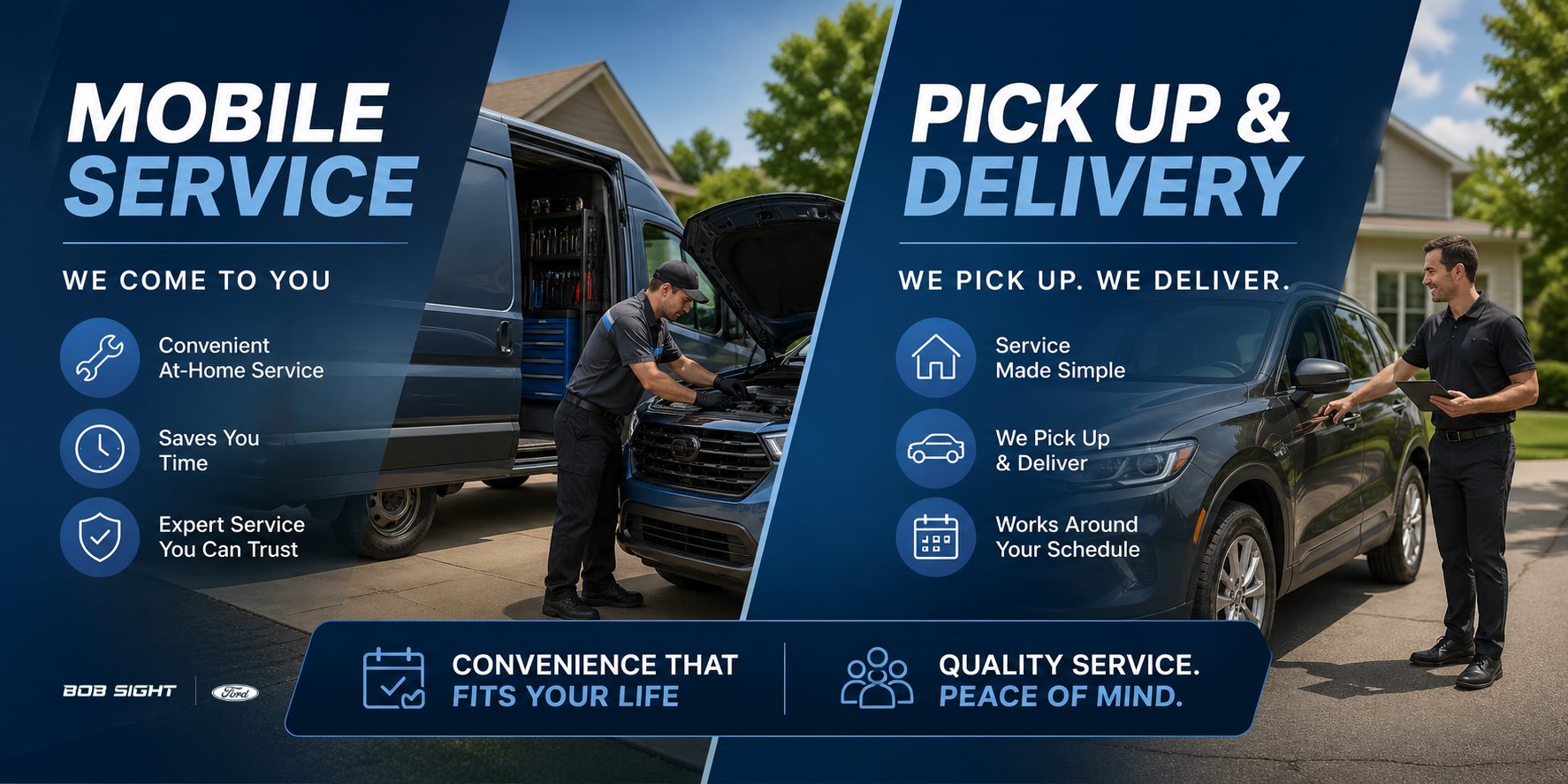
Every new and pre-owned SUV on our lot undergoes rigorous pre-delivery inspections by factory-certified master technicians using specialized Ford diagnostic tools. We offer access to competitive Ford Credit finance incentives, flexible lease structures, and comprehensive Ford Blue Advantage Certified Pre-Owned warranties. Furthermore, our modern service facility features Quick Lane Tire & Auto Center convenience, Ford Mobile Service vans, and pre-arranged pickup and delivery options for routine maintenance.
Located conveniently at 610 NW Blue Parkway in Lee's Summit, Bob Sight Ford is committed to making your vehicle purchase simple, clear, and enjoyable. Visit our showroom today to test-drive both the Ford Edge and Ford Escape and experience customer-first automotive care.
Why Choosing a Trusted Local Dealership Matters for SUV Shoppers
Purchasing your SUV from an established local dealership like Bob Sight Ford creates an ongoing partnership focused on dedicated customer care, transparent pricing, and reliable service. Buying a vehicle is a significant financial investment, and having a trusted neighborhood dealership nearby ensures you receive professional support throughout your entire ownership journey. Unlike national online car vendors or distant out-of-town dealers, a local family-owned dealership relies on building lasting relationships within the community it serves.
Located conveniently at 610 NW Blue Parkway in Lee's Summit, Missouri, Bob Sight Ford proudly serves drivers across Jackson County and the broader Kansas City Metro. Our proximity to major commuting corridors like US-50, I-470, and MO-291 makes dropping off your SUV for routine maintenance, oil changes, or safety inspections fast and convenient. Our certified technicians utilize state-of-the-art diagnostic equipment and genuine Motorcraft parts to keep your vehicle running in top condition for years to come.
Choosing a local dealership also connects you with valuable ownership amenities like Quick Lane Tire & Auto Center service, Ford Mobile Service vans, and pre-arranged pickup and delivery options. Our staff lives and works right here in western Missouri, giving us first-hand understanding of local driving demands and seasonal road conditions. We invite you to visit Bob Sight Ford today to test-drive the Ford Edge and Ford Escape and experience customer-first service built around your lifestyle.
Helpful Links
- Explore New Ford Escape SUV Inventory in Lee's Summit
- Browse New Ford Edge SUV Inventory at Bob Sight Ford
- View Current Ford Lease Deals & Finance Specials
- Value Your Trade-In Online at Bob Sight Ford
- Schedule Certified Ford Maintenance & SUV Repair Online
Proud to Be Part of the Bob Sight Auto Group
Bob Sight Ford is proud to be a member of the Bob Sight Auto Group, serving drivers throughout Missouri and Kansas with trusted automotive sales, service, and financing support for over a century. Our dealership group operates four convenient retail locations across the region, delivering honest guidance, transparent pricing, and customer-focused service to every community we serve.
Explore all of our Bob Sight Auto Group dealership locations below: