Ford Escape vs. Ford Bronco Sport for Missouri Winter Driving: AWD, Ground Clearance, Traction, and Cold-Weather Daily Use
Shop New Ford SUVs at Bob Sight Ford
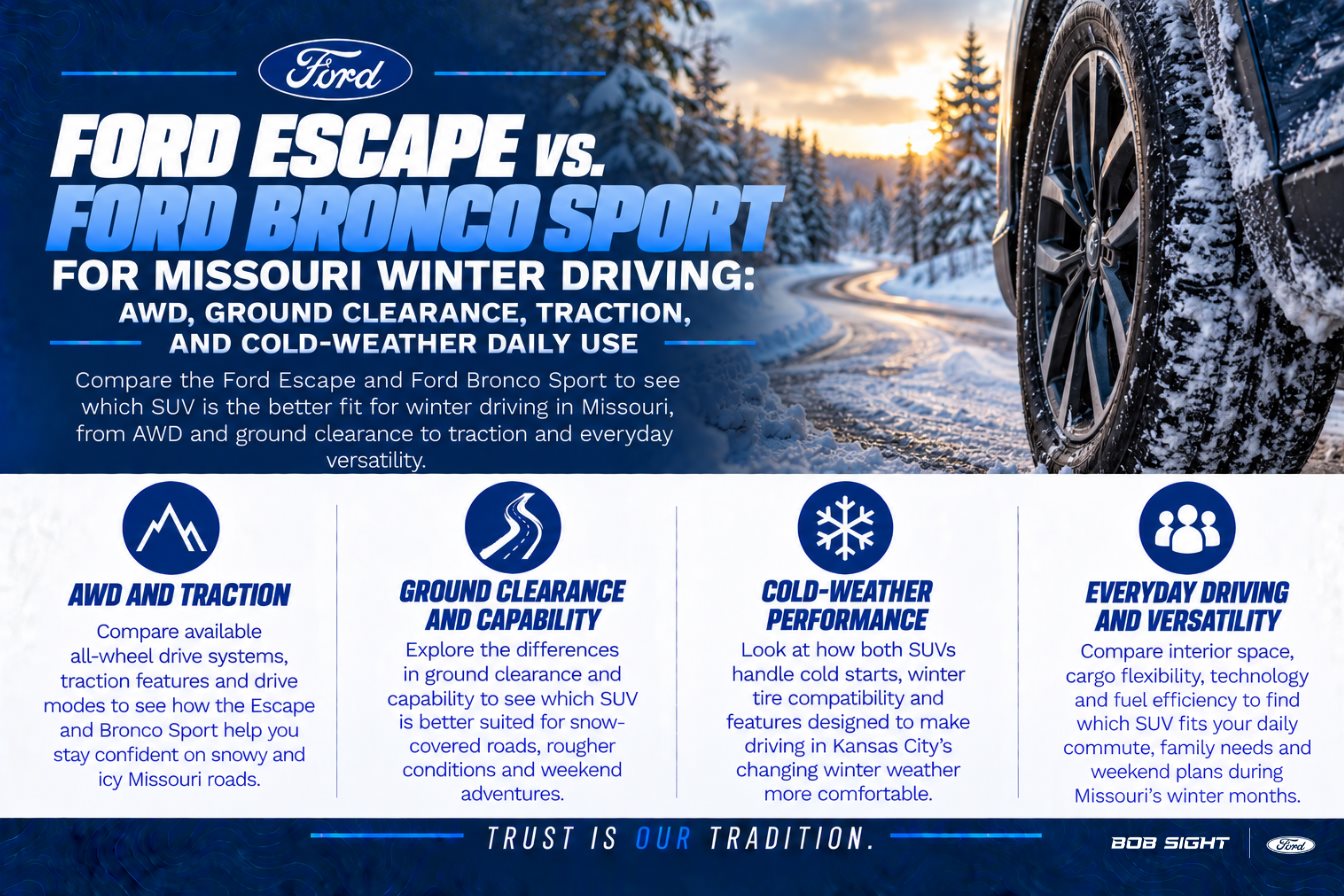
The Ford Escape and Ford Bronco Sport approach Missouri winter driving differently, with the Escape emphasizing efficient everyday commuting and available all-wheel-drive configurations while the Bronco Sport provides standard 4x4, additional terrain-focused capability, and greater ground clearance. For drivers around Lee’s Summit, Blue Springs, Independence, Raytown, and the Greater Kansas City Metro, choosing between these compact Ford SUVs can come down to where you drive when roads become snowy, icy, slushy, or uneven. A daily commute on I-470 or US-50 creates different demands than an unplowed neighborhood street, gravel road, rural driveway, or weekend route where deeper snow may be encountered. This comparison focuses specifically on winter-relevant differences rather than repeating a general Escape versus Bronco Sport comparison.
In This Guide You’ll Learn
This comparison looks at the Ford Escape and Ford Bronco Sport through the lens of real Missouri winter driving.
- How available Escape AWD compares with standard Bronco Sport 4x4
- Why ground clearance matters when snow begins accumulating
- How the Bronco Sport G.O.A.T. Modes® can help with changing surfaces
- Why tires remain critical regardless of drivetrain
- How the Escape fits winter commuting around Kansas City
- Where the Bronco Sport adds capability for less predictable winter conditions
- How fuel economy, passenger space, and daily usability affect the decision
Ford Escape vs. Ford Bronco Sport: What Are the Biggest Winter-Driving Differences?
The biggest winter-driving difference is that the 2026 Ford Bronco Sport comes standard with 4x4 across its lineup, while the Ford Escape offers configurations that prioritize everyday road driving with front-wheel drive or available all-wheel-drive capability depending on powertrain and trim. The Bronco Sport also incorporates terrain-focused systems such as G.O.A.T. Modes®, including a Slippery mode designed for reduced-traction surfaces. The Escape takes a more road-oriented approach, making it a natural fit for commuters who spend most of winter on treated city streets and highways. Neither approach eliminates the need to slow down and drive for conditions.
The 2026 Bronco Sport Big Bend®, Heritage, and Outer Banks® models use a 1.5L EcoBoost® engine and standard 4x4. Ford lists five G.O.A.T. Modes® on these models, including Normal, ECO, Sport, Slippery, and Off-Road. The Bronco Sport Badlands® moves to a 2.0L EcoBoost® engine, Advanced 4x4 with a twin-clutch rear drive unit, and seven G.O.A.T. Modes®, adding Rock Crawl and Rally. That hardware is designed to give the Bronco Sport a wider capability envelope when the surface becomes more challenging. :chatgpt-content-reference{index="0"}
The Escape is designed around a different daily-use mission. Ford lists a 1.5L EcoBoost® configuration with both front-wheel-drive and AWD fuel-economy ratings, while 2.0L EcoBoost® and hybrid AWD configurations are also available within the lineup. For someone commuting from Blue Springs to Lee’s Summit or traveling from Independence toward Kansas City on maintained roads, an AWD Escape can provide the all-weather traction many shoppers are seeking without moving into the Bronco Sport’s more terrain-focused design. :chatgpt-content-reference{index="1"}
This distinction is important because “better for winter” does not have one universal definition. A driver whose winter consists primarily of plowed roads, salted highways, parking garages, and suburban neighborhoods may prioritize efficiency and road comfort differently from someone who regularly travels rural roads or needs additional clearance after snowfall. The most useful comparison starts with the roads you actually use rather than assuming every Missouri driver needs the same level of winter capability.
How Does Ford Escape AWD Compare With Bronco Sport 4x4 in Snow?
For everyday snowy-road traction, an AWD Ford Escape can provide additional traction beyond a front-wheel-drive configuration, while the Bronco Sport builds standard 4x4 and terrain-management capability into every trim. That distinction gives shoppers two different approaches to winter mobility. The Escape is oriented toward normal paved-road driving with available all-wheel traction, while the Bronco Sport is engineered with a stronger emphasis on changing terrain and low-traction surfaces. Drivers should still remember that neither AWD nor 4x4 can override available tire grip.
All-wheel drive and four-wheel drive are related concepts, but the terminology should not be treated as if every system operates identically. In general terms, these systems can direct driving force to additional wheels when traction demands it. The actual strategy depends on the vehicle and drivetrain design. For a Missouri shopper, the practical question is less about the badge itself and more about how the vehicle is equipped for the roads and conditions you expect to encounter.
The Bronco Sport provides an additional layer through its Terrain Management System™. Slippery mode is intended for slick conditions such as rain, snow, or ice, while Off-Road mode is designed for loose surfaces including deeper snow. On the Badlands, Advanced 4x4 with a twin-clutch rear drive unit adds another level of drivetrain capability. These systems make sense for drivers who want their compact SUV to handle both ordinary commuting and more unpredictable surfaces. :chatgpt-content-reference{index="2"}
An Escape with AWD can make sense for a different winter routine. Imagine commuting from Lee’s Summit toward downtown Kansas City after crews have treated I-470 and major connecting routes. The road may still contain wet patches, slush, or occasional slick sections, but the vehicle is spending nearly all its time on pavement. In that scenario, an AWD Escape provides an all-weather configuration while retaining the Escape’s strong focus on commuting and everyday crossover use.
- Identify whether most of your winter driving occurs on maintained pavement or more variable surfaces.
- Decide whether you specifically want AWD or 4x4 rather than assuming every Escape configuration includes it.
- Consider whether terrain modes would provide useful capability for the places you regularly travel.
- Evaluate the tires installed on the exact vehicle because drivetrain capability does not replace tire traction.
- Test-drive both SUVs to compare visibility, seating position, controls, and everyday road feel.
How Much Ground Clearance Do the Escape and Bronco Sport Have?
The Bronco Sport generally provides more ground clearance than the road-oriented Escape, which can become relevant when snow accumulates rather than simply making pavement slippery. Ford lists 7.8 inches of ground clearance for the 2026 Bronco Sport Big Bend, Heritage, and Outer Banks configurations and 8.1 inches for the Badlands. Published specifications list approximately 7.5 inches for many gas-powered Escape configurations, while certain electrified configurations can differ. Shoppers should verify the specification for the exact Escape they are considering because powertrain and configuration can affect measurements. :chatgpt-content-reference{index="3"}
Ground clearance is the distance between the lowest relevant part of the vehicle and the road surface. It does not determine traction by itself, and having more clearance does not automatically make a vehicle safer on ice. Its advantage becomes easier to understand when snow depth increases, plows create ridges at driveway entrances, or a driver needs to travel over uneven surfaces covered by snow. In those situations, additional space underneath the vehicle can provide useful operating margin.
That difference may rarely matter during a typical commute on US-50 after roads have been cleared. It can matter more when leaving a neighborhood before residential streets have been plowed or when turning into a driveway where a snowplow has pushed a ridge across the entrance. Drivers traveling toward more rural areas outside Lee’s Summit, Blue Springs, Grain Valley, or eastern Jackson County may also encounter roads where snow removal occurs later than on major highways.
Ground clearance should therefore be considered alongside drivetrain, tires, and driving environment. If nearly every winter mile occurs on maintained pavement, the Escape’s more road-focused stance may align well with your needs. If your routine includes uneven roads, gravel, deeper snow, or unplowed surfaces, the Bronco Sport’s additional clearance and terrain-focused equipment may become more relevant. This is one reason a winter-specific comparison produces a different shopping conversation than simply comparing cargo volume or infotainment technology.
| Winter-Driving Feature | 2026 Ford Escape | 2026 Ford Bronco Sport |
|---|---|---|
| Drivetrain approach | FWD and AWD configurations depending on model/powertrain | Standard 4x4 |
| Ground clearance | Approximately 7.5 inches on many gas configurations | 7.8 inches on Big Bend, Heritage, and Outer Banks; 8.1 inches on Badlands |
| Terrain management | Road-focused crossover systems | G.O.A.T. Modes® including Slippery and Off-Road |
| Winter personality | Commuting and paved-road versatility | Added terrain and low-traction capability |
How Important Are Tires for Escape and Bronco Sport Winter Traction?
Tires are one of the most important parts of winter traction because AWD or 4x4 can help a vehicle accelerate, but the tires still provide the contact with the road when accelerating, turning, and braking. This applies equally to the Ford Escape and Ford Bronco Sport. A sophisticated drivetrain cannot create traction that the tire and road surface cannot support. Missouri shoppers should therefore consider tire type, tread condition, inflation pressure, and seasonal driving conditions alongside AWD or 4x4.
This distinction matters because drivetrain systems are sometimes treated as substitutes for winter-ready tires. They are not. AWD and 4x4 can distribute engine torque across more driven wheels, which can help the vehicle move from a stop when traction is limited. Braking and cornering still depend heavily on tire grip, vehicle speed, road conditions, and driver input. Ice can reduce available traction dramatically regardless of which Ford SUV you choose.
The Bronco Sport lineup illustrates how tires can also vary by configuration. Ford lists 225/65R17 all-season tires on the Big Bend, while other models and available off-road packages can use different tire configurations, including all-terrain tires. Those differences can affect road feel, noise, traction characteristics, and capability. The exact tire installed on a vehicle matters more than assuming every Bronco Sport has the same setup. :chatgpt-content-reference{index="4"}
Missouri’s temperature swings add another consideration. Tire pressure changes as ambient temperatures change, so a sharp cold front in Jackson County can coincide with a tire-pressure warning that was not present during warmer weather. Drivers should use the vehicle manufacturer’s specified cold tire pressure rather than the maximum pressure molded onto the tire sidewall. Regular inspections also provide an opportunity to identify uneven wear, low tread, or damage before winter conditions make those issues more consequential.
- Check tire pressure when the tires are cold and follow the vehicle-specific specification.
- Inspect tread condition across the full width of each tire.
- Look for cuts, bulges, punctures, or irregular wear.
- Confirm what type of tire is installed rather than assuming based on the SUV model.
- Have tires inspected if traction, vibration, pulling, or wear patterns change.
For a driver traveling between Lee’s Summit and Independence during a mixed precipitation event, good tires can matter every time the vehicle accelerates away from a light, changes lanes through slush, or slows for traffic. The Bronco Sport’s standard 4x4 provides meaningful drivetrain capability, and an AWD Escape can provide useful all-weather traction, but both vehicles ultimately rely on four tire contact patches. Winter preparation should address the entire vehicle rather than focusing on drivetrain alone.
Which Ford SUV Fits Daily Winter Commuting Around Kansas City?
The Ford Escape is well suited to shoppers whose winter driving is dominated by commuting and maintained pavement, while the Bronco Sport adds capability for drivers whose routine regularly extends onto less predictable surfaces. The decision becomes clearer when you separate normal Kansas City winter commuting from deeper-snow or rough-surface use. Many local drivers spend most of their time on roads that are plowed and treated relatively quickly. Others live or work where road conditions can remain challenging longer.
Fuel economy can matter for commuters covering significant mileage. Ford lists the 2026 Escape with a 1.5L EcoBoost at an EPA-estimated 27 city, 34 highway, and 30 combined mpg in front-wheel-drive form, while the AWD version is rated at 26 city, 32 highway, and 28 combined mpg. Ford also lists an AWD 2.5L hybrid configuration at 42 city, 36 highway, and 39 combined mpg. Actual mileage varies based on driving conditions and other factors. :chatgpt-content-reference{index="5"}
Ford lists the 2026 Bronco Sport with the 1.5L EcoBoost at an EPA-estimated 25 city, 30 highway, and 27 combined mpg. The Badlands with its 2.0L EcoBoost and Advanced 4x4 is listed at 21 city, 27 highway, and 23 combined mpg. Those numbers reinforce the different missions of these SUVs: the Escape lineup provides more efficiency-focused powertrain choices, while the Bronco Sport builds standard 4x4 capability into the vehicle. :chatgpt-content-reference{index="6"}
For someone commuting from Blue Springs to Lee’s Summit five days a week, fuel economy may carry significant weight over a full year. For a household that frequently travels gravel roads, reaches trailheads, deals with unplowed access roads, or simply wants a greater capability margin when Missouri weather deteriorates, the Bronco Sport’s configuration may justify different efficiency tradeoffs. The right comparison is based on how often you will actually use each capability.
Cold-weather comfort and visibility should also be part of the test drive. Sit in both vehicles wearing the type of heavier coat you might use in January. Check sightlines, mirror visibility, control placement, rear-seat access, and cargo loading. Winter ownership is not just about moving through snow. It includes dark morning commutes, wet coats, road salt, grocery trips, school pickups, and loading cargo when the temperature is below freezing.
Does the Bronco Sport’s G.O.A.T. Modes System Matter in Missouri Winter Weather?
The Bronco Sport’s G.O.A.T. Modes® can be useful in Missouri winter conditions because the Terrain Management System provides selectable settings for different surface conditions, including a dedicated Slippery mode. Big Bend, Heritage, and Outer Banks models include five modes: Normal, ECO, Sport, Slippery, and Off-Road. Ford describes Slippery mode as being intended for slick surfaces such as rain, snow, or ice, while Off-Road mode is designed for loose surfaces including sand and deep snow. :chatgpt-content-reference{index="7"}
G.O.A.T. stands for Goes Over Any Type of Terrain, but the important winter takeaway is not the name. It is that the driver can select a mode intended for a particular type of surface. Vehicle systems can then adjust certain operating characteristics to better match that selection. These technologies are aids rather than permission to maintain normal dry-road speeds when traction is poor.
The Badlands expands this system to seven G.O.A.T. Modes and combines it with Advanced 4x4, a twin-clutch rear drive unit, and HOSS 2.0 suspension. That combination is more relevant for shoppers expecting challenging surfaces than for someone whose SUV will rarely leave treated pavement. It is useful capability, but shoppers should distinguish capability they will genuinely use from equipment that simply sounds appealing on a specification sheet. :chatgpt-content-reference{index="8"}
Imagine two Lee’s Summit households after an overnight snowfall. One driver leaves a subdivision, enters a plowed arterial road, joins US-50, and parks in a cleared office lot. Another leaves before residential roads are cleared, travels several miles of secondary roads, and regularly visits property accessed by gravel. Both are experiencing Missouri winter, but their vehicle requirements are different. The second scenario makes the Bronco Sport’s terrain-management hardware more relevant.
The Escape remains focused on everyday crossover driving rather than duplicating the Bronco Sport’s terrain-oriented personality. That separation is useful because Ford shoppers do not have to buy the same type of compact SUV for every use case. One prioritizes efficient daily versatility, while the other places greater emphasis on standard 4x4 and capability when pavement becomes less predictable.
How Do Passenger Space and Cargo Needs Affect a Winter SUV Decision?
Winter capability matters, but passenger space and cargo flexibility can determine which SUV works better during the other eleven months of ownership. The Escape provides up to 65.4 cubic feet of maximum cargo space in Ford’s published specifications for certain configurations, while the Bronco Sport with the 1.5L EcoBoost provides up to 65.2 cubic feet behind the first row. Although those maximum figures are close, the vehicles package their interiors differently and should be evaluated in person with the type of cargo your household actually carries. :chatgpt-content-reference{index="9"}
The difference becomes more noticeable with the rear seats in use. Ford lists 32.5 cubic feet behind the Bronco Sport second row with the 1.5L powertrain, while published Escape specifications list up to 37.5 cubic feet behind its second row in certain gas configurations. The Bronco Sport’s upright design may appeal to shoppers carrying taller outdoor gear, while the Escape’s passenger-focused packaging and available cargo space may appeal to commuters and families. Configuration affects the exact numbers, so compare the specific vehicles being considered. :chatgpt-content-reference{index="10"}
Winter changes the type of cargo people carry. Ice scrapers, emergency supplies, coats, boots, sports equipment, grocery bags, work gear, and travel luggage can all compete for space. Families driving from Lee’s Summit toward Overland Park or Olathe for weekend activities may care more about rear-seat comfort and cargo organization than an extra fraction of an inch of clearance. Someone carrying outdoor equipment on rural trips may value the Bronco Sport’s upright cargo area and rugged-use orientation differently.
Passenger space matters too. Ford lists 42.4 inches of front legroom for both vehicles, while the Escape provides up to 40.7 inches of second-row legroom in certain configurations and the Bronco Sport lists 36.9 inches. Those numbers do not tell the entire comfort story because seating position and seat design also matter, but they provide another reason to physically compare the cabins rather than deciding solely from exterior styling. :chatgpt-content-reference{index="11"}
A winter-focused SUV decision should therefore include a normal-life test. Open the rear doors, sit in the second row, fold the seats, examine cargo height, and imagine loading the vehicle while wearing gloves on a cold day. Capability matters most when it aligns with the rest of your ownership needs rather than forcing compromises every day for conditions you encounter only occasionally.
Quick Facts: Escape vs. Bronco Sport for Missouri Winters
The Escape is the more road- and efficiency-oriented choice within this comparison, while the Bronco Sport provides standard 4x4, G.O.A.T. Modes®, and greater terrain-focused capability. Missouri drivers should match those differences to their actual routes, snowfall exposure, commute length, and need for all-weather versatility.
- The 2026 Bronco Sport has standard 4x4 across the lineup.
- Bronco Sport Big Bend, Heritage, and Outer Banks models include five G.O.A.T. Modes®, including Slippery and Off-Road.
- Bronco Sport Badlands adds Advanced 4x4 with a twin-clutch rear drive unit and seven G.O.A.T. Modes®.
- Ford lists 7.8 inches of ground clearance for several Bronco Sport trims and 8.1 inches for Badlands.
- Many gas Escape configurations provide approximately 7.5 inches of ground clearance.
- The Escape lineup includes FWD and AWD configurations depending on trim and powertrain.
- The Escape offers gas and electrified powertrain choices, while the 2026 Bronco Sport lineup uses EcoBoost gas engines.
- Ford lists up to 39 combined mpg for an AWD Escape hybrid configuration.
- The 1.5L Bronco Sport is listed at 27 combined mpg.
- AWD and 4x4 help with traction but do not replace properly maintained tires or safe winter driving.
- Ground clearance becomes more relevant as snow depth and surface irregularity increase.
- Exact specifications should always be verified for the particular trim and configuration being considered.
For shoppers around Lee’s Summit and the Kansas City Metro, these facts create a useful starting point without declaring one SUV universally better. Someone prioritizing commuting efficiency may interpret the comparison differently from someone who regularly drives on unplowed roads. A test drive at Bob Sight Ford can help connect the specification differences to actual seating position, visibility, controls, and everyday driving feel.
Ownership Planning for Missouri Winter Driving
Whichever Ford SUV you choose, winter reliability depends on maintenance, tire condition, battery health, fluid condition, visibility, and preparation as much as drivetrain design. An Escape with AWD or a Bronco Sport with 4x4 still needs routine maintenance and seasonal inspections. Missouri winters can combine freezing mornings, rain, sleet, snow, road salt, potholes, and rapid temperature swings within a relatively short period. Preparing the entire vehicle supports safer and more predictable ownership.
Battery condition deserves attention before sustained cold weather because low temperatures can expose a battery that was already weakening. Tire pressure should also be monitored as temperatures fall. Windshield washer fluid, wiper blades, exterior lighting, coolant, brakes, and tires all contribute to winter readiness. Owners can review Ford service and parts specials when planning seasonal maintenance at Bob Sight Ford.
Driving habits matter as well. A household making short trips around Lee’s Summit may experience frequent cold starts, while a commuter traveling I-470 every day may accumulate highway mileage quickly. Someone living farther east toward Grain Valley may encounter different road-clearing schedules than a driver staying primarily on major Lee’s Summit streets. Maintenance planning is more useful when it reflects how the vehicle is actually driven.
Winter ownership should also include a simple emergency plan. Keep appropriate cold-weather supplies in the vehicle, maintain adequate fuel or charge for expected travel, check forecasts before longer trips, and avoid assuming AWD or 4x4 makes a road passable. During significant storms, road closures and official travel guidance matter more than vehicle capability. No drivetrain technology eliminates the physics of snow and ice.
Bob Sight Ford also offers Ford Pickup & Delivery, which may provide additional convenience when eligible service is needed. For busy households balancing work, school, and winter schedules, convenient maintenance options can be part of the ownership decision. Long-term reliability comes from choosing a vehicle that fits your driving pattern and then maintaining it consistently.
Frequently Asked Questions About the Ford Escape vs. Bronco Sport in Winter
Does the Ford Bronco Sport have AWD or 4x4?
The 2026 Ford Bronco Sport comes with standard 4x4 rather than offering a front-wheel-drive configuration. Big Bend, Heritage, and Outer Banks models use standard 4x4, while the Badlands features Advanced 4x4 with a twin-clutch rear drive unit. This is one of the clearest drivetrain differences between the Bronco Sport and Escape. :chatgpt-content-reference{index="12"}
The Bronco Sport also combines its 4x4 system with G.O.A.T. Modes®. Big Bend, Heritage, and Outer Banks include five modes, with Slippery and Off-Road among them. Badlands expands the system to seven modes. These features reinforce the Bronco Sport’s terrain-focused design.
For Lee’s Summit drivers, standard 4x4 may be appealing if winter travel regularly includes unplowed neighborhood streets, gravel roads, or other unpredictable surfaces. Drivers spending nearly all their time on treated pavement may not use the Bronco Sport’s broader capability as frequently. The right choice depends on the surfaces you actually encounter.
Is an AWD Ford Escape suitable for Missouri snow?
An AWD-equipped Ford Escape can provide useful all-weather traction for Missouri drivers who primarily travel maintained roads, but vehicle speed, tire condition, snow depth, and road treatment remain critical. The Escape’s mission is more road-focused than the Bronco Sport’s. That can make it a strong fit for commuters who want all-weather capability without prioritizing off-road-oriented hardware.
AWD can help distribute driving force when traction is limited, but it does not shorten stopping distance simply because all four wheels can receive power. Tires remain responsible for transmitting acceleration, braking, and cornering forces to the road. Drivers should reduce speed and increase following distance when roads become slick regardless of drivetrain.
A typical Lee’s Summit commute on treated portions of US-50, I-470, or Route 291 may represent the type of winter environment where an AWD Escape fits naturally. Conditions can still change rapidly, and bridges, ramps, shaded areas, and untreated side streets may remain slick after major routes improve. Winter driving requires attention even when the vehicle is equipped with AWD.
Does the Bronco Sport have more ground clearance than the Escape?
Yes, commonly compared Bronco Sport configurations provide more ground clearance than many Escape configurations. Ford lists 7.8 inches for Bronco Sport Big Bend, Heritage, and Outer Banks and 8.1 inches for Badlands. Published specifications place many gas-powered Escape configurations at approximately 7.5 inches. :chatgpt-content-reference{index="13"}
The practical advantage becomes more relevant when snow accumulates or the road surface is uneven. Clearance does not create tire traction, so it should not be confused with grip on ice. It simply provides additional space beneath the vehicle before deeper snow or uneven terrain begins interfering with vehicle movement.
Drivers in Blue Springs, Grain Valley, Raytown, or other communities around the Kansas City Metro may rarely need extra clearance on cleared main roads. Someone leaving before neighborhood roads are plowed or traveling rural routes may appreciate it more often. Consider the worst roads you realistically expect to drive, not just the conditions during a normal dry-weather test drive.
Does the Ford Escape get better fuel economy than the Bronco Sport?
The Escape offers configurations with higher EPA-estimated fuel economy than the Bronco Sport, including an available AWD hybrid configuration that Ford lists at 42 city, 36 highway, and 39 combined mpg. Ford lists the 1.5L AWD Escape at 26 city, 32 highway, and 28 combined mpg. Actual mileage varies based on vehicle configuration, weather, driving habits, and other factors. :chatgpt-content-reference{index="14"}
Ford lists the 1.5L Bronco Sport at 25 city, 30 highway, and 27 combined mpg, while the 2.0L Badlands is listed at 21 city, 27 highway, and 23 combined mpg. The Bronco Sport’s standard 4x4 and terrain-oriented hardware reflect a different set of priorities. Shoppers should compare efficiency alongside capability rather than evaluating either number in isolation. :chatgpt-content-reference{index="15"}
Fuel economy can become a larger consideration for someone commuting daily from Independence or Blue Springs into Lee’s Summit or Kansas City. A household that drives fewer miles but regularly needs the Bronco Sport’s additional terrain capability may weigh that tradeoff differently. Annual driving habits provide better context than comparing EPA figures alone.
Where can I compare a Ford Escape and Bronco Sport near me in Lee’s Summit?
Drivers can explore new Ford SUV inventory at Bob Sight Ford in Lee’s Summit and compare available Escape and Bronco Sport configurations based on drivetrain, features, passenger space, and winter-driving needs. Inventory changes over time, so shoppers should check current availability rather than assuming a particular trim or configuration is in stock. Bob Sight Ford serves drivers throughout Lee’s Summit and the Greater Kansas City Metro.
Before the test drive, make a short list of the winter conditions you encounter most often. Include commute distance, whether your neighborhood is plowed quickly, how often you drive gravel or rural roads, passenger needs, and whether fuel economy or additional terrain capability carries more weight. That makes it easier to compare the vehicles based on real ownership rather than styling alone.
Drivers visiting from Blue Springs, Independence, Raytown, Grandview, Belton, Liberty, Overland Park, Olathe, and surrounding communities can also compare how each SUV feels on normal roads around Lee’s Summit. Seating position, outward visibility, ride characteristics, cabin layout, and cargo access are difficult to judge from specifications alone. Those everyday factors remain important long after the snow melts.
Compare the Ford Escape and Bronco Sport at Bob Sight Ford in Lee’s Summit
The Ford Escape and Ford Bronco Sport can both serve Missouri drivers through winter, but they are designed around different priorities. The Escape emphasizes everyday crossover versatility and offers efficiency-focused powertrain choices along with AWD configurations. The Bronco Sport provides standard 4x4, G.O.A.T. Modes®, additional ground clearance, and a more terrain-focused approach. Understanding that difference is more useful than trying to declare one vehicle the universal answer for every Kansas City driver.
If most of your winter travel consists of commuting on maintained roads between Lee’s Summit, Blue Springs, Independence, and Kansas City, the Escape deserves consideration for its road-oriented packaging and available efficient powertrains. If your routine includes unplowed roads, deeper snow, gravel, outdoor recreation, or surfaces where additional clearance and terrain-management capability may be useful, the Bronco Sport provides a different set of tools.
The final decision should also account for tires, passenger comfort, cargo needs, annual mileage, and how often you will genuinely use each vehicle’s capability. Missouri winter weather is only part of the ownership year. Choosing the SUV that works during January but also fits commuting, errands, road trips, and family needs throughout spring, summer, and fall creates a more complete ownership decision.
Bob Sight Ford in Lee’s Summit serves Ford shoppers throughout Jackson County and the Greater Kansas City Metro, including Blue Springs, Independence, Raytown, Grandview, Belton, Liberty, Overland Park, Olathe, and nearby communities. Comparing available Ford SUVs in person can help you see how their different designs translate into daily use, from winter visibility and seating position to cargo access and driving feel.
Helpful Links
- Shop New Ford Inventory
- Shop Ford Escape Inventory
- Shop Ford Bronco Sport Inventory
- Value Your Trade
- Explore Ford Financing
Proud to Be Part of the Bob Sight Auto Group
Bob Sight Ford is proud to be part of the Bob Sight Auto Group, serving drivers throughout the Kansas City Metro and surrounding communities with local automotive sales, service, parts, and collision repair resources. Our dealerships include Bob Sight Ford in Lee’s Summit, Bob Sight Kia in Independence, Bob Sight Honda in Lawrence, Bob Sight CDJR in Lawrence, and the Bob Sight Collision Center in Lee’s Summit. Whether you are comparing Ford SUVs for Missouri winter driving, preparing for your next vehicle, or maintaining the Ford already in your driveway, our goal is to provide useful local resources throughout your ownership journey.