Ford Explorer vs. Ford Expedition: Which SUV Fits Your Family?
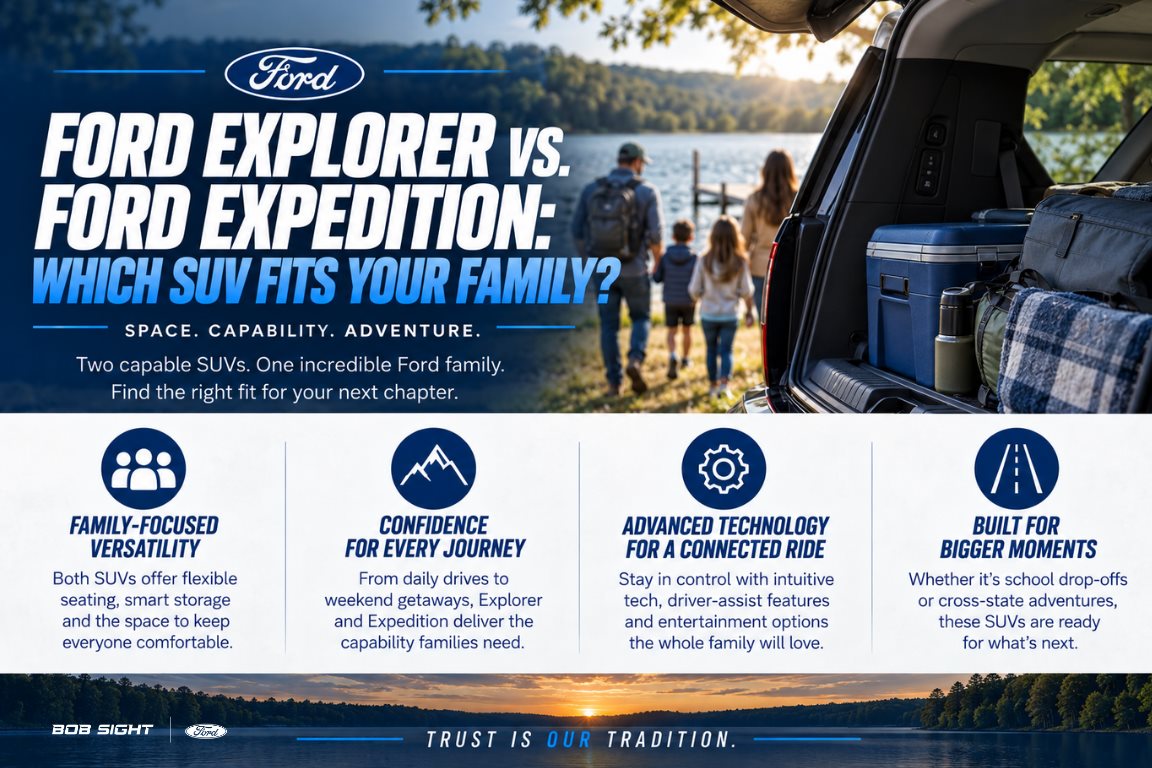
Explore New Ford SUVs at Bob Sight Ford
The Ford Explorer is a strong fit for families that want three-row seating, easier everyday maneuverability, and useful cargo space, while the Ford Expedition is better for larger families that need more passenger room, greater cargo capacity, and substantially more towing capability. Both SUVs can support school schedules, work commutes, weekend activities, and road trips around Lee’s Summit and the Greater Kansas City Metro. The right choice depends on how often your family uses the third row, how much cargo you carry, what you plan to tow, and where you park each day.
The current Ford Explorer offers available seating for up to seven, up to 85.8 cubic feet of cargo space, available Intelligent 4WD, and a maximum towing capacity of 5,000 pounds when properly equipped. The current Ford Expedition offers seating for up to eight in select configurations, as much as 108.5 cubic feet of cargo space in the standard-length model, and up to 123.1 cubic feet in Expedition MAX. Properly equipped Expedition configurations can tow up to 9,600 pounds.
Those numbers establish the basic difference, but family usability involves more than maximum specifications. A smaller household commuting along I-470 may value the Explorer’s more manageable footprint, while a family regularly carrying teenagers, sports equipment, luggage, and a trailer may benefit from the Expedition. This comparison explains how both Ford SUVs fit real life in Lee’s Summit, Blue Springs, Independence, and surrounding Kansas City communities.
In This Guide You’ll Learn
This Ford Explorer vs. Ford Expedition comparison explains the passenger, cargo, towing, performance, technology, and ownership differences that matter to families. It is designed to help Kansas City Metro shoppers identify which SUV aligns with their everyday routines and long-term plans.
- Which SUV is easier to drive and park around Lee’s Summit
- How Explorer and Expedition seating configurations compare
- How much cargo space each model provides
- Which SUV is better for towing boats, campers, and utility trailers
- How their available engines and drivetrains differ
- Which model may fit commuting, road trips, and winter driving
- How to choose between Expedition and Expedition MAX
Specifications and features can vary by model year, trim, package, and drivetrain. This guide uses current 2027 Ford Explorer and Expedition information as reference points while focusing on family considerations that remain useful over time. Shoppers should confirm the equipment and ratings of the specific vehicle they are considering.
Ford Explorer vs. Ford Expedition: What Is the Main Difference?
The Explorer is a midsize three-row SUV designed for everyday versatility, while the Expedition is a full-size three-row SUV built for greater passenger space, cargo capacity, and towing. Both models can carry a family, but the Expedition provides more room and capability at the cost of a larger exterior footprint. The Explorer is easier to manage for many ordinary commutes and parking situations.
The current Explorer measures approximately 198.7 inches long. The standard-length Expedition measures approximately 209.9 inches, while Expedition MAX extends to approximately 221.7 inches. That makes the standard Expedition more than 11 inches longer than the Explorer, and the Expedition MAX approximately 23 inches longer.
Vehicle length affects more than garage fit. It changes turning space, parking-lot maneuverability, parallel parking, driveway use, and how easily a driver navigates narrow lanes. A parent moving through a crowded school pickup area near downtown Lee’s Summit may find the Explorer’s size more convenient.
The Expedition’s larger body provides benefits once everyone is inside. It offers greater room for passengers and cargo, including more usable storage behind the third row. This can matter when all seating positions are occupied and the family still needs space for backpacks, groceries, strollers, sports bags, or luggage.
The Explorer is not a small SUV. It provides three rows, available seating for seven, and up to 85.8 cubic feet of cargo capacity with rear seating folded. For families that use the third row occasionally or carry younger passengers, it can deliver the needed flexibility without moving into the full-size category.
The simplest decision starts with frequency. If your family occasionally needs the third row and usually carries a moderate amount of cargo, start with Explorer. If the third row is used daily, adults or growing teenagers regularly sit in back, or family trips involve substantial luggage and towing, start with Expedition.
Which SUV Has the Best Seating for Your Family?
The Expedition provides the more spacious seating solution and can accommodate up to eight people in select configurations, while Explorer offers seating for up to seven. The right layout depends on passenger count, child-seat placement, third-row use, and whether the family prefers a second-row bench or captain’s chairs. Seating capacity can vary by trim.
A second-row bench generally maximizes passenger capacity by providing three positions across the middle row. Captain’s chairs reduce the middle row to two seats but create a pass-through that can make the third row easier to reach. Families should test both arrangements with the passengers and child restraints they expect to carry.
The Explorer offers configurations for six or seven occupants, depending on the selected seating layout. Its third row can be useful for children, occasional adult passengers, or the extra friend joining an activity. When the third row is not needed, folding it expands the cargo area.
Expedition Active and Expedition MAX Active models provide seating for up to eight with an appropriate second-row bench. Other Expedition configurations may seat seven with second-row captain’s chairs, while seating availability varies across the lineup. The Expedition’s full-size dimensions provide more room for families that use all three rows regularly.
Consider a Lee’s Summit family with three children involved in different activities. If the SUV routinely carries five people and only occasionally adds friends or grandparents, the Explorer may provide enough seating. If the same family regularly carries seven or eight people with equipment, Expedition offers a more accommodating layout.
Child-seat installation should be evaluated in person. Check the location of lower anchors and tethers, the room needed for rear-facing seats, access to seat-belt buckles, and whether a child restraint blocks the third-row pathway. Vehicle and child-seat manuals provide the controlling installation guidance.
Passenger comfort also changes as children grow. A third row that works well for elementary-school passengers may feel different when those passengers become teenagers. Families planning to keep the SUV for many years should test the cabin with future space needs in mind.
Explorer vs. Expedition Cargo Space
The Expedition offers more cargo space than the Explorer, and Expedition MAX provides the most room for families that need to carry passengers and luggage at the same time. The Explorer supplies up to 85.8 cubic feet of cargo space, while the standard Expedition provides up to 108.5 cubic feet. Expedition MAX increases maximum capacity to 123.1 cubic feet.
| Current Ford SUV | Maximum Cargo Space | Best-Fit Family Use |
|---|---|---|
| Ford Explorer | Up to 85.8 cubic feet | Daily family use, groceries, school gear, and moderate road-trip luggage |
| Ford Expedition | Up to 108.5 cubic feet | Larger households, frequent third-row use, and heavier cargo needs |
| Ford Expedition MAX | Up to 123.1 cubic feet | Maximum passenger-and-cargo flexibility for large families and long trips |
Maximum cargo capacity is measured with rear seating folded, so it does not tell the complete family story. Space behind the third row is more relevant when every seating position is needed. The current standard Expedition offers approximately 22.9 cubic feet behind the third row, while Expedition MAX provides approximately 37.4 cubic feet.
That additional space can change how a family packs. A standard Expedition may carry several bags behind the third row, while Expedition MAX gives owners more room for luggage, a folded stroller, sports equipment, or groceries without lowering passenger seats. Explorer may require more selective packing when all three rows are occupied.
A family heading from Blue Springs to Kansas City International Airport should consider passengers and luggage together. If six or seven people each bring a suitcase, Expedition MAX may be the easiest fit. If four people are traveling and the third row can be folded, Explorer may provide ample space.
Cargo shape also matters. Test the liftgate opening, load-floor height, seat-folding controls, underfloor storage, and space around wheel housings. A published cubic-foot number cannot show whether a specific stroller, dog crate, hockey bag, or mobility device fits easily.
Bring measurements or commonly used items to the dealership when practical. Testing the cargo area with real family equipment can reveal more than comparing specifications on a screen. The best cargo area is the one that handles your routine without constant rearranging.
Which Is Easier to Drive Around Lee’s Summit?
The Explorer is generally easier to maneuver, park, and place in traffic because it is shorter and narrower than the Expedition. The Expedition remains manageable with available cameras and driver-assist features, but its full-size dimensions require more space. Expedition MAX adds even more length for maximum cargo capacity.
Daily driving in the Kansas City Metro often involves parking garages, school pickup lanes, grocery-store lots, drive-throughs, construction zones, and narrow neighborhood streets. Vehicle size can affect each of these situations. A smaller turning footprint may reduce the effort required to navigate crowded areas.
The Explorer’s approximate 198.7-inch length makes it more compact than both Expedition versions. It can be the easier choice for a driver who regularly parks near Summit Fair, commutes to an office near downtown Kansas City, or uses a garage with limited depth. Families should measure the home garage before assuming either SUV will fit.
The standard Expedition measures approximately 209.9 inches long, and Expedition MAX measures approximately 221.7 inches. Expedition’s width, including mirrors, is also substantial. Drivers should account for garage doors, storage shelves, walking space, and whether the liftgate can open when the garage door is closed.
Available 360-degree camera systems, parking sensors, and other driver-assist technologies may improve awareness around either SUV. These tools can help drivers monitor curbs, parking lines, pedestrians, and nearby vehicles. They do not replace mirrors, direct observation, or careful low-speed driving.
Families who value Expedition space should not automatically avoid it because of size. A test drive can show how quickly the driver becomes comfortable with the vehicle’s dimensions. Drive through the routes you use, enter a typical parking space, and test visibility from the seating position.
Explorer wins the everyday-maneuverability comparison. Expedition wins when the interior benefits justify the added exterior size. Expedition MAX is best reserved for households that will regularly use its additional cargo length.
Performance and Powertrain Differences
The Explorer provides a choice between efficient turbocharged four-cylinder power and an available performance-focused V6, while Expedition uses a 3.5-liter EcoBoost® V6 to support its larger size and higher towing capability. Both SUVs use turbocharged engines, but their output, mission, and available configurations differ.
The current Explorer uses a standard 2.3-liter EcoBoost inline-four producing 300 horsepower and 310 pound-feet of torque on applicable models. An available 3.0-liter twin-turbocharged EcoBoost V6 produces 400 horsepower and 415 pound-feet of torque. The more powerful V6 is standard in Explorer ST and available on select other configurations.
The current Expedition uses a standard 3.5-liter EcoBoost V6 producing 400 horsepower and 480 pound-feet of torque. An available high-output version produces 440 horsepower and 510 pound-feet of torque on select models. The additional torque supports the Expedition’s passenger, cargo, and towing mission.
| Powertrain | Published Output | Family-Use Perspective |
|---|---|---|
| Explorer 2.3L EcoBoost I-4 | 300 horsepower and 310 lb.-ft. of torque | Strong everyday performance for commuting and family travel |
| Explorer 3.0L EcoBoost V6 | 400 horsepower and 415 lb.-ft. of torque | Added performance for ST and selected configurations |
| Expedition 3.5L EcoBoost V6 | 400 horsepower and 480 lb.-ft. of torque | Greater torque for full-size passenger, cargo, and towing demands |
| Expedition 3.5L High-Output EcoBoost V6 | 440 horsepower and 510 lb.-ft. of torque | Higher output for selected Expedition models |
Horsepower describes the rate at which an engine can perform work, while torque describes rotational force. Families may notice torque when accelerating with passengers, climbing grades, or towing. Maximum numbers should not be the only decision factor because vehicle weight, gearing, drivetrain, and intended use also shape performance.
A parent merging onto US-50 during a Lee’s Summit commute may find the standard Explorer engine responsive and practical. A family towing a larger camper toward the Ozarks may benefit from Expedition’s additional torque and towing capacity. Both should be tested under normal driving conditions.
Fuel use generally rises as vehicle size, weight, power, cargo, speed, weather demand, and towing load increase. Families comparing ownership should look beyond one published estimate and consider their actual mix of city driving, highway commuting, idling, short trips, and towing.
Explorer vs. Expedition Towing Capacity
The Expedition is the stronger towing SUV, offering up to 9,600 pounds of available capacity compared with the Explorer’s 5,000-pound maximum when properly equipped. Explorer can handle many smaller boats, utility trailers, and compact recreational trailers. Expedition is better suited to heavier boats, larger campers, and families that tow with more passengers and cargo.
The Explorer’s 5,000-pound maximum applies to properly equipped configurations. The trailer, passengers, cargo, hitch equipment, and tongue weight must remain within all applicable ratings. Do not assume every Explorer has the same towing equipment or capacity.
Select Expedition 4x4 configurations can tow up to 9,600 pounds with the available Heavy-Duty Trailer Tow Package. Expedition MAX reaches up to 9,000 pounds in applicable 4x4 configurations. The longer MAX body adds cargo room, but its maximum available tow rating may differ from the standard-length model.
Tongue weight is the downward force the trailer places on the hitch. It counts against vehicle payload along with passengers, luggage, cargo, and accessories. A family can remain below the published trailer rating while exceeding another limit if the SUV is heavily loaded.
A Lee’s Summit family towing a lightweight utility trailer to a home-improvement project may find Explorer more than capable. A household towing a large boat to Lake of the Ozarks while carrying several passengers and equipment may need Expedition’s greater capacity. Actual loaded weights should determine the choice.
Towing affects acceleration, stopping distance, handling, fuel use, cooling demands, and maintenance. Use the correct hitch, trailer brakes where required, safety chains, lighting, mirrors, tire pressures, and load distribution. Review the owner’s manual and Ford towing information for the exact SUV.
Expedition wins decisively for towing. Explorer remains the more practical everyday option when the family’s trailer falls comfortably within its ratings and heavy towing is not a regular need.
Which SUV Is Better for Kansas City Winter Driving?
Both SUVs can be capable in Missouri winter weather when equipped with the appropriate drivetrain and tires, but Explorer is easier to maneuver while Expedition offers greater size, clearance, and available 4x4 capability. Winter performance depends heavily on tire condition, speed, visibility, road treatment, and driver behavior. Four-wheel drive cannot eliminate sliding on ice.
Explorer offers available Intelligent 4WD on applicable configurations. The system can support traction by managing power delivery based on operating conditions. Explorer Tremor includes Intelligent 4WD, all-terrain tires, increased ride height, off-road-tuned suspension, and a Torsen® limited-slip rear axle.
Expedition offers available 4x4, and Expedition Tremor provides additional off-road-focused equipment with approximately 10.6 inches of minimum running ground clearance. Most standard Expedition models provide approximately 8.7 inches. These figures may help on deeper snow or uneven surfaces but do not shorten stopping distances.
Winter tires or appropriately rated all-weather tires can have a larger impact on snow and ice performance than choosing between the model names. Check tread depth, cold tire pressure, rubber condition, and the Three-Peak Mountain Snowflake symbol where relevant. All-terrain tires vary in winter performance.
A driver leaving a neighborhood near Raintree Lake after freezing rain may appreciate Explorer’s smaller footprint and predictable maneuverability. A larger family traveling on an unplowed rural road near Grain Valley may value Expedition’s available clearance and passenger room. Both drivers need slower speeds and additional following distance.
Missouri freeze-thaw cycles can create black ice on bridges and shaded areas along I-470, US-50, and Missouri Route 291. Reduce speed before reaching a slick section, avoid abrupt steering, and leave room to stop. Driver-assist systems support awareness but cannot override physical traction limits.
How Technology Supports Family Travel
Explorer and Expedition offer connected technology and driver-assist features designed to support navigation, communication, entertainment, and awareness during family travel. Feature availability varies by trim, package, subscription, and model year. Families should choose technology based on actual use rather than the length of the feature list.
The current Explorer includes a 13.2-inch center display and the Ford Digital Experience. Available wireless Apple CarPlay® and Android Auto™ compatibility can help drivers access compatible navigation, audio, and communication functions. Screen use should remain secondary to safe driving.
Expedition offers a 24-inch panoramic display paired with a 13.2-inch center display. The wide information layout can help present vehicle and trip information within the driver’s field of view. Families should test the interface to make sure controls are understandable and comfortable.
Ford Co-Pilot360® technologies can include functions such as Adaptive Cruise Control, Lane Centering, 360-degree camera views, and additional assistance features, depending on the model. These systems require driver attention and have operational limitations. They do not make either SUV autonomous.
Available Ford BlueCruise can provide hands-free highway driving assistance on compatible roads while the driver remains attentive. It can help control steering, braking, acceleration, and lane position within system limits. Availability, hardware, software, subscription, and mapped-road requirements apply.
A family driving from Independence to a tournament in Overland Park may use navigation, smartphone connectivity, and available driver assistance throughout the trip. Passengers may value charging access and available connectivity, while the driver may value clear directions and camera support in a crowded parking lot.
Before purchasing, connect the family’s phones, test the available displays, locate physical controls, and inspect charging-port placement. A feature that is difficult to reach or understand may add less value than a simpler system used every day.
How to Choose Between Explorer and Expedition
Choose Explorer when maneuverability, commuting, and flexible three-row seating are the priorities, and choose Expedition when passenger space, cargo room, and towing capability matter most. Use a structured comparison based on the family’s real schedule rather than choosing only by exterior appearance or maximum specifications.
- Count regular passengers. Include children, adults, relatives, teammates, friends, and anyone who rides with the family each week.
- Evaluate third-row frequency. Occasional use may fit Explorer, while daily third-row use may point toward Expedition.
- Measure regular cargo. Consider strollers, groceries, sports bags, musical instruments, pet equipment, and luggage.
- Check the garage and parking space. Measure depth, width, door clearance, storage obstacles, and liftgate room.
- Calculate towing needs. Use the fully loaded trailer weight and include passengers, cargo, hitch equipment, and tongue weight.
- Choose drivetrain needs. Consider available Intelligent 4WD or 4x4 based on weather, towing, and road conditions.
- Test every seating row. Have regular passengers enter, exit, buckle up, and adjust their seats.
- Drive familiar roads. Evaluate acceleration, braking, visibility, turning, parking, and ride comfort.
A family with two children and occasional guests may discover that Explorer provides more than enough room. Its third row can remain folded for cargo most of the week and rise when extra seating is needed. The smaller footprint can make daily travel more convenient.
A household with four children, frequent grandparents, or regular team transportation may find Expedition more comfortable. Expedition MAX becomes relevant when the family needs all three rows and significant luggage space during the same trip. Its additional length should be tested in the home garage.
Do not choose Expedition solely because it is bigger. Extra space adds value only when the household uses it enough to justify the size. Do not choose Explorer solely because it is easier to park if the third row and cargo area will feel crowded every day.
A test drive at Bob Sight Ford can make the decision clearer. Compare both SUVs on the same day, use the same parking area, and sit in each row. Direct comparison reveals differences that specifications alone cannot show.
Quick Facts About Explorer and Expedition
Explorer is the more maneuverable midsize choice, while Expedition provides greater space, passenger capacity, and towing capability. Expedition MAX adds the largest cargo area but also has the longest exterior dimensions.
- Explorer offers available seating for up to seven.
- Expedition offers seating for up to eight in select configurations.
- Explorer provides up to 85.8 cubic feet of cargo space.
- Standard Expedition provides up to 108.5 cubic feet of cargo space.
- Expedition MAX provides up to 123.1 cubic feet of cargo space.
- Explorer can tow up to 5,000 pounds when properly equipped.
- Expedition can tow up to 9,600 pounds when properly equipped.
- Expedition MAX can tow up to 9,000 pounds in applicable configurations.
- Explorer is approximately 198.7 inches long.
- Standard Expedition is approximately 209.9 inches long.
- Expedition MAX is approximately 221.7 inches long.
- Explorer offers available Intelligent 4WD.
- Expedition offers available 4x4.
These are lineup reference points rather than universal specifications for every vehicle. Trim, seating, drivetrain, powertrain, wheelbase, and package selection can change capacity and features. Verify the exact SUV before deciding.
For most Lee’s Summit families, Explorer offers an appealing balance of room and everyday usability. Expedition becomes the stronger choice when a family regularly fills the third row, carries substantial cargo, or tows heavier trailers. Expedition MAX serves households that need maximum enclosed storage behind an occupied third row.
Ownership Planning for a Three-Row Ford SUV
Long-term ownership planning should include passenger needs, maintenance, tires, fuel use, insurance, garage space, towing, and how the family may change over time. The right SUV should continue to work as children grow, activities change, and travel needs evolve. A vehicle that barely fits today may feel restrictive later.
Maintenance requirements vary by engine, drivetrain, model, and operating conditions. Follow the owner’s manual, vehicle information, and maintenance reminders for oil service, filters, fluids, tires, brakes, batteries, cooling components, and inspections. Towing, repeated short trips, heavy traffic, and severe weather may affect service needs.
Explorer may use less space and fuel in many everyday scenarios because it is the smaller vehicle, but actual fuel use depends on engine, drivetrain, traffic, speed, weather, cargo, and driving style. Expedition owners should budget for the operating demands of a full-size SUV. Published estimates do not predict every household’s result.
Tires affect ride quality, traction, road noise, replacement planning, and winter performance. Large wheel-and-tire packages may drive differently than smaller configurations. Families should compare the installed tire size and type rather than viewing wheels only as a styling choice.
Keep records of maintenance, tire rotations, alignments, repairs, and inspections. Organized history can help with service planning and may provide useful information if the family later evaluates a trade. Bob Sight Ford’s trade-in value tool can help owners begin that process.
Bob Sight Ford also provides Ford Pickup & Delivery for eligible service appointments. Availability and location criteria apply. Convenience options can help busy families stay current with maintenance without making the dealership round trip themselves.
Frequently Asked Questions About Explorer vs. Expedition
Is the Ford Explorer big enough for a family of five?
The Ford Explorer is generally spacious enough for a family of five and provides additional third-row seating when more passengers need to ride. Its flexible rear seating also allows the family to prioritize cargo room when the third row is not needed. The exact seating arrangement depends on configuration.
A family of five can use the first two rows for daily driving and fold the third row for groceries, strollers, sports gear, or luggage. When friends or relatives join, the third row can provide additional seating. Passenger comfort should be tested in person.
For school trips around Lee’s Summit and weekend activities in Blue Springs, Explorer may provide a practical combination of room and maneuverability. Families carrying large equipment or using all three rows daily should compare Expedition before deciding.
Is the Ford Expedition too large for everyday driving?
The Ford Expedition can serve as an everyday family vehicle, but drivers should be comfortable with its full-size dimensions and parking needs. Available cameras and parking technology may improve awareness, while the spacious interior rewards households that regularly use the added room.
The standard Expedition is longer and wider than Explorer, and Expedition MAX adds more length. Measure the garage and evaluate common parking locations before purchasing. A test drive should include tight turns, parking, and neighborhood travel.
A family in Grain Valley with a large driveway may find Expedition easy to own, while a commuter using compact downtown Kansas City parking may prefer Explorer. The answer depends on where the SUV spends most of its time.
Which has more third-row and cargo room, Explorer or Expedition?
The Ford Expedition offers more overall passenger and cargo space than the Explorer, with Expedition MAX providing the greatest cargo capacity. The standard Expedition offers approximately 22.9 cubic feet behind the third row, while Expedition MAX provides approximately 37.4 cubic feet.
Explorer reaches up to 85.8 cubic feet with the rear seating folded. Standard Expedition reaches up to 108.5 cubic feet, and Expedition MAX reaches up to 123.1 cubic feet. Maximum capacity does not show space with every seat occupied.
Families who regularly carry seven passengers and luggage should closely evaluate Expedition MAX. Families that use the third row occasionally may find Explorer provides enough flexibility with easier daily maneuvering.
Which is better for towing, Explorer or Expedition?
The Ford Expedition is better for towing because it offers up to 9,600 pounds of available capacity compared with the Explorer’s 5,000-pound maximum. Both figures require proper equipment, and the individual vehicle’s ratings must be verified.
Explorer may fit a lightweight camper, boat, or utility trailer within its ratings. Expedition can accommodate heavier recreational trailers and greater family cargo when properly configured. Payload and tongue weight remain important for both.
A family towing across Missouri should calculate the loaded trailer, passengers, cargo, and hitch equipment. Choose the SUV with sufficient capacity for the complete combination rather than relying only on the trailer’s advertised empty weight.
Should my family choose Expedition or Expedition MAX?
Choose Expedition MAX when your family regularly needs three rows and substantial cargo space at the same time. Choose the standard Expedition when full-size room is important but easier parking and a shorter body are more valuable than maximum cargo length.
Expedition MAX provides 37.4 cubic feet behind the third row and up to 123.1 cubic feet overall. Its approximate 221.7-inch length is nearly a foot longer than the standard Expedition. That difference should be tested in the home garage.
A large family traveling from Lee’s Summit to the airport with luggage may appreciate the MAX. A family that tows frequently and wants the highest available Expedition rating should compare configurations carefully because towing capacity varies by wheelbase and equipment.
Find the Right Ford SUV for Your Family at Bob Sight Ford
The Explorer is the best fit for many families seeking three-row versatility and easier everyday driving, while Expedition is the better choice for maximum room and towing strength. Expedition MAX adds another level of cargo flexibility for households that regularly carry passengers and gear together. No single model is right for every family.
Local needs make a difference. Driving along I-470, parking near Summit Fair, navigating school lines, traveling between Lee’s Summit and Independence, or towing toward a Missouri lake can change which features matter most. A useful comparison should reflect those real routines.
Bob Sight Ford serves SUV shoppers from Lee’s Summit, Blue Springs, Independence, Raytown, Grandview, Belton, Liberty, Grain Valley, Overland Park, Olathe, and surrounding Kansas City Metro communities. Families can compare seating, cargo access, powertrains, technology, drivetrains, and towing equipment in person.
Bring the family, child-seat measurements, cargo dimensions, garage measurements, and trailer information to your test drive. Sit in all three rows and practice folding the seats. The right Ford SUV should make everyday life easier while providing room for the family’s next stage.
Helpful Links
- Browse Ford Explorer Inventory
- Browse Ford Expedition MAX Inventory
- Explore New Ford Inventory
- Value Your Trade
- Schedule a Ford SUV Test Drive
Proud to Be Part of the Bob Sight Auto Group
Bob Sight Ford in Lee’s Summit is proud to be part of the Bob Sight Auto Group, serving drivers throughout the Kansas City Metro and Northeast Kansas. The group connects shoppers and owners with vehicle sales, financing assistance, maintenance, parts support, and collision repair. Each location serves its own community while continuing the Bob Sight tradition of helpful automotive guidance.
Ford SUV shoppers can compare family-focused vehicles at Bob Sight Ford, while drivers interested in other brands can visit Bob Sight Honda, Bob Sight CDJR, or Bob Sight Kia. The Bob Sight Collision Center provides a local resource when a vehicle requires professional collision repair. Together, these locations support area drivers through shopping, ownership, maintenance, and repair.