Ford F-150 vs Ford Super Duty: Which Truck Is Right for Your Job in the Kansas City Metro?
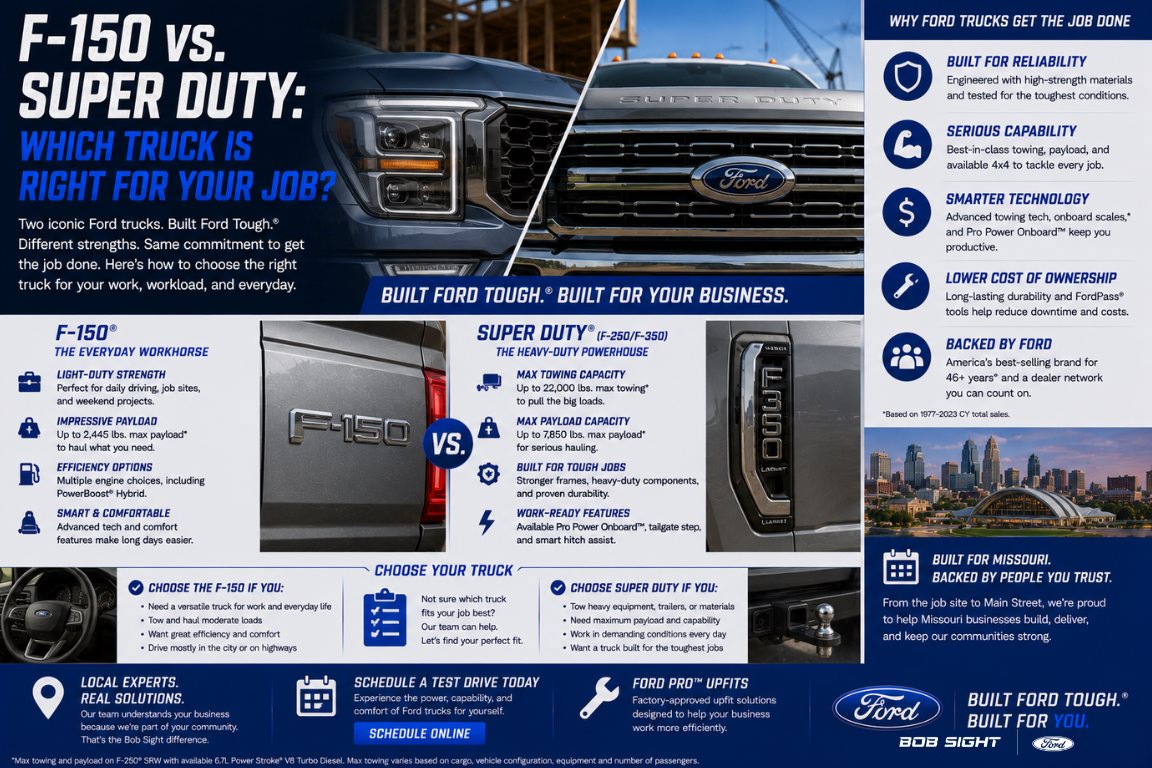
Deciding between the Ford F-150 and the Ford Super Duty comes down to evaluating your daily towing requirements, payload demands, vehicle maneuverability, and overall operational budget across the Kansas City metro area. Whether you are a general contractor hauling heavy equipment through Lee's Summit, a local business owner managing a service fleet in Independence, or a recreational driver towing a horse trailer out toward Grain Valley, choosing the right truck platform directly impacts your daily productivity and bottom line. At Bob Sight Ford, located conveniently in Lee's Summit, MO, our knowledgeable sales team works with contractors, tradespeople, and everyday truck drivers to compare light-duty and heavy-duty options side by side. From the nimble handling and impressive fuel efficiency of the full-size Ford F-150 to the uncompromising diesel torque and gooseneck towing capability of the Ford Super Duty F-250 and F-350, this detailed comparison guide breaks down engines, towing capacities, payload ratings, upfit flexibility, and ownership costs to help you select the precise truck built for your workload.
Browse New Ford Truck Inventory at Bob Sight Ford in Lee's Summit
In This Guide You'll Learn:
- The core structural differences between light-duty half-ton trucks and heavy-duty three-quarter-ton or one-ton platforms.
- How engine performance varies from EcoBoost V6 and Ti-VCT V8 options to the 6.7L Power Stroke Turbo Diesel.
- Step-by-step instructions for calculating your exact gross combined weight rating and trailer payload needs.
- Real-world towing limits comparing conventional bumper-pull hitches against fifth-wheel and gooseneck setups.
- Key commercial upfit possibilities, bed dimensions, cab configurations, and Pro Power Onboard technology.
- Long-term ownership considerations including fuel economy, routine maintenance schedules, and tax incentives.
1. Understanding the Structural Differences Between the Ford F-150 and Ford Super Duty
The fundamental difference between the Ford F-150 and the Ford Super Duty lies in their underlying chassis design, axle ratings, and vehicle classification, distinguishing a light-duty half-ton truck from heavy-duty three-quarter-ton and one-ton workhorses. The Ford F-150 belongs to the Class 1 and Class 2a light-duty vehicle segment, constructed on a fully boxed, high-strength steel frame that prioritizes a balance between work capability, daily ride comfort, and overall fuel efficiency. In contrast, the Ford Super Duty lineup, which includes the F-250, F-350, and F-450, occupies the Class 2b through Class 5 commercial vehicle spectrum. These heavy-duty trucks utilize thicker boxed steel frame rails, heavier-duty crossmembers, and commercial-grade axles engineered specifically to handle continuous structural stress under heavy loads without flexing.
Suspension architecture also sets these two truck lines apart for Missouri drivers navigating varied terrain along US Highway 50 or navigating bumpy construction access roads near Raytown. The Ford F-150 features an independent front suspension with double-wishbone architecture and coil-over-shock springs, delivering car-like steering precision, smooth cornering, and comfortable highway cruising across Jackson County. Rear suspension on the F-150 relies on traditional leaf springs or specialized multi-link coil setups on select performance trims. The Super Duty series utilizes heavy-duty solid front and rear axles with robust leaf-spring assemblies designed to support massive tongue weights and heavy bed loads, sacrificing a soft unladen ride quality in exchange for massive weight-bearing strength.
Understanding terms like Gross Vehicle Weight Rating (GVWR) is essential when selecting a vehicle platform for your personal or commercial needs. GVWR defines the maximum total allowable weight of the truck itself, including the chassis, engine, fluids, passengers, cargo, and trailer tongue weight. A standard Ford F-150 operates with a GVWR typically ranging from 6,010 pounds to 7,850 pounds, making it comfortable for garage parking and light commercial duty. A Ford Super Duty F-250 or F-350 boasts GVWR ratings spanning from 9,900 pounds to over 14,000 pounds, providing the structural mass necessary to remain stable while pulling heavy commercial trailers across Interstate 470 in windy conditions.
Braking systems and cooling components are scaled up significantly on the Super Duty platform to maintain safety during long downhill descents or heavy stop-and-go traffic near the I-35 split. While the Ford F-150 features heavy-duty four-wheel disc brakes tuned for impressive stopping distances, the Super Duty equips massive rotor diameters, larger brake calipers, and available integrated engine exhaust braking on diesel powertrains. This additional braking power prevents thermal brake fade when slowing down loaded equipment trailers, providing unmatched driver confidence when hauling severe payloads across Western Missouri highways.
2. Engine Performance, Horsepower, and Torque Breakdown Across Powertrains
Ford provides a diverse range of powertrains across both truck platforms, offering light-duty efficiency via EcoBoost technology and massive heavy-duty muscle through high-displacement V8 gas and Power Stroke diesel engines. Engine choice directly dictates your truck's responsiveness, towing capacity, and fuel consumption during daily commutes or jobsite transport across Lee's Summit and surrounding communities. Matching engine output to your specific operational demands prevents underpowering a heavy work vehicle or overspending on commercial diesel maintenance when a gas engine would easily fulfill your needs.
The Ford F-150 features an versatile engine lineup designed to maximize both horsepower and low-end torque. The popular 2.7L EcoBoost V6 delivers 325 horsepower and 400 lb-ft of torque, making it an ideal choice for daily commuting and moderate towing setups. Buyers seeking classic atmospheric power can choose the 5.0L Ti-VCT V8, generating 400 horsepower and 410 lb-ft of torque. For maximum full-size capability, the available 3.5L EcoBoost V6 cranks out 400 horsepower and 500 lb-ft of torque, while the advanced 3.5L PowerBoost Full Hybrid V6 combines twin-turbo gasoline performance with an electric motor to yield 430 horsepower and 570 lb-ft of torque, delivering instant electric acceleration and exceptional city fuel efficiency.
Stepping up to the Ford Super Duty lineup unlocks heavy-duty commercial powertrains built for extreme endurance. The standard engine on the F-250 is a robust 6.8L DEVCT gas V8 producing 405 horsepower and 445 lb-ft of torque, ideal for fleet operations and trades requiring reliable gas performance. For greater gas-powered muscle, the available 7.3L "Godzilla" V8 produces 430 horsepower and 485 lb-ft of torque, representing the largest displacement gas engine in its class. This pushrod V8 uses a cast-iron block and forged crankshaft, offering rugged mechanical simplicity and impressive payload pulling power without the maintenance complexity of a turbo-diesel system.
For ultimate commercial strength, the Super Duty features the legendary 6.7L Power Stroke V8 Turbo Diesel engine. Available in standard output (475 horsepower and 1,050 lb-ft of torque) and High-Output configurations (500 horsepower and a class-leading 1,200 lb-ft of torque), this diesel powerplant effortlessly moves massive trailers up steep highway inclines. Utilizing variable-geometry turbochargers, common-rail direct fuel injection, and a heavy-duty 10-speed TorqShift automatic transmission, the 6.7L Power Stroke provides relentless pull from low RPMs, making it the premier engine choice for commercial haulers across Blue Springs and the wider Kansas City market.
3. Towing Capacity Comparison: Conventional, Fifth-Wheel, and Gooseneck Capability
While a properly equipped Ford F-150 can tow up to 13,500 pounds conventionally, the Ford Super Duty expands trailering capability up to 40,000 pounds utilizing specialized fifth-wheel and gooseneck hitch configurations. Towing safely requires looking far beyond a single headline number, as hitch style, axle ratios, cab style, and trailer weight distribution determine how a truck performs when pulling heavy loads down Highway 50 or along the busy Interstate 70 corridor. Selecting the wrong truck for your trailer type can result in hazardous sway, strain on transmission components, and illegal weight violations.
The Ford F-150 excels in conventional receiver-hitch towing, where the trailer connects to a hitch ball mounted below the rear bumper. With the available 3.5L EcoBoost V6 and the Max Trailer Tow Package, the F-150 comfortably hauls speedboats, enclosed utility trailers, medium-sized travel campers, and skid-steer equipment trailers. Integrated technology options such as Pro Trailer Backup Assist, Smart Hitch weight calculation, and Onboard Scales take the guesswork out of loading your trailer, allowing drivers to monitor tongue weight in real time directly on the interior SYNC 4 touchscreen display.
When towing demands exceed 14,000 pounds or involve heavy industrial loads, the Ford Super Duty becomes necessary. The F-250 provides conventional towing limits up to 22,000 pounds and gooseneck ratings reaching 23,000 pounds. Moving up to the F-350 Single Rear Wheel (SRW) or Dual Rear Wheel (DRW "dually") setup increases conventional towing up to 28,000 pounds and gooseneck capacity up to 38,000 pounds. The range-topping F-450 Super Duty achieves a maximum 40,000-pound gooseneck tow rating when equipped with the High-Output 6.7L Power Stroke diesel engine, easily handling large agricultural livestock trailers, multi-car haulers, and commercial construction equipment.
Fifth-wheel and gooseneck towing systems mount directly inside the truck bed, placing trailer tongue weight directly over the rear axle rather than behind the rear bumper. This central hitch placement dramatically improves vehicle balance, reduces leverage-induced sway, and allows tighter turning radiuses when maneuvering long trailers through tight jobsites or suburban staging areas near Summit Fair. For drivers who tow heavy loads multiple times a week, the added stability of a Super Duty dually chassis provides unmatched control, preventing road buffeting when passing high-profile commercial semi-trucks on Missouri highways.
4. Bed Lengths, Cab Options, and Maximum Payload Ratings Explained
Payload capacity represents the total weight a truck can carry inside its cab and cargo bed, with the Ford F-150 capping out at 2,440 pounds while the Ford Super Duty offers payload ratings up to 8,000 pounds. Confusing payload capacity with towing capacity is a common mistake among truck shoppers. Every pound of tools, cargo, passengers, fuel, bed liners, ladder racks, and trailer tongue weight counts directly against your truck's published maximum payload limit. Exceeding this rating compresses suspension springs prematurely, reduces steering control, and strains tire sidewalls.
The Ford F-150 offers three distinct cab styles: Regular Cab (two doors), SuperCab (extended cab with reverse-opening rear doors), and SuperCrew (four full-size doors with generous rear legroom). Bed options include a 5.5-foot short box (popular on SuperCrew models for easy garage parking), a 6.5-foot standard box, and an 8.0-foot long box. When configured with the Regular Cab, 8.0-foot bed, 5.0L V8 engine, and Heavy-Duty Payload Package, the F-150 achieves its maximum 2,440-pound payload rating, providing ample capacity for gravel loads, drywall sheets, or landscaping stone pallets.
The Ford Super Duty lineup expands bed and cabin space for severe commercial duty. Available in Regular Cab, SuperCab, and Crew Cab configurations, Super Duty models pair with either a 6.75-foot standard box or an 8.0-foot long box. Because of its heavier frame and higher Gross Axle Weight Ratings (GAWR), an F-250 gas model carries up to 4,302 pounds of payload. The F-350 DRW equipped with the 6.8L or 7.3L gas engine achieves an extraordinary 8,000-pound payload limit, allowing commercial masonry crews or municipal departments to haul raw stone, concrete blocks, or heavy bed-mounted equipment without needing a Class 6 commercial truck.
Bed utility is enhanced across both truck lines through smart storage solutions and durable factory coatings. The F-150 features the FLEXBED system with built-in tie-down points, pocket recesses for custom wooden dividers, and available power outlets. Super Duty models offer ultra-tough factory spray-in bedliners, bed step access integrated into the rear bumper and side box corners, and LED box lighting, making early morning jobsite loading near Independence Center efficient and safe in cold winter weather.
5. Step-by-Step Guide: How to Calculate Your Required Truck Payload and Towing Capacity
Accurately calculating your true required payload and towing capacity prevents purchasing a truck that operates at unsafe weight limits or fails to comply with Missouri road regulations. Many buyers rely solely on maximum factory brochure figures without accounting for real-world equipment, passenger weights, and aftermarket modifications. Following a structured step-by-step formula ensures you choose a Ford truck properly rated for your daily workload in the Kansas City region.
Follow these five step-by-step instructions to calculate your exact vehicle capacity needs:
- Weigh Your Fully Loaded Trailer (Gross Trailer Weight): Do not rely on the dry weight listed on trailer manufacturer tags. Weigh your trailer fully loaded with water tanks, equipment, fuel, and cargo at a local commercial scale along I-70 or US-50 to find its true Gross Trailer Weight (GTW).
- Calculate Necessary Tongue Weight: A safe trailer setup requires 10% to 15% of total trailer weight on the hitch ball for conventional trailers, or 15% to 25% for fifth-wheel and gooseneck trailers. For example, a 10,000-pound conventional equipment trailer creates roughly 1,200 to 1,500 pounds of tongue weight resting on the truck.
- Sum Up All In-Cab and In-Bed Cargo: Add up the weight of all drivers, passengers, tools, toolboxes, ladder racks, auxiliary fuel tanks, luggage, and personal gear that will travel inside or on the truck during a typical work assignment.
- Add Tongue Weight to In-Truck Cargo to Determine Total Payload: Combine your calculated trailer tongue weight from Step 2 with your total internal cargo weight from Step 3. If your combined total equals 2,200 pounds, your vehicle must have a certified payload rating of at least 2,200 pounds.
- Verify Gross Combined Weight Rating (GCWR): Check that the combined weight of your loaded truck plus your loaded trailer does not exceed the factory GCWR listed on the driver's side door jamb sticker. If your total weight approaches within 10% of the maximum limit, step up to a higher truck class like the Ford F-250 or F-350 for safety reserves.
Consider a practical example of a local landscaping business operating out of Grain Valley. The business hauls a 12,000-pound trailer setup including twin zero-turn mowers and handheld power equipment. The trailer places 1,500 pounds of tongue weight on the truck hitch, while three crew members, safety gear, and fuel in the bed add another 1,000 pounds of internal load. With a total required payload of 2,500 pounds, a standard Ford F-150 would be operating beyond its rated payload threshold, making the Ford F-250 Super Duty the correct, legal, and safe truck choice for the company.
6. Daily Drivability, Fuel Economy, and Highway Handling in Jackson County
For drivers who use their vehicle as both a daily family commuter and a work vehicle, the Ford F-150 delivers superior fuel economy, easier parking, and smoother ride comfort compared to the heavier Super Duty. Navigating daily traffic along I-470 during morning rush hour or pulling into tight parking garages near downtown Kansas City requires evaluating how comfortably a truck fits into your everyday lifestyle outside of heavy towing tasks.
Fuel economy performance favors the light-duty Ford F-150 across all engine configurations. Models equipped with the 2.7L EcoBoost V6 or 3.5L PowerBoost Hybrid achieve impressive EPA-estimated fuel economy numbers, reaching up to 24 MPG highway on hybrid models. The hybrid system uses regenerative braking to store energy in a 1.5-kWh lithium-ion battery, assisting the engine during acceleration and drastically reducing fuel consumption during stop-and-go driving along Colbern Road or Chipman Road in Lee's Summit. Lower fuel consumption yields significant annual savings for trade contractors driving tens of thousands of miles per year.
The Ford Super Duty is larger, taller, and heavier, consuming more fuel during unladen driving. Heavy-duty trucks with GVWR ratings over 8,500 pounds are exempt from official EPA fuel economy testing, but real-world mileage for gas Super Duty models typically averages between 12 and 16 MPG on the highway, while 6.7L Power Stroke diesel models average between 15 and 19 MPG depending on axle ratios and driving style. Additionally, diesel owners must account for the added cost of Diesel Exhaust Fluid (DEF), which must be replenished every few thousand miles to meet modern emissions standards.
Maneuverability and parking convenience also differ noticeably between the two platforms. A standard Ford F-150 SuperCrew with a 5.5-foot bed measures approximately 231.7 inches in length, fitting easily into standard residential garages and suburban parking stalls at Summit Woods Crossing. A Super Duty Crew Cab with a 6.75-foot bed measures 250 inches in length and stands over 81 inches tall, requiring extra care in low-clearance parking structures and turning circles in residential cul-de-sacs. However, advanced 360-degree camera systems on both trucks provide aerial bird's-eye views, simplifying tight parking maneuvers for Lee's Summit drivers.
7. Commercial Upfitting and Jobsite Power Technology
Both the Ford F-150 and Ford Super Duty offer specialized jobsite integration features, highlighted by Ford Pro Power Onboard generator systems and factory upfitter switches. Modern jobsites demand mobile electrical power to run diagnostic tools, charge cordless tool batteries, operate heavy saws, and power auxiliary lighting. Integrating power sources directly into the truck chassis eliminates the hassle of towing separate gas generators, keeping your bed space clear for tools and materials.
Ford Pro Power Onboard transforms the F-150 into a mobile power station. Available in 2.0kW, 2.4kW, and 7.2kW power outputs, the system delivers exportable 120V and 240V AC power directly from outlets mounted inside the bed wall. The 7.2kW system standard on the F-150 PowerBoost Hybrid provides up to 30 amps of continuous 240V power, allowing mobile welders, framers, and residential electricians to run heavy plasma cutters, air compressors, and multiple circular saws simultaneously without a standalone jobsite generator.
The Super Duty lineup excels in heavy commercial upfit flexibility, featuring factory-installed auxiliary upfitter switches mounted cleanly into the overhead console. These six pre-wired, high-amperage switches allow body builders and commercial buyers to easily control exterior LED light bars, snowplows, hydraulic dump beds, winch systems, and salt spreaders without running messy wiring through the firewall. The Super Duty also offers Live-Drive Power Take-Off (PTO) capability on diesel models, allowing hydraulic pumps to operate directly off the transmission while the truck is stationary or driving.
Commercial upfit bodies fit seamlessly onto Super Duty Chassis Cab models (F-350, F-450, and F-550). Whether your business requires a Reading utility service body for organized tool storage, a Knapheide stake bed for bulk delivery, or a specialized dump body for excavation, the flat, straight frame rails of the Super Duty chassis accept standard commercial bodies from certified bailment pools. Bob Sight Ford works directly with regional upfit partners to deliver turnkey commercial work trucks configured directly to your industry requirements.
8. Step-by-Step Guide: Evaluating Commercial Financing and Section 179 Tax Benefits
Small business owners in Missouri can leverage federal Section 179 tax deductions and specialized Ford commercial financing to significantly lower the net acquisition cost of new work trucks. Understanding how vehicle weight ratings impact tax write-offs allows business owners to make tax-advantageous fleet purchases before the end of the fiscal year, maximizing capital reserves for business expansion.
Follow these four step-by-step guidelines to evaluate commercial financing and tax savings:
- Verify Vehicle Weight Eligibility (GVWR over 6,000 lbs): Confirm that your selected Ford truck carries a Gross Vehicle Weight Rating (GVWR) exceeding 6,000 pounds. All Ford F-150 models, F-250s, and F-350s exceed this threshold, making them eligible for accelerated IRS Section 179 depreciation deductions.
- Confirm Business Use Percentage: To claim full Section 179 tax deductions, the vehicle must be used for legitimate business operations at least 50% of the time. Keep clear mileage logs detailing client site visits, material pickups, and jobsite travel across Jackson County.
- Structure Commercial Financing or Lease Terms: Work with the commercial finance department at Bob Sight Ford to establish a Commercial Line of Credit (CLOC) or structure a CommerciaLease contract. Commercial leases offer flexible mileage limits and tailored buyout structures designed around business cash flow.
- Consult Your Missouri CPA Before Purchase: Bring vehicle spec sheets and purchase invoices to your corporate accountant or tax advisor to calculate your exact first-year tax savings under current federal tax code guidelines and Missouri state tax regulations.
Applying IRS Section 179 allows qualifying businesses to deduct up to 100% of the purchase price of an eligible Ford work truck in the first year of service, rather than depreciating the asset slowly over five to seven years. For a commercial contractor purchasing a $65,000 Ford Super Duty F-250 in Lee's Summit, writing off the entire purchase amount in year one can result in thousands of dollars in direct tax savings, providing immediate financial relief for growing companies.
9. Quick Facts: Ford F-150 vs. Ford Super Duty Direct Specification Comparison
This quick specification comparison highlights the primary mechanical, towing, and payload differences between the Ford F-150, Ford F-250, and Ford F-350 models. Having these key figures consolidated in one reference table allows buyers to easily match vehicle capability against trailer tongue weights and payload demands across the Kansas City metro market.
| Specification Feature | Ford F-150 | Ford F-250 Super Duty | Ford F-350 Super Duty |
|---|---|---|---|
| Vehicle Classification | Class 1 / Class 2a (Half-Ton) | Class 2b (Three-Quarter-Ton) | Class 3 (One-Ton) |
| Max Conventional Towing | Up to 13,500 lbs | Up to 22,000 lbs | Up to 28,000 lbs |
| Max Gooseneck Towing | N/A (Light Duty) | Up to 23,000 lbs | Up to 38,000 lbs |
| Max Payload Capacity | Up to 2,440 lbs | Up to 4,302 lbs | Up to 8,000 lbs (DRW) |
| Standard Gas Engine | 2.7L EcoBoost V6 | 6.8L DEVCT V8 | 6.8L DEVCT V8 |
| Available Top Diesel Engine | N/A | 6.7L Power Stroke V8 Diesel | 6.7L High-Output Power Stroke V8 |
| Max Horsepower / Torque | 450 hp / 510 lb-ft (Raptor) | 500 hp / 1,200 lb-ft (Diesel) | 500 hp / 1,200 lb-ft (Diesel) |
| Pro Power Onboard Available | Yes (2.0kW, 2.4kW, 7.2kW) | Yes (2.0kW Pro Power) | Yes (2.0kW Pro Power) |
As shown in the data summary above, the Ford F-150 provides plenty of strength for light-to-medium towing and daily personal driving, while the Super Duty series delivers massive heavy-duty headroom for commercial transport and extreme payloads. Consulting these verified metrics ensures you select a truck that exceeds your operational demands without sacrificing safety margins on public roads.
10. Ownership Planning and Preventative Maintenance Strategy for Missouri Truck Owners
A structured preventative maintenance strategy protects your truck's drivetrain, prolongs component lifespan, and maintains high resale value through years of heavy Missouri driving. Severe Midwest weather patterns bring freezing sub-zero winter temperatures, heavy road salt usage, humid summer heatwaves, and rough road surfaces that accelerate wear on steering joints, brakes, and cooling systems. Following factory-approved maintenance protocols keeps your Ford truck operating reliably whether driving locally in Lee's Summit or hauling cross-country.
Engine maintenance requirements vary based on powertrain selection. Turbocharged EcoBoost gas engines and high-pressure Power Stroke diesel engines require high-quality synthetic blend or full synthetic motor oils to protect turbocharger bearings from heat breakdown. Gas engines typically utilize SAE 5W-20 or 5W-30 viscosity oils, while Power Stroke diesel engines operate on heavy-duty SAE 10W-30 or 15W-40 CK-4 diesel oils. For trucks performing frequent towing or long idling cycles, oil change intervals should be shortened to 5,000-mile cycles using genuine Motorcraft oil filters.
Diesel owners must follow specialized maintenance steps to protect fuel system components. The 6.7L Power Stroke Turbo Diesel relies on ultra-precise high-pressure common-rail fuel injectors operating at pressures exceeding 30,000 PSI. Water contamination or dirt particles in diesel fuel can cause severe pump damage. Replacing dual fuel filters every 15,000 miles and draining the water-fuel separator regularly prevents costly fuel system repairs. Additionally, monitoring Diesel Exhaust Fluid (DEF) levels ensures exhaust treatment systems function properly in cold weather.
Tire rotations and brake inspections should occur every 5,000 to 7,500 miles at Quick Lane Tire & Auto Center at Bob Sight Ford. Heavy towing places significant heat stress on truck tires and brake pads. Certified technicians inspect tread depth, check for uneven shoulder wear, and verify inflation pressures across high-load Michelin, Goodyear, or Continental truck tires. Utilizing Ford Pickup & Delivery service allows local owners and fleet managers to have routine maintenance completed without taking valuable time away from busy work schedules.
11. Frequently Asked Questions About the Ford F-150 and Super Duty
Can a Ford F-150 tow a 10,000-pound travel trailer safely?
Yes, a properly configured Ford F-150 can safely tow a 10,000-pound travel trailer when equipped with the 3.5L EcoBoost V6 or 5.0L V8 engine, appropriate axle ratios, and the factory Max Trailer Tow Package. However, safely towing a 10,000-pound camper requires careful attention to payload limits and tongue weight. A 10,000-pound travel trailer creates roughly 1,200 to 1,500 pounds of hitch tongue weight, which subtracts directly from the F-150's available payload capacity. If your truck carries four passengers and heavy gear in the bed, you may quickly exceed the truck's GVWR limits.
To ensure maximum towing stability when pulling a 10,000-pound camper through windy conditions along I-470 or US-50 near Lee's Summit, using a high-quality weight-distribution hitch with integrated sway control is essential. A weight-distribution hitch levers trailer tongue weight forward onto the front axle of the truck, keeping steering crisp and headlights leveled properly.
If you plan to tow a 10,000-pound trailer frequently over long distances or through hilly terrain, stepping up to a Ford Super Duty F-250 provides a heavier truck chassis, stiffer suspension, larger brakes, and greater payload reserves. The heavier curb weight of the F-250 prevents the trailer from pushing the truck during sudden braking or high-wind situations, delivering a much more comfortable towing experience.
Is the 7.3L Godzilla gas V8 better than the 6.7L Power Stroke diesel for short trips?
Yes, the 7.3L Godzilla gas V8 engine is generally a better choice than the 6.7L Power Stroke Turbo Diesel for work trucks that perform frequent short trips, low-speed jobsite idling, and lower annual mileage. Modern diesel engines feature complex emissions systems, including Diesel Particulate Filters (DPF) and Selective Catalytic Reduction (SCR) systems, that require long, continuous highway driving at operating temperatures to perform automatic exhaust soot regeneration cycles. Short 5-minute to 10-minute trips prevent diesel exhaust systems from reaching necessary heat levels, leading to clogged DPF filters and frequent dealer service visits.
The 7.3L gas V8 engine provides robust low-end power (430 hp and 485 lb-ft of torque) using simple, proven pushrod architecture without turbochargers, DEF fluid, or complex diesel exhaust filters. It warms up rapidly during short winter drives across Lee's Summit and Independence, handling cold starts and frequent engine shutoffs without harming emissions components.
However, if your primary workload involves daily heavy towing over 15,000 pounds, pulling long highway distances across Missouri, or maximizing resale value on heavy-duty commercial trucks, the 6.7L Power Stroke diesel remains the ultimate choice. The diesel's massive 1,200 lb-ft of torque pulls heavy gooseneck loads with minimal effort, providing superior pulling power on steep highway grades.
What is the difference between Single Rear Wheel (SRW) and Dual Rear Wheel (DRW) Super Duty trucks?
The primary difference between Single Rear Wheel (SRW) and Dual Rear Wheel (DRW, commonly called a "dually") Super Duty trucks is that a DRW truck features four tires on the rear axle instead of two, providing massive increases in payload capacity and gooseneck towing stability. The additional two rear tires widen the truck's rear track, distributing heavy bed loads and high pin weights over a broader surface area. This extra contact patch prevents rear tire overload and eliminates lateral sway when hauling tall, high-profile fifth-wheel trailers or heavy slide-in truck campers.
An F-350 SRW truck is more maneuverable, easier to park in suburban shopping centers like Summit Fair, and fits through standard drive-through lanes because its rear fenders align flush with the cab. It provides impressive payload ratings up to 5,137 pounds and gooseneck towing over 22,000 pounds, making it an excellent daily-driver compromise for contractors who tow heavy loads occasionally.
An F-350 DRW truck features wide fiberglass rear fender flares to cover the dual wheels, making the vehicle over 96 inches wide at the rear axle. While less convenient for tight parking garages, the dually chassis increases payload capacity up to 8,000 pounds and gooseneck towing up to 38,000 pounds. For commercial operators pulling massive equipment trailers daily across Western Missouri, the dually setup offers safety and structural strength that single-rear-wheel trucks cannot match.
Do I need a Commercial Driver's License (CDL) to drive a Ford Super Duty in Missouri?
In Missouri, you generally do not need a Commercial Driver's License (CDL) to drive a personal or light business Ford Super Duty F-250 or F-350 as long as the Gross Combination Weight Rating (GCWR) of the truck and trailer stays under 26,001 pounds. Federal and Missouri DOT regulations state that a CDL is required when a vehicle's GVWR exceeds 26,000 pounds, or when a truck and trailer combination has a combined GCWR exceeding 26,000 pounds with the trailer itself rated over 10,000 pounds GVWR.
For example, if you drive a Ford F-350 with a GVWR of 11,500 pounds pulling a commercial equipment trailer rated at 15,000 pounds GVWR, your total combined rating is 26,500 pounds. Because the total exceeds 26,000 pounds and the trailer exceeds 10,000 pounds, the driver must possess a valid Commercial Driver's License (CDL Class A) when operating for commercial purposes on public roads.
However, non-commercial recreational drivers towing personal RV campers, boat trailers, or horse trailers are generally exempt from CDL requirements in Missouri under farm and recreational vehicle exemptions. Commercial fleet managers should always consult Missouri Department of Transportation (MoDOT) guidelines and verify driver licensing compliance based on specific vehicle weight ratings and commercial usage.
12. Why Local Truck Buyers Choose Bob Sight Ford in Lee's Summit
Bob Sight Ford has served truck owners, local contractors, and commercial fleet managers across Jackson County and the Kansas City metro with transparency, integrity, and exceptional service for generations. Choosing where to buy your work truck matters just as much as selecting the truck itself. Our family-owned dealership, located conveniently along Highway 50 in Lee's Summit, MO, focuses on building long-term relationships with local drivers by offering expert guidance, extensive inventory selection, and dedicated long-term maintenance support.
Our sales team understands the detailed technical requirements of local truck buyers. We take the time to analyze your specific towing needs, payload requirements, upfit preferences, and budget goals, ensuring you drive away in a Ford F-150 or Super Duty configured properly for your daily work. We maintain a large selection of new Ford F-150, F-250, and F-350 models in popular trims ranging from rugged XL work trucks and versatile XLT models to luxurious Lariat, King Ranch, and Platinum editions.
Beyond vehicle sales, Bob Sight Ford provides comprehensive commercial fleet support and certified service. Our state-of-the-art Ford Service Center is equipped with heavy-duty lifts, specialized diagnostic tools, and Ford-Certified Master Technicians trained to service EcoBoost engines, Power Stroke diesels, and commercial chassis systems. With convenient Ford Pickup & Delivery service, Mobile Service vans, and competitive commercial financing packages, we make owning and maintaining your Ford truck simple and hassle-free. Visit our showroom in Lee's Summit today to experience why local truck buyers trust Bob Sight Ford.
Helpful Links
- Shop New Ford F-150 Truck Inventory in Lee's Summit, MO
- Browse New Ford Super Duty F-250 Models at Bob Sight Ford
- Search Ford Super Duty F-350 Dually Trucks Near Kansas City
- Schedule Service at Bob Sight Ford Service Center in Lee's Summit
- Learn About Ford Pickup & Delivery Service Options
PROUD TO BE PART OF THE BOB SIGHT AUTO GROUP
Bob Sight Ford is extremely proud to be part of the Bob Sight Auto Group, a family-owned automotive network that has served Midwest drivers with integrity, transparency, and top-tier customer service for generations. Across all our dealership locations in Missouri and Kansas, our mission remains simple: to provide our local communities with reliable vehicles, expert certified service, and a welcoming, hassle-free automotive experience. Whether you are searching for a commercial work truck, a family SUV, or professional collision repair, the Bob Sight Auto Group is honored to be your trusted automotive partner.