Is the Ford Maverick Reliable for Daily Driving in Kansas City?
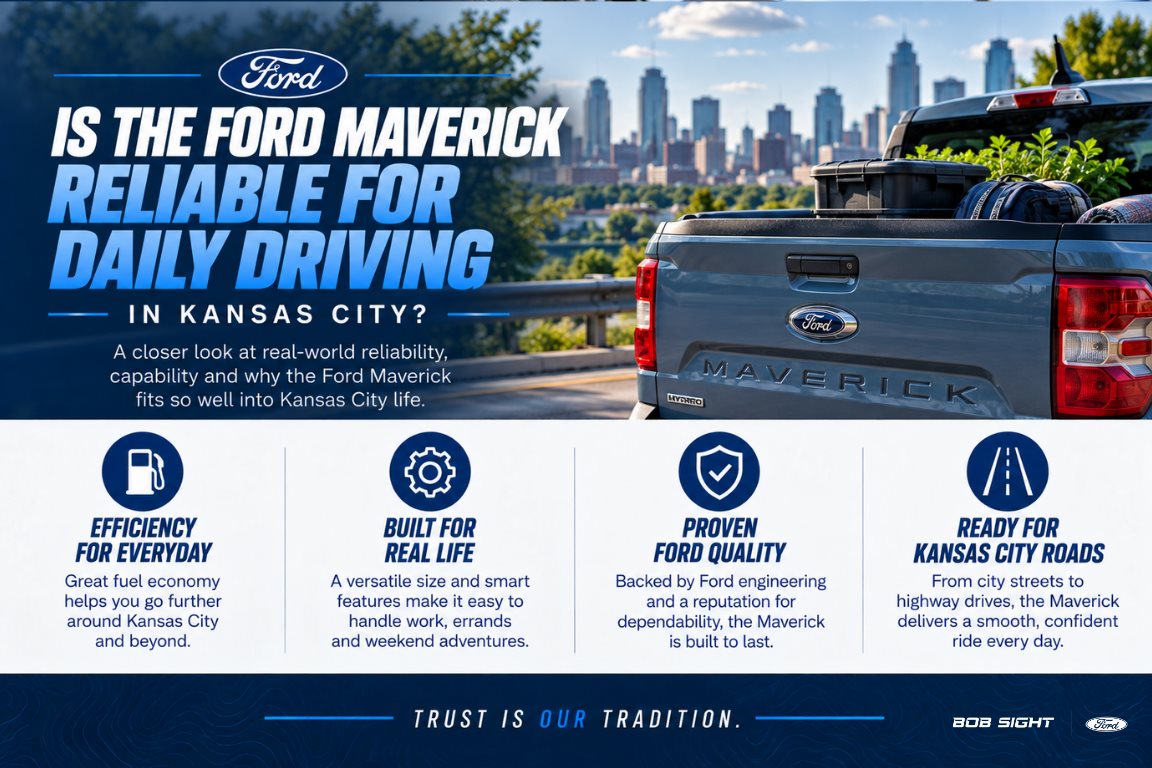
The Ford Maverick is a practical and reliable daily-driving choice for Kansas City Metro drivers who want truck utility without the size and fuel demands of a traditional full-size pickup. Its compact dimensions, available hybrid powertrain, comfortable five-passenger cabin, and versatile FLEXBED® make it well suited for commuting around Lee’s Summit, Blue Springs, Independence, and surrounding Jackson County communities. Drivers can use it for weekday trips along US-50 and I-470 while still having a truck bed available for home projects, outdoor equipment, or weekend errands. Bob Sight Ford helps local shoppers compare Maverick configurations based on how they actually plan to drive.
The answer to whether a Ford Maverick will be reliable depends partly on choosing the appropriate powertrain, following Ford’s maintenance schedule, and matching the truck to the owner’s workload. A Maverick used primarily for commuting has different demands than one that regularly pulls a trailer, travels on unpaved roads, or carries heavy materials. Understanding those differences helps drivers make a more informed decision without confusing daily-driving reliability with maximum towing or off-road capability.
Explore Ford Maverick inventory near Kansas City
In This Guide You'll Learn
This guide explains how the Ford Maverick performs as a daily driver and what Kansas City shoppers should consider before choosing one. Reliability involves more than whether an engine starts every morning. It also includes predictable maintenance, manageable operating demands, comfortable commuting, useful technology, and the ability to handle changing Missouri conditions.
- Why the Ford Maverick works well for daily commuting
- How the hybrid and EcoBoost® powertrains differ
- What local weather and road conditions mean for ownership
- How maintenance habits can support long-term reliability
- Which Maverick configuration may fit different daily routines
- What to inspect during a test drive
- How Bob Sight Ford supports Maverick owners in Lee’s Summit
This article remains focused on reliability for commuting and routine ownership. Towing limits, off-road performance, and comparisons with midsize trucks are discussed only when they affect daily use. That keeps the guidance useful for drivers deciding whether the Maverick fits normal travel between home, work, school, shopping, and weekend activities.
Quick Facts About Ford Maverick Daily-Driving Reliability
The Ford Maverick combines a compact footprint with proven everyday features that make it easy to use as a primary vehicle. The lineup includes a standard 2.5-liter full-hybrid powertrain on XL, XLT, and Lariat® models, while a 2.0-liter EcoBoost® engine is available in select configurations. Actual equipment varies by trim, drivetrain, package, and inventory, so shoppers should verify each truck’s window sticker before making comparisons.
- The Maverick seats up to five occupants.
- The 2.5-liter hybrid uses an automatic continuously variable transmission.
- Front-wheel drive is offered with the hybrid, and all-wheel drive is available in qualifying configurations.
- The available 2.0-liter EcoBoost engine produces 250 horsepower and 280 pound-feet of torque.
- Ford lists an EPA-estimated 42 mpg city rating for qualifying front-wheel-drive hybrid models.
- The standard 13.2-inch center display includes SYNC® 4 technology.
- The FLEXBED® system provides a 54.4-inch-long cargo bed with configurable storage.
- Standard towing capacity is 2,000 pounds, with up to 4,000 pounds available when properly configured with the 4K Tow Package.
These specifications help explain why the Maverick can work for both commuting and occasional truck tasks. A driver traveling from Grain Valley to Lee’s Summit may value hybrid city efficiency, while someone carrying tools across western Missouri may prefer the response of the EcoBoost powertrain. Reliability begins with selecting equipment that fits the actual workload rather than choosing capability that will rarely be used.
Is the Ford Maverick a Reliable Daily Driver?
Yes, the Ford Maverick can be a reliable daily driver when it is properly maintained and operated within its designed limits. Its powertrain choices are designed for different ownership priorities, and its compact truck platform makes routine urban and suburban driving less demanding than maneuvering a larger pickup. No vehicle is maintenance-free, but the Maverick gives owners clear service information, vehicle alerts, and access to Ford-trained support.
Daily-driving reliability means that a vehicle delivers consistent performance during ordinary use. That includes starting in changing temperatures, shifting smoothly, braking predictably, maintaining proper fluid levels, and communicating maintenance needs before small concerns become larger ones. It does not mean that every Maverick will have an identical ownership history because driving style, maintenance timing, road conditions, mileage, and workload influence wear. A truck driven gently between Lee’s Summit neighborhoods will accumulate wear differently from one that spends every week carrying materials to jobsites.
The Maverick’s size can reduce several daily frustrations that discourage some people from owning a pickup. At approximately 200 inches long in most configurations, it is easier to place in a parking space than many full-size trucks. That matters near Summit Fair, downtown Lee’s Summit, and crowded retail areas where parking lanes and turning spaces can feel tight. Drivers receive an open cargo bed without having to manage the dimensions of an F-150 or Super Duty during every commute.
Long-term dependability also depends on responding to changes in the truck’s normal behavior. New warning lights, unusual noises, vibration, reduced fuel economy, fluid spots, or changes in braking should not be ignored. Scheduling an inspection early through the Bob Sight Ford service center in Lee’s Summit can help identify whether the condition involves routine wear, a software update, or a component that needs attention. Reliable ownership is supported by both vehicle design and responsible maintenance decisions.
Hybrid or EcoBoost: Which Powertrain Fits Daily Driving?
The Maverick hybrid is generally the stronger match for efficiency-focused commuting, while the available 2.0-liter EcoBoost suits drivers who prioritize stronger acceleration, additional drivetrain choices, or specialized capability. Neither powertrain is automatically the reliable choice for every driver. The better option is the one that operates comfortably within the owner’s normal commute, cargo, terrain, and towing requirements.
| Daily-Driving Factor | 2.5L Full Hybrid | 2.0L EcoBoost |
|---|---|---|
| Primary Strength | City efficiency and smooth commuting | Responsive turbocharged performance |
| Transmission | Automatic continuously variable transmission | Automatic transmission, configuration dependent |
| Driving Environment | Urban, suburban, and stop-and-go travel | Highway travel, heavier use, and capability-focused driving |
| Drivetrain Availability | Front-wheel drive or available all-wheel drive on qualifying models | Available all-wheel-drive or advanced four-wheel-drive configurations |
| Ownership Priority | Reducing fuel stops during frequent commuting | Balancing compact size with stronger power delivery |
The hybrid system combines a gasoline engine with an electric motor and battery system. During low-speed or stop-and-go operation, the system can use electric assistance and regenerative braking to recover energy that would otherwise be lost as heat. That makes it attractive for trips through traffic near Independence Center or repeated local errands around Lee’s Summit. Hybrid owners should still follow normal maintenance guidance because engine oil, coolant, brakes, tires, and other components remain important.
The EcoBoost engine uses turbocharging to provide strong output from a compact 2.0-liter engine. Turbocharging forces more air into the engine so it can create more power when needed, which can feel useful when merging onto I-470 or passing on open stretches of US-50. Proper oil quality and maintenance timing matter because the engine oil helps protect both the engine and turbocharger. Drivers who tow, carry frequent loads, or operate in demanding conditions should tell their service advisor how the truck is used.
Shoppers should compare both powertrains during similar driving conditions. A short loop with neighborhood streets, highway merging, parking, and low-speed traffic reveals more than sitting in a parked truck. The Bob Sight Ford team can help arrange a Maverick test drive so shoppers can evaluate power delivery, braking feel, visibility, and cabin comfort before choosing.
How the Maverick Handles Kansas City Commuting
The Ford Maverick is well matched to Kansas City commuting because it offers manageable dimensions, useful technology, and truck capability without requiring a full-size footprint. Its unibody construction contributes to a driving experience that feels familiar to many crossover and SUV owners. That can make the transition into a pickup less intimidating for first-time truck buyers.
Drivers navigating the I-470 and US-50 interchange need clear visibility, predictable acceleration, and confident braking. The Maverick’s elevated seating position provides a useful view of surrounding traffic, while available Ford Co-Pilot360® features can add support during lane changes and longer highway trips. Driver-assistance technology does not replace attentive driving, but features such as available adaptive cruise control, lane centering, and a 360-degree camera can reduce some routine workload. Availability varies, making the equipment list important when comparing trims.
Ride quality is another part of practical reliability because a truck that feels tiring or awkward may not remain a good daily fit. The Maverick is designed around a five-passenger cabin with useful door storage, rear under-seat storage, and accessible controls. The standard 13.2-inch center display supports everyday navigation and connectivity functions through SYNC 4. Drivers should test seat comfort, phone integration, rear-seat space, and control placement based on their own routine.
The FLEXBED system adds utility that a sedan or small crossover cannot duplicate. A Lee’s Summit homeowner can carry garden supplies, a bicycle, or home-improvement materials without placing dirty equipment inside the passenger cabin. The multi-position tailgate and configurable bed features can help organize smaller loads when correctly secured. Those benefits support daily use without turning every commute into a heavy-duty truck experience.
Missouri Weather and Road Conditions That Affect Reliability
Kansas City weather does not make the Maverick unreliable, but temperature swings, winter road treatments, summer heat, potholes, and storm debris increase the importance of preventive care. Missouri can move quickly from freezing mornings to warmer afternoons, and those changes influence tire pressure, battery performance, fluids, wipers, and traction. Drivers who prepare for seasonal conditions are more likely to experience predictable performance.
Cold weather reduces tire pressure because the air inside the tire contracts as temperatures fall. Underinflated tires can affect steering response, fuel economy, tire wear, and braking behavior. Checking the pressure against the value on the driver-side door-jamb label is more accurate than relying on the number molded into the tire sidewall. This becomes important after the first hard freeze in Jackson County or before a winter trip beyond the Kansas City Metro.
Road surfaces create a separate concern. Potholes along busy corridors can affect tire sidewalls, wheels, alignment, and suspension components even when the impact does not cause an immediate flat. A Maverick that begins pulling to one side, producing steering-wheel vibration, or wearing tires unevenly should be inspected. Drivers should also rinse road salt and deicing residue from the body and underbody during winter because accumulated residue can contribute to corrosion over time.
Summer conditions place different demands on the cooling system, air conditioning, battery, and tires. Stop-and-go traffic near Raytown or construction slowdowns on regional highways can keep the powertrain operating in high ambient temperatures for extended periods. Maintaining coolant condition, removing debris from airflow paths, and addressing temperature warnings promptly helps protect long-term operation. Seasonal service is a practical reliability strategy rather than an optional cosmetic routine.
Maintenance Habits That Support Long-Term Maverick Reliability
The most effective way to support Ford Maverick reliability is to follow the vehicle-specific maintenance schedule and respond promptly to inspections, warning messages, and changes in performance. Service intervals can vary according to engine, mileage, operating conditions, and the truck’s onboard monitoring systems. The owner’s manual and vehicle information should guide decisions rather than a universal schedule copied from another model.
Engine oil protects moving components by reducing friction, carrying heat, and helping control deposits. The required viscosity and Ford specification can differ by powertrain and model year, so owners should confirm the oil-cap marking and official manual before service. Using the correct Motorcraft® product or an approved equivalent matters more than choosing oil based only on brand recognition. The oil-life monitoring system should be taken seriously, but owners should also check the oil level between services.
Hybrid models still require mechanical maintenance even though regenerative braking may reduce some friction-brake use. Brake fluid can absorb moisture over time, tires continue to wear, and brake hardware may need inspection due to age, corrosion, or driving conditions. EcoBoost models need consistent oil care because clean, specification-correct oil supports engine and turbocharger protection. Every Maverick benefits from tire rotations, fluid inspections, battery checks, and software or recall verification when applicable.
- Review the maintenance information for the exact Maverick model year, engine, and drivetrain.
- Monitor oil life, fluid levels, tire pressure, warning messages, and changes in normal performance.
- Schedule service based on Ford guidance and sooner when severe use or an active concern calls for inspection.
- Tell the advisor about towing, frequent short trips, dusty roads, heavy cargo, or extended idling.
- Keep service records so future maintenance decisions are based on accurate history.
Drivers can review current Ford service and parts specials when planning routine care. Special offers change, so the service advisor should confirm eligibility and recommended work for the individual truck. Maintenance should be chosen because the vehicle needs it, not simply because an offer is available.
How to Choose the Right Maverick for Your Routine
The right Maverick configuration is the one that meets normal daily needs without forcing the owner to compromise on efficiency, traction, comfort, or capability. A careful needs assessment is more useful than selecting the most equipment or the highest possible capability. Reliability improves when the truck is not routinely asked to operate beyond its intended configuration.
Start with the weekly routine. A driver commuting from Blue Springs to an office in Lee’s Summit may prioritize hybrid efficiency and driver-assistance features. A contractor carrying tools between local properties may place more value on all-wheel drive, a spray-in bedliner, cargo organization, and the EcoBoost engine. A family using the Maverick as its primary vehicle should examine rear-seat access, child-seat placement, interior storage, and bed security.
Next, separate occasional wants from recurring needs. Pulling a small trailer once or twice a year does not create the same requirement as towing equipment every week. Standard Maverick towing capacity is 2,000 pounds, while properly configured trucks with the available 4K Tow Package can reach a maximum of 4,000 pounds. Trailer weight, cargo, passengers, accessories, and individual vehicle ratings all matter, so the door label, equipment configuration, and official towing guidance must be checked before towing.
- List the roads, distances, passengers, and cargo involved in a normal week.
- Decide whether fuel efficiency, stronger acceleration, or added traction is the top priority.
- Identify must-have features such as a 360-degree camera, heated seats, all-wheel drive, or trailer equipment.
- Compare actual in-stock window stickers rather than assuming every trim has identical equipment.
- Test drive the truck on both lower-speed streets and a highway route.
- Confirm maintenance, warranty, and service-support expectations before completing the decision.
Shoppers can also review current Ford Employee Pricing details in Kansas City when applicable. Program availability, vehicle eligibility, and terms can change, so details should be verified directly. The central decision should still be whether the Maverick configuration supports the owner’s daily routine.
Ownership Planning
Good ownership planning helps a Ford Maverick remain dependable by coordinating maintenance, seasonal preparation, tire care, and changing transportation needs. A simple record of service dates, mileage, tire rotations, repairs, and inspections creates a useful history. That record can also help a technician identify patterns when a concern develops.
Owners should budget time for maintenance before it becomes urgent. Waiting until a long road trip to address a warning light, worn tire, weak battery, or overdue service can create unnecessary stress. Scheduling care ahead of holiday travel or winter weather gives the service team time to inspect the truck and discuss findings. This is valuable for drivers traveling between Lee’s Summit and communities across western Missouri where roadside options may be limited.
Tire planning should consider tread depth, pressure, rotation history, alignment, and the type of roads traveled. Brands such as Michelin, Goodyear, and Continental offer different tire designs, but the correct size, load rating, speed rating, and application matter more than the name alone. A Ford-Certified Technician can help owners evaluate whether the current tires suit commuting, year-round traction, or more specialized use. Installing a tire that does not match the truck’s requirements can compromise the driving experience.
Convenience can also help owners remain consistent. Bob Sight Ford offers information about Ford Pickup and Delivery in Lee’s Summit, which may allow qualifying service needs to be handled with less disruption to the workday. Availability and service eligibility should be confirmed when scheduling. Removing logistical barriers makes it easier to address routine maintenance instead of postponing it.
Frequently Asked Questions
These answers address common questions Kansas City shoppers ask when evaluating Ford Maverick reliability for commuting and everyday ownership. Individual results depend on model year, configuration, maintenance history, driving environment, and use. Shoppers should verify vehicle-specific information before relying on a general recommendation.
Is the Ford Maverick hybrid reliable for daily commuting?
The Ford Maverick hybrid can be a reliable commuter when maintained according to Ford guidance and used within its intended operating limits. Its combination of a gasoline engine, electric motor, high-voltage battery, and automatic continuously variable transmission is designed to manage everyday driving efficiently. The hybrid system can be particularly useful during repeated stops and lower-speed travel. Drivers should not assume that fuel-saving operation eliminates the need for routine care.
Hybrid maintenance still includes engine oil, filters, fluids, tires, steering, suspension, and brake inspections. Regenerative braking can reduce reliance on friction brakes during some driving, but brake hardware and fluid still require attention. The cooling systems that support powertrain components must also remain in proper condition. Warning messages should be evaluated promptly rather than cleared or ignored.
A commuter traveling from Independence to Lee’s Summit may experience a mix of local streets, congestion, and highway speeds. That route can suit the hybrid’s ability to blend gasoline and electric operation, though actual fuel economy varies with temperature, traffic, speed, accessories, and driving behavior. Cold Missouri mornings may temporarily influence efficiency. Consistent maintenance remains the stronger measure of reliability than one isolated mileage result.
How long can a Ford Maverick last?
There is no responsible way to promise an exact Maverick lifespan because longevity depends on maintenance, mileage, climate, load, driving habits, and repair history. A well-maintained truck that receives prompt care has a better opportunity to provide extended service than one operated with neglected fluids, warning lights, or worn components. Calendar age and mileage are only part of the condition assessment. Usage history provides essential context.
Frequent short trips may prevent the engine from spending much time at full operating temperature, while towing and heavy loads can add heat and mechanical demand. Highway mileage can create different wear than repeated stop-and-go travel. Tire care, alignment, corrosion prevention, and fluid condition also influence how the truck feels as it ages. Owners should evaluate the entire vehicle rather than focusing only on the odometer.
For Kansas City Metro ownership, seasonal inspections can identify concerns linked to winter road treatments, spring potholes, summer heat, and severe storms. A documented service history makes it easier to plan future maintenance and can provide useful information if the truck is later traded or sold. Bob Sight Ford can inspect current condition and explain recommended service without relying on an arbitrary mileage promise. That approach gives owners more useful guidance than a universal lifespan estimate.
Is the Ford Maverick comfortable enough for a long commute?
The Maverick can be comfortable for long commutes, but shoppers should test the exact trim because seat materials, adjustment features, cabin equipment, and driver-assistance technology vary. Its compact exterior does not prevent it from providing seating for up to five. The upright driving position and accessible controls can work well for drivers moving from a crossover or small SUV. Personal comfort remains subjective.
A useful test drive should last long enough to evaluate seat support, steering effort, road noise, visibility, climate controls, and technology. The 13.2-inch center display and SYNC 4 system support common connected functions, while available Ford Co-Pilot360 technologies can assist during certain driving situations. Features such as adaptive cruise control and lane centering may be valuable for highway commuters when equipped. Drivers must remain attentive and in control at all times.
Someone traveling between Belton and Lee’s Summit should test the Maverick at realistic highway speeds rather than limiting the drive to a parking lot. The shopper should also park, reverse, enter traffic, and sit in the rear seat if passengers will use it regularly. Bringing a child seat, work bag, or other daily item can reveal whether storage and access fit the routine. Real-world testing is more informative than relying on dimensions alone.
Does all-wheel drive make the Maverick more reliable in Missouri winters?
All-wheel drive can improve traction during acceleration on slippery surfaces, but it does not replace proper tires, cautious driving, or adequate stopping distance. Reliability and winter traction are related but different ideas. An all-wheel-drive system helps distribute power, while tires provide the actual contact with the road. Every drivetrain still depends on maintenance and appropriate operation.
Winter preparation should include checking tire pressure, tread depth, battery condition, wiper performance, washer fluid, exterior lighting, and coolant protection. Drivers should clear snow and ice from the vehicle before travel and avoid sudden steering, braking, or acceleration. Even advanced traction systems cannot overcome the physical limits of an icy road. The safest configuration is one supported by good tires and sound judgment.
Drivers facing hills around Raytown or untreated neighborhood streets may value available all-wheel drive more than someone who can postpone travel during storms. Front-wheel-drive hybrid models can still perform well when equipped with suitable tires and driven responsibly. The choice should reflect commute timing, road treatment, terrain, and the owner’s ability to adjust plans. A test drive and equipment review can help determine whether the added traction capability fits the household.
Should I buy a new or used Ford Maverick for daily driving?
Both new and used Mavericks can serve as dependable daily drivers, but the better choice depends on warranty preferences, equipment needs, service history, condition, and availability. A new truck allows the shopper to choose current features and begin the maintenance record from delivery. A used Maverick may offer a configuration that is no longer easy to find new. Condition matters more than category alone.
Used-truck evaluation should include service records, tire wear, warning lights, fluid condition, body repairs, corrosion, bed use, towing equipment, and a professional inspection. Shoppers should verify that recalls and applicable service campaigns have been addressed. Hybrid and EcoBoost models require powertrain-specific evaluation rather than a generic used-car checklist. A vehicle history report is useful but does not replace a physical inspection.
A Lee’s Summit shopper comparing new and used options should drive both trucks on similar routes and inspect their equipment lists carefully. Changes between model years may affect powertrain availability, technology, packages, and driver-assistance features. Bob Sight Ford provides access to both new Ford inventory and pre-owned choices for side-by-side research. The strongest daily driver is the truck whose condition, configuration, and ownership plan align.
Visit Bob Sight Ford Today
Bob Sight Ford in Lee’s Summit helps Kansas City Metro drivers decide whether the Ford Maverick fits their commuting, cargo, and long-term ownership needs. Local guidance matters because traffic patterns, seasonal weather, highway travel, and neighborhood parking all influence how a truck works in daily life. A vehicle that looks appropriate on a specification sheet should also feel comfortable and manageable on familiar Missouri roads.
Shoppers visiting from Blue Springs, Independence, Grain Valley, Raytown, Belton, and other Jackson County communities can compare actual Maverick equipment rather than relying on broad trim assumptions. Reviewing window stickers and testing relevant features can clarify the differences between hybrid, EcoBoost, front-wheel-drive, all-wheel-drive, and specialized configurations. The goal is to select a truck that performs its normal duties comfortably. That creates a stronger foundation for satisfied, reliable ownership.
Current owners can also rely on Bob Sight Ford for maintenance support, Motorcraft parts, service scheduling, and vehicle-specific guidance. Ford-Certified Technicians can review the truck’s maintenance information and evaluate concerns based on its engine, drivetrain, mileage, and use. Drivers searching for Ford service near me can plan care locally instead of postponing an inspection. Trust Is Our Tradition.
Helpful Links
Proud to be part of the Bob Sight Auto Group
Bob Sight Ford is proud to be part of the Bob Sight Auto Group, serving drivers throughout Lee’s Summit, Lawrence, Independence, and the Kansas City Metro. Our family of dealerships and automotive services helps local drivers shop, maintain, and care for their vehicles across the region. Each location remains connected by a commitment to useful guidance, long-term relationships, and trusted automotive support.