Lifted Ford Trucks for Sale Near Kansas City: Factory Packages, Aftermarket Builds, and What to Check
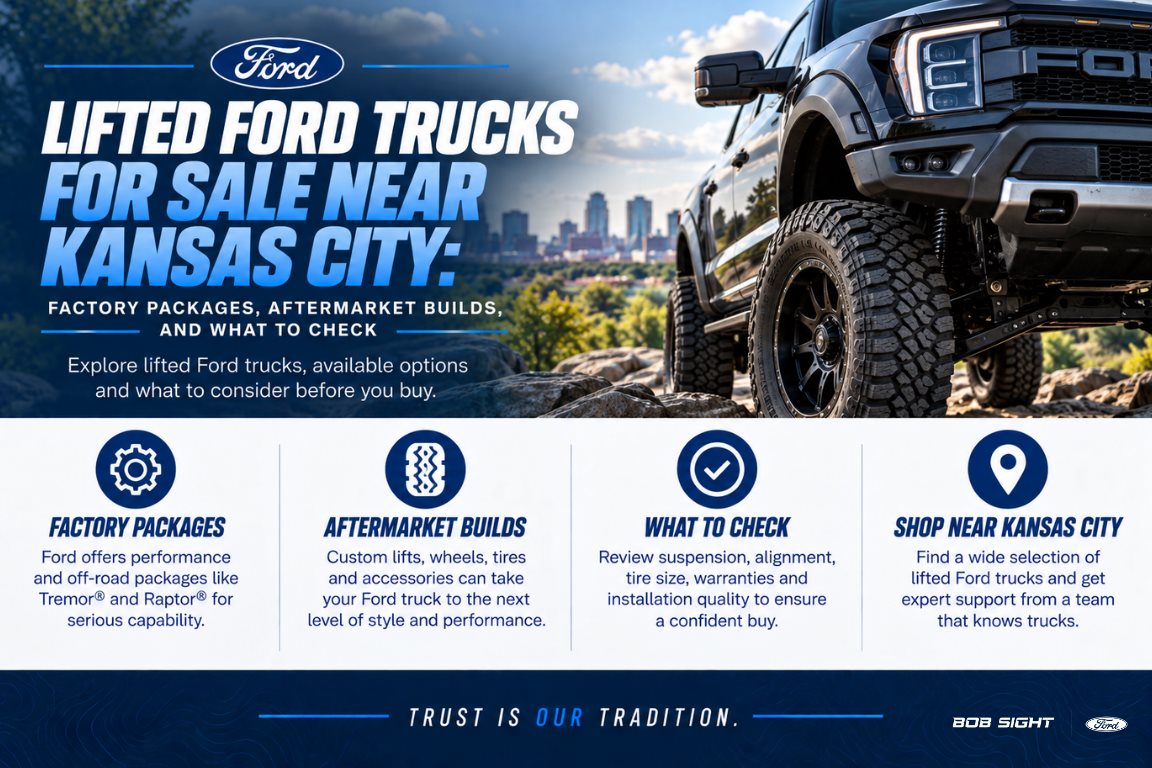
Lifted Ford trucks for sale near Kansas City can deliver increased ground clearance, a more commanding appearance, and added room for larger tires, but shoppers should evaluate the complete build rather than focusing only on lift height. Bob Sight Ford in Lee’s Summit helps drivers compare factory-equipped Ford trucks, professionally upfitted models, and pre-owned trucks with aftermarket modifications. Suspension geometry, tire fitment, alignment, steering behavior, component quality, service history, and warranty coverage can all influence whether a lifted truck is a good match for daily driving, work, or recreation across western Missouri.
A well-planned lift should function as a complete vehicle system. Springs, shocks, control arms, steering components, wheels, tires, electronic calibrations, and alignment settings may all interact after the truck’s ride height changes. A truck that looks impressive in a parking lot may behave very differently during highway travel, braking, cornering, or trips over uneven Jackson County roads. Careful inspection and a thorough test drive help shoppers separate a thoughtfully built truck from one modified mainly for appearance.
Browse Ford trucks for sale near Kansas City
In This Guide You'll Learn
This guide explains how to evaluate lifted Ford trucks for sale without turning the discussion into a step-by-step modification manual. The focus is on choosing an existing truck, reviewing its equipment, checking workmanship, and understanding how the lift may affect ownership. Kansas City shoppers can use these points when comparing a new upfitted truck with a modified pre-owned Ford.
- The difference between factory packages and aftermarket lift systems
- How suspension lifts and leveling kits change a truck
- What to inspect around the suspension, steering, wheels, and tires
- Why alignment and electronic calibration matter
- How a lift can affect daily driving and long-term maintenance
- What warranty questions to ask before buying
- How to test drive a lifted Ford truck in Lee’s Summit
This article covers F-150, Ranger, and Super Duty shopping considerations at a broad level. It does not provide installation instructions or a detailed comparison of specific specialty upfit brands. Those subjects require their own focused guidance because equipment, engineering, and warranty structures can differ significantly among individual builds.
Quick Facts About Lifted Ford Trucks
A lifted Ford truck should be evaluated according to its complete configuration, not just the advertised size of the lift or tires. The quality of the parts, the method of installation, the condition of related components, and the truck’s intended use all matter. A modification that works well for one F-150 or Super Duty configuration may not be appropriate for another.
- A suspension lift raises the truck by changing or relocating suspension components.
- A leveling kit generally raises the front of the truck to reduce the factory rake.
- Larger tires can change effective gearing, acceleration, braking feel, and speedometer accuracy.
- Wheel offset affects tire position and can influence clearance, scrub radius, and bearing loads.
- Alignment should be verified after suspension height or steering geometry changes.
- Added ride height raises the truck’s center of gravity.
- Modifications may affect warranty coverage when a failure is connected to an altered component.
- Payload and towing ratings should not be assumed to increase after a lift.
- Documentation is valuable when evaluating an aftermarket build.
Not every lifted truck has been used aggressively, and not every stock-height truck has had an easy life. Condition, maintenance, workmanship, and use history matter more than appearance alone. A detailed evaluation gives shoppers better information than making assumptions based on tire size or exterior accessories.
Drivers should also remember that Ford truck configurations vary before any modification occurs. Cab style, bed length, engine, drivetrain, axle ratio, trim, suspension package, and factory equipment shape the starting point. The individual truck’s certification labels, owner information, and installed components should guide the evaluation.
Factory Packages Versus Aftermarket Lifted Ford Trucks
Factory packages integrate capability features during vehicle engineering and production, while aftermarket lifted trucks receive modifications after the base truck is built. Both paths can serve Kansas City drivers, but they involve different equipment, documentation, and warranty considerations. Shoppers should not describe every taller Ford truck as having a factory lift.
Ford offers factory configurations designed for specialized terrain and performance, including packages and models that may include revised suspension tuning, added ground clearance, skid plates, all-terrain tires, locking differentials, selectable drive modes, or other capability equipment. An F-150 Tremor®, Ranger Raptor®, or Super Duty Tremor is engineered as a coordinated factory package. Equipment varies by model and model year, so the window sticker should be reviewed rather than relying on a general trim description.
An aftermarket lift is installed after production and can range from a modest leveling system to a comprehensive suspension package. Quality aftermarket builds may use components designed for the specific Ford model, drivetrain, cab, and intended tire size. Installation documentation, alignment records, part identification, and upfitter information can help a shopper understand what was changed. Missing documentation does not automatically prove poor workmanship, but it increases the importance of a professional inspection.
Factory packages may be a stronger fit for shoppers who want additional capability without managing a separately modified suspension. Aftermarket trucks can provide a more distinctive stance or specialized setup that factory configurations do not offer. The better choice depends on use, ride preferences, service expectations, and the quality of the individual build. Neither category should be judged by appearance alone.
| Comparison Point | Factory Capability Package | Aftermarket Lifted Truck |
|---|---|---|
| Engineering | Integrated during vehicle development | Depends on lift manufacturer and installer |
| Documentation | Shown through factory build information | May require receipts, part numbers, and installer records |
| Ride and Handling | Calibrated as a factory configuration | Varies with parts, tires, geometry, and installation |
| Warranty Questions | Covered according to applicable Ford terms | May involve Ford, part-maker, and installer coverage |
| Customization | Limited to available factory combinations | Broader range of heights, wheels, tires, and components |
Suspension Lifts, Leveling Kits, and Body Lifts
Suspension lifts, leveling kits, and body lifts change a truck in different ways, so shoppers should identify which system is installed before evaluating the build. The name of the modification provides clues about what was changed, but the actual components must still be inspected. A seller’s description may not include enough detail to understand the system.
A suspension lift raises the truck through changes involving springs, struts, shocks, control arms, spacers, brackets, knuckles, or related hardware. More complete systems may address geometry through revised control arms, differential relocation components, crossmembers, track bars, or other model-specific parts. The precise equipment varies between independent front suspension trucks and solid-axle applications. Shoppers should avoid assuming that every kit with the same lift height includes the same engineering.
A leveling kit usually raises the front of a truck to reduce the nose-down stance that manufacturers build into many pickups. Factory rake can help a truck sit more level when cargo or tongue weight compresses the rear suspension. Changing that stance may affect how the truck looks and how much visual rake remains when loaded. A leveling kit does not increase payload, axle, or trailer ratings.
A body lift creates space between the body and frame while leaving much of the suspension height unchanged. This approach can create room for different tire fitment without delivering the same under-chassis clearance changes as a suspension lift. Body mounts, bumpers, brackets, steering connections, and other affected components should be reviewed. Shoppers need to know whether the truck has a body lift, suspension lift, leveling system, or a combination.
Drivers using lifted trucks around Lee’s Summit may spend most of their time on pavement rather than trails. For that reason, steering precision, braking stability, tire wear, and highway behavior often matter more than maximum articulation. A build should match the owner’s real driving environment, including I-470 merges, US-50 travel, parking near Summit Fair, and uneven neighborhood streets.
What to Inspect on a Lifted Ford Truck
A lifted Ford truck inspection should examine the suspension, steering, driveline, brakes, tires, wheels, frame, and signs of component interference or uneven wear. The goal is to understand whether the system was installed correctly and whether the truck has developed related problems. A clean exterior cannot answer those questions.
Begin with visible hardware. Look for loose or missing fasteners, damaged bushings, leaking shocks, bent brackets, contact marks, cracked components, and signs that parts have shifted. Fresh paint or undercoating can make inspection more difficult if it covers corrosion or recent repair areas. Components should appear correctly positioned and appropriate for the specific model.
Steering and suspension joints deserve close attention because altered geometry can affect their operating angles. Tie-rod ends, ball joints, control-arm bushings, track bars, sway-bar links, wheel bearings, and CV axles may experience different loads after a lift. Torn boots can allow contamination into protected joints. Uneven wear or looseness should be evaluated by a qualified technician.
Driveline angles also matter. A lift can alter driveshaft, universal-joint, CV-joint, and pinion relationships, depending on the truck and suspension design. Vibration during acceleration or at highway speed can point to several possible causes, including tires, wheels, driveline geometry, or worn components. Diagnosis should be based on inspection and testing rather than one assumed cause.
- Identify the lift manufacturer and installed components.
- Review receipts, alignment reports, and installer documentation.
- Inspect suspension and steering hardware for damage or looseness.
- Check tires for rubbing, uneven wear, age, and correct load ratings.
- Look for leaks, contact marks, driveline concerns, and altered wiring.
- Verify the truck’s warning lights and driver-assistance functions.
- Complete a professional inspection before making a final decision.
Shoppers comparing pre-owned Ford trucks near Kansas City should ask whether the lift was installed before or during the previous owner’s possession. They should also ask how the truck was used after modification. Documentation and inspection findings are more useful than a broad claim that the truck was never driven off pavement.
Wheels, Tires, Alignment, and Electronic Calibration
Wheel and tire fitment is one of the most important parts of a lifted-truck evaluation because it affects clearance, steering, braking, ride quality, and long-term wear. Larger tires may be part of the desired look, but their diameter, width, construction, load rating, and position must suit the truck. A lift does not make every wheel and tire combination appropriate.
Wheel offset describes how the mounting surface sits relative to the wheel’s centerline. Changing offset can move the tire inward or outward, affecting fender clearance, suspension clearance, scrub radius, and leverage on wheel bearings. Excessive outward placement may create a wide stance while increasing stress or allowing the tire to contact bodywork during steering and suspension movement. Clearance should be checked with the steering turned and suspension loaded.
Tire load ratings must support the truck’s requirements. Brands such as Michelin, Goodyear, Continental, and other manufacturers offer highway, all-terrain, and mud-terrain options with different characteristics. Aggressive tread can improve performance in certain loose-surface conditions but may produce more road noise, heavier steering feel, or different wet-road behavior. Tire choice should reflect actual Kansas City driving rather than appearance alone.
Alignment settings influence steering response and tire wear. Camber describes the inward or outward tilt of the tire when viewed from the front, caster relates to steering-axis angle and return-to-center behavior, and toe describes whether the tires point slightly inward or outward. A lifted truck may require model-specific components or adjustment ranges to achieve acceptable alignment. An alignment printout can provide useful evidence, but current tire wear still needs inspection.
Larger tire diameter can also affect speedometer readings, transmission behavior, shift scheduling, anti-lock braking, stability-control responses, and other calculations. Proper calibration may be necessary depending on the vehicle and equipment. Warning lights, unusual shifting, or inaccurate speed readings should not be dismissed as normal characteristics of a lifted truck. A Ford-focused inspection can help identify whether the vehicle’s systems are operating as intended.
How a Lift Changes Daily Driving in Kansas City
A lifted Ford truck may provide better ground clearance and visibility, but it can also change entry height, cornering behavior, braking feel, parking access, wind response, and fuel use. Shoppers should evaluate these tradeoffs during a realistic test drive. The truck must work well on ordinary roads even if recreation is part of the ownership plan.
Raising the suspension and fitting larger tires generally raises the center of gravity. That can increase body movement during turns or quick lane changes compared with the same truck at stock height. Drivers should allow additional space, use smooth steering inputs, and understand that electronic stability systems cannot override every physical limit. A thoughtful suspension system can deliver controlled behavior, but the laws of weight transfer still apply.
Parking and clearance create practical considerations. A lifted F-150 or Super Duty may not fit comfortably in every residential garage, downtown structure, car wash, or low-clearance facility. Roof accessories can add more height, and wider wheel fitment can complicate narrow spaces. Shoppers should measure the places they use rather than assuming the truck will fit because another pickup does.
Entry and loading height also increase. Running boards or power-deployable steps can improve access, but families should confirm that children and passengers can enter comfortably. A higher bed floor may make it more difficult to load coolers, tools, landscaping supplies, or recreation equipment. The same height that helps on rough terrain can create more effort during routine errands.
Highway testing is important for drivers commuting from Blue Springs, Independence, Grain Valley, or Belton. The truck should track predictably, return to center, brake straight, and remain free of unusual vibration. Wind, grooved pavement, and rough expansion joints can reveal behavior that is not noticeable during a slow trip around a parking lot. A thorough test drive should reflect the roads the owner will use most.
Warranty and Service Questions to Ask
Lifted-truck shoppers should ask which components are covered by Ford, the lift manufacturer, the upfitter, or the installer before buying. Warranty coverage is not a simple all-or-nothing issue. The answer can depend on the vehicle, modification, failed component, cause of the failure, and applicable written terms.
A modification does not automatically explain every future concern, but damage caused by or connected to an altered component may be handled differently from an unrelated covered condition. Shoppers should avoid relying on verbal promises that every modification is fully protected. Written warranty documents, installation records, and the identities of the responsible companies are more useful. Ask where the truck should be taken if a lift component needs inspection or replacement.
New upfitted trucks may include separate warranty coverage for the base vehicle and added components. A pre-owned lifted truck may have remaining Ford coverage, a transferable component warranty, no remaining upfit coverage, or a combination of those situations. Transfer rules should be checked directly. The buyer should also determine whether prior maintenance and modification records are available.
Service access matters after purchase. Some routine Ford maintenance can proceed normally, while lift-related work may require specific parts, procedures, or an upfitter. Owners should know whether replacement shocks, bushings, brackets, or other components can be identified and sourced later. A build using unknown or discontinued parts can make long-term maintenance more complicated.
- Ask who manufactured the lift system.
- Request the exact part numbers and installation documentation.
- Identify which company installed or upfitted the truck.
- Review the written warranty for the lift and related components.
- Confirm whether applicable coverage transfers to a new owner.
- Ask where lift-related warranty service must be completed.
- Review how modifications may affect Ford warranty claims.
Drivers can schedule a Ford truck inspection in Lee’s Summit when evaluating maintenance or condition concerns. Ford-Certified Technicians can review the base vehicle and explain findings related to Ford systems. Specialized aftermarket components may also require consultation with their manufacturer or installer.
How to Test Drive a Lifted Ford Truck
A lifted Ford truck test drive should include low-speed turns, braking, uneven pavement, highway travel, parking, and careful attention to noise or vibration. A short loop on smooth streets may not reveal problems related to alignment, tires, steering geometry, or driveline angles. Shoppers should test the truck in conditions similar to their normal routine.
Start by checking entry, visibility, seat position, mirror coverage, and control access. Confirm that running boards or steps feel secure and that passengers can enter safely. Turn the steering wheel at low speed and listen for rubbing, popping, binding, or contact. Inspect the tires again after the maneuver for fresh marks around liners, suspension components, or bodywork.
During moderate acceleration, notice whether the truck tracks straight and shifts consistently. Vibration that appears within a narrow speed range can relate to wheel balance, tire construction, driveline geometry, or other mechanical conditions. The steering wheel should not shake excessively, and the truck should not require constant correction on a reasonably level road. Aggressive tire tread may create noise, but unusual vibration still deserves evaluation.
Brake from several appropriate speeds while maintaining a safe following distance. The truck should stop predictably without pulling, severe steering movement, or unexpected pedal behavior. Larger and heavier wheel-and-tire combinations can affect braking feel and unsprung weight. A lift does not increase the truck’s original brake ratings.
A route involving the I-470 and US-50 area can help reveal highway behavior, while lower-speed Lee’s Summit streets allow parking and turning evaluation. The driver should also test reverse visibility and available camera systems. If the truck feels difficult to control during a normal test drive, do not assume the behavior is unavoidable simply because it is lifted.
Shoppers ready to compare configurations can use the Bob Sight Ford test-drive and finance resources. Comparing a lifted truck with a stock-height or factory capability model can clarify which characteristics come from the base truck and which result from the modifications.
Ownership Planning
Owning a lifted Ford truck requires a maintenance plan that accounts for tires, alignment, steering, suspension, driveline angles, fastener checks, and the truck’s real operating conditions. Maintenance needs vary by lift system, tire choice, model, and use. Owners should follow Ford guidance for the base truck along with applicable instructions from the lift and component manufacturers.
Tire rotations and pressure checks are important because larger tires represent a major part of the vehicle’s handling and wear pattern. The correct cold pressure should reflect the truck, tire, load, and applicable guidance rather than being chosen only from the tire sidewall maximum. Uneven wear may indicate alignment, pressure, balance, suspension, or driving concerns. Addressing the pattern early can protect tire life and help identify developing issues.
Suspension and steering hardware should be inspected at appropriate intervals. Some aftermarket systems include instructions for checking torque after an initial break-in period and during later maintenance. Owners should retain those instructions and receipts. Guessing at torque values or service procedures is not appropriate for safety-related components.
Payload and towing planning should remain based on the vehicle’s labels and Ford documentation. A lift, stronger-looking suspension, or larger tire does not automatically raise Gross Vehicle Weight Rating, Gross Axle Weight Ratings, payload capacity, or trailer limits. Added equipment also contributes weight and may reduce the remaining capacity for passengers and cargo. Detailed towing evaluation should be handled separately for the exact truck and trailer combination.
Owners should also plan for Missouri seasons. Winter road treatments can accumulate around suspension hardware, while spring potholes can affect alignment and wheels. Mud and debris should be removed after off-pavement use so components can be inspected. Routine cleaning supports condition monitoring rather than serving only a cosmetic purpose.
Bob Sight Ford offers information about Ford Pickup and Delivery in Lee’s Summit for qualifying service needs. Availability and eligibility should be confirmed when scheduling. Convenient service options can help owners remain consistent with base-vehicle maintenance during busy work and travel schedules.
Frequently Asked Questions
These answers address common questions Kansas City shoppers ask when evaluating lifted Ford trucks for sale. Every build is different, so documentation, inspection findings, and an individual test drive should guide the decision. Broad assumptions about all lifted trucks are rarely useful.
Are lifted Ford trucks good for daily driving?
A properly engineered and maintained lifted Ford truck can work for daily driving, but comfort and road behavior depend on the complete setup. Lift height, shock tuning, spring rates, wheel offset, tire construction, alignment, and calibration can all change the experience. A modest build with highway-friendly tires may feel very different from a tall truck on aggressive mud-terrain tires. Shoppers should drive the exact truck rather than relying on general expectations.
Daily use includes more than ride comfort. Entry height, garage clearance, parking space, fuel use, road noise, wet-weather traction, and cargo loading height all matter. Families should test passenger access, while commuters should evaluate highway stability and turning space. A lifted truck that fits weekend recreation but creates daily frustration may not be the right configuration.
Kansas City drivers should include familiar conditions in the test drive. Highway travel near Lee’s Summit can reveal vibration or wandering, while crowded areas near Independence Center can expose parking and turning challenges. Uneven Jackson County pavement can show how the suspension responds to sharp impacts. The right lifted truck should remain predictable during ordinary use.
Does lifting a Ford truck void the warranty?
Lifting a Ford truck does not automatically eliminate every warranty protection, but a modification can affect coverage when it causes or contributes to a failure. Coverage depends on the applicable Ford warranty, the altered component, the cause of the concern, and the written terms. Aftermarket parts may also have separate manufacturer or installer coverage. Verbal assurances should be supported by documentation.
New upfitted trucks may involve multiple responsible parties. Ford may cover qualifying base-vehicle concerns, while an upfitter or component maker may handle lift-related parts. Pre-owned vehicles can have different remaining coverage and transfer conditions. Buyers should know whom to contact before a concern develops.
Ask Bob Sight Ford to explain the available documentation for a truck under consideration. If an aftermarket warranty applies, request its complete written terms and contact information. Keep all records after purchase. Clear documentation reduces uncertainty when service is needed later.
Do larger tires affect a lifted truck’s performance?
Larger tires can affect acceleration, braking feel, effective gearing, steering effort, speedometer accuracy, ride quality, and fuel use. The degree of change depends on tire diameter, width, weight, tread, construction, wheel fitment, and vehicle calibration. A larger tire is not merely a visual accessory. It becomes part of the truck’s operating system.
Heavier tires increase rotating and unsprung mass, which can influence how the truck accelerates and responds to road impacts. Aggressive tread may improve traction in mud or loose terrain while creating more noise or different wet-pavement behavior. Improper offset or oversized fitment can cause rubbing during steering and suspension movement. Correct load ratings and clearances are essential.
For Missouri driving, tire selection should account for rain, winter temperatures, highway miles, jobsite surfaces, and recreation plans. A tire chosen mainly for deep mud may not provide the quiet highway experience a Lee’s Summit commuter expects. Compare realistic use rather than choosing the most aggressive appearance. A professional inspection can help identify fitment or wear concerns.
Should I buy a factory off-road package or an aftermarket lifted Ford truck?
A factory off-road package may fit shoppers who prefer integrated engineering and straightforward documentation, while an aftermarket lifted truck may suit buyers seeking a more customized stance or component setup. Neither choice is automatically better for every owner. The quality and appropriateness of the individual configuration matter most.
Factory packages can include coordinated suspension, drivetrain, tire, protection, and electronic features developed for the vehicle. Aftermarket builds offer a wider range of lift heights, wheel designs, tire sizes, and component combinations. That flexibility requires closer attention to installer quality, geometry, calibration, and separate warranty terms. Documentation is a major part of the comparison.
A Kansas City shopper who mostly commutes and visits maintained recreation areas may prefer the balance of a factory package. Someone with a specific appearance or terrain goal may prefer a professionally upfitted truck. Test both paths under similar conditions before deciding. Daily usability should carry as much weight as visual impact.
What should I check before buying a used lifted Ford truck?
Before buying a used lifted Ford truck, verify the installed parts, inspect the workmanship, review service records, examine tire wear, and complete a professional mechanical evaluation. Look beyond the lift itself for signs of hard use, neglected maintenance, collision repair, or corrosion. A vehicle history report can add context but cannot replace a physical inspection. The truck’s present condition is the deciding factor.
Ask for lift-system part numbers, installer information, alignment records, calibration documentation, and applicable warranty details. Inspect suspension joints, steering components, shocks, bushings, wheels, tires, brakes, driveline parts, frame areas, wiring, and body clearances. Listen for vibration, rubbing, binding, or unusual noise during the test drive. Confirm that warning lights and driver-assistance systems operate normally.
Drivers shopping near Blue Springs, Raytown, Grain Valley, and Lee’s Summit should test the truck on both local streets and highway routes. Missouri potholes, winter road treatments, and changing weather can expose weaknesses in tires, alignment, and hardware. A careful inspection provides more value than assumptions about the previous owner’s use. Do not skip evaluation because the truck appears clean.
Find Lifted Ford Trucks Near Kansas City at Bob Sight Ford
Bob Sight Ford helps Kansas City Metro shoppers compare lifted, upfitted, factory-equipped, and stock-height Ford trucks based on real ownership needs. Drivers can review F-150, Ranger, and Super Duty configurations while considering suspension quality, tire fitment, daily comfort, service history, and documentation. The goal is to choose a truck that works as well on the road as it looks while parked.
Shoppers visiting from Blue Springs, Independence, Raytown, Grain Valley, Belton, and other western Missouri communities can compare available trucks in Lee’s Summit. Bring measurements for garage clearance, information about passengers and cargo, and a clear description of the truck’s intended use. Those details help narrow the search without defaulting to the tallest or most aggressive build.
Current programs may also affect eligible new Ford shoppers. Review Ford Employee Pricing details in Kansas City when applicable, then confirm program terms and vehicle eligibility directly. The truck’s configuration, condition, and long-term fit should remain central to the decision.
Bob Sight Ford supports Ford owners with vehicle-specific service, Motorcraft parts, maintenance scheduling, and qualifying convenience options. A lifted truck benefits from attentive tire, alignment, steering, suspension, and driveline care throughout ownership. Trust Is Our Tradition.
Helpful Links
Use these Bob Sight Ford resources to compare Ford trucks, review pre-owned options, and prepare for ownership.
Proud to be part of the Bob Sight Auto Group
Bob Sight Ford is proud to be part of the Bob Sight Auto Group, helping drivers throughout Lee’s Summit, Lawrence, Independence, and the Kansas City Metro. Our family of automotive locations supports local shoppers and owners with vehicle research, maintenance resources, collision assistance, and long-term care. Each location shares a commitment to clear guidance, trusted relationships, and useful automotive support.