How Second Chance Auto Financing Works in Lee’s Summit
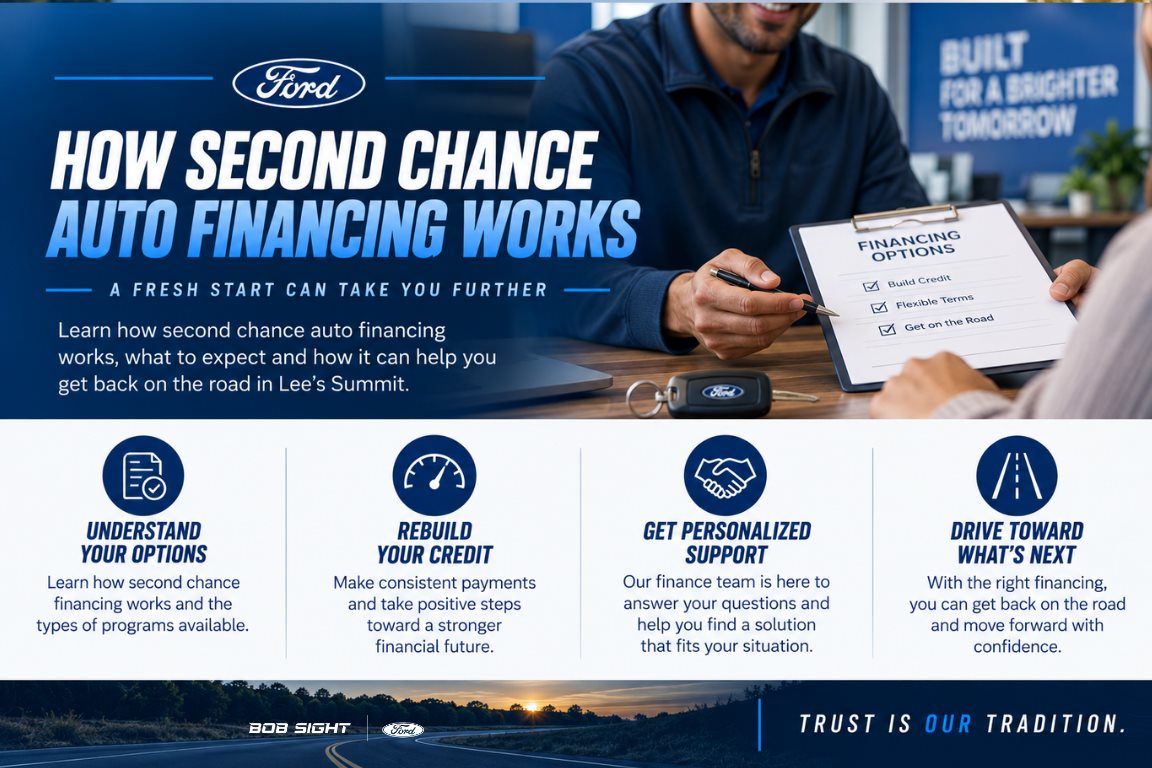
Apply for Auto Financing Through Bob Sight Ford
Second chance auto financing helps shoppers with credit challenges apply for a vehicle loan through lenders that consider more than a perfect credit history. At Bob Sight Ford in Lee’s Summit, the process begins with a financing application that can be submitted to a network of automotive lenders. Each lender reviews the application according to its own standards, so approval, interest rate, loan term, down payment requirements, and vehicle eligibility are never guaranteed.
Credit challenges can happen for many reasons, including missed payments, high credit utilization, a limited credit history, previous repossession, bankruptcy, medical expenses, divorce, job disruption, or an existing loan with negative equity. Second chance financing does not erase those circumstances. It creates a structured way for a lender to evaluate the shopper’s current financial picture, available income, existing obligations, potential down payment, trade-in position, and vehicle selection.
For drivers in Lee’s Summit, Blue Springs, Independence, Raytown, and the Greater Kansas City Metro, reliable transportation may be necessary for work, family responsibilities, school, and everyday errands. Understanding the financing process before visiting a dealership can make the experience less stressful and help a shopper compare options responsibly. This guide explains how second chance auto financing works, what information lenders may review, which documents may be requested, and how to evaluate an offer before signing.
In This Guide You’ll Learn
This guide explains the second chance auto financing process from preparation and application through lender review, vehicle selection, and final paperwork. It also defines important loan terms and outlines responsible steps shoppers can take before accepting financing.
- What second chance auto financing means
- How dealer-arranged financing works at Bob Sight Ford
- Which factors lenders may consider beyond a credit score
- What documents may be needed for an application
- How down payments and trade-ins affect the amount financed
- How to compare APR, loan term, monthly payment, and total loan cost
- How on-time payments may support future credit progress
Second chance financing should be approached as a financial decision, not simply a way to leave with a vehicle. A useful approval must fit the shopper’s budget, transportation needs, insurance costs, and ongoing ownership expenses. Taking time to understand the full agreement can help prevent a loan from becoming another source of financial strain.
What Is Second Chance Auto Financing?
Second chance auto financing is a lending pathway for shoppers whose credit histories may make traditional auto-loan approval more difficult. It may also be described as bad-credit auto financing, credit-challenge financing, or subprime auto financing. These terms generally refer to financing considered by lenders that work with a broader range of credit profiles.
A credit score is a numerical estimate of credit risk based on information in a consumer’s credit report. Lenders may use different scoring models and may receive different scores than the consumer sees through a monitoring service. A score can influence the decision, but it is not always the only factor reviewed.
Lenders may also evaluate income, job history, residence history, existing debts, recent credit inquiries, previous auto-loan performance, down payment, trade equity, and the vehicle being financed. A shopper with a lower score but stable income and manageable obligations may present a different application than someone with the same score and a much heavier debt load. Each lender sets its own underwriting standards.
Underwriting is the process a lender uses to evaluate risk and decide whether to approve an application and under what terms. The lender may approve the requested structure, offer different terms, require additional documentation, request a co-signer, require more money down, restrict the amount financed, or decline the application. Bob Sight Ford can submit legitimate applications to its lender network, but the lenders make their own decisions.
A shopper commuting from Blue Springs to Lee’s Summit may need dependable transportation after a period of missed payments caused by temporary job disruption. Second chance financing gives that person a way to present current income, employment, obligations, and vehicle needs for review. It does not guarantee a result, but it creates a defined next step.
Second chance financing should not be confused with a promise of “guaranteed approval.” Any responsible financing process includes lender review. Shoppers should be cautious of claims that appear to remove all qualifications or hide important loan details.
How Dealer-Arranged Second Chance Financing Works
Dealer-arranged financing begins when a shopper provides financial and identifying information that the dealership submits to one or more prospective lenders. If a lender is willing to finance the purchase, it returns proposed terms or conditions for the transaction. The shopper can then review the complete offer before deciding whether to proceed.
- Complete the financing application. Provide accurate identifying, employment, income, residence, and credit-related information requested on the application.
- Authorize the credit review. The applicant gives permission for the relevant parties to obtain credit information and evaluate the request.
- Respond to documentation requests. A lender or finance manager may request proof of income, residence, insurance, identity, or other application details.
- Review potential lender decisions. A lender may approve the request as submitted, propose modified terms, request additional information, or decline the application.
- Select an eligible vehicle. The vehicle must fit the lender’s requirements, the approved financing structure, and the shopper’s practical needs.
- Compare the complete terms. Review APR, amount financed, finance charge, payment schedule, loan term, total of payments, and optional products.
- Sign only after questions are answered. Confirm that the written documents match the agreement and obtain copies of everything signed.
Dealer-arranged financing differs from applying directly through a bank or credit union. With direct financing, the consumer contacts a financial institution and may obtain a quote or preapproval before selecting a vehicle. With dealer-arranged financing, the dealership sends the consumer’s information to prospective lenders and helps coordinate the transaction.
Shoppers can compare both paths. An outside preapproval may provide a reference point for evaluating a dealer-arranged offer. The dealership may also locate another option through its lender network. Comparing the full terms can help the shopper identify which choice fits the budget and long-term plan.
A Lee’s Summit shopper should avoid focusing only on whether an application receives a response quickly. Speed does not determine whether an offer is affordable. Take time to understand how the down payment, trade-in, interest rate, loan length, and optional products affect the total obligation.
What Do Second Chance Auto Lenders Consider?
Second chance auto lenders may consider credit history, income, existing debt, employment, residence stability, down payment, trade position, and vehicle selection. The exact combination varies by lender, and no single factor guarantees approval. Providing complete and accurate information gives the lender a clearer application to evaluate.
| Application Factor | What It May Show | How a Shopper Can Prepare |
|---|---|---|
| Credit history | Past payment patterns, account balances, collections, and loan performance | Review credit reports and dispute inaccurate information through the proper process |
| Income | Resources potentially available for recurring obligations | Gather current and verifiable income documentation |
| Debt obligations | How much income is already committed to other payments | Create a realistic monthly budget before applying |
| Employment history | Continuity and stability of reported income | Provide accurate employer information and dates |
| Residence history | Contact information and residential stability | Bring current address documentation if requested |
| Down payment | How much of the purchase is paid upfront | Decide what amount can be used without draining emergency savings |
| Trade-in position | Whether the current vehicle contributes equity or carries a remaining balance | Obtain the payoff amount and estimate the trade value |
| Vehicle selection | Collateral value, age, mileage, condition, and fit within lender guidelines | Remain flexible about eligible vehicles and loan structure |
Debt-to-income ratio is a comparison between recurring monthly debt obligations and gross monthly income. Lenders may calculate and interpret this ratio differently. A heavy existing debt load can affect how much additional payment a lender believes the applicant can reasonably manage.
Payment-to-income ratio focuses more directly on the proposed vehicle payment compared with income. A vehicle that produces a lower payment may be easier to fit within lender guidelines, but a lower payment created through a longer loan can raise the total financing cost. Both affordability and total cost matter.
Vehicle selection is important because an auto loan is secured by the vehicle. The vehicle serves as collateral, which means the lender may repossess it if the borrower defaults under the agreement. A lender may set standards related to age, mileage, condition, value, loan-to-value ratio, or amount financed.
A shopper driving between Independence and the I-470 corridor may begin with a particular truck or SUV in mind. If that vehicle does not fit a lender’s structure, considering another dependable option may produce a more manageable application. Flexibility can be helpful, but the replacement vehicle should still meet real transportation needs.
What Documents May Be Needed for a Second Chance Auto Loan?
Applicants may be asked to provide identification, proof of income, proof of residence, insurance information, employment details, and trade-in documents. Requirements vary by lender and application. Having current documents ready can reduce delays and make it easier to verify the information submitted.
- Confirm your identification. Bring a valid driver’s license or other acceptable identification requested by the dealership or lender.
- Gather proof of income. This may include recent pay information, bank statements, benefit documentation, tax records, or other acceptable evidence depending on how income is earned.
- Prepare proof of residence. A current utility statement, lease, mortgage document, or another accepted record may be requested.
- List employer information. Provide accurate employer name, address, contact information, position, and length of employment.
- Collect insurance information. A lender generally requires the financed vehicle to carry appropriate insurance before the transaction is completed.
- Bring trade-in documents. If trading a vehicle, gather registration, title information where applicable, loan account information, and the current payoff amount.
- Prepare references only if requested. Some lenders may request personal references with current contact information.
Self-employed shoppers may need different income records than salaried or hourly employees. Bank statements, tax documents, business records, or other evidence may be used depending on lender requirements. Ask what documentation is acceptable instead of assuming one type will satisfy every lender.
Income should be reported accurately. Inflating income, changing employment dates, or omitting material debt information can create problems during verification. Accurate information protects the integrity of the application and helps avoid a lender decision based on incorrect facts.
A shopper from Raytown who recently changed jobs should be prepared to explain the transition and provide current documentation. A lender may look at both employment length and the continuity of income. The dealership can help organize requested information but cannot change the lender’s verification requirements.
Protect sensitive information throughout the process. Submit applications through the dealership’s secure financing channel rather than sending Social Security numbers, financial statements, or identification through an unverified message. If someone requests sensitive documents, confirm the recipient and approved submission method first.
How Credit Scores Affect Second Chance Financing
Credit scores can influence approval and loan terms, but they are only one part of a second chance auto financing review. Lenders may use different credit bureaus, scoring models, and underwriting criteria. The score a consumer sees may not exactly match the score used for an auto-loan decision.
A credit report contains information about credit accounts, payment history, balances, collections, and certain public or inquiry records. Consumers can review reports from the major nationwide credit reporting companies through AnnualCreditReport.com. Checking the reports before applying can help identify inaccurate information or unfamiliar accounts.
If information appears incorrect, the consumer can dispute it through the appropriate credit-reporting process. A dealership cannot simply remove accurate negative information, guarantee a score increase, or rewrite a credit file. Be cautious of anyone promising a specific score improvement or immediate deletion of legitimate history.
Recent payment behavior may matter because it shows how accounts are being managed now. Keeping current accounts on time, reducing revolving balances where practical, and avoiding unnecessary new debt can support a healthier financial profile over time. The effect and timing vary by person and scoring model.
Several inquiries related to auto-loan shopping within a limited period may be treated as a single shopping event by some scoring models, but the exact window can vary. Consumers should complete their comparison shopping within a focused timeframe and ask how applications will be submitted. Do not assume every inquiry will be scored identically.
A resident near Grandview may have a lower score after a past medical collection but stable current income and recent on-time payments. Another applicant may have a similar score with different debts and income. Because their complete profiles differ, their lender decisions and terms may also differ.
How Down Payments and Trade-Ins Affect the Application
A down payment or positive trade equity can reduce the amount that must be financed, which may improve the structure of a second chance auto loan. It does not guarantee approval, and shoppers should avoid using money needed for rent, utilities, insurance, emergencies, or other essential expenses. The right contribution depends on the household budget and lender requirements.
A down payment is money paid upfront toward the transaction. Reducing the amount borrowed can lower the loan-to-value ratio and may reduce the total financing cost. Loan-to-value ratio compares the amount financed with the lender’s assessment of the vehicle’s value.
Trade equity is the difference between a vehicle’s trade value and the amount still owed on its loan. If the trade value is higher than the payoff amount, the vehicle has positive equity that may be applied to the next transaction. If the payoff is higher than the trade value, the vehicle has negative equity.
Rolling negative equity into a new loan increases the amount financed. This can make lender approval more difficult and increase the risk of owing more than the replacement vehicle is worth. Shoppers should request the current payoff amount, review the trade value, and understand exactly how any remaining balance is addressed.
A Ford owner in Liberty may have a vehicle that still carries a loan balance. Before applying for replacement financing, the shopper can use the Bob Sight Ford trade-in value tool and contact the current lender for a payoff quote. These are separate numbers, and the difference affects the transaction.
Never evaluate a trade only by how much it changes the monthly payment. Review the vehicle price, trade allowance, payoff, down payment, amount financed, APR, loan term, and total of payments as separate figures. Clear separation makes it easier to understand the full agreement.
How to Compare Second Chance Auto Financing Offers
Compare second chance auto financing offers using APR, loan term, amount financed, finance charge, total of payments, monthly payment, and optional products. A monthly payment alone does not reveal the complete cost. A longer term may lower the scheduled payment while increasing the length of the obligation and total interest paid.
| Loan Term | Plain-Language Meaning | Why It Matters |
|---|---|---|
| APR | The cost of credit expressed as a yearly percentage rate | Helps compare financing costs across offers |
| Amount financed | The amount of credit provided after applicable calculations | Shows how much is being borrowed |
| Finance charge | The cost of credit expressed as a dollar amount | Shows the interest and certain fees paid over the loan |
| Loan term | The length of time scheduled to repay the loan | Affects payment size and total financing cost |
| Total of payments | The sum of scheduled payments over the loan | Provides a broader view than the monthly payment alone |
| Optional products | Additional products or services selected by the buyer | Can increase the amount financed and total cost |
APR is not always the same as the stated interest rate because APR is designed to reflect certain financing costs as a yearly rate. Compare the disclosures provided for each offer. Ask questions when figures appear inconsistent or unclear.
Optional products may include service contracts, Guaranteed Asset Protection, credit insurance, tire-and-wheel products, appearance protection, or other items. Availability and terms vary. Review whether each product is optional, what it covers, what it excludes, how long it lasts, and how adding it to the loan changes the amount financed.
A shopper from Belton should not accept a longer loan solely because it produces a more comfortable monthly payment. Consider how long the vehicle is expected to remain dependable, how quickly it may depreciate, and whether the loan could create extended negative equity. The total commitment matters alongside the payment.
Before signing, compare the written terms with what was discussed. Confirm that no field is blank and that every selected product, trade amount, down payment, APR, loan term, and payment schedule is correct. Keep copies of all signed documents.
Second Chance Financing vs. Buy Here Pay Here Financing
Dealer-arranged second chance financing and buy here pay here financing are not automatically the same process. In dealer-arranged financing, a dealership may submit an application to outside lenders that make their own credit decisions and service or own the resulting loan. In a buy here pay here arrangement, the dealership commonly finances the transaction directly and collects the payments.
Outside lenders can include banks, credit unions, finance companies, or specialized automotive lenders. The dealership helps collect information and coordinate the application. If a lender approves the request, the retail installment contract may be assigned to that lender.
Buy here pay here dealerships often serve shoppers with limited or damaged credit histories, but their financing structures, interest rates, payment methods, vehicle selection, reporting practices, and repossession tools may differ. Consumers should review the full contract and ask whether payments are reported to credit bureaus.
Second chance financing at Bob Sight Ford involves submitting legitimate applications through a lender network. That does not guarantee that every lender will respond positively or that every applicant will qualify. It gives the finance team an opportunity to explore available lender decisions based on the information provided.
A Kansas City Metro shopper comparing both paths should review more than the convenience of approval. Ask who the lender is, where payments will be sent, whether the APR is fixed or variable, whether there is a prepayment penalty, how late fees work, whether payments are reported, and what happens if a payment is missed.
The most useful financing option is one the borrower understands and can reasonably manage. A fast answer does not make an agreement safe, affordable, or appropriate. Read the contract and walk away if the terms do not fit.
Quick Facts About Second Chance Auto Financing
Second chance auto financing offers a structured application path for shoppers with credit challenges, but every approval and loan term remains subject to lender review. Preparation, accurate documentation, realistic vehicle selection, and careful comparison can make the process easier to understand.
- Second chance financing is intended for a wider range of credit histories.
- Approval is not guaranteed.
- Interest rates, loan terms, down payments, and vehicle requirements vary by lender.
- A credit score is important but may not be the only factor reviewed.
- Income, debt, employment, residence, trade position, and vehicle selection may also matter.
- A down payment can reduce the amount financed but does not guarantee approval.
- Negative trade equity can increase the amount that must be financed.
- A co-signer becomes legally responsible for the debt and should understand the risk.
- Monthly payment should be reviewed together with APR, loan term, and total cost.
- Optional products can increase the amount financed.
- On-time payments may contribute to future credit progress, but a specific score increase cannot be promised.
- Applicants should keep copies of all signed documents.
Shoppers searching for second chance auto financing near me should evaluate the lender, dealership, vehicle, and contract together. A dealership’s ability to submit an application does not replace the shopper’s responsibility to review the terms. Ask questions until the agreement is clear.
Local transportation needs also belong in the decision. A vehicle used for daily travel along US-50, I-470, or Missouri Route 291 must be practical to insure, fuel, maintain, and repair. Affordability continues after the first payment.
Ownership Planning After Receiving Auto Financing
Successful ownership after second chance financing depends on making payments on time, maintaining the vehicle, carrying required insurance, monitoring the budget, and communicating with the loan servicer. The financing agreement creates an ongoing obligation that continues long after the vehicle leaves the dealership. Planning for the full term can help reduce surprises.
Set up payment reminders or automatic payments if the lender offers them and they fit your account-management preferences. Verify the payment due date, accepted payment methods, processing time, grace-period rules, and late-fee terms. Do not assume a payment submitted on the due date will be credited immediately.
The loan servicer may be different from the dealership or original lender. Review the welcome information that identifies where payments should be sent and how to access the account. Be cautious of unexpected payment instructions and verify changes directly through trusted contact information.
Keep insurance active according to lender and legal requirements. A lapse can create serious financial and contractual consequences. Compare insurance costs before selecting a vehicle because premiums can vary based on the driver, vehicle, coverage, location, and insurer.
Plan for maintenance as part of the monthly ownership budget. Oil changes, tires, brakes, batteries, fluids, repairs, registration, fuel, and insurance do not disappear because a vehicle is financed. Bob Sight Ford provides online service scheduling for owners in Lee’s Summit and surrounding communities.
If financial trouble develops, contact the lender or servicer before missing payments when possible. Available options vary, and no accommodation is guaranteed. Early communication may provide more time to understand the account and possible next steps.
Frequently Asked Questions About Second Chance Auto Financing
Can I get auto financing with bad credit in Lee’s Summit?
You can apply for auto financing with bad credit in Lee’s Summit, but approval and terms depend on lender review. Bob Sight Ford can submit legitimate applications through its automotive lender network. No dealership can responsibly guarantee that every applicant will be approved.
Lenders may evaluate credit history, current income, existing debts, employment, residence, down payment, trade equity, and vehicle selection. Two applicants with similar credit scores may receive different decisions because their complete financial profiles differ.
Lee’s Summit shoppers can prepare by reviewing their credit reports, creating a realistic budget, gathering documents, and remaining flexible about vehicle selection. Applying provides information about possible options, but it does not require the shopper to accept an offer.
Does second chance financing require a down payment?
A lender may require a down payment, but the amount and requirement vary by application, vehicle, and lender. Providing money upfront can reduce the amount financed and may improve the loan structure. It does not guarantee approval or a particular interest rate.
Shoppers should avoid committing funds needed for housing, utilities, food, insurance, emergencies, or other essential expenses. A larger down payment can reduce borrowing, but it should fit within a responsible household plan.
A shopper from Independence may also have positive trade equity that can contribute to the transaction. The finance team can explain how cash down, trade value, payoff amount, and lender requirements affect the proposed structure.
Will a co-signer help with an auto loan?
A qualified co-signer may affect a lender’s decision or terms, but using one does not guarantee approval. A co-signer agrees to repay the loan if the primary borrower does not. The debt can affect both people’s credit and financial obligations.
The co-signer generally does not gain an automatic right to use or possess the vehicle merely by signing the loan. Both parties should read the contract and understand responsibility for payments, late fees, default, and collection activity.
Never ask someone to co-sign without a direct conversation about the risks. A missed payment can damage both credit histories and strain the relationship. The decision should be made voluntarily and with full understanding.
Can an auto loan help rebuild my credit?
An auto loan may contribute positive payment history when payments are reported and made on time, but no specific credit-score increase can be guaranteed. Credit scores consider multiple accounts and behaviors, so one loan does not control the entire result. Reporting practices can also vary by lender.
Before accepting financing, ask whether the lender reports payments to the nationwide credit bureaus. Make every payment by the due date and keep other accounts current. Late or missed payments can have negative consequences and may lead to repossession.
Credit improvement generally takes time. Focus on sustainable behaviors such as paying obligations on time, limiting unnecessary debt, monitoring reports, and disputing inaccurate information through the appropriate channels. Avoid companies promising an immediate score transformation.
What should I check before signing a second chance auto loan?
Before signing, check the APR, amount financed, finance charge, payment amount, number of payments, loan term, total of payments, late fees, optional products, and prepayment terms. Confirm that the written agreement matches what was discussed. Do not sign documents with blank spaces.
Separate the vehicle price, trade allowance, trade payoff, down payment, taxes, government fees, negotiable fees, and optional products. Combining everything into one monthly payment can make it harder to evaluate the agreement.
Take the time you need and ask for clarification. A Blue Springs or Lee’s Summit shopper is not required to accept financing simply because an application was submitted or approved. Proceed only when the vehicle and complete loan structure fit the budget.
Explore Second Chance Auto Financing in Lee’s Summit
Second chance auto financing gives Lee’s Summit shoppers with credit challenges a way to present their current financial information to prospective automotive lenders. It is an application process, not a promise of approval. The strongest approach combines preparation, accurate information, flexible vehicle selection, careful budgeting, and a complete review of the written terms.
Working with a local finance department allows shoppers to discuss transportation needs connected to the Kansas City Metro. A commuter traveling from Raytown, a family in Blue Springs, or a worker navigating I-470 may need different vehicle features and ownership costs. The financed vehicle should meet those needs without stretching the household beyond a sustainable budget.
Bob Sight Ford in Lee’s Summit works with a network of automotive lenders and accepts legitimate financing applications from shoppers with a range of credit backgrounds. The finance team can explain available lender responses, documentation requests, vehicle eligibility, trade considerations, and written terms. Final decisions remain with the lenders and applicants.
Before applying, review your budget and gather current information. When you receive an offer, compare the full cost rather than focusing only on the monthly payment. A carefully evaluated loan can support dependable transportation and a more organized financial path forward.
Helpful Links
- Explore Second Chance Financing at Bob Sight Ford
- Apply for Auto Financing
- Visit the Bob Sight Ford Finance Department
- Browse Pre-Owned Vehicle Inventory
- Value Your Trade
Proud to Be Part of the Bob Sight Auto Group
Bob Sight Ford in Lee’s Summit is proud to be part of the Bob Sight Auto Group, serving drivers throughout the Kansas City Metro and Northeast Kansas. The group connects shoppers and owners with vehicle sales, financing assistance, maintenance, parts support, and collision repair. Each location serves its own community while continuing the Bob Sight tradition of helpful automotive guidance.
Ford shoppers can explore vehicle and financing options at Bob Sight Ford, while drivers interested in other brands can visit Bob Sight Honda, Bob Sight CDJR, or Bob Sight Kia. The Bob Sight Collision Center provides a local resource when a vehicle requires professional collision repair. Together, these locations support area drivers through shopping, financing, ownership, maintenance, and repair.