What to Check Before Buying a Used Ford F-150 in Lee’s Summit, MO
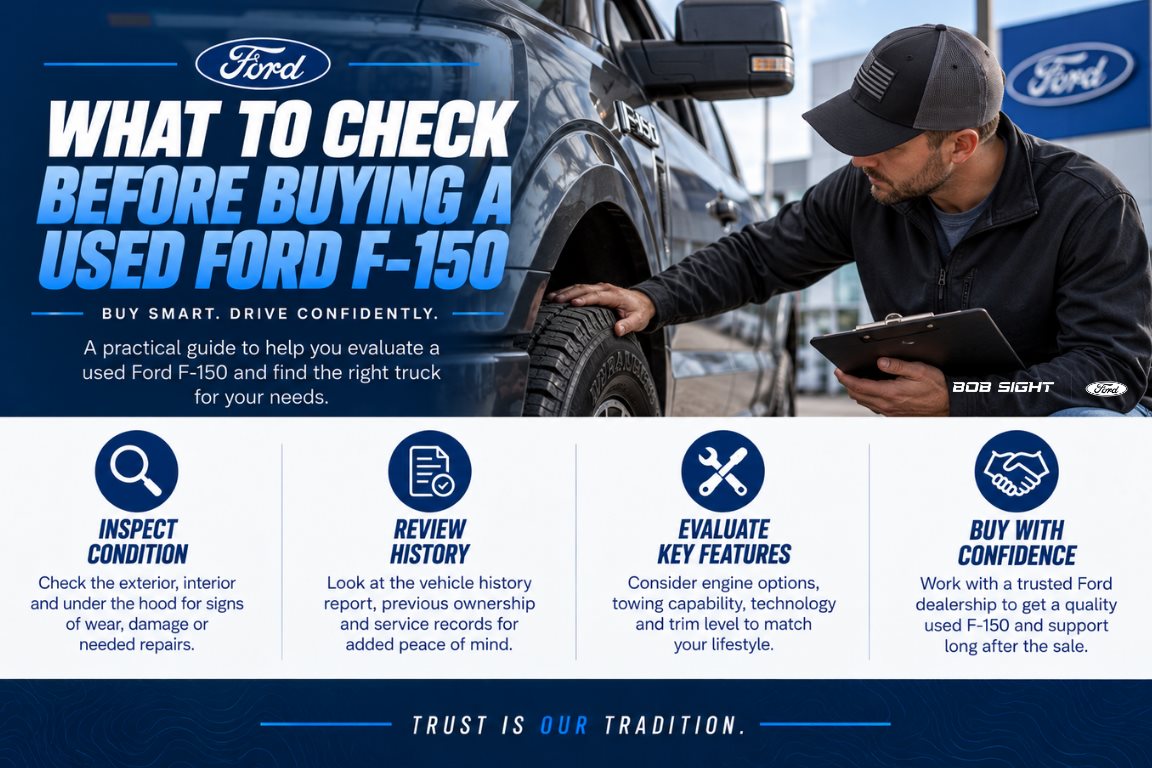
Before buying a used Ford F-150, check the truck’s history, condition, maintenance records, engine and transmission performance, four-wheel-drive operation, towing equipment, tires, brakes, frame, bed, cabin technology, and vehicle-specific ratings. A careful inspection and meaningful test drive can help Kansas City truck shoppers find an F-150 that fits their work, towing, commuting, and recreational needs. Bob Sight Ford in Lee’s Summit offers pre-owned vehicle resources for drivers throughout Blue Springs, Independence, Raytown, Grain Valley, Belton, and the surrounding Kansas City Metro.
The Ford F-150 has been offered across many model years with different engines, cab sizes, bed lengths, drivetrains, axle ratios, trim levels, and equipment packages. That variety gives used-truck shoppers plenty of choices, but it also means two similar-looking F-150 trucks may have very different capabilities. Use this guide to organize your research and know what to check before making a decision.
In This Guide You'll Learn
This guide explains how to evaluate a used Ford F-150 from its vehicle history and mechanical condition to its towing equipment and everyday usability.
A used-truck inspection should consider how the F-150 was previously used and how you plan to use it next. A lightly driven commuter may have experienced different wear than a truck used for frequent towing, construction work, snow removal, or rural property maintenance. Mileage is useful information, but it should be considered alongside service history, condition, and configuration.
- How to research a used F-150 before visiting the dealership
- Which exterior, frame, bed, and tire areas to inspect
- What to evaluate under the hood and during a test drive
- How to confirm towing and payload information
- Why cab size, bed length, drivetrain, and trim matter
- Which records and vehicle history details to review
- How to prepare for long-term used F-150 ownership
You do not need to be a technician to ask useful questions or notice potential concerns. A structured process helps you avoid getting distracted by appearance, accessories, or one appealing feature. When a mechanical or structural concern requires deeper evaluation, a professional inspection can provide additional information.
Research the Used Ford F-150 Before You Visit
Start by reviewing the F-150’s model year, trim, engine, drivetrain, cab, bed, mileage, equipment, and available history information.
Ford has offered the F-150 in many configurations, including regular, extended, and crew-cab layouts as well as different bed lengths. Powertrain choices have also varied by model year. Confirming the basic configuration helps you determine whether the truck fits your passenger, parking, cargo, towing, and commuting needs before you travel to see it.
Review listing photos closely and compare the visible equipment with the written description. Look for trailer equipment, bed accessories, running boards, wheel and tire changes, and modifications. If a specific feature matters, ask the dealership to verify it on the truck rather than assuming it is included because it was available for that model year or trim.
When browsing pre-owned vehicles at Bob Sight Ford, identify several trucks that could work instead of focusing on only one listing. Comparing cab space, bed length, drivetrain, mileage, and equipment side by side can clarify your priorities. Contact the dealership to confirm current availability before driving from another Kansas City community.
- Write down your passenger, cargo, towing, and parking requirements.
- Confirm the truck’s model year, trim, engine, drivetrain, cab, and bed.
- Review the listing photos and vehicle description carefully.
- Ask about history information and available maintenance records.
- Verify any feature that is essential to your decision.
- Schedule enough time for an inspection and test drive.
Review the Vehicle History and Maintenance Records
A used F-150’s history and maintenance records can help you understand how consistently it was cared for and whether important events were reported.
Review available history information for reported accidents, ownership changes, title concerns, mileage records, and documented service. A history report is valuable, but it may not include every repair, maintenance visit, or incident. Treat it as one source of information rather than a substitute for inspecting the truck.
Maintenance records can reveal whether routine items were addressed at reasonable intervals. Look for documentation involving oil and filter changes, tires, brakes, batteries, fluids, spark plugs, cooling-system care, and other work recommended for the specific truck. Service needs vary by engine, model year, mileage, operating conditions, and previous use.
Ask whether open recalls apply to the vehicle and whether completion records are available for past recall work. The vehicle identification number is the key to researching truck-specific information. Model-wide assumptions are less useful than records connected to the exact F-150 you are considering.
For a truck that spent years towing, hauling, idling, or operating in dusty conditions, maintenance history becomes even more important. Those activities do not automatically make an F-150 a poor choice, but they provide context for the inspection. A well-documented work truck may be easier to evaluate than a cleaner-looking truck with little known history.
Inspect the Body, Frame, Bed, and Undercarriage
Check the used F-150 for corrosion, collision repairs, uneven panel alignment, bed damage, fluid leaks, and signs of hard use underneath the truck.
Walk around the F-150 in good lighting and view it from several angles. Look for differences in paint color or texture, inconsistent panel gaps, overspray, dents, scratches, cracked lamps, and damaged trim. Cosmetic wear may be expected on a used truck, but irregularities can lead to useful questions about previous repairs.
Inspect the pickup bed for dents, deep gouges, damaged tie-down points, worn coatings, and signs that loads may have shifted or struck the cab. A bedliner can protect the surface, but it may also make the underlying metal harder to see. Check the tailgate operation, step features, power outlets, lighting, and tonneau cover when equipped.
Look underneath for visible corrosion, fresh coatings that obscure older surfaces, bent components, damaged shields, and active fluid drips. Surface corrosion and structural corrosion are not the same, so ask for professional guidance when you are uncertain. Missouri road salt, winter moisture, gravel roads, and jobsite use can all leave evidence underneath a truck.
Also inspect the hitch receiver, trailer wiring connector, recovery points, and any aftermarket equipment. Heavy wear around these areas may indicate regular towing or off-road use. That history should be considered with the truck’s maintenance, mechanical condition, and vehicle-specific ratings.
Check the Engine, Transmission, and Drivetrain
The engine, transmission, transfer case, and four-wheel-drive system should operate smoothly without unexplained warning lights, leaks, unusual noises, or delayed engagement.
If possible, evaluate the truck from a cold start because some symptoms are easier to notice before the engine warms. Listen for prolonged rattling, knocking, squealing, or other unusual sounds. Watch the instrument panel for warning indicators and confirm that expected lights illuminate during the startup check before turning off normally.
Open the hood and look for visible leaks, damaged hoses, loose wiring, corrosion, and signs of rushed repairs. Fluid condition can provide information, but interpretation should account for the system and service procedure involved. Do not open a hot cooling system, and ask a qualified technician to evaluate anything unfamiliar.
During the test drive, the transmission should shift consistently for the conditions and selected drive mode. Notice hesitation, harsh engagement, slipping sensations, unexpected vibration, or unusual noises during acceleration and deceleration. Test four-wheel drive only according to the operating instructions and on an appropriate surface.
Used F-150 engines and drivetrains differ across model years, so research the exact powertrain rather than relying on broad claims about the model. If a particular engine is central to your search, ask about its service history and maintenance requirements. Ford-Certified Technicians can help evaluate Ford-specific systems when a deeper mechanical inspection is appropriate.
Examine the Tires, Wheels, Brakes, and Suspension
Tires, wheels, brakes, steering, and suspension can reveal how the F-150 was maintained and whether additional service may be approaching.
Check all four tires for tread depth, cracking, punctures, sidewall damage, and uneven wear. Confirm that the tires are the correct size and appropriate type for the truck. Mismatched brands, sizes, load ratings, or tread levels may affect how the vehicle drives and can be more significant on four-wheel-drive configurations.
Uneven wear can point toward pressure, rotation, alignment, steering, or suspension concerns. Inspect the wheels for bends, cracks, heavy curb damage, or signs of repeated off-road impacts. Oversized aftermarket wheels and tires may change ride quality, clearance, speedometer accuracy, gearing demands, and suspension wear.
During the drive, evaluate braking response in a safe area. Notice pulling, steering-wheel shake, pedal pulsation, grinding, squealing, or a soft pedal. Some sounds can have simple causes, while others warrant a closer inspection of the pads, rotors, calipers, lines, or related components.
Drive over normal Kansas City pavement and listen for clunks, rattles, or repeated bouncing. Jackson County potholes, construction zones, gravel roads, towing, and heavy loads can contribute to wear over time. A professional inspection can help determine whether a noise comes from the suspension, steering, tires, body, or cargo area.
Confirm Towing and Payload Capability
Use the exact F-150’s labels and equipment information to confirm towing and payload capability because ratings vary by configuration.
An F-150’s capability can depend on model year, engine, transmission, drivetrain, wheelbase, cab, bed, axle ratio, packages, and installed equipment. A maximum figure advertised for the F-150 lineup does not apply to every used truck. Vehicle-specific information is necessary when towing or hauling is part of your plan.
Check the certification and tire-loading labels for weight information related to the individual truck. Review the owner’s information and available towing documentation for the model year. Account for passengers, accessories, cargo, hitch equipment, trailer tongue weight, and everything placed in the bed or cabin.
Inspect the trailer hitch receiver, wiring connection, brake controller, mirrors, camera features, and towing technology when equipped. Confirm that each feature operates correctly rather than assuming it works because the hardware is visible. Aftermarket towing equipment should be evaluated for proper installation and compatibility.
A Lee’s Summit buyer planning to tow a boat, camper, utility trailer, or work equipment should bring the trailer’s loaded specifications to the dealership. The team can help compare the intended load with the information available for the truck. If the F-150 does not provide enough margin, a differently configured F-150 or a Super Duty may be more appropriate.
Test the Cabin, Electronics, and Safety Features
Operate every important cabin feature and electronic system because small problems can be easy to overlook during a short test drive.
Adjust the front seats, steering wheel, mirrors, climate controls, and pedals when equipped. Test seat heating or ventilation, power adjustments, memory functions, windows, locks, interior lights, and the rear window. Check the condition of the upholstery, flooring, headliner, storage compartments, and seat belts.
Pair a phone with the infotainment system and test audio, charging ports, cameras, navigation-related functions, voice controls, and steering-wheel buttons. Confirm that the center display and instrument cluster respond correctly. Technology differs widely across F-150 model years and trims, so focus on the equipment installed in the specific truck.
Driver-assist features should also be evaluated when present. These may include a rearview camera, parking sensors, blind-spot monitoring, lane-related systems, adaptive cruise control, or trailer-focused camera views. Driver-assist technology has operating limits and does not replace attentive driving, but a malfunction should still be investigated.
Do not forget the rear seating area. Crew-cab shoppers should check legroom, child-seat needs, folding-seat operation, under-seat storage, vents, ports, and door access. A truck that feels comfortable from the driver’s seat may still be a poor match if the cabin cannot support the people or equipment you carry.
Take a Meaningful Used F-150 Test Drive
A useful test drive should include startup, neighborhood speeds, highway acceleration, braking, turning, parking, and rougher pavement similar to your normal route.
Begin by confirming that the driving position, visibility, and controls feel comfortable. Turn the steering wheel at low speed and listen for unusual noises. Check the backup camera, parking aids, mirrors, and turning radius in a parking area before entering faster traffic.
On a safe road, evaluate acceleration, transmission behavior, steering stability, braking, vibration, and wind or road noise. A route near Highway 50 or the I-470 corridor can help reveal how the truck behaves during merging and sustained speed. Do not let conversation or audio distract you from listening to the vehicle.
Drive over a section of ordinary uneven pavement to assess body motion, suspension noise, and cabin rattles. Return to the parking area and look underneath for new drips or odors. Recheck the instrument cluster for warnings that may have appeared during the drive.
- Start the truck and observe the warning-light check.
- Listen to the engine at idle before turning on the audio system.
- Test steering and braking at low speed.
- Evaluate acceleration and shifting during normal driving.
- Check highway stability and vibration when practical.
- Test parking, cameras, sensors, and visibility.
- Reinspect the truck for warning lights, odors, or leaks.
- Write down questions before comparing another F-150.
Consider Modifications and Previous Truck Use
Aftermarket modifications and signs of demanding use should be evaluated carefully because they can affect reliability, handling, capability, and future service.
Common F-150 modifications include suspension lifts, leveling kits, oversized tires, wheels, lighting, exhaust components, intake systems, bed accessories, towing equipment, and electronic tuning. Some upgrades may be useful and professionally installed. Others may introduce wear, change vehicle behavior, or complicate diagnostics.
Ask who installed the components, whether documentation is available, and whether original parts are included. Look for cut wiring, unsecured connectors, uneven suspension geometry, tire rubbing, poor alignment, or warning lights. Modifications should also be considered when reviewing warranty status and future service needs.
Signs of commercial work, off-road driving, plowing, or frequent towing do not automatically disqualify a truck. They do make condition and maintenance documentation more important. Bed damage, worn hitch components, underbody impacts, interior wear, and mismatched tires can provide clues about prior use.
If you prefer a truck closer to its original configuration, state that early in the shopping process. Shoppers who want a modified truck should still confirm that the work was completed correctly and fits their intended use. A visually dramatic setup is not a substitute for sound mechanical condition.
Ownership Planning
Plan for maintenance, tires, brakes, fluids, repairs, insurance, fuel, and the demands of your intended towing or hauling before selecting a used F-150.
Review the maintenance guidance for the truck’s model year, engine, drivetrain, mileage, and operating conditions. Ask which services have been completed and which may be approaching. Building a maintenance timeline is more useful than assuming every used F-150 needs the same work at the same mileage.
Consider the condition of wear items such as tires, brakes, the battery, filters, wiper blades, and fluids. These components may not make a truck a poor purchase, but they affect near-term ownership planning. A professional inspection can help identify visible concerns and provide context for future maintenance.
If the truck will tow, haul, idle frequently, travel on gravel, or support commercial work, discuss that use with the service team. Severe or demanding operating conditions may change how certain maintenance items should be monitored. Keep records after purchase so future decisions are based on documented work.
Bob Sight Ford supports F-150 owners with online scheduling, Ford-Certified Technicians, Motorcraft parts, and current Ford service and parts specials. You can also learn about Ford Pickup and Delivery for eligible service needs. Availability and service eligibility should be confirmed when scheduling.
Quick Facts
A used F-150 should be evaluated as an individual truck, not only by its model year, trim, mileage, or appearance.
- Confirm the exact engine, drivetrain, cab, bed, axle, and equipment.
- Review available vehicle history and maintenance information.
- Inspect the frame, bed, body, hitch, tires, and undercarriage.
- Evaluate the truck from a cold start when possible.
- Test the transmission and four-wheel-drive system appropriately.
- Use vehicle-specific labels when reviewing payload and towing.
- Operate every important cabin and technology feature.
- Evaluate modifications for installation quality and compatibility.
- Take a test drive that reflects your Kansas City routine.
- Request professional guidance when a concern needs deeper evaluation.
A high-mileage truck with strong records and consistent care may present a clearer ownership story than a lower-mileage truck with unknown maintenance. Mileage still matters, but condition, configuration, history, and previous use complete the picture. Compare several vehicles before deciding what represents the right fit.
Some shoppers may decide that a new F-150 better matches their preferences after comparing equipment, condition, and ownership goals. If you expand your search, review current new Ford F-150 inventory and Ford Employee Pricing details for Kansas City. Eligibility, availability, and program terms can change.
Frequently Asked Questions
These answers address common questions Kansas City shoppers ask before purchasing a used Ford F-150.
What is the most important thing to check on a used Ford F-150?
The most important step is evaluating the complete truck, including its history, configuration, mechanical condition, structural condition, and maintenance records.
No single mileage number, engine choice, trim, or model year tells the entire story. A used F-150 should be inspected for leaks, warning lights, drivetrain concerns, corrosion, tire wear, collision repairs, and signs of demanding use. The test drive should then confirm how the truck starts, shifts, steers, brakes, and rides.
For Lee’s Summit shoppers, the intended use should shape the inspection. A truck used for commuting around Kansas City requires a different capability review than one purchased for towing, construction, farming, or regular travel on rural Missouri roads.
How many miles is too many for a used F-150?
There is no universal mileage cutoff because condition, maintenance, engine hours, previous use, and service history all affect a used F-150.
Higher mileage may reflect steady highway driving, while lower mileage can include short trips, idling, towing, or demanding work. Review the odometer together with available records and physical condition. Engine-hour information may also provide helpful context when available.
A Kansas City commuter truck with documented maintenance may tell a different story than a rural work truck with similar mileage. Have concerns evaluated professionally and choose based on the individual vehicle rather than mileage alone.
Should I get a used F-150 inspected before buying?
Yes, a professional inspection can provide valuable information about the truck’s mechanical, structural, tire, brake, suspension, and electronic condition.
A vehicle history report cannot reveal every current problem, and a short drive may not expose every concern. An inspection can identify visible issues, verify system operation, and help you understand maintenance that may be approaching. It cannot predict every future repair, but it adds useful information.
This is valuable for drivers traveling from Blue Springs, Independence, Raytown, Grain Valley, Belton, or another Kansas City community to purchase a truck. Clarifying the condition before completing the process can support a more informed decision.
How do I know how much a used F-150 can tow?
Confirm towing capability using information for the exact truck, including its model year, engine, drivetrain, cab, bed, axle ratio, packages, and vehicle-specific ratings.
Do not assume that a lineup-wide maximum applies to every F-150. Account for passengers, cargo, accessories, hitch equipment, trailer tongue weight, and the trailer’s loaded weight. The truck’s certification labels, owner information, and applicable towing resources should guide the calculation.
Bring your trailer specifications when shopping at Bob Sight Ford in Lee’s Summit. If the used F-150 does not provide enough margin, another F-150 configuration or Super Duty may be a better match.
Is four-wheel drive necessary on a used F-150 in Missouri?
Four-wheel drive is useful for certain Missouri weather, work, recreation, and low-traction conditions, but it is not necessary for every F-150 owner.
Drivers who travel on unpaved roads, launch boats, manage rural property, visit worksites, or must drive during winter weather may value four-wheel drive. Drivers who remain primarily on maintained roads may decide that a two-wheel-drive configuration fits their routine. Tires and driver judgment remain important with either drivetrain.
If choosing four-wheel drive, test the system according to the truck’s operating instructions and on an appropriate surface. Ask for an evaluation if engagement is delayed, warning messages appear, or unusual noises occur.
Shop Used Ford F-150 Trucks at Bob Sight Ford
Bob Sight Ford helps Kansas City truck shoppers compare used F-150 configurations based on condition, capability, equipment, and real ownership needs.
A careful buying process gives you a better understanding of the truck before it becomes part of your daily life. Review the history, inspect the vehicle, test every important system, verify capability, and compare more than one option. The right used F-150 should fit both your current needs and your ownership plans.
Our Lee’s Summit location serves shoppers from Blue Springs, Independence, Raytown, Grain Valley, Belton, Jackson County, Kansas City, and surrounding western Missouri communities. Whether you need a commuter, family truck, recreational vehicle, towing platform, or work pickup, the Bob Sight Ford team can help you explore available options.
Browse current pre-owned inventory online, prepare your trade, explore financing resources, and schedule time to see the trucks that interest you. Inventory changes, so confirm availability before making a special trip. Bring your questions, trailer information, and must-have features to make the comparison more productive.
Helpful Links
Proud to be part of the Bob Sight Auto Group
Bob Sight Ford is proud to be part of the Bob Sight Auto Group, serving drivers across Lee’s Summit, Lawrence, Independence, and the Kansas City Metro.
Our family of dealerships helps area drivers with vehicle shopping, financing, service, parts, and collision repair resources. Whether you are purchasing a used Ford F-150 or maintaining the truck already in your driveway, the Bob Sight Auto Group is here to support your next step. Trust Is Our Tradition.