Ford Bronco Missouri Driving Tips: Mastering Midwest Trails and Highways
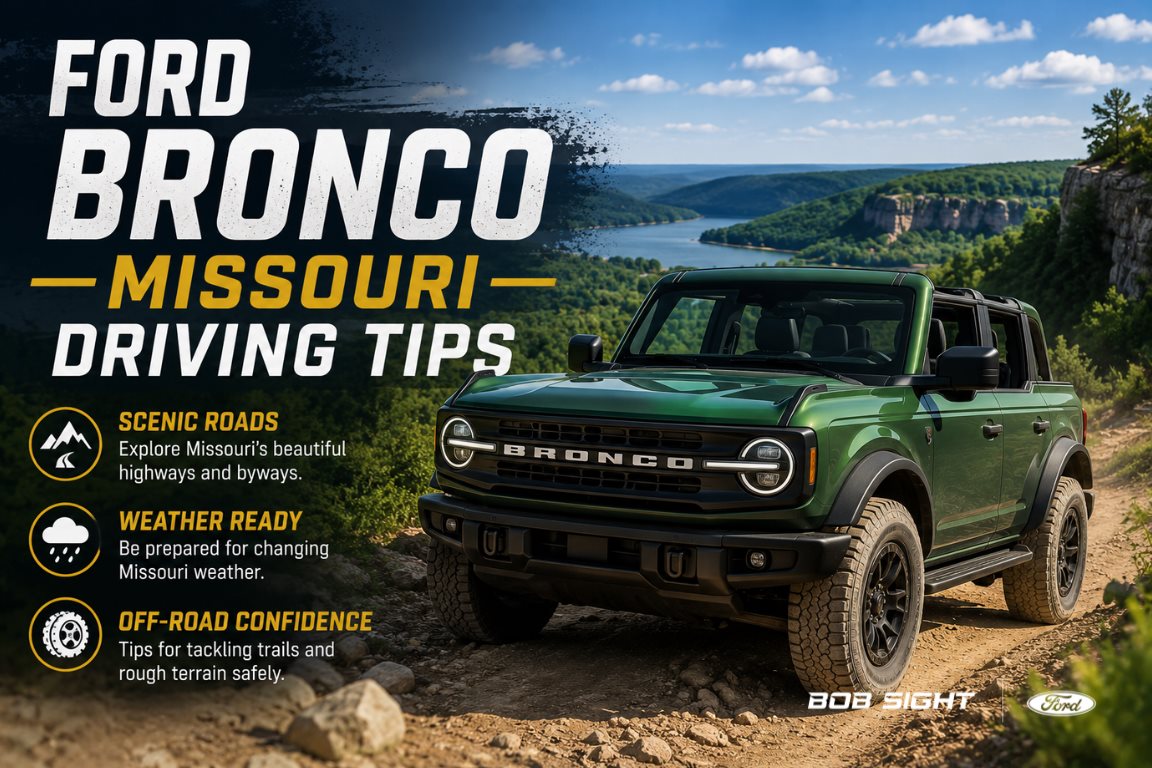
At Bob Sight Ford in Lee's Summit, Missouri, our off-road specialists help Ford Bronco owners maximize capability across changing Midwest weather, highway routes, and rugged state trails. Driving an iconic SUV like the Ford Bronco requires an understanding of G.O.A.T. Modes, tire pressure management, 4x4 engagement, and seasonal vehicle maintenance. Whether you commute daily along Interstate 470, tackle snowy morning conditions near the Summit Fair shopping corridor, or explore off-road trails across Jackson County and western Missouri, proper driving techniques protect your vehicle while delivering maximum performance. In this comprehensive guide, our dealership experts break down essential terrain modes, weather strategies, trail prep, and routine care to keep your Bronco performing at its best.
In this guide you will learn:
- How to utilize Ford Bronco G.O.A.T. Modes for maximum traction on local highways and regional off-road trails.
- Essential driving techniques for handling severe Missouri winter weather, freezing rain, and road ice.
- Step-by-step procedures for adjusting tire pressures when transitioning between paved highways and off-road terrain.
- Key operational differences between 4H, 4L, and 4A drive modes across varied driving scenarios.
- Important off-road recovery gear and trail preparation checklists for Midwest adventuring.
- Proactive maintenance practices that protect suspension components and underbody armor from road salt and mud.
Mastering Ford Bronco G.O.A.T. Modes for Missouri Roads and Trails
Ford Bronco G.O.A.T. (Goes Over Any Type of Terrain) Modes automatically calibrate throttle response, transmission shift points, steering feel, and traction control for specific driving conditions. Selecting the correct mode before encountering difficult terrain or severe weather allows the Bronco to adjust electronic stability controls and differential locks automatically. Designed to make off-roading and inclement weather driving effortless, these terrain settings ensure optimum power delivery whether navigating slick city pavement or rocky Ozark trails.
On everyday paved routes like US-50 or MO-291, Normal and Eco modes provide balanced steering feel and optimized fuel economy. However, when sudden Midwest weather hits Lee's Summit, switching to Slippery mode softens throttle response and optimizes traction control to prevent tire spin on icy overpasses. For off-road enthusiasts exploring local mud parks or dirt trails across Jackson County, Mud/Ruts and Sand modes allow controlled wheel spin to clear tread grooves while keeping momentum steady through deep soil.
Real-world driving along I-470 during sudden spring downpours highlights the immediate benefit of selecting the right drive mode. Slippery mode engages the 4A (Auto) four-wheel-drive setting continuously, redistributing torque between front and rear axles as road friction changes. Understanding how each G.O.A.T. mode interacts with your vehicle's drivetrain allows you to react confidently to changing Midwest road conditions year-round.
Navigating Missouri Winter Weather, Ice, and Freezing Rain
Driving a Ford Bronco safely through severe Missouri winters requires understanding 4x4 system engagement, anti-lock braking dynamics, and specialized tire grip limits. While the Bronco's high ground clearance and advanced 4WD systems excel in deep snow, icy blacktop requires smooth control inputs and proper speed management. Freezing rain along highway bridges near Chipman Road or Blue Ridge Boulevard creates invisible hazards that demand proactive driving habits regardless of vehicle capability.
When driving on paved roads covered in patchy ice or packed snow, utilize 4A (Auto 4WD) if equipped, or engage 4H (4WD High) for consistent four-wheel traction. It is critical to note that 4H mechanically locks the front and rear driveshafts together at equal speeds, which means it should only be used on loose or slippery surfaces. Driving in 4H on dry, high-traction asphalt causes drivetrain binding, increased tire wear, and unnecessary stress on transfer case components. For extreme low-speed situations, such as navigating an unplowed driveway or pulling out of a snowbank, 4L (4WD Low) provides maximum low-end torque control.
Consider a morning commute from Raytown to downtown Kansas City during the first winter freeze. Maintaining a safe following distance of 6 to 8 seconds gives the Bronco's AdvanceTrac with Roll Stability Control (RSC) ample room to modulate braking without losing directional stability. Additionally, keeping all-season or 3-Peak Mountain Snowflake (3PMSF) rated tires inflated to factory door-jamb specifications ensures maximum contact patch area on frozen pavement.
Step-by-Step Guide to Airing Down and Reinflating Bronco Tires
Airing down tire pressure increases the tire contact patch for off-road traction, while reinflating to street pressure before highway driving prevents tire damage and overheating. Adjusting tire pressure is one of the most effective ways to improve ride comfort and traction when transitioning from pavement to rough trails. Below is the step-by-step tire pressure adjustment routine recommended by off-road specialists.
- Park on a Flat, Level Surface Before the Trailhead: Pull off the main road onto a flat staging area, engage the parking brake, and select Park before beginning tire pressure adjustments.
- Attach a Quality Tire Deflator or Pressure Gauge: Remove the valve stem cap and attach a brass tire deflator or calibrated pressure gauge to monitor pressure drop in real time.
- Lower Pressure to Target Off-Road PSI: Reduce tire pressure from standard street levels (typically 35-39 PSI) down to 18-22 PSI for general trail riding or 15-18 PSI for deep sand and mud. Never drop below 15 PSI unless using true beadlock-capable wheels.
- Complete Your Off-Road Trail Ride: Enjoy improved traction, smoother obstacle absorption, and enhanced tire flexibility over rocks, roots, and uneven terrain.
- Reinflate Tires Before Returning to Paved Highways: Connect a 12-volt portable air compressor or onboard air system to reinflate all four tires back to recommended factory door-sticker pressures before driving on public highways like US-50.
Following this procedure protects both your tires and your rims from damage. For example, a Bronco owner exploring dirt access trails near Lake Jacomo will notice a softer ride and far better grip over sharp rocks when operating at 20 PSI. However, driving at high highway speeds on underinflated tires causes extreme heat buildup, tread separation risks, and severe fuel economy losses.
Always carry a reliable tire pressure gauge and a heavy-duty portable air compressor in your rear cargo area. Reinflating your tires before hopping back onto I-470 ensures full vehicle stability, proper braking distances, and predictable handling at highway speeds.
Comparing Ford Bronco 4x4 Drivetrain Modes: 4A, 4H, 4L, and 2H
Understanding when to use 2H, 4A, 4H, and 4L drivetrain modes prevents transfer case wear while optimizing fuel economy and off-road capability. The Ford Bronco features either a standard part-time 4x4 system or an available advanced automatic 4x4 system. Selecting the appropriate transfer case setting for your immediate surface conditions ensures maximum control without causing mechanical stress.
To help you select the ideal drivetrain mode for local Missouri driving scenarios, review the comparison table below:
| Drivetrain Mode | Mechanical Operation | Recommended Driving Surface | Speed & Usage Limitations |
|---|---|---|---|
| 2H (2WD High) | Power sent exclusively to rear wheels | Dry pavement, highway cruising, clean city streets | Unlimited highway speeds; delivers maximum fuel economy |
| 4A (4WD Auto) | Electronically varies power between front/rear axles as needed | Wet roads, patchy snow, mixed rain, changing pavement conditions | Unlimited highway speeds; safe for dry pavement transitions |
| 4H (4WD High) | Mechanically locks front and rear driveshafts at 50/50 split | Deep snow, muddy backroads, loose gravel, unpaved dirt trails | Moderate speeds; do not use on dry, high-traction asphalt |
| 4L (4WD Low) | Engages low gear reduction ratio for maximum wheel torque | Steep rock crawling, deep mud extraction, severe incline climbs | Low speeds only (under 25 MPH); requires shifting to Neutral to engage |
Consider a trip from Grain Valley through heavy spring rain that turns into slush along I-70. Using 4A (Auto 4WD) allows the transfer case clutch pack to engage automatically whenever rear tire slip is detected, providing continuous traction without requiring driver intervention. This mode is completely safe to leave engaged as pavement transitions between wet patches and dry concrete overpasses.
Conversely, if you pull into a muddy staging area or unplowed access road, switching to 4H or locking the rear differential via the dash-mounted Hero Switches provides equal power distribution across both axles. Knowing how and when to engage these transfer case settings preserves your Bronco's driveline longevity for years to come.
Essential Trail Preparation and Off-Road Recovery Gear
Packing essential recovery gear and completing a pre-trail safety inspection ensures you handle unexpected off-road situations safely. Exploring wooded trails across western Missouri or mud routes in Jackson County exposes your vehicle to unpredictable terrain, deep ruts, and hidden obstacles. Preparing your vehicle before leaving the pavement guarantees that minor trail delays do not become major headaches.
Before heading out, inspect underbody skid plates, check recovery hook integrity, and verify that all fluid levels are full. Equipping your Bronco Sasquatch Package or Outer Banks model with recovery tools gives you the ability to extract your vehicle or assist fellow trail drivers. Below is a checklist of essential off-road recovery gear recommended for Midwest trail outings:
- Heavy-Duty Kinetic Recovery Strap or Rope: Minimum 20,000-lb break strength strap designed to stretch and absorb kinetic energy during vehicle extractions.
- Soft Shackles and Rated D-Rings: Lightweight, ultra-strong synthetic soft shackles to secure recovery straps safely without heavy metal hazards.
- Tire Traction Boards: Molded plastic recovery tracks to place under spinning tires when stuck in deep mud, loose sand, or slick snow.
- Compact Folding Shovel and Trail Saw: Essential tools for clearing mud from around tires or removing fallen tree limbs along narrow Midwest forest trails.
- Heavy-Duty 12V Air Compressor and Deflator: High-output portable compressor to reinflate tires back to highway pressures before driving home.
- First Aid Kit and LED Headlamps: Emergency medical supplies, flashlights, and extra batteries for nighttime trail repairs or unexpected delays.
Imagine navigating a wooded trail near Blue Springs after a heavy spring rainfall. If your tires drop into a slick clay rut, placing traction boards in front of the front tires and engaging Trail Turn Assist allows the Bronco to pivot around tight obstacles and pull out of the mud effortlessly. Having proper recovery tools onboard keeps trail adventures fun, safe, and stress-free.
After returning from a trail weekend, take time to wash wet mud and trail debris off your vehicle promptly. Heavy mud trapped around brake calipers, suspension components, and drive shafts can cause wheel imbalances and premature component wear if left uncleaned.
Step-by-Step Process for Post-Trail Inspection and Cleaning
Performing a thorough post-trail inspection catches minor component wear, protects body panels, and removes corrosive mud and road salt from the chassis. Mud and trail debris trapped against the underbody hold moisture against metal surfaces, accelerating rust and damaging suspension bushings over time. Following a structured post-trail maintenance routine protects your investment after every off-road excursion.
- Power-Wash the Underbody and Chassis Armor: Use a pressure washer to thoroughly clean mud, dirt, and road salt from underbody skid plates, frame rails, suspension control arms, and brake assemblies.
- Inspect Tires for Cuts, Punctures, and Embedded Rocks: Check tire sidewalls and tread blocks for sharp rock cuts or deep gouges, and remove large stones wedged between tread lugs to prevent wheel unbalance at highway speeds.
- Verify Suspension and Steering Component Integrity: Check tie rods, sway bar end links, shock absorbers, and CV axle boots for signs of physical impact, grease leaks, or torn rubber boots.
- Check Engine Air Filter for Dust or Water Contamination: Open the air cleaner box to inspect the filter element, replacing heavily dusted or damp air filters to maintain engine performance and fuel economy.
- Check Fluid Levels and Differential Vents: Inspect engine oil, transmission fluid, and front/rear differential fluid clarity, ensuring no water ingress occurred during deep water crossings.
Taking 20 minutes to complete this post-trail inspection at your Lee's Summit home prevents minor trail scrapes from turning into expensive mechanical repairs. For instance, discovering a torn CV axle boot early allows you to schedule a quick service visit at Bob Sight Ford before road grit ruins the constant-velocity joint inside.
Additionally, keeping your vehicle's radiator and A/C condenser fins free of dried mud preserves cooling system efficiency during hot Missouri summer drives along I-470. Clean heat exchangers ensure your EcoBoost engine maintains optimal operating temperatures whether towing or commuting.
Quick Facts: Ford Bronco Driving and Capability at a Glance
Key technical specifications and factory capability figures highlight why the Ford Bronco excels on both pavement and trails. Reviewing these core operational metrics helps owners understand vehicle limits and performance characteristics. Below is a summary of important Ford Bronco technical capability figures:
- Maximum Water Fording Depth: Up to 33.5 inches capability when equipped with the factory Sasquatch Package and elevated air intake.
- Maximum Ground Clearance: Up to 11.6 inches of ground clearance on Sasquatch-equipped 35-inch territory tires.
- Maximum Crawl Ratio: Up to 94.75:1 crawl ratio when combining the 7-speed manual transmission with 4L transfer case reduction.
- Standard Terrain System: Up to 7 available G.O.A.T. Modes tailored for automatic throttle, steering, and traction adjustments.
- Trail Turn Assist Radius: Reduces turning radius by up to 40 percent on tight off-road trails by applying the inside rear brake.
- Trail One-Pedal Drive: Allows low-speed rock crawling using only the accelerator pedal for precise control on technical terrain.
These factory engineering benchmarks demonstrate the Bronco's incredible versatility. Whether you are maneuvering through tight parking spots near Summit Fair or crawling over rocky ledges in southern Missouri, advanced chassis electronics provide unmatched confidence. Visiting Bob Sight Ford gives you access to knowledgeable specialists who can explain how to activate and optimize every built-in trail feature.
Long-Term Ownership Planning and Off-Road Maintenance Strategy
Maintaining your Ford Bronco according to factory severe-duty service schedules ensures maximum driveline reliability and high resale value. Off-road driving, water crossings, towing, and cold Midwest winter starts subject engine oil, differential lubricants, and braking systems to higher stress levels than standard highway commuting. Adhering to proactive maintenance intervals protects sensitive mechanical components against premature wear.
Engine oil changes for 2.3L and 3.0L EcoBoost engines should occur every 5,000 to 7,500 miles using recommended full synthetic Motorcraft SAE 5W-30 engine oil meeting Ford WSS-M2C961-A1 specifications. If you frequently tow trailers, negotiate deep mud, or operate in dusty off-road environments across Jackson County, shorter 5,000-mile service intervals are strongly recommended to prevent thermal oil breakdown and keep turbochargers properly lubricated.
Drivetrain fluid maintenance is equally critical for 4x4 vehicles. Front and rear differential fluids, as well as transfer case lubricants, should be inspected after deep water crossings to confirm seals were not compromised. Replacing differential fluid every 30,000 to 50,000 miles removes microscopic metal wear particles, keeping ring-and-pinion gears running quietly. Servicing your Bronco at Bob Sight Ford guarantees that factory-certified technicians install genuine Motorcraft fluids and OEM replacement parts, preserving your factory warranty coverage from bumper to bumper.
Maintaining full service documentation at an authorized dealership significantly enhances your Bronco's market resale value when it comes time to upgrade. A detailed service record showing regular oil changes, multi-point inspections, and chassis maintenance proves to future buyers that your vehicle was meticulously cared for. Proactive maintenance planning protects your vehicle investment for miles and trails to come.
Frequently Asked Questions About Ford Bronco Missouri Driving
Can I drive my Ford Bronco in 4H (4WD High) on dry pavement in Kansas City?
No, you should never drive your Ford Bronco in 4H on dry, high-traction pavement because it causes severe drivetrain binding and accelerated tire wear. In 4H mode, the transfer case mechanically locks the front and rear driveshafts together, forcing both axles to rotate at identical speeds. When turning on dry asphalt near Summit Fair, the outer wheels need to rotate faster than the inner wheels, creating driveline stress known as wheel hop or driveline binding.
If you encounter mixed driving conditions—such as alternating dry pavement and slushy snow along I-470—engage 4A (Auto 4WD) if your Bronco is equipped with the advanced 4x4 system. 4A utilizes an electronically controlled clutch pack that automatically sends power to the front wheels only when rear slip occurs, allowing safe, bind-free turning on dry concrete while delivering instant four-wheel traction when hitting icy patches.
Pro-Tip from the Bob Sight Service Bay: Reserve 4H for low-traction surfaces like unpaved dirt trails, deep snow, or loose gravel where tires can slip naturally without stressing transfer case gears. Using 4A on mixed winter roads keeps your drive smooth while protecting your driveline components.
What G.O.A.T. Mode should I use for driving in severe Missouri winter snow?
You should select Slippery Mode on your Ford Bronco when driving through winter snow, freezing rain, or icy road conditions across Missouri. Slippery Mode relaxes throttle sensitivity, adjusts automatic transmission shift schedules to prevent sudden rear-wheel torque spikes, and increases stability control sensitivity to suppress tire spin before it starts.
Additionally, Slippery Mode automatically engages the 4A (Auto 4WD) system, continuously monitoring wheel speed sensors to distribute torque between front and rear axles. If you encounter unplowed deep snow drifts on rural roads in Jackson County, switching to Deep Snow/Sand Mode allows controlled wheel spin to maintain momentum and clear snow from tread channels.
For example, a morning commute along MO-291 during a winter storm is significantly safer when utilizing Slippery Mode. The adjusted throttle mapping allows smooth, controlled acceleration from stoplights without spinning tires on frozen intersections.
How deep can a Ford Bronco safely ford water in Missouri creeks or trails?
A factory Ford Bronco can safely ford water up to 33.5 inches deep when equipped with the Sasquatch Package and 35-inch tires. Standard Bronco models offer water-fording capability ranging from 31.5 to 33.5 inches depending on trim level, tire package, and axle clearance. Critical electrical components, breathers, and intake ducts are positioned high within the engine bay to allow safe water crossings when executing proper low-speed driving techniques.
When approaching water crossings near local parks or trails, enter the water slowly at 2 to 3 MPH to create a gentle bow wave in front of the bumper. Maintain steady throttle momentum without stopping or shifting gears mid-crossing, and avoid creating large splashes that can enter the air intake cowl. Never enter moving floodwaters across submerged roadways like Chipman Road during heavy Midwest rainstorms.
After completing deep water crossings, tap your brakes gently several times to dry out brake pads and rotors. Inspect differential vent hoses and check axle fluid clarity at your next service visit to confirm no moisture bypassed seal assemblies.
What is Trail Turn Assist on the Ford Bronco and how do I use it?
Trail Turn Assist is an off-road driver-assist feature that significantly reduces the Bronco's turning radius on tight trails by applying the inside rear brake. When activated during low-speed, high-steering-angle maneuvers in 4H or 4L, the system holds the inside rear wheel stationary while front wheels pull the vehicle around tight corners, reducing turning radius by up to 40 percent.
To engage Trail Turn Assist, bring your Bronco to a complete stop on a loose off-road trail, ensure the vehicle is in 4H or 4L, and press the Trail Turn Assist button located on the top dash Hero Switch panel. As you turn the steering wheel sharply while accelerating gently, you will feel the vehicle pivot smoothly around tight trees or rock obstacles.
Midwest Seasonal Maintenance Alert: Trail Turn Assist should only be used on loose off-road surfaces like mud, sand, or dirt. Engaging Trail Turn Assist on high-traction pavement or hard packed surfaces causes extreme tire drag and severe driveline strain.
How often should I service my Ford Bronco's 4x4 differentials and transfer case?
You should inspect differential and transfer case fluid levels every 15,000 miles, and replace fluid every 30,000 to 50,000 miles under normal driving conditions. If you regularly engage in off-road driving, tow heavy trailers, or navigate deep water crossings around western Missouri, shorter fluid service intervals of 20,000 to 30,000 miles are recommended to keep gear sets fully lubricated.
Front and rear differentials use high-pressure hypoid gear oils that break down over time due to heat, friction, and moisture accumulation. Regular fluid exchanges remove microscopic metal wear particles, preventing bearing whine, locker chatter, and premature gear pitting inside differential housings.
Bringing your Bronco to Bob Sight Ford for scheduled 4x4 maintenance ensures factory-trained technicians install original Motorcraft synthetic gear lubricants engineered specifically for Ford electronic locking differentials. Proactive driveline maintenance keeps your Bronco trail-ready for years to come.
Why Local Dealership Expertise Matters for Ford Bronco Owners
Servicing and outfitting your Ford Bronco at Bob Sight Ford guarantees expert support from factory-trained master technicians who understand off-road systems and Midwest driving conditions. Modern 4x4 vehicles feature complex electronic sway-bar disconnects, front/rear locking differentials, and specialized terrain management software that require dedicated diagnostic equipment. Relying on generic repair shops that lack factory software can lead to misdiagnosed faults or improper driveline maintenance.
Located conveniently at 610 NW Blue Parkway in Lee's Summit, Missouri, Bob Sight Ford has served Jackson County and the Kansas City Metro for generations. Our service department features factory diagnostic stations (IDS and FDRS), alignment bays calibrated for oversized off-road tires, and a complete inventory of genuine Motorcraft parts and Ford Performance accessories. Our proximity to major travel routes like US-50, I-470, and MO-291 makes dropping off your vehicle for routine service fast and convenient.
Local accountability means we stand behind every service job and accessory installation we complete. Whether you need routine synthetic oil changes, 4x4 fluid exchanges, seasonal tire rotations, or off-road pre-trail inspections, our staff provides transparent guidance and customer-first service. Partnering with Bob Sight Ford keeps your Bronco performing flawlessly on daily commutes and weekend trail adventures alike.
Helpful Links
- Explore New Ford Bronco SUV Inventory in Lee's Summit
- View Current Ford Lease Offers & Finance Specials
- Schedule Certified Ford Maintenance & 4x4 Service
- Order Genuine Motorcraft OEM Parts & Bronco Accessories
- Value Your Trade-In Online at Bob Sight Ford
Proud to Be Part of the Bob Sight Auto Group
Bob Sight Ford is proud to be a member of the Bob Sight Auto Group, serving drivers throughout Missouri and Kansas with trusted automotive sales, service, and financing support for over a century. Our dealership group operates four convenient retail locations across the region, delivering honest guidance, transparent pricing, and customer-focused service to every community we serve.
Explore all of our Bob Sight Auto Group dealership locations below: