Ford Diesel Truck Service Kansas City: What Diesel Owners Need To Know
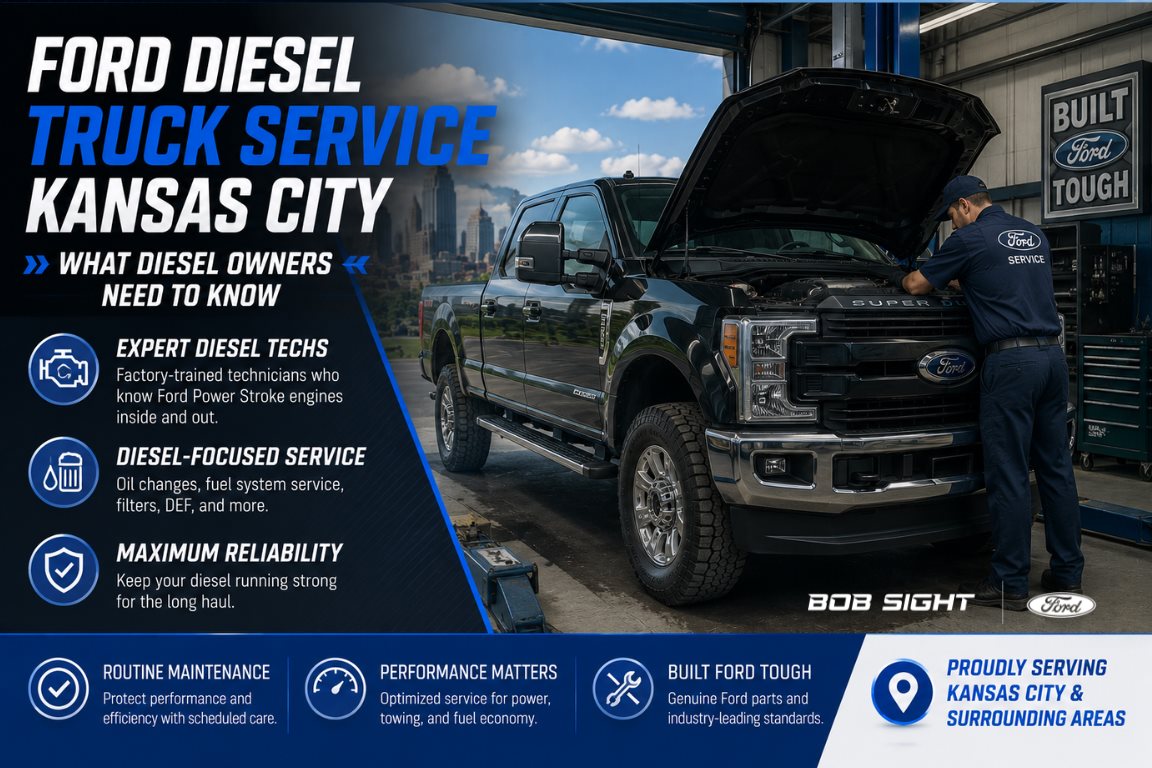
At Bob Sight Ford in Lee's Summit, Missouri, our factory-certified diesel master technicians provide specialized maintenance and repair services for Power Stroke owners across the Kansas City Metro. Maintaining a modern high-output turbo diesel truck like the Ford Super Duty F-250, F-350, or commercial F-450 requires a far more precise service strategy than a standard gasoline pickup. Whether you haul heavy gooseneck trailers along Interstate 470, manage a commercial fleet near the Summit Fair shopping area, or tow agricultural loads across Jackson County on US-50, staying ahead of scheduled maintenance prevents costly injector failures, turbocharger damage, and emissions system shut-downs. In this comprehensive maintenance resource, our certified diesel specialists break down key Power Stroke service requirements, fluid specifications, fuel filtration protocols, and seasonal prep strategies designed for Midwest driving conditions.
In this guide you will learn:
- The essential routine service intervals required to keep 6.7L Power Stroke Turbo Diesel engines running at peak efficiency.
- How high-pressure common rail (HPCR) fuel systems depend on regular fuel filter changes and water separator drainage.
- Step-by-step procedures for managing Diesel Exhaust Fluid (DEF) and maintaining Diesel Particulate Filter (DPF) regeneration.
- Key operational differences between 15W-40 heavy-duty oil and 5W-40 full synthetic lubricants for Missouri winters.
- A step-by-step pre-winter diesel preparation checklist to ensure reliable cold-weather starts across western Missouri.
- Plain-language definitions of critical diesel components including cetane ratings, variable-geometry turbochargers, and EGR coolers.
Essential Service Requirements for 6.7L Power Stroke Engines
Maintaining a 6.7L Power Stroke Turbo Diesel engine requires strict adherence to factory maintenance intervals for engine oil, fuel filters, coolant chemistry, and crankcase ventilation. Unlike gasoline engines that tolerate minor maintenance delays, modern high-pressure diesel engines operate under extreme internal combustion pressures and high thermal loads. Neglecting routine fluid changes or using improper oil viscosities leads directly to oil shear, soot accumulation, and premature turbocharger bearing wear. Establishing a routine maintenance schedule with an authorized Ford service center preserves your engine's output, fuel economy, and factory warranty coverage.
Engine oil selection is particularly critical for 6.7L Power Stroke engines operating in the varied climate of the Kansas City Metro. Ford factory engineers specify motor oils meeting Ford Material Specification WSS-M2C171-F1 and API CK-4 standards. Using approved heavy-duty diesel oils protects high-pressure valve trains, turbocharger shaft bearings, and wrist pins from mechanical wear caused by soot suspension. Furthermore, replacing the engine oil filter every 5,000 to 7,500 miles removes abrasive carbon particulates before they circulate through sensitive engine passages.
Real-world commercial work across Jackson County places heavy demands on diesel cooling and lubrication systems. For example, a Super Duty truck towing a tandem-axle machinery trailer along I-70 near Blue Springs generates massive exhaust gas temperatures (EGTs). The 6.7L Power Stroke utilizes a dual-cooling system with separate high-temperature and low-temperature radiator circuits to cool the engine block, charge air cooler, transmission fluid, and fuel cooler simultaneously. Having certified technicians test coolant nitrite levels and perform multi-point inspections during routine service visits protects these vital cooling loops from internal cavitation and corrosion.
Understanding Diesel Fuel Systems, Water Separators, and Fuel Filters
High-pressure common rail (HPCR) fuel systems operate at pressures up to 36,000 PSI, making ultra-clean fuel and regular water separator maintenance vital for fuel injector longevity. Modern Bosch fuel injection pumps and piezo fuel injectors rely entirely on ultra-low sulfur diesel (ULSD) fuel for internal lubrication. Microscopic water droplets, dirt particles, or algae growth drawn from contaminated fuel tanks can cause catastrophic metal-on-metal abrasion inside the high-pressure pump, sending metal filings through the entire fuel rail system. Replacing fuel filters regularly is the single most effective way to prevent multi-thousand-dollar fuel system repairs.
Ford Super Duty trucks feature a two-stage fuel filtration setup consisting of a primary fuel filter and water separator mounted on the frame rail, along with a secondary fine-particulate filter mounted on top of the engine intake manifold. The primary filter separates entrained water from diesel fuel and traps particles down to 10 microns, while the secondary filter traps particles as small as 4 microns before fuel enters the high-pressure pump. Ford specifies replacing both fuel filters every 15,000 miles or every third oil change, whichever comes first.
Driver habits in Lee's Summit directly impact fuel system health, especially during wet spring seasons and cold winter snaps. Moisture condenses inside ambient storage tanks at local filling stations and inside your truck's fuel tank as temperatures fluctuate along MO-291. Draining the primary frame-mounted water separator monthly using the built-in drain valve prevents water from reaching the fuel injectors. If the Water-In-Fuel (WIF) warning light illuminates on your instrument cluster while driving along Chipman Road, draining the separator immediately prevents engine damage and keeps your fuel pump protected.
Step-by-Step Guide to Maintaining Your Ford Diesel Emissions System
Proper maintenance of the Diesel Exhaust Fluid (DEF) system and Diesel Particulate Filter (DPF) ensures clean exhaust emissions while preventing engine power derate conditions. Modern Ford diesel trucks utilize Selective Catalytic Reduction (SCR) and active DPF regeneration cycles to reduce nitrogen oxides (NOx) and soot particles to near-zero levels. Understanding how these emissions control systems operate helps owners prevent unexpected warning messages and limp-mode speed restrictions. Below is the step-by-step maintenance routine for managing your truck's emissions assembly.
- Refill Diesel Exhaust Fluid (DEF) with API-Certified Solution: Monitor your DEF gauge on the instrument cluster, refilling the reservoir with fresh Motorcraft or API-certified ISO 22241 DEF before the fluid level drops below quarter-tank.
- Allow Active DPF Regeneration Cycles to Complete: When the instrument cluster displays "Exhaust Filter Overloaded - Drive to Clean," drive the truck at highway speeds along I-470 or US-50 for 20 to 30 minutes to allow exhaust temperatures to burn off accumulated soot.
- Inspect the DEF Filler Neck and Cap for Crystal Buildup: Clean away white urea crystal buildup around the DEF fill port using warm water and a clean microfiber cloth to prevent debris from falling into the tank.
- Perform Occasional Heavy Towing or Highway Runs: Periodically towing heavy loads raises exhaust gas temperatures naturally, enabling passive regeneration that keeps the DPF clean without consuming extra fuel.
- Schedule Professional Emissions System Diagnostic Checks: Have certified technicians scan the Powertrain Control Module (PCM) for pending reductant heater or soot load codes during annual service visits to catch sensor drift early.
Following these maintenance steps protects your truck from frustrating speed limitations on Missouri roadways. For example, a commercial truck operating frequently on short stop-and-go delivery routes around Raytown may struggle to achieve the high exhaust temperatures required for passive DPF cleaning. The PCM responds by injecting small amounts of diesel fuel into the exhaust stream to trigger active regeneration while driving.
If a truck is repeatedly turned off mid-regeneration, soot accumulates inside the ceramic filter matrix, eventually requiring a manual stationary regeneration in the service bay. Partnering with Bob Sight Ford ensures your emissions system sensors, DEF heaters, and pressure lines remain fully functional so your truck stays ready for heavy work.
Comparing Synthetic vs Conventional Diesel Engine Oils for Midwest Weather
Choosing between 15W-40 conventional diesel oil and 5W-40 full synthetic oil depends on seasonal temperature swings, towing frequency, and cold-start demands in Kansas City. Heavy-duty diesel engines require high oil film strength to protect bearings under heavy loads, yet they also need low-temperature fluidity to allow rapid oil pressure build-up during sub-zero morning starts across Jackson County. Evaluating viscosity ratings ensures your engine receives optimal protection year-round.
To help you compare popular diesel engine oil formulations clearly, review the operational specifications outlined in the comparison table below:
| Engine Oil Formulation | Viscosity & Specification Rating | Cold Weather Operating Limits | Best Suited Application Profile |
|---|---|---|---|
| Conventional Heavy-Duty Diesel Oil | SAE 15W-40 (API CK-4 / WSS-M2C171-F1) | Suitable for ambient temps above 20°F (-7°C) | Warm summer driving, heavy highway towing, cost-effective warm-weather maintenance |
| Synthetic Blend Diesel Oil | SAE 10W-30 (API CK-4 / WSS-M2C171-F1) | Suitable for ambient temps down to 0°F (-18°C) | Balanced year-round daily driving, moderate towing, reliable mid-temperature performance |
| Full Synthetic Heavy-Duty Diesel Oil | SAE 5W-40 (API CK-4 / WSS-M2C171-F1) | Exceptional flow down to -30°F (-34°C) | Severe cold winter starts, extreme commercial towing, maximum turbocharger protection |
| Ultra-Low Viscosity Fuel Economy Oil | SAE 5W-30 (API FA-4 / Spec Specific) | Controlled low-temp flow characteristics | Select late-model light-duty commercial applications prioritizing maximum fuel economy |
Consider a practical scenario involving a Super Duty contractor operating near Grain Valley during a freezing January cold snap. Using conventional 15W-40 oil in sub-zero weather causes high oil viscosity and slow cranking speeds, putting extreme electrical stress on starter motors and batteries. Switching to Motorcraft 5W-40 Full Synthetic Diesel Oil provides rapid oil circulation to turbocharger bearings within seconds of ignition, drastically reducing cold-engine wear.
Conversely, during hot July weather when towing heavy livestock or machinery trailers along Highway 150, full synthetic oils maintain superior thermal shear resistance compared to conventional formulations. Synthetic molecules resist oxidation and thermal breakdown under high oil sump temperatures, keeping your engine clean and well-protected regardless of load demands.
Step-by-Step Diesel Pre-Winter Maintenance Checklist
Preparing your Ford diesel truck for severe Missouri winters involves servicing the glow plug system, testing Dual-AGM batteries, checking anti-gel additives, and verifying engine block heater function. Cold temperatures reduce battery cranking amperage significantly while simultaneously causing untreated diesel fuel to wax and clog fuel filters. Following a structured winterization checklist before the first freeze guarantees your truck starts reliably every morning.
- Perform Dual-Battery Digital Conductance Testing: Test cold cranking amps (CCA) on both 12-volt AGM batteries simultaneously, replacing aged or weak batteries in pairs to prevent starter motor damage.
- Inspect Glow Plugs and Glow Plug Control Module (GPCM): Scan the engine control system for hidden glow plug resistance fault codes, replacing faulty glow plugs to ensure efficient cylinder pre-heating.
- Treat Diesel Fuel with Anti-Gel and Cetane Improver: Add Motorcraft Anti-Gel & Cetane Improver to your fuel tank prior to filling up when ambient temperatures are forecasted to drop below 32°F (0°C) to prevent fuel gelling.
- Test Engine Block Heater Cord and Element: Inspect the front bumper block heater plug for corrosion, testing heating element resistance to ensure reliable warm-block heating during sub-zero nights.
- Install Fresh Fuel Filters and Drain Water Separator: Replace primary and secondary fuel filters and drain all water from the frame-mounted separator to prevent ice crystals from blocking fuel lines.
Applying this winter preparation routine keeps commercial fleets and personal trucks moving safely across Lee's Summit during winter storms. For example, a contractor parking their F-350 outdoors near Highway 50 can plug in their engine block heater 2 to 3 hours before starting work on a 10-degree morning. Pre-heating the engine coolant reduces battery drain, speeds up cabin heater delivery, and minimizes cold-start cylinder wear.
Furthermore, adding Anti-Gel additive before temperature drops prevents paraffin wax molecules in diesel fuel from solidifying inside the fuel filter media. Taking these simple preventative steps ensures your Power Stroke starts instantly, keeping your workday on schedule regardless of winter weather.
Understanding Key Diesel Technical Terms: Cetane, Turbo VGT, and EGR
Understanding plain-language definitions of specialized diesel engineering terms helps owners communicate effectively with service advisors and make informed maintenance choices. Modern Ford diesel trucks incorporate sophisticated mechanical, hydraulic, and electronic components that operate differently from gasoline engine systems. Defining these key technical terms builds confidence when planning routine truck care.
- Cetane Number: A measurement rating of diesel fuel ignition quality and combustion speed; higher cetane numbers (45 to 50+) result in smoother combustion, faster cold starts, and reduced engine noise.
- Variable-Geometry Turbocharger (VGT): A high-tech turbocharger that utilizes electronically controlled internal vanes to adjust exhaust gas velocity, delivering rapid low-RPM throttle response and high-RPM horsepower.
- Exhaust Gas Recirculation (EGR) Cooler: A heat exchanger that recirculates cooled exhaust gases back into engine cylinders to lower combustion temperatures and reduce nitrogen oxide (NOx) emissions.
- High-Pressure Common Rail (HPCR): An advanced fuel injection architecture that stores diesel fuel in a shared high-pressure rail before injecting precise multi-stage fuel charges directly into combustion chambers.
- Regeneration (Regen): The automated high-temperature process of burning trapped carbon soot accumulated inside the Diesel Particulate Filter (DPF) into harmless ash.
Understanding these concepts highlights why specialized maintenance is so valuable for Power Stroke owners. For instance, the Variable-Geometry Turbocharger (VGT) on a 6.7L engine utilizes delicate internal vanes moved by a hydraulic actuator. Using clean, un-sheared engine oil prevents carbon soot and varnish from sticking to the VGT vane assembly, ensuring smooth turbo boost delivery across all engine speeds.
Similarly, understanding cetane ratings explains why treating winter fuel with Motorcraft Cetane Booster improves engine smoothness and throttle response during drives along NW Blue Parkway. Plain-language technical clarity allows owners to protect their investment and optimize vehicle performance.

Quick Facts: Ford Diesel Truck Service at a Glance
Essential service parameters and factory specifications summarize core maintenance requirements for Ford Power Stroke trucks. Reviewing these key metrics helps owners track service schedules and maintain factory standards effortlessly. Below is a summary of core diesel service facts:
- Engine Oil Capacity: 6.7L Power Stroke engines require 13.0 quarts of approved engine oil with filter replacement.
- Fuel Filter Service Interval: Replace primary and secondary fuel filters every 15,000 miles or every third oil change.
- Primary Oil Specification: Requires oils meeting Ford WSS-M2C171-F1 and API CK-4 quality standards (15W-40, 10W-30, or 5W-40).
- Water Separator Drain Schedule: Drain frame-mounted water separator valve monthly or immediately when the WIF light illuminates.
- DEF Reservoir Capacity: Standard Super Duty DEF tanks hold approximately 7.4 gallons of API-certified Diesel Exhaust Fluid.
- Dual AGM Battery Maintenance: Replace dual 12-volt batteries in pairs to maintain balanced electrical current for high-draw glow plugs.
These factory engineering benchmarks emphasize the importance of precision care for heavy-duty trucks. Whether you use your Super Duty for commercial towing or weekend hauling across western Missouri, following these guidelines preserves long-term durability. Our service specialists at Bob Sight Ford are always available to review your service history and customize a maintenance plan for your truck.
Long-Term Ownership Planning and Commercial Fleet Strategy
Developing a long-term maintenance strategy with an authorized Ford dealer protects commercial uptime, reduces operating costs per mile, and maximizes trade-in value. Commercial trucks and heavy-duty personal pickups represent significant capital investments. Unplanned roadside breakdowns on major corridors like I-470 or US-50 cause missed contract deadlines, expensive towing fees, and lost business revenue. Establishing a structured preventative maintenance schedule with Bob Sight Ford ensures your truck remains dependable year after year.
Proactive fleet care involves conducting thorough multi-point inspections during every routine oil service. Certified technicians inspect serpentine drive belts, tensioner pulleys, brake pad thickness, steering linkage play, and universal joints to identify wear before components fail on the jobsite. Furthermore, tracking oil analysis reports over time can reveal microscopic metal wear trends or fuel dilution issues early, allowing for planned maintenance rather than emergency overhauls.
Maintaining full service documentation at an authorized dealership significantly enhances your truck's market value when it comes time to trade up. A complete CARFAX service history showing regular oil changes, fuel filter replacements, and emissions maintenance using genuine Motorcraft parts proves to future buyers that the truck was meticulously cared for. Proactive ownership care keeps your business moving forward while protecting your financial investment.
Frequently Asked Questions About Ford Diesel Truck Service in Kansas City
How often should I change the fuel filters on my 6.7L Power Stroke in Kansas City?
You should replace both primary and secondary fuel filters on your 6.7L Power Stroke diesel every 15,000 miles or every third oil change, whichever comes first. Ford diesel trucks utilize a two-filter system designed to protect ultra-precise high-pressure fuel injectors from microscopic dirt particles and moisture. Driving in western Missouri exposes trucks to humidity and variable bulk fuel quality, making strict adherence to fuel filter replacement schedules essential.
Delaying fuel filter changes causes fuel pressure drops across the high-pressure injection pump, leading to engine hesitation under load, poor acceleration, and potential fuel pump cavitation. The primary filter on the frame rail separates water and coarse debris, while the engine-mounted secondary filter traps fine particulates down to 4 microns. Replacing both filters simultaneously using genuine Motorcraft elements ensures maximum fuel flow and pressure stability.
Pro-Tip from the Bob Sight Service Bay: If you operate your truck in severe commercial environments—such as dusty construction sites near MO-291 or agricultural fields in Jackson County—consider shortening your fuel filter replacement interval to every 10,000 to 12,000 miles. Fresh filters are cheap insurance against high-pressure fuel pump damage.
What causes the "Exhaust Filter Overloaded" message on my Ford Super Duty dashboard?
The "Exhaust Filter Overloaded" message indicates that soot accumulation inside your Diesel Particulate Filter (DPF) has reached a level requiring immediate high-speed driving to complete an active regeneration. The DPF traps unburned carbon soot particles from engine exhaust. Under normal highway driving along I-470 or US-50, hot exhaust gases burn off trapped soot automatically through passive regeneration.
However, if your truck is driven primarily on short trips around Lee's Summit, idled for extended periods on jobsites, or driven at low city speeds, the exhaust system never reaches the temperatures needed to clear the filter naturally. The Powertrain Control Module (PCM) then initiates an active regeneration by injecting extra fuel into the exhaust stream to raise filter temperatures to approximately 1,100°F. If short driving cycles repeatedly interrupt active regeneration, the soot load builds up, triggering the dashboard warning message.
To clear the message safely, drive your truck at highway speeds (50 MPH or higher) continuously for 20 to 30 minutes until the screen updates. If the message is ignored, the filter will become fully clogged, forcing the engine into reduced-power limp mode and requiring a manual service-bay regeneration at Bob Sight Ford.
Can I use standard 15W-40 oil in my Ford diesel truck during Missouri winters?
While conventional 15W-40 oil is suitable for warm summer weather, using 5W-40 full synthetic or 10W-30 synthetic blend oil is strongly recommended during freezing Missouri winter months. Standard 15W-40 conventional diesel oil thickens significantly when ambient temperatures drop below 20°F (-7°C), increasing oil viscosity and slowing oil circulation during cold engine starts.
When starting a cold Power Stroke engine in freezing winter weather near Summit Fair, low-viscosity 5W-40 full synthetic oil flows rapidly to upper valve trains and turbocharger bearings, delivering instant lubrication pressure. Synthetic formulations also reduce internal starter motor drag, allowing the engine to turn over faster and start easily without straining dual AGM batteries.
Missouri Seasonal Maintenance Alert: Switching to Motorcraft 5W-40 Full Synthetic Diesel Oil during your autumn oil change service ensures your truck is prepped for sub-zero winter mornings. Synthetic oil maintains film strength across both extreme cold starts and heavy summer towing loads.
Why is my Ford diesel truck having trouble starting on cold mornings in Lee's Summit?
Cold-start difficulties on Ford diesel trucks are typically caused by weak dual batteries, failing glow plugs, a faulty glow plug control module, or gelled fuel. Diesel engines rely on high cylinder compression and heat to ignite fuel. When ambient temperatures drop in Jackson County, cold metal cylinder walls absorb heat rapidly, requiring functional glow plugs to pre-heat combustion chambers before cranking.
Additionally, Ford diesel trucks utilize two high-capacity 12-volt batteries wired in parallel to power heavy electrical cranking loads and glow plug heating elements simultaneously. If one battery develops a weak cell, total cold cranking amperage drops, resulting in slow engine turnover. Un-treated summer-blend diesel fuel can also begin gelling at temperatures below 32°F, waxing fuel filter media and starving the engine of fuel.
If your truck cranks slowly or produces white exhaust smoke upon cold starting, visit Bob Sight Ford for a digital battery conductance test and glow plug diagnostic check. Installing fresh dual AGM batteries and treating your fuel tank with Motorcraft Anti-Gel eliminates cold-start headaches.
Why should I choose Bob Sight Ford for my Power Stroke diesel service instead of a general repair shop?
Bob Sight Ford employs factory-certified diesel master technicians equipped with specialized Ford diagnostic systems, heavy-duty service lifts, and genuine Motorcraft OEM parts. Modern 6.7L Power Stroke engines feature complex high-pressure fuel systems, twin cooling loops, and sophisticated emissions controls that require specialized factory training and diagnostic software (IDS and FDRS) to service correctly.
General repair shops or quick-lube outlets often lack specialized diesel diagnostic tools, factory technical service bulletins (TSBs), and specific Ford fluid specification knowledge. Servicing your diesel truck at Bob Sight Ford guarantees that repairs are completed using exact-fit Motorcraft components backed by a 2-year/unlimited-mileage factory parts and labor warranty nationwide.
Located conveniently at 610 NW Blue Parkway in Lee's Summit, Bob Sight Ford offers commercial vehicle Bay priority, Ford Mobile Service vans, and pre-arranged pickup and delivery options to minimize business downtime. Trusting our certified diesel team keeps your Super Duty performing reliably for the long haul.
Why Local Certified Diesel Service Matters for Kansas City Truck Owners
Servicing your Power Stroke diesel at an established local dealership like Bob Sight Ford guarantees long-term community accountability, dedicated commercial support, and reliable vehicle care. Heavy-duty diesel trucks represent critical tools for local businesses, contractors, and families across Jackson County and western Missouri. Partnering with a neighborhood dealership creates an ongoing relationship focused on keeping your truck safe, powerful, and dependable on every job.
Located conveniently at 610 NW Blue Parkway in Lee's Summit, Missouri, Bob Sight Ford has served commercial drivers and fleet owners across the Kansas City Metro for generations. Our proximity to major transportation corridors like US-50, I-470, MO-291, and I-70 makes dropping off your Super Duty for routine service, fuel filter changes, or specialized diagnostics fast and convenient. Our heavy-duty service bays are staffed by master diesel technicians who understand the demands of Midwest trailering and seasonal weather shifts.
Choosing a local dealership connects you with valuable ownership amenities including Quick Lane Tire & Auto Center service, Ford Mobile Service vans, and pre-arranged pickup and delivery options. Our staff lives and works right here in western Missouri, giving us first-hand understanding of what local truck owners need to stay productive. We invite you to visit Bob Sight Ford today to experience customer-first diesel care built around your schedule.
Helpful Links
- Schedule Certified Ford Diesel Service & Maintenance Online
- View Current Ford Service Specials & Maintenance Coupons
- Order Genuine Motorcraft OEM Diesel Parts & Fuel Filters
- Learn About Ford Mobile Service & Pickup Delivery Options
- Explore New Ford Super Duty Diesel Truck Inventory in Lee's Summit
Proud to Be Part of the Bob Sight Auto Group
Bob Sight Ford is proud to be a member of the Bob Sight Auto Group, serving drivers throughout Missouri and Kansas with trusted automotive sales, service, and financing support for over a century. Our dealership group operates four convenient retail locations across the region, delivering honest guidance, transparent pricing, and customer-focused service to every community we serve.
Explore all of our Bob Sight Auto Group dealership locations below: