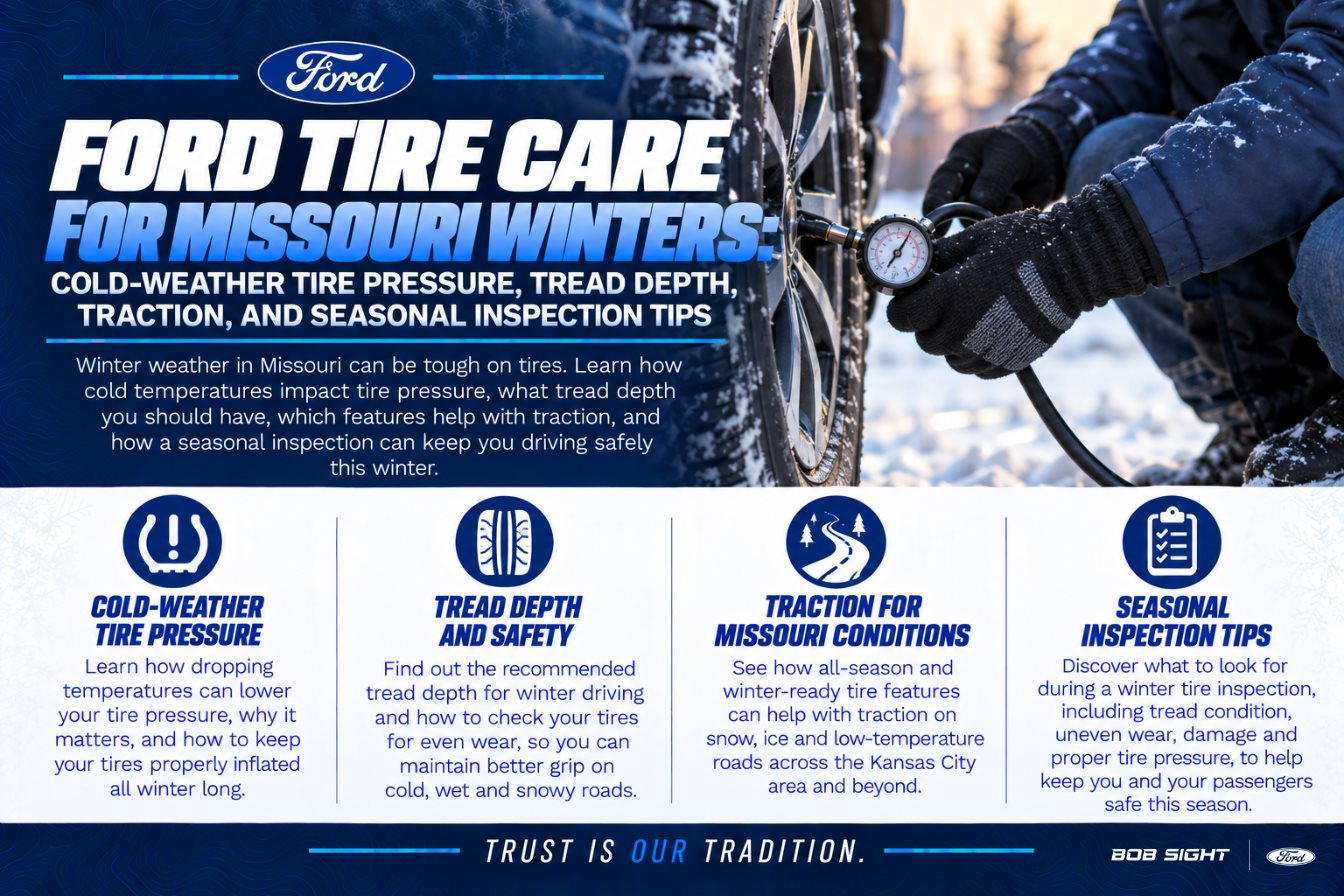
Ford Tire Care for Missouri Winters: Cold-Weather Tire Pressure, Tread Depth, Traction, and Seasonal Inspection Tips
Schedule Ford Tire Service in Lee’s Summit
Missouri winter tire care starts with maintaining the correct cold tire pressure, checking tread condition before snow and ice arrive, watching for uneven wear, and understanding that AWD or 4x4 cannot compensate for tires that no longer provide adequate grip. For Ford owners in Lee’s Summit, Blue Springs, Independence, Raytown, Grandview, Belton, Liberty, and throughout the Kansas City Metro, winter can bring freezing mornings, rapid temperature swings, wet pavement, slush, snow, ice, potholes, and road debris within the same season. Those conditions make tire maintenance a critical part of cold-weather vehicle ownership. Checking your tires before winter becomes severe can help improve predictable handling, braking, and everyday confidence on Missouri roads.
In This Guide You’ll Learn
This guide focuses specifically on tire care for Ford owners preparing for winter driving around Lee’s Summit and the Greater Kansas City Metro.
- Why tire pressure changes as Missouri temperatures fall
- How to find the correct tire pressure for your Ford
- Why tread depth matters for snow, slush, and standing water
- How uneven tread wear can reduce winter traction
- Why AWD and 4x4 still depend on tire grip
- How all-season, all-weather, and winter tires differ
- What to inspect before the first major cold snap
- How potholes and Missouri winter roads can affect alignment and tire condition
- When tire rotation, replacement, or professional inspection may be appropriate
Why Does Tire Pressure Drop During Missouri Cold Weather?
Tire pressure typically decreases as outdoor temperatures fall because the air inside the tire contracts in colder conditions. This is one reason Ford owners may see a tire-pressure warning shortly after the first significant cold front of the season. A tire that was correctly inflated during a warm afternoon can read lower after sitting outside overnight when temperatures drop sharply. Missouri’s frequent fall and winter temperature swings make regular cold-pressure checks particularly useful.
Tire pressure should be checked when the tires are cold, meaning the vehicle has been parked long enough that driving has not significantly heated the tires. Driving causes the air and tire structure to warm, which can temporarily increase the pressure reading. Checking after a long highway drive may therefore produce a different number than checking first thing in the morning. For the most useful comparison, measure cold tire pressure and use the vehicle manufacturer’s recommended specification.
The correct pressure is not the maximum pressure printed on the tire sidewall. The sidewall marking describes tire-related limits, while the Ford vehicle placard provides the recommended cold inflation pressure for the specific vehicle configuration. This information is commonly located on the driver-side doorjamb or door area and should be used along with the owner information for the vehicle.
Imagine leaving Lee’s Summit on a 55-degree afternoon and returning home before a strong cold front moves through Jackson County overnight. By the following morning, temperatures may be well below freezing. A Tire Pressure Monitoring System warning that appears after that change does not necessarily mean a tire suddenly developed a puncture, but it should still be checked. If one tire is substantially lower than the others or continues losing pressure after adjustment, inspection may be needed to identify a leak or other issue.
How Should Ford Owners Check Tire Pressure in Winter?
Ford owners should check tire pressure when the tires are cold, compare each reading with the vehicle-specific specification on the tire placard, and investigate any tire that repeatedly loses pressure. Consistency matters more than simply adding air until a dashboard warning disappears. The goal is to bring each tire to the correct specification and then monitor whether the pressure remains stable.
A quality tire-pressure gauge makes the process straightforward. Remove the valve-stem cap, place the gauge firmly on the valve, record the reading, and compare it with the recommended cold pressure. If air is added, recheck the pressure rather than estimating. Replace the valve cap when finished to help protect the valve from dirt and moisture.
Ford’s Tire Pressure Monitoring System can provide an important warning, but it should not replace periodic manual inspections. The system is designed to alert the driver to significant pressure concerns, not to serve as the only method of routine tire maintenance. A tire can be underinflated relative to its recommended pressure without immediately triggering the warning threshold.
Drivers commuting along I-470, US-50, or Route 291 may experience large temperature differences between a cold morning departure and a warmer afternoon. Avoid repeatedly adjusting the tires based on warm readings throughout the same day. Use cold pressure as the reference and follow the specification for your Ford.
- Park the Ford long enough for the tires to cool.
- Locate the recommended cold tire pressure on the vehicle placard.
- Measure all four tires with a reliable gauge.
- Adjust each tire to the vehicle-specific recommendation as needed.
- Inspect the valve stems and visible tire surfaces while checking pressure.
- Recheck any tire that was significantly lower than the others.
- Schedule an inspection if pressure continues dropping after correction.
Why Does Tread Depth Matter More During Winter?
Tread depth matters during winter because the grooves in the tire must help move water, slush, and loose snow away from the contact area while the tread compound works to maintain grip. A tire with heavily worn tread may still be capable of rolling normally on dry pavement but have less ability to manage winter precipitation. That difference becomes important when Missouri roads transition rapidly between rain, freezing rain, slush, snow, and standing water.
Tread depth is measured in thirty-seconds of an inch in the United States. Tires also include tread-wear indicators molded into the grooves. When the tread wears down near those indicators, replacement should be discussed rather than waiting for winter conditions to reveal the loss of traction. Drivers who routinely encounter snow or heavy rain may choose to replace tires before they reach the absolute minimum wear level because wet- and snow-weather performance can decline as tread depth decreases.
The pattern of the wear matters as much as the remaining depth. A tire that has substantially more tread on one side than the other may indicate alignment, suspension, inflation, or rotation concerns. Cupping, feathering, center wear, edge wear, or isolated bald areas provide clues about how the tire has been operating. Winter is not the ideal season to discover that only part of the tire has adequate tread.
A Ford owner driving from Independence toward Lee’s Summit may encounter wet pavement on one part of US-50 and slushy ramps or neighborhood roads closer to home. Deeper, evenly distributed tread can help the tire manage those transitions more effectively than a tire that has worn unevenly. No tread design can eliminate the need to reduce speed, but tire condition directly affects how much traction is available to work with.
| Tire Condition | What It May Mean | Why It Matters in Winter |
|---|---|---|
| Low overall tread | Tire is approaching replacement | Less ability to manage water, slush, and snow |
| More wear on one edge | Possible alignment or suspension concern | Uneven contact can reduce predictable traction |
| Center wear | Possible inflation-related wear pattern | Reduces usable tread across the tire |
| Cupping or scalloping | Possible suspension, balance, or wear issue | Can affect ride quality and road contact |
| Cracks, bulges, or damage | Potential structural concern | Professional inspection is recommended |
Does AWD or 4x4 Reduce the Need for Good Winter Tires?
No, AWD and 4x4 do not eliminate the need for tires with proper pressure, adequate tread, and appropriate traction characteristics. Drivetrain technology can help distribute engine torque to additional wheels, which may improve the vehicle’s ability to accelerate on slippery surfaces. Braking and cornering still depend heavily on the grip available where each tire contacts the road.
This distinction is important for Ford F-150, Bronco, Bronco Sport, Explorer, Expedition, Maverick, Ranger, Escape, and Super Duty owners. A vehicle may have advanced AWD, 4x4, terrain-management, or traction-control systems, but those systems ultimately work through the tires. If the tires cannot generate sufficient grip, the vehicle’s electronic and mechanical systems have less traction available to manage.
Winter driving provides a simple example. An AWD Ford may pull away from a snowy intersection more confidently than a comparable two-wheel-drive vehicle under certain conditions, but both vehicles still rely on tire friction to stop. If the road is covered in ice, braking distance can increase substantially regardless of drivetrain. Driver speed, following distance, steering input, and tire condition remain important.
Drivers traveling from Blue Springs to Kansas City sometimes spend long portions of their commute on treated highways and then encounter untreated residential streets near the beginning or end of the trip. AWD or 4x4 can be valuable during these transitions, but the tires remain the connection between the vehicle and pavement. Keeping them properly maintained allows the drivetrain and stability-control systems to operate with the best traction the tires can provide.
All-Season, All-Weather, or Winter Tires: What Should Missouri Drivers Consider?
The right tire type depends on your Ford, driving schedule, road conditions, storage situation, and how often you expect to drive during snow, ice, and sustained cold temperatures. Many Missouri drivers use all-season tires year-round, while others may benefit from all-weather or dedicated winter tires depending on their routes and tolerance for severe-weather driving. Tire category alone does not determine quality, so the specific tire model and application still matter.
All-season tires are designed to provide balanced performance across a broad range of normal conditions. They are commonly installed on many passenger vehicles and SUVs and may be appropriate for drivers who primarily use plowed urban and suburban roads. Performance varies substantially among specific all-season tire models, which is why the category should not be treated as a single level of winter capability.
All-weather tires are designed for year-round use while typically offering greater cold- and snow-weather emphasis than a traditional all-season design. Many carry the Three-Peak Mountain Snowflake symbol when they meet applicable severe-snow performance criteria. That symbol can help shoppers distinguish tires designed to meet a defined snow-traction test from generic marketing terms.
Dedicated winter tires are designed to maintain flexibility and traction characteristics in colder conditions and use tread patterns and compounds specifically optimized for winter performance. They can be useful for drivers who must travel during snow events or regularly encounter untreated roads. The tradeoff is that they are seasonal tires and generally require a second set of tires or wheels plus storage when temperatures rise.
A commuter living in Lee’s Summit and working in downtown Kansas City may have different needs from someone whose daily route includes rural areas beyond Grain Valley or roads that are plowed later. The decision should consider when you can avoid severe weather, not just whether snow occurs in Missouri. A driver who can stay home during major storms may prioritize differently from a healthcare worker, utility employee, first responder, or other owner who must travel regardless of conditions.
How Can Missouri Potholes Affect Ford Tires and Alignment?
Winter potholes can damage tires, wheels, suspension components, and alignment, making post-impact inspection important when a Ford begins pulling, vibrating, or showing new tire-pressure problems. Freeze-and-thaw cycles can accelerate pavement deterioration, and roads throughout the Kansas City Metro often become rougher as winter progresses. A pothole impact that seems minor from the driver’s seat can still affect the tire or wheel.
After a significant pothole impact, inspect the tire sidewall for cuts, bulges, or other visible damage. Also pay attention to whether the steering wheel is now off-center, the vehicle pulls in one direction, vibration appears at certain speeds, or a tire begins losing pressure. Those symptoms can indicate a problem that deserves professional inspection.
Alignment refers to the angles at which the wheels are positioned relative to the vehicle and road. Proper alignment helps the tires contact the road as intended and wear evenly. A hard pothole impact can sometimes disturb alignment, which may lead to uneven wear if it is not corrected. Because winter already reduces available traction, preserving even tire contact becomes particularly important.
Consider a driver traveling along a rough section of road after several freeze-thaw cycles near Raytown or Independence. If the vehicle strikes a pothole hard enough to produce an immediate steering vibration, continuing for months without inspection could allow a tire or alignment issue to worsen. Addressing the change early can protect tire life and help maintain predictable handling.
Why Is Tire Rotation Important Before and During Winter?
Regular tire rotation can help distribute wear more evenly, allowing all four tires to maintain more consistent tread characteristics as winter progresses. The recommended rotation pattern and interval depend on the Ford, tire type, drivetrain, and tire manufacturer requirements, so owners should follow the guidance for their specific vehicle and tires.
Front and rear tires can wear at different rates because they perform different jobs. Steering, braking, acceleration, drivetrain layout, vehicle weight distribution, and driving style all influence wear. Rotating tires at appropriate intervals helps prevent one axle from reaching an advanced wear level significantly sooner than the other.
Even tread characteristics are valuable during winter because the vehicle’s stability, braking, and traction systems rely on predictable behavior from all four corners. Large differences in tread depth can affect how tires respond in rain, slush, or snow. AWD vehicles can also have specific requirements regarding tire circumference differences, making consistent tire condition important beyond simple tread appearance.
A Ford owner who drives thousands of miles between Lee’s Summit, Overland Park, Olathe, and Kansas City can accumulate substantial mileage during a winter season. Tire wear does not stop simply because temperatures are lower. Including rotation in routine maintenance planning can help maintain even tread while also creating regular opportunities to inspect the tires for damage.
- Review the tire-rotation interval for your specific Ford and tires.
- Measure tread depth at multiple points across each tire.
- Compare front and rear wear patterns.
- Inspect for cuts, punctures, sidewall damage, or irregular wear.
- Check cold tire pressure after rotation.
- Reset or relearn tire-pressure systems when required for the vehicle.
- Investigate unusual wear instead of assuming rotation alone will correct it.
What Should a Ford Winter Tire Inspection Include?
A useful winter tire inspection should include pressure, tread depth, tread-wear pattern, sidewalls, valve stems, wheel condition, tire age, and signs of puncture or impact damage. Looking only at whether the tire appears inflated can miss several conditions that affect winter performance. A few minutes of inspection before temperatures fall can reveal concerns that are easier to address before a snow event.
Begin with pressure and tread. Measure the tires cold, compare the readings with the Ford specification, and inspect tread across the entire width rather than checking only the easiest visible groove. Uneven wear can hide on an inside edge, particularly if alignment has been incorrect for some time.
Next inspect the sidewalls. Look for cracks, cuts, bulges, abrasions, or objects that may have damaged the tire. A bulge can indicate internal structural damage and should not be ignored. Wheels should also be checked after known pothole impacts, curb strikes, or other events that could cause bending or damage.
Tire age can also provide useful context. The Department of Transportation tire identification code includes manufacturing information, but age alone does not determine whether a tire is safe or unsafe. Tire manufacturers provide guidance on inspection and replacement based on age, condition, use, and storage. If the tire’s history is uncertain, professional inspection can help.
For Ford owners around Grandview, Belton, Liberty, and Lee’s Summit, a seasonal inspection can also create a maintenance baseline. Knowing your tire pressure, approximate tread condition, and wear pattern before winter begins makes it easier to recognize changes later. That is more useful than discovering a problem after traction has already deteriorated.
Quick Facts About Ford Tire Care for Missouri Winters
Winter tire maintenance is about preserving consistent road contact, predictable handling, and adequate tread before Missouri roads become cold, wet, snowy, or icy. The key points apply whether your Ford uses front-wheel drive, rear-wheel drive, AWD, or 4x4.
- Tire pressure generally decreases as temperatures fall.
- Check tire pressure when the tires are cold.
- Use the vehicle placard specification, not the maximum pressure printed on the tire sidewall.
- A TPMS warning should prompt a pressure check rather than simply adding air without measuring.
- One tire losing pressure repeatedly may have a puncture, valve, wheel, or sealing issue.
- Tread depth affects the tire’s ability to manage rain, slush, and snow.
- Uneven wear can indicate alignment, suspension, inflation, or rotation concerns.
- AWD and 4x4 do not replace adequate tire grip.
- All-season, all-weather, and winter tires serve different ownership needs.
- The Three-Peak Mountain Snowflake symbol identifies tires that meet applicable severe-snow performance criteria.
- Winter potholes can damage tires, wheels, and alignment.
- Regular rotation can help maintain more even tread wear.
- Visible sidewall bulges, cuts, or other damage should be inspected promptly.
- The exact tire requirements for your Ford depend on model, configuration, tire size, and intended use.
For Kansas City Metro drivers, these fundamentals can make seasonal tire maintenance much easier to manage. Instead of waiting for the first snowstorm to think about tires, owners can check condition during fall and continue monitoring pressure as temperatures fluctuate throughout winter.
Ownership Planning for Ford Tires Through a Missouri Winter
Long-term tire planning should combine regular pressure checks, rotation, alignment awareness, tread monitoring, and timely replacement rather than waiting until traction becomes noticeably poor. Tires wear gradually, which can make changes easy to overlook. Creating a consistent maintenance routine helps owners recognize deterioration before winter weather magnifies the difference.
Driving patterns matter. A Ford F-150 used on construction sites around Jackson County may encounter gravel, nails, mud, and heavy loads. An Escape commuting between Lee’s Summit and Kansas City may accumulate substantial highway mileage. A Bronco Sport used for weekend trips may spend more time on unpaved surfaces, while an Explorer carrying a family around town may experience frequent stop-and-go traffic. Each use pattern places different demands on tires.
Missouri weather also contributes to wear and maintenance needs. Cold mornings affect pressure, while warmer winter afternoons can raise it again. Snow and ice introduce traction challenges. Road salt, potholes, standing water, and debris can create additional tire and wheel concerns. Owners should respond to the full environment rather than focusing only on snowfall.
Tire maintenance should also coordinate with other winter service. Battery testing, wiper condition, coolant, brakes, exterior lighting, and windshield-washer performance all contribute to cold-weather readiness. Tires are one part of a vehicle-wide system, but they are the only components directly connecting the Ford to the road.
Ford owners can review current Ford service and parts specials when planning seasonal maintenance. Bob Sight Ford also provides Ford Pickup & Delivery availability for eligible service situations, which can make routine maintenance easier to fit around work, family, and winter schedules.
Frequently Asked Questions About Ford Tire Care in Missouri Winters
Why does my Ford tire-pressure light come on when it gets cold?
A Ford tire-pressure warning may appear during cold weather because the pressure inside the tires decreases as temperatures fall. Rapid Missouri temperature drops can make this particularly noticeable during fall and early winter. The warning should still be treated as a reason to measure the tires rather than assuming temperature is the only cause.
Check all tires cold and compare them with the pressure specified on the Ford vehicle placard. If they are uniformly low after a major temperature drop, correct them to the recommended cold pressure. Do not use the maximum sidewall pressure as the target.
If one tire around Lee’s Summit repeatedly loses more pressure than the others, an inspection may be appropriate. A puncture, valve-stem issue, wheel problem, or bead-sealing concern can cause ongoing pressure loss. Temperature-related changes tend to affect all tires, while a single continuously low tire deserves additional attention.
How often should I check tire pressure during a Missouri winter?
Ford owners should check tire pressure regularly throughout winter and after major temperature changes rather than waiting solely for the TPMS warning light. A monthly check is a practical routine for many drivers, with additional checks before long trips or after significant cold fronts. Vehicle and tire conditions may justify more frequent monitoring.
Always perform the comparison using cold tires when possible. Pressure rises during driving as the tires warm, so warm readings can be misleading when compared with a cold-pressure specification. A small digital or analog gauge kept at home can make routine checks easy.
Drivers commuting from Blue Springs or Independence into Lee’s Summit may experience changing conditions throughout the day. Using a consistent cold-morning check helps remove some of that variability. If pressure changes dramatically without a corresponding temperature shift, have the tire inspected.
Do I need winter tires if my Ford has AWD or 4x4?
AWD or 4x4 does not automatically eliminate the potential benefit of winter-oriented tires because drivetrain systems and tires perform different jobs. AWD and 4x4 can help distribute propulsion, while tires provide the actual grip used for acceleration, steering, and braking. The appropriate tire type depends on where, when, and how you drive.
Some Kansas City drivers may be well served by quality all-season tires because they primarily travel treated urban and suburban roads and can avoid major storms. Other drivers who must travel during snow or regularly encounter untreated roads may prefer all-weather or dedicated winter tires. There is no single answer for every Ford owner.
Consider your commute, work obligations, road-treatment schedule, storage options, and tolerance for severe-weather travel. A driver on maintained portions of I-470 has different winter needs from someone regularly using rural roads outside the metro. The tire decision should reflect actual exposure rather than drivetrain branding alone.
How do I know if my Ford tires have enough tread for winter?
Check tread depth across multiple areas of each tire and look for both low tread and uneven wear before winter conditions become severe. Tread-wear indicators built into the tire provide a visible reference as the tire approaches its wear limit, but wet- and snow-weather performance can decline before the tread reaches the minimum level.
A tread-depth gauge provides a more precise measurement than visual inspection alone. Check inner, center, and outer tread areas because a tire may wear unevenly. Significant differences across the tire can point toward alignment, suspension, inflation, or rotation issues that should be addressed.
For Lee’s Summit owners preparing for snow and slush, the question should not simply be whether a tire is technically still usable. Consider how much winter driving the tire needs to complete before the next planned replacement. Tires that are already approaching the end of their service life in fall may become a bigger concern by midwinter.
Where can I have my Ford tires inspected near me in Lee’s Summit?
Ford owners can schedule tire inspection and service at Bob Sight Ford in Lee’s Summit. A tire-service visit can evaluate pressure, tread condition, wear patterns, damage, and other concerns that may affect winter driving. If unusual wear is present, additional evaluation may help determine whether alignment, suspension, or another vehicle condition is contributing.
Tell the service team about any recent tire-pressure warnings, pothole impacts, vibration, pulling, steering changes, or repeated pressure loss. Those details can help guide the inspection. If you are considering replacement tires, discuss how you use the vehicle and what winter conditions you expect rather than choosing solely by tire category.
Bob Sight Ford serves Ford owners from Lee’s Summit, Blue Springs, Independence, Raytown, Grandview, Belton, Liberty, and throughout the Greater Kansas City Metro. Addressing tire concerns before Missouri winter becomes severe can make seasonal vehicle preparation more predictable and convenient.
Prepare Your Ford Tires Before Missouri Winter Roads Get Worse
Preparing your Ford for winter starts where the vehicle meets the road: the tires. Correct cold inflation pressure, adequate tread depth, even wear, proper alignment, and damage-free tires give the vehicle’s braking, steering, traction-control, AWD, and 4x4 systems a better foundation to work with. Waiting until snow arrives to inspect worn or underinflated tires can make an already challenging driving situation harder.
Missouri winters are unpredictable. Drivers may encounter rain in the morning, falling temperatures in the afternoon, and icy patches by evening. A week later, the same roads may be dry but full of new potholes. Regular inspection helps owners respond to these changes instead of treating winter tire care as a one-time task.
For drivers throughout Lee’s Summit and the Kansas City Metro, the most practical approach is to inspect tires before the season, monitor pressure as temperatures change, rotate them according to the applicable schedule, and address unusual wear or damage promptly. Those habits can help preserve tire life while supporting more predictable winter handling.
Bob Sight Ford in Lee’s Summit can help Ford owners evaluate tire condition, pressure, tread wear, seasonal maintenance needs, and related vehicle concerns. Whether you drive a Ford truck, SUV, crossover, performance vehicle, or commercial model, maintaining the tires throughout winter is one of the most important steps in keeping the vehicle prepared for Missouri roads.
Helpful Links
- Schedule Ford Service
- Ford Service and Parts Specials
- Ford Pickup & Delivery
- Ford Parts Department
- Bob Sight Ford in Lee’s Summit
Proud to Be Part of the Bob Sight Auto Group
Bob Sight Ford is proud to be part of the Bob Sight Auto Group, serving drivers throughout the Kansas City Metro and surrounding communities with automotive sales, service, parts, financing, and collision repair resources. Our dealerships include Bob Sight Ford in Lee’s Summit, Bob Sight Kia in Independence, Bob Sight Honda in Lawrence, Bob Sight CDJR in Lawrence, and the Bob Sight Collision Center in Lee’s Summit. Whether you are preparing your tires for another Missouri winter or planning routine Ford maintenance throughout the year, our goal is to provide useful local automotive resources throughout your ownership journey.