Ford Transmission Service Kansas City: Early Warning Signs To Watch For
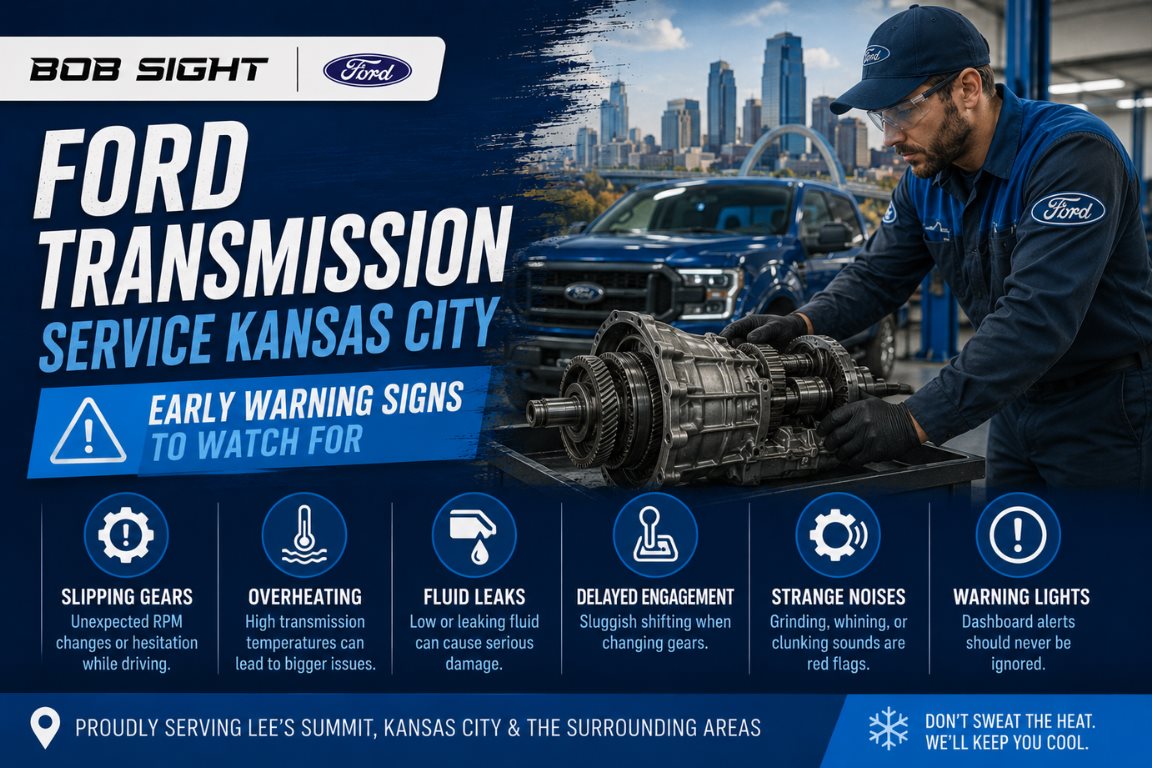
Ford transmission service in Kansas City matters because small shifting symptoms can quickly affect performance, safety, and long-term reliability for drivers across Lee's Summit, Blue Springs, Independence, Raytown, Grain Valley, Belton, and the wider Kansas City Metro. At Bob Sight Ford in Lee's Summit, Missouri, our service team helps Ford owners understand early warning signs before they become larger drivability concerns. If your Ford hesitates, slips, leaks fluid, makes unusual noises, or feels different during acceleration, it is worth scheduling a professional inspection before the issue spreads into additional systems.
Schedule Ford transmission service at Bob Sight Ford
In This Guide You'll Learn
This guide is built to help Kansas City Metro drivers recognize transmission symptoms, understand what they may mean, and know when to schedule Ford service near Lee's Summit.
- Which early transmission warning signs Ford drivers should take seriously
- How slipping, delayed shifting, leaks, noises, and burning smells can point to transmission concerns
- Why Missouri traffic, towing, hills, heat, and winter conditions can affect transmission performance
- What to do step by step when your Ford starts shifting differently
- How Ford-Certified Technicians diagnose transmission concerns
- Why dealership service can provide stronger Ford-specific support than a general repair path
- How to plan transmission maintenance for long-term ownership confidence
Why Ford Transmission Service Should Not Be Delayed
Ford transmission service should not be delayed because the transmission controls how engine power reaches the wheels, and small symptoms can create larger drivability problems when ignored. A transmission does more than shift gears. It helps manage acceleration, cruising, towing response, efficiency, and the smooth power delivery drivers expect from a properly maintained Ford vehicle.
For Kansas City drivers, transmission health is tied closely to daily driving conditions. Stop-and-go traffic near Independence Center, highway merging around the I-470 and US-50 split, and frequent speed changes through Lee's Summit can all require the transmission to shift repeatedly. When fluid condition, sensors, clutch components, valve body function, or software calibration are not working as intended, those conditions can make symptoms more noticeable.
Many Ford vehicles use advanced automatic transmissions that rely on hydraulic pressure, electronic controls, torque management, and precise fluid performance. Transmission fluid is not just a lubricant. It also helps cool internal components, transfer hydraulic force, reduce friction, and support smooth gear engagement. If fluid becomes contaminated, overheated, low, or unable to maintain proper pressure, the transmission may begin to hesitate, slip, shift roughly, or trigger warning lights.
Delaying service can also make diagnosis more complicated. A minor leak or fluid concern may be easier to address early than a condition that has been driven for weeks through Kansas City traffic, summer heat, or repeated towing. Bob Sight Ford helps drivers take a practical approach by inspecting symptoms early and explaining what the vehicle needs without guesswork.
Early Warning Signs Kansas City Drivers Should Watch For
The most common transmission warning signs include slipping gears, delayed shifting, rough engagement, fluid leaks, burning smells, unusual noises, vibration, and warning lights. These symptoms can appear gradually, which is why Ford owners should pay attention when their vehicle begins feeling different during normal driving around the Kansas City Metro.
Transmission concerns often show up during repeatable conditions. You may notice a hesitation when leaving a stoplight near Summit Fair, a clunk when shifting from Park to Drive, or a high-revving feeling while accelerating onto Highway 50. Some symptoms happen only when the vehicle is cold, while others appear after the transmission warms up during a longer commute.
The table below gives drivers a quick way to understand common symptoms and why they matter. This is not a replacement for diagnosis, but it can help you describe what you are experiencing when scheduling service with Bob Sight Ford.
| Warning Sign | What You May Notice | Why It Matters |
|---|---|---|
| Slipping gears | Engine revs rise but speed does not increase normally | May indicate low fluid, worn internal components, pressure issues, or control concerns |
| Delayed shifting | Vehicle pauses before engaging Drive, Reverse, or the next gear | Can point to fluid condition, valve body, sensor, or internal wear concerns |
| Rough shifts | Shifts feel harsh, jerky, or inconsistent | May involve calibration, fluid pressure, mounts, or drivetrain components |
| Fluid leak | Red, reddish-brown, or dark fluid under the vehicle | Low transmission fluid can reduce cooling, lubrication, and hydraulic control |
| Burning smell | Hot or burnt odor after driving | May indicate overheated fluid or excessive friction |
| Warning light | Check engine light or powertrain message appears | Diagnostic codes may identify transmission or related powertrain concerns |
If you notice any of these signs, it is wise to schedule a Ford service appointment before the issue becomes harder to isolate. Ford-Certified Technicians can use diagnostic equipment, road testing, fluid inspection, and system checks to identify the source of the concern.
Transmission Slipping and Delayed Shifting Explained
Transmission slipping means the transmission is not holding or applying the correct gear as expected, while delayed shifting means the vehicle hesitates before changing gears or engaging Drive or Reverse. Both symptoms should be inspected promptly because they can involve fluid pressure, internal wear, electronic controls, or drivetrain load.
Slipping often feels like the engine is working harder than the vehicle response suggests. A driver may press the accelerator, hear the engine rev, and feel the vehicle lag before speed increases. This can be unsettling when merging onto I-435, climbing hills near Raytown, or crossing busy intersections in Lee's Summit.
Delayed shifting can feel different but is just as important. You may shift into Drive and feel a pause before the vehicle moves, or you may notice a delayed upshift during acceleration. In some cases, this delay is more obvious when the vehicle is cold in the morning or after sitting overnight during a Missouri winter.
Several systems can contribute to these symptoms. Low or degraded automatic transmission fluid can reduce hydraulic performance, while worn clutch packs, solenoids, valve body concerns, or software-related issues can also affect shift timing. Because modern Ford vehicles are engineered around precise electronic and mechanical coordination, professional diagnosis is more reliable than guessing from symptoms alone.
Leaks, Fluid Condition, and Overheating Concerns
Transmission fluid leaks and degraded fluid condition can lead to overheating, poor lubrication, weak hydraulic pressure, and accelerated internal wear. Fluid concerns should always be taken seriously because automatic transmission fluid plays several roles inside the transmission at once.
Transmission fluid may appear red, reddish-brown, brown, or dark depending on age, contamination, and heat exposure. A small spot under the vehicle can still matter because even a gradual leak can lower fluid level over time. Drivers in Blue Springs, Grain Valley, and Belton who park in driveways or garages should occasionally check for stains under their Ford, particularly after long drives or towing.
Heat is one of the biggest threats to transmission performance. Kansas City summers, slow traffic, repeated stop-and-go driving, and pulling trailers can raise operating temperatures. When fluid overheats, it can lose protective qualities and may develop a burnt odor. That odor can signal friction or fluid breakdown, both of which deserve timely inspection.
A Ford service center can inspect the source of a leak, evaluate fluid condition, and determine whether the issue involves a seal, cooler line, pan gasket, axle seal, or another related component. Drivers can schedule service online through Bob Sight Ford's service scheduler and explain where the leak appears, when they first noticed it, and whether the vehicle is also shifting differently.
Unusual Noises, Vibration, and Rough Gear Changes
Unusual noises, vibration, and rough gear changes can signal transmission, driveline, mount, or related powertrain concerns that should be diagnosed before they worsen. Grinding, whining, humming, clunking, shuddering, or vibration under acceleration may not always come from the transmission itself, but these symptoms should not be ignored.
Drivers often notice these concerns during predictable moments. A clunk may happen when shifting from Reverse to Drive after backing out of a driveway in Lee's Summit. A whining sound may appear during acceleration on Highway 291. A shudder may happen when cruising at steady speed across the Kansas City Metro or when the vehicle shifts under light throttle.
These symptoms can have several causes. They may involve transmission fluid pressure, torque converter behavior, worn mounts, driveshaft components, differential concerns, wheel and tire issues, or software calibration. This is why a complete inspection is important. A symptom that feels like a transmission issue to the driver may involve another part of the drivetrain.
Ford-Certified Technicians can road test the vehicle and compare the symptom to operating data. They may check for diagnostic trouble codes, inspect fluid condition, verify mounts and driveline components, and evaluate shift behavior under controlled conditions. The goal is to identify the source accurately rather than replacing parts based on a guess.
Step-by-Step: What To Do When Your Ford Starts Shifting Differently
If your Ford starts shifting differently, document the symptom, avoid heavy strain, check for leaks or warning lights, and schedule a professional inspection with a Ford service center. Taking organized action helps protect the vehicle and gives technicians better information when diagnosing the concern.
Transmission concerns can feel stressful, but drivers do not need to panic. The most helpful first step is paying attention to when the symptom happens. A problem that occurs only during cold starts may point technicians in a different direction than one that appears after a long drive through summer traffic near downtown Kansas City.
- Write down the symptom. Note whether the vehicle slips, hesitates, clunks, vibrates, leaks, smells hot, or displays a warning message.
- Identify when it happens. Track whether it appears during acceleration, braking, shifting into Reverse, highway driving, towing, cold starts, or warm operation.
- Look for fluid spots. Check your driveway or parking space for red, brown, or dark stains under the vehicle.
- Avoid extra strain. Until inspected, avoid aggressive acceleration, unnecessary towing, or heavy hauling if the vehicle is showing symptoms.
- Schedule service promptly. Use a Ford service center so technicians can inspect the transmission with Ford-specific knowledge and diagnostic tools.
When you bring your vehicle to Bob Sight Ford, share your notes with the service advisor. Details such as speed, temperature, driving route, load, and symptom frequency help technicians duplicate and diagnose the concern. The more specific you are, the more efficient the inspection process can be.
Dealership Service vs. General Repair for Ford Transmission Concerns
Dealership service can be a strong choice for Ford transmission concerns because Ford-Certified Technicians have access to Ford-specific procedures, diagnostic systems, service information, and OEM-focused repair guidance. A general repair shop may handle many vehicle concerns, but transmission symptoms on modern Ford vehicles often require brand-specific knowledge.
Ford transmissions are engineered to work with the engine, powertrain control systems, sensors, software, and vehicle-specific calibration. A shift concern may involve mechanical wear, but it can also involve module communication, adaptive learning, software updates, fluid specifications, or sensor input. That makes accurate diagnosis important before any repair path is chosen.
Bob Sight Ford can also support maintenance with Motorcraft parts and Ford service information designed for your vehicle. If parts are needed, the Bob Sight Ford Parts Department can help ensure the correct fit and specification. This matters because using the wrong fluid, part, or procedure can affect performance and long-term reliability.
Convenience is another factor. Bob Sight Ford serves drivers from Lee's Summit, Blue Springs, Independence, Raytown, Grain Valley, Belton, and the Kansas City Metro, making it easier to keep service local. Drivers can also review Ford service and parts specials when planning maintenance and repairs without changing the quality of the inspection path.
Quick Facts
Ford transmission warning signs are easier to address when drivers catch them early and schedule service before additional symptoms develop. Kansas City Metro drivers should pay attention to how their Ford shifts, accelerates, sounds, smells, and responds in daily driving.
- Transmission slipping can feel like engine revs rising without normal vehicle acceleration.
- Delayed shifting may happen when shifting into Drive, Reverse, or during normal acceleration.
- Transmission fluid helps cool, lubricate, transfer hydraulic pressure, and protect internal components.
- Burning smells can indicate overheated fluid or excessive internal friction.
- Warning lights may store diagnostic codes that help technicians identify powertrain concerns.
- Kansas City stop-and-go traffic, towing, hills, and seasonal temperature swings can increase transmission stress.
- Ford-Certified Technicians can inspect transmission concerns using Ford-specific service information and diagnostic procedures.
These quick facts are useful because transmission symptoms are often misunderstood. A driver may assume a hesitation is minor when it is actually the first sign of a fluid, control, or pressure issue. Scheduling a professional inspection early helps protect drivability and gives you a clearer plan for your Ford vehicle.
Ownership Planning
Long-term transmission reliability depends on proper maintenance, good driving habits, early symptom awareness, and service recommendations based on your specific Ford model and usage. Drivers who commute, tow, haul, or spend time in heavy traffic may need to think more carefully about transmission care than drivers with lighter use.
Service intervals can vary by vehicle, model year, powertrain, and driving conditions. Severe-duty use may include frequent towing, heavy loads, extended idling, repeated short trips, high temperatures, dusty conditions, or consistent stop-and-go traffic. Many Kansas City Metro drivers experience at least some of these conditions, particularly during summer construction season or winter weather delays.
Ownership planning also means keeping records. Save service history, inspection notes, and maintenance recommendations so you can track patterns over time. This is helpful if you plan to keep your Ford for many years, pass it to a family member, or use its service history during a future trade-in conversation through the Bob Sight Ford trade-in value tool.
Convenience can also make maintenance easier to follow. If your schedule is packed with commuting, family events, and work responsibilities, review Ford pickup and delivery service options at Bob Sight Ford. Service is easier to prioritize when the process fits your real life, not just your vehicle's maintenance needs.
If you are planning future ownership decisions, it can also be helpful to compare service needs with current shopping opportunities. Drivers considering an upgrade can review Ford Employee Pricing in Kansas City while still taking care of their current vehicle. Whether you repair, maintain, or upgrade, the goal is the same: make a confident decision with clear information.
Frequently Asked Questions
How do I know if my Ford needs transmission service near Kansas City?
Your Ford may need transmission service near Kansas City if you notice slipping gears, delayed shifting, rough gear changes, leaking fluid, burning smells, unusual noises, vibration, or a warning light. These symptoms often begin subtly and may only appear during certain driving conditions. If the vehicle feels different while accelerating, shifting into Drive or Reverse, or cruising at steady speed, it is smart to schedule an inspection.
Transmission symptoms can come from several sources, including fluid condition, low fluid level, electronic controls, solenoids, the valve body, torque converter behavior, internal wear, or related drivetrain components. Because many of these systems interact, guessing based on one symptom can lead to the wrong conclusion. A Ford service center can inspect the vehicle, retrieve diagnostic codes, road test the concern, and evaluate fluid condition.
For drivers around Lee's Summit, Blue Springs, Independence, and Raytown, local driving patterns can make symptoms more noticeable. Stop-and-go traffic, highway merging, hills, winter cold starts, and summer heat all place different demands on the transmission. A good rule is simple: if the symptom repeats, changes, worsens, or makes the vehicle feel less predictable, schedule service promptly.
Can low transmission fluid cause slipping or delayed shifting?
Yes, low transmission fluid can cause slipping, delayed shifting, rough engagement, overheating, and poor hydraulic pressure inside an automatic transmission. Transmission fluid is essential because it lubricates internal components, supports cooling, helps transfer hydraulic force, and allows the transmission to apply gears properly. When fluid level drops, the transmission may struggle to operate consistently.
Low fluid can happen because of leaks, age, service concerns, or component wear. A driver may notice reddish fluid under the vehicle, a burnt odor, hesitation when shifting, or inconsistent acceleration. Even if the symptom comes and goes, low fluid should be inspected quickly because continued driving can increase heat and internal wear.
Kansas City drivers who park on concrete driveways or in garages may catch leaks early by checking the ground under the vehicle. If you notice fluid spots after commuting along Highway 50, towing a trailer, or driving in summer traffic, do not wait for the symptom to become severe. Bob Sight Ford can inspect the leak source and determine the correct next step for your Ford model.
What does transmission slipping feel like in a Ford vehicle?
Transmission slipping usually feels like the engine is revving higher than normal while the vehicle does not accelerate as expected. You may feel a sudden loss of pull, a delayed response after pressing the accelerator, or a gear change that does not feel fully connected. Some drivers describe it as the vehicle feeling like it is briefly in neutral before power returns.
Slipping can occur during acceleration, highway merging, hill climbing, or when the vehicle is carrying extra weight. It may happen more often when the transmission is warm, but some symptoms appear when the vehicle is cold. The cause can involve fluid level, fluid condition, clutch wear, pressure control concerns, torque converter behavior, or electronic control issues.
A Missouri driving example would be accelerating onto I-470 with traffic moving quickly and feeling the engine rev without the expected forward response. That moment can feel uncomfortable because predictable power delivery is important for safe merging. If slipping happens more than once, schedule Ford transmission service instead of assuming it will resolve on its own.
How often should Ford transmission service be performed?
Ford transmission service timing depends on your specific model, model year, powertrain, driving conditions, and the maintenance schedule listed for your vehicle. There is no single interval that fits every Ford vehicle because transmissions, fluid types, usage patterns, and operating conditions vary. The most reliable answer comes from your owner's manual and a service discussion with Ford-Certified Technicians.
Driving conditions matter because some vehicles experience more transmission stress than others. Towing, hauling, frequent short trips, heavy traffic, extended idling, high heat, and steep grades can all increase operating demands. A driver commuting through Kansas City congestion each day may have different maintenance needs than someone who mostly drives open rural routes.
Drivers around Lee's Summit and the Kansas City Metro should ask about service timing during routine maintenance visits. A technician can consider mileage, usage, fluid condition, diagnostic history, and any symptoms you have noticed. This creates a more accurate maintenance plan than relying on a generic recommendation.
Is it better to use a Ford dealership for transmission diagnosis?
A Ford dealership is often a strong choice for transmission diagnosis because Ford-Certified Technicians use Ford-specific service information, diagnostic procedures, and OEM-focused repair guidance. Modern transmission concerns may involve mechanical components, electronic controls, adaptive shifting, software calibration, fluid specifications, or related drivetrain systems. Brand-specific knowledge helps narrow the cause more accurately.
Dealership diagnosis can also help drivers avoid unnecessary repairs. A symptom that feels like a transmission problem may involve engine performance, mounts, tires, driveline components, or software-related behavior. Proper diagnosis separates the actual cause from similar symptoms so you can make a more informed service decision.
For Kansas City Metro drivers, Bob Sight Ford offers local access to Ford service support in Lee's Summit. This is helpful if you need an inspection, follow-up maintenance, parts, or future service records. Keeping service local can make ownership simpler and help you stay ahead of long-term maintenance needs.

Visit Bob Sight Ford Today
Bob Sight Ford is a trusted local Ford service resource for drivers who need Ford transmission service in Kansas City, Lee's Summit, and nearby Missouri communities. If your Ford is slipping, hesitating, leaking fluid, making unusual noises, or showing a warning light, our team can help you take the next step with a clear inspection process.
Local service matters because Kansas City Metro driving is not one-size-fits-all. Drivers near Summit Fair may deal with frequent short trips and errands, while commuters toward Kansas City may face longer highway stretches and stop-and-go congestion. Truck and SUV owners may also tow, haul, or travel across Missouri in ways that place additional demand on the transmission.
At Bob Sight Ford, drivers can schedule service, review maintenance options, ask questions, and plan long-term care with a team that understands Ford vehicles and local driving conditions. Whether you are trying to solve a current symptom or prevent future issues, timely transmission service can help keep your Ford performing with confidence.
Helpful Links
- Schedule Ford Service
- Ford Service and Parts Specials
- Ford Parts Department
- Ford Pickup and Delivery
- Bob Sight Ford
Proud to be part of the Bob Sight Auto Group
Bob Sight Ford is proud to be part of the Bob Sight Auto Group, helping drivers across Lee's Summit, Lawrence, Independence, and the Kansas City Metro find trusted dealership resources for shopping, service, parts, collision repair, and long-term ownership support.