Ford Winter Maintenance Checklist for Lee’s Summit: What to Inspect Before the First Freeze
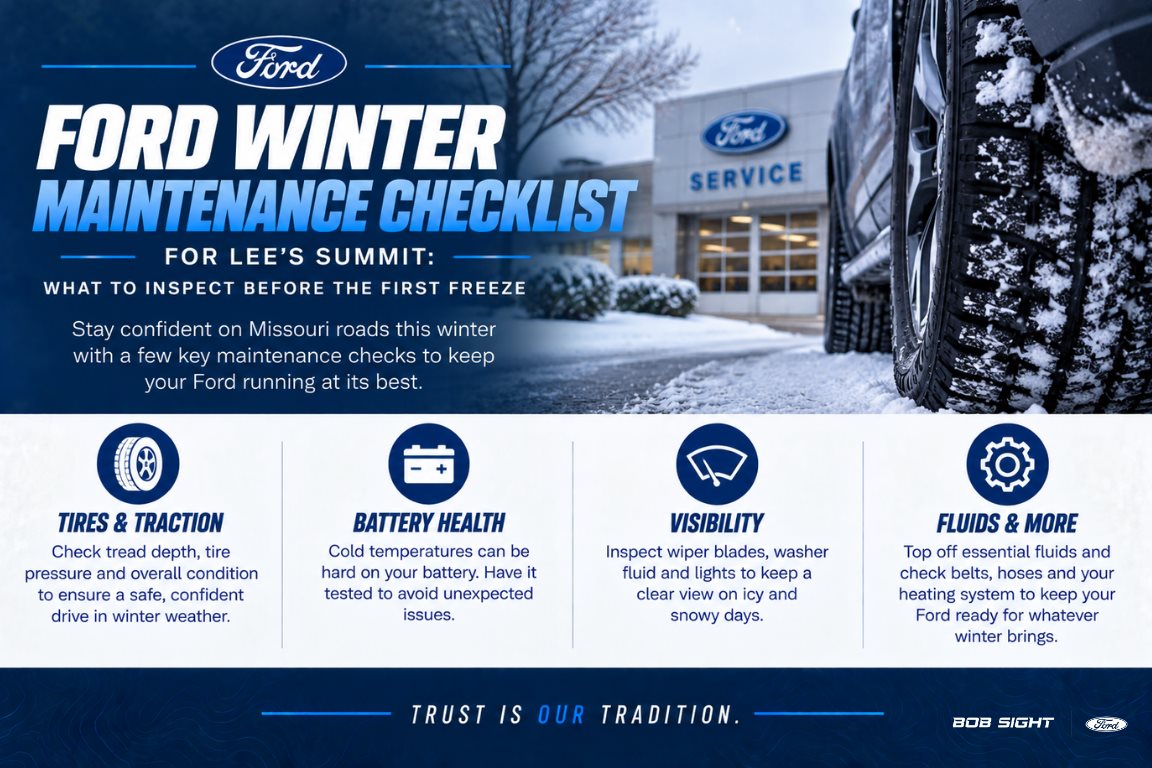
A Ford winter maintenance checklist helps Lee’s Summit drivers prepare their vehicles before freezing temperatures, slick roads, reduced daylight, and changing tire pressure affect daily travel. Bob Sight Ford supports owners throughout Lee’s Summit, Blue Springs, Independence, Raytown, Grain Valley, Belton, and the Kansas City Metro with vehicle-specific winter inspections and maintenance guidance. A complete pre-winter check should cover the battery, tires, brakes, fluids, wipers, lights, heating system, emergency supplies, and maintenance information for the individual Ford.
Winter preparation is most effective when it happens before the first hard freeze in Jackson County. Waiting for a no-start condition, low tire warning, weak heater, or damaged wiper blade can turn routine maintenance into an urgent problem. This checklist provides a broad seasonal overview without replacing dedicated guidance about batteries, brakes, tires, oil, or service offers. The goal is to help Ford owners identify what should be checked and when professional evaluation may be useful.
Schedule a Ford winter maintenance visit in Lee’s Summit
In This Guide You'll Learn
This guide explains the major systems Missouri drivers should review before winter weather arrives. It covers essential inspection points for gasoline, hybrid, plug-in hybrid, and all-electric Ford vehicles. Owners should still follow the maintenance schedule and operating instructions for their exact model, model year, powertrain, and equipment.
- When to begin preparing a Ford for winter
- Why cold weather affects batteries and tire pressure
- What to review around brakes, fluids, wipers, and lights
- How to confirm the heater and defroster are working properly
- What to keep in a Missouri winter emergency kit
- How winter preparation differs for electrified Ford vehicles
- How to schedule a vehicle-specific winter inspection
A seasonal checklist provides organization, but it should not create a universal replacement schedule. An F-150 used for towing, an Escape driven through daily traffic, a Mustang Mach-E parked outside, and a Super Duty working on jobsites may have different needs. Inspection findings and official Ford guidance should determine which services are appropriate.
Quick Facts About Ford Winter Maintenance
Ford winter maintenance should begin in the fall, before temperatures stay below freezing and before the first major winter storm is forecast. Early preparation gives owners time to address wear, weak components, low fluids, and overdue maintenance. It also reduces the pressure of finding service after severe weather has already arrived.
- Cold temperatures can reduce 12-volt battery performance.
- Tire pressure commonly drops as outdoor temperatures fall.
- Tread depth and tire condition influence wet, snowy, and icy-road performance.
- Brake inspection is important before roads become slick.
- Coolant must provide the protection specified for the exact Ford vehicle.
- Winter-formulated washer fluid helps support cold-weather visibility.
- Wiper blades should clear the glass without streaking or skipping.
- Headlamps, brake lamps, turn signals, and hazard lamps should operate correctly.
- Heating and defrosting systems should be tested before they are urgently needed.
- Emergency supplies should match the trip, passengers, and expected conditions.
Drivers should not rely only on dashboard alerts. Some developing conditions may not trigger a warning until performance has already changed. A visual inspection, maintenance-history review, and vehicle-specific service check can identify needs that an instrument-panel message does not cover.
| Winter Check | What to Review | Why It Matters |
|---|---|---|
| 12-Volt Battery | Charge condition, terminals, age, and test results | Cold weather can expose reduced starting capacity |
| Tires | Pressure, tread, damage, age, and seasonal suitability | Tires control road contact and traction |
| Brakes | Wear, operation, fluid, and reported symptoms | Predictable braking matters on slick roads |
| Fluids | Coolant, oil, washer fluid, and visible leaks | Correct fluids support cold-weather operation |
| Visibility | Wipers, washers, lights, mirrors, and glass | Winter brings darkness, spray, snow, and glare |
| Cabin Heat | Heater, front defroster, and rear defogger | Clear glass and cabin comfort support safe travel |
When Lee’s Summit Drivers Should Start Winter Preparation
Lee’s Summit drivers should begin winter preparation during the fall rather than waiting for the first forecast of snow or freezing rain. A useful target is to review the vehicle before regular overnight freezes begin. The exact timing can vary because Missouri weather often changes quickly.
Early preparation allows time for parts, service scheduling, and follow-up work if an inspection identifies a concern. Battery testing, tire evaluation, fluid checks, and wiper replacement are easier to plan before a storm creates widespread demand. Owners can also test winter equipment without the pressure of needing it immediately. This makes the process more deliberate and less disruptive.
Start by reviewing the Ford’s maintenance history and current mileage. Check whether the vehicle is approaching a scheduled service interval and note unresolved warning messages or previously recommended work. The Ford maintenance schedule is vehicle-specific, so the owner should use information for the exact model year, engine, and drivetrain. A general winter checklist should complement that schedule rather than replace it.
Driving patterns should influence the timing and depth of the check. Someone commuting daily through the I-470 and US-50 split may have less flexibility to stay home during poor weather than a driver with a remote schedule. Owners traveling early in the morning or late at night also encounter colder temperatures and reduced service availability. Those circumstances support completing maintenance well before winter peaks.
- Review the vehicle’s mileage and maintenance history.
- Check the instrument panel for alerts or warning messages.
- List any changes in starting, steering, braking, visibility, or heating.
- Inspect basic items such as tires, lights, wipers, and washer fluid.
- Schedule professional evaluation for concerns or overdue maintenance.
- Assemble emergency supplies before winter travel begins.
Drivers can review current Ford service and parts specials while planning a winter appointment. Offers can change and may have eligibility requirements. Maintenance should be selected according to the vehicle’s condition rather than the availability of a promotion.
Check the Battery Before Cold Weather Arrives
A battery test before winter can identify reduced reserve or starting capacity before cold temperatures expose the weakness. The 12-volt battery supports starting and electrical systems in gasoline vehicles and performs important control functions in hybrids, plug-in hybrids, and electric vehicles. A vehicle can have a high-voltage battery and still depend on a healthy 12-volt system.
Cold weather slows the chemical activity inside a conventional automotive battery while the vehicle may require more energy to start and power accessories. A battery that appeared adequate during warm weather can struggle on a freezing morning. Battery age provides context, but age alone does not determine condition. Testing offers better information than replacing solely according to the calendar.
Owners can visually check for loose connections, damaged cables, corrosion, swelling, or leakage, but they should avoid touching damaged components or attempting repairs without appropriate knowledge. Battery terminals should remain secure and clean according to proper service procedures. A charging-system concern can also produce symptoms that resemble a weak battery. Professional testing helps distinguish the battery from related electrical issues.
Warning signs may include slow cranking, repeated jump starts, dim or unstable lighting, electrical messages, or inconsistent accessory operation. Those symptoms should be evaluated promptly rather than treated as normal winter behavior. A jump start may restore temporary operation without correcting the cause. Drivers should follow the owner’s manual because jump-start connection procedures differ among vehicles.
A commuter parked overnight in an open lot near Independence may face different battery temperatures than a vehicle stored in an attached garage in Lee’s Summit. Short trips can also limit the time available for the charging system to replenish energy used during starting. These factors help explain why two batteries of similar age may perform differently. A dedicated battery article can explore testing and replacement in greater depth, while this checklist keeps the focus on scheduling the pre-winter check.
Inspect Tires and Adjust Cold Tire Pressure
Winter tire preparation should include checking cold pressure, tread depth, damage, age, and whether the tire design matches the driver’s expected conditions. Tires provide the contact between the Ford and the road, making them central to acceleration, steering, and braking. Four-wheel drive or all-wheel drive cannot compensate for tires that are worn, damaged, or incorrectly inflated.
Tire pressure generally falls as outdoor temperatures decrease because the air inside contracts. The correct reference is the pressure shown on the vehicle’s Tire and Loading Information label, not the maximum pressure molded into the tire sidewall. Pressure should be checked when the tires are cold and adjusted according to Ford guidance. Drivers should also inspect the spare tire or inflation system if the vehicle is equipped with one.
Tread depth influences the tire’s ability to move water and snow away from the contact area. Uneven tread can point to alignment, suspension, inflation, or rotation concerns. Cracks, bulges, punctures, exposed material, or impact damage require professional evaluation. Potholes along Highway 50 can affect tires and wheels even when the vehicle does not immediately develop a flat.
Michelin, Goodyear, Continental, Motorcraft, and other brands offer tires with different seasonal and performance characteristics. The correct size, load index, speed rating, and application matter more than brand name alone. Some Kansas City drivers may benefit from all-weather or winter-oriented tires, while others can use suitable all-season tires based on routes and travel flexibility. A qualified tire professional can help evaluate the individual use case.
- Check the recommended cold pressure on the vehicle label.
- Measure all tires before driving or after the vehicle has been parked.
- Inspect tread depth and look for uneven wear.
- Check sidewalls for cuts, cracks, bulges, or impact damage.
- Review tire age and seasonal suitability.
- Confirm the spare or mobility equipment is ready.
- Schedule rotation, alignment, or replacement when inspection supports it.
A dedicated Ford tire service article can address winter tire selection in greater depth. For this checklist, the essential action is to confirm that every tire is properly inflated, structurally sound, appropriately rated, and suitable for expected Missouri conditions.
Review Brakes, Fluids, and Visible Leaks
A pre-winter service visit should include a broad review of braking performance, essential fluids, and any visible leaks. Cold weather does not create one universal brake or fluid service interval. Inspection results, maintenance history, vehicle specifications, and operating conditions should determine the appropriate work.
Brake concerns can be harder to manage after roads become slick. Changes in pedal feel, warning indicators, unusual vibration, pulling, or reduced braking response should be evaluated promptly. Friction materials, rotors or drums, hydraulic components, electronic controls, and tires all influence how the vehicle stops. A winter checklist should flag the need for inspection without attempting to diagnose the complete system.
Engine coolant, sometimes called antifreeze, helps manage temperature and protect the cooling system from freezing and corrosion when the correct mixture and specification are used. Coolant type and service requirements differ among Ford vehicles, so owners should not mix products based only on color. The reservoir should be checked according to the owner’s manual when the vehicle is cool. Low coolant or a visible leak requires attention.
Engine oil should also match the viscosity and Ford specification required for the exact engine. Terms such as 0W-20 or 5W-30 describe viscosity behavior, including cold-temperature flow and operating-temperature characteristics. The correct grade can vary by model, model year, engine, and operating conditions. Owners should confirm the oil-cap marking and official documentation rather than assuming every Ford uses the same product.
Winter-formulated windshield washer fluid supports visibility in freezing conditions. Water or warm-weather fluid can freeze in the reservoir, lines, or nozzles when temperatures fall. Brake fluid, transmission fluid, and other serviceable fluids should be reviewed according to vehicle-specific procedures. Fluid spots under the vehicle should be investigated instead of automatically attributed to condensation.
Test Wipers, Lights, Heat, and Defrosting Systems
Winter visibility preparation requires working wiper blades, washer nozzles, exterior lights, mirrors, cabin heat, and front and rear glass-clearing systems. Snow, road spray, darkness, glare, and freezing precipitation can reduce visibility quickly. Drivers should test these systems before winter rather than discovering a problem during a storm.
Wiper blades should move smoothly and clear the glass without persistent streaking, skipping, chatter, or missed areas. The rubber edge can harden, split, or deform over time. Owners should also check that washer nozzles spray correctly and that the reservoir contains appropriate fluid. Ice should be removed from the windshield before operating the wipers to reduce unnecessary strain.
Headlamps, taillamps, brake lamps, turn signals, reverse lamps, license-plate lamps, and hazard flashers should all function. Lenses should be clean and free from heavy snow or ice before travel. Automatic headlamp systems can add convenience, but the driver remains responsible for confirming adequate lighting. Daytime running lamps may not illuminate every rear lamp needed in poor visibility.
Test the heater, front defroster, rear-window defogger, and heated mirrors if equipped. A weak airflow concern may involve a filter, blower, door control, or another heating and ventilation component. A sweet smell, interior moisture, or recurring windshield film can also deserve evaluation. The system should clear the glass effectively without requiring unsafe manual wiping while driving.
Drivers navigating evening traffic near Summit Fair or early-morning routes through Raytown need reliable visibility before snow accumulates. Winter darkness and spray from surrounding vehicles can be challenging even on treated roads. Clean glass inside and outside, properly adjusted mirrors, and functioning lights support better awareness. Visibility maintenance is an essential part of winter readiness.
Prepare Gasoline, Hybrid, Plug-In Hybrid, and Electric Ford Vehicles
Every Ford needs winter preparation, but hybrids, plug-in hybrids, and electric vehicles add battery, charging, and range considerations to the standard checklist. Owners should follow guidance for the exact powertrain. Gasoline, hybrid, and electric vehicles do not share identical systems or operating procedures.
Gasoline-powered vehicles need the correct engine oil, coolant protection, battery condition, tires, brakes, wipers, and fuel-system readiness. Drivers should avoid allowing maintenance to become overdue before a long winter trip. Keeping sufficient fuel for the planned route and possible delays is a practical precaution. The owner’s manual provides model-specific guidance for extreme cold and winter equipment.
Hybrid vehicles combine a gasoline engine with an electric motor and high-voltage battery. They still require engine oil, coolant, a 12-volt battery, tires, brakes, and other routine inspections. Regenerative braking can reduce some friction-brake use, but it does not eliminate inspection needs. Cold weather may temporarily affect fuel economy as the vehicle manages warm-up and cabin heat.
Plug-in hybrids and all-electric models benefit from advance charging and planned climate use. Electric range can decrease in cold conditions due to battery temperature, cabin heating, speed, wind, tire pressure, and road conditions. When available and appropriate, preconditioning while connected to a charger can warm the cabin and prepare the vehicle before departure. Owners should use Ford’s current instructions for their model and charging equipment.
Mustang Mach-E and F-150 Lightning drivers traveling beyond the Kansas City Metro should plan charging stops with winter conditions in mind. Allow additional range margin and consider possible delays or charging-site availability. Charging connectors and ports should remain clear of snow, ice, and debris according to safe procedures. Never use damaged charging equipment.
Build a Practical Missouri Winter Emergency Kit
A Missouri winter emergency kit should help occupants remain warm, visible, informed, and prepared during a delay or roadside problem. The contents should match the number of passengers, trip distance, weather, medical needs, and vehicle type. A short urban commute and a rural western Missouri trip may require different levels of preparation.
Basic supplies can include warm clothing, gloves, hats, blankets, water, shelf-stable food, a flashlight, replacement batteries, phone charging equipment, and a first-aid kit. A reflective vest, warning devices, ice scraper, snow brush, and small shovel may also be useful. Owners should confirm that every item is secure so it does not become a projectile during sudden braking. Supplies should be reviewed periodically for expiration, damage, or depleted batteries.
Traction aids may help in some situations, but they should be compatible with the vehicle and used according to instructions. Tire chains or cables should never be installed based only on wheel-well appearance. Clearance limitations can vary by Ford model, wheel size, tire size, and drivetrain. Consult the owner’s manual before purchasing or installing traction devices.
Keep important contact information accessible even when cellular service is unreliable or a phone battery is low. Tell someone the route and expected arrival time before longer winter travel. Check weather and road conditions before departure, then delay travel when authorities advise against driving. Emergency supplies reduce risk but do not make severe conditions safe.
- Pack warmth, water, food, medication, and first-aid supplies.
- Add a flashlight, charging equipment, and visibility devices.
- Include an ice scraper, snow brush, and other vehicle-appropriate tools.
- Confirm traction equipment is permitted for the exact Ford.
- Secure every item in the cargo area.
- Review the kit at the beginning and middle of winter.
- Adjust supplies for children, pets, and longer trips.
A driver delayed near a busy Kansas City interchange may have help nearby, while someone traveling through rural areas may wait longer. Preparing for the more demanding route creates a useful safety margin. The emergency kit should remain accessible rather than buried beneath luggage or cargo.
Ownership Planning
Winter ownership planning works best when Ford drivers combine seasonal checks with the vehicle’s ongoing maintenance schedule. A fall inspection should not become the only time the vehicle receives attention. Tire pressure, fluid levels, lights, warning messages, and driving behavior can change throughout winter.
Keep a record of battery tests, tire rotations, tread measurements, fluid services, wiper replacement, brake findings, and other inspection results. Written records help owners recognize trends and avoid repeating work unnecessarily. They also provide context when a warning message or performance change appears later. Digital and printed records can both be useful.
Recheck tire pressure after major temperature changes. Clear snow and ice from the roof, hood, lamps, windows, cameras, sensors, and mirrors before driving. Wash road salt and deicing residue from the body and underbody when conditions allow. These small habits support visibility, sensor operation, tire performance, and long-term condition.
Convenience can help owners remain consistent during busy winter schedules. Bob Sight Ford provides information about Ford Pickup and Delivery in Lee’s Summit for qualifying service needs. Availability, distance, weather conditions, and service eligibility should be confirmed when scheduling. Ford Mobile Service may also be available for qualifying work.
Current owners planning to replace or add a vehicle can review Ford Employee Pricing details in Kansas City when applicable. Program terms and vehicle eligibility can change. Winter capability should still be evaluated through drivetrain, tires, ground clearance, passenger needs, cargo use, and the driver’s normal routes.
Frequently Asked Questions
These answers address common questions about Ford winter maintenance in Lee’s Summit and the Kansas City Metro. Service needs vary by vehicle, so owners should use Ford guidance and inspection results for the exact model. A seasonal checklist supports maintenance but does not provide a universal replacement schedule.
When should I schedule Ford winter maintenance in Lee’s Summit?
Schedule Ford winter maintenance during the fall, before overnight temperatures remain below freezing and before the first major storm is forecast. Early service provides time to address battery, tire, fluid, visibility, or heating concerns. It also avoids waiting until winter demand increases. The exact timing can depend on mileage and upcoming travel.
Review the maintenance schedule before booking. A vehicle approaching an oil service, tire rotation, or other interval may be able to combine scheduled care with a winter inspection. Explain any changes in starting, braking, steering, heating, or visibility when arranging the visit. Accurate information helps the service team prepare.
Lee’s Summit commuters who travel daily along US-50 or I-470 should finish preparation before weather limits travel options. Drivers with holiday trips planned should allow additional time for any follow-up work. A routine visit is easier to manage than an urgent appointment after a freeze. Planning early supports a more dependable winter routine.
How often should my Ford battery be tested before winter?
A Ford battery should be tested when its condition is uncertain, when symptoms appear, or when vehicle-specific service guidance calls for evaluation. Many drivers choose to include a battery test in an annual pre-winter inspection. Battery age can increase concern, but test results provide better information than age alone. Electrical and charging-system conditions may also affect performance.
Slow cranking, repeated jump starts, unstable lights, electrical messages, or inconsistent accessory operation deserve prompt evaluation. Hybrid and electric vehicles also rely on 12-volt battery systems even though they contain high-voltage batteries. Owners should follow model-specific jump-start and service procedures. High-voltage systems require trained personnel and proper safety practices.
Cold Jackson County mornings can expose a battery that appeared adequate during warmer weather. Vehicles parked outdoors or driven mainly on short trips may experience different demands than garage-stored vehicles used for longer travel. Testing before winter gives owners more time to respond. Do not wait for a no-start event if warning signs are present.
Does all-wheel drive replace the need for winter tires?
All-wheel drive does not replace properly maintained tires because tires provide the vehicle’s contact with the road. All-wheel drive can improve acceleration traction in certain conditions, but it does not eliminate the physical limits of wet, snowy, or icy pavement. Braking and cornering still depend heavily on tire condition. Drivers must adjust speed and following distance.
Tire needs depend on route, weather exposure, driving schedule, vehicle, and the ability to postpone travel. Some drivers may use appropriate all-season or all-weather tires, while others may benefit from dedicated winter tires. Size, load rating, speed rating, tread, age, and pressure all matter. A tire professional can help evaluate the individual use case.
A Ford Explorer with Intelligent Four-Wheel Drive and worn tires may be less prepared than a properly maintained front-wheel-drive Escape on suitable tires. Technology supports traction but does not create grip independently. Drivers facing untreated hills near Raytown or early-morning travel should review tires before winter. The exact choice should match realistic conditions.
What fluids should be checked before winter?
Pre-winter fluid checks commonly include engine coolant, engine oil, windshield washer fluid, and other vehicle-specific serviceable fluids. The correct types and service intervals depend on the Ford model, model year, engine, transmission, and powertrain. Owners should use the manual and official maintenance information. Fluid color alone is not a reliable compatibility guide.
Coolant should provide the specified freeze and corrosion protection, while engine oil should meet the required viscosity and Ford specification. Washer fluid should be appropriate for expected freezing temperatures. Low levels may indicate normal use or a leak, depending on the system. Visible leaks and warning messages should be investigated.
Missouri temperature swings can place different demands on fluids and seals. A spot under the vehicle may be harmless water from climate-system condensation, but it can also be another fluid that needs identification. Do not open a hot cooling system. Professional evaluation is appropriate when the source or correct product is uncertain.
What should I keep in my Ford during a Kansas City winter?
Keep supplies that support warmth, visibility, communication, hydration, and basic roadside preparedness. Useful items can include blankets, gloves, hats, water, shelf-stable food, a flashlight, charging equipment, a first-aid kit, an ice scraper, and a snow brush. The kit should match the passengers and trip. Medications and child or pet supplies may also be necessary.
Reflective warning devices and a vest can improve visibility during a roadside delay. A small shovel and vehicle-compatible traction aids may be helpful in certain conditions. Tire chains or cables should be used only when permitted for the exact vehicle and tire setup. Follow the owner’s manual rather than assuming universal compatibility.
A commute within Lee’s Summit may involve a shorter wait for help than travel across rural western Missouri, but storms can delay assistance anywhere. Keep the kit accessible and secure. Review expiration dates and battery charge during the season. The safest choice may still be postponing travel when road conditions are dangerous.
Schedule Winter Service at Bob Sight Ford
Bob Sight Ford helps Lee’s Summit drivers prepare their Ford vehicles for winter with vehicle-specific inspections, maintenance guidance, and convenient scheduling options. Ford-Certified Technicians can review battery condition, tires, brakes, fluids, wipers, lights, heating systems, and applicable maintenance information. Recommendations should be based on the individual vehicle rather than a generic seasonal package.
Drivers from Blue Springs, Independence, Raytown, Grain Valley, Belton, and surrounding Kansas City communities can prepare before the first hard freeze. Bring service records and explain any changes in vehicle behavior. If winter travel, towing, short trips, outdoor parking, or early-morning commuting affects the vehicle, share those details with the advisor.
Seasonal preparation cannot prevent every weather-related delay, but it can reduce avoidable problems and improve readiness. Checking major systems before winter gives owners time to address concerns under more manageable conditions. Trust Is Our Tradition.
Helpful Links
Use these Bob Sight Ford resources to schedule winter maintenance, review current offers, and prepare for seasonal ownership.
Proud to be part of the Bob Sight Auto Group
Bob Sight Ford is proud to be part of the Bob Sight Auto Group, helping drivers throughout Lee’s Summit, Lawrence, Independence, and the Kansas City Metro. Our family of automotive locations supports local shoppers and owners with vehicle research, maintenance resources, collision assistance, and long-term care. Each location shares a commitment to clear guidance, trusted relationships, and useful automotive support.