How Long Does a Ford F-150 Last With Proper Maintenance? High-Mileage Guide
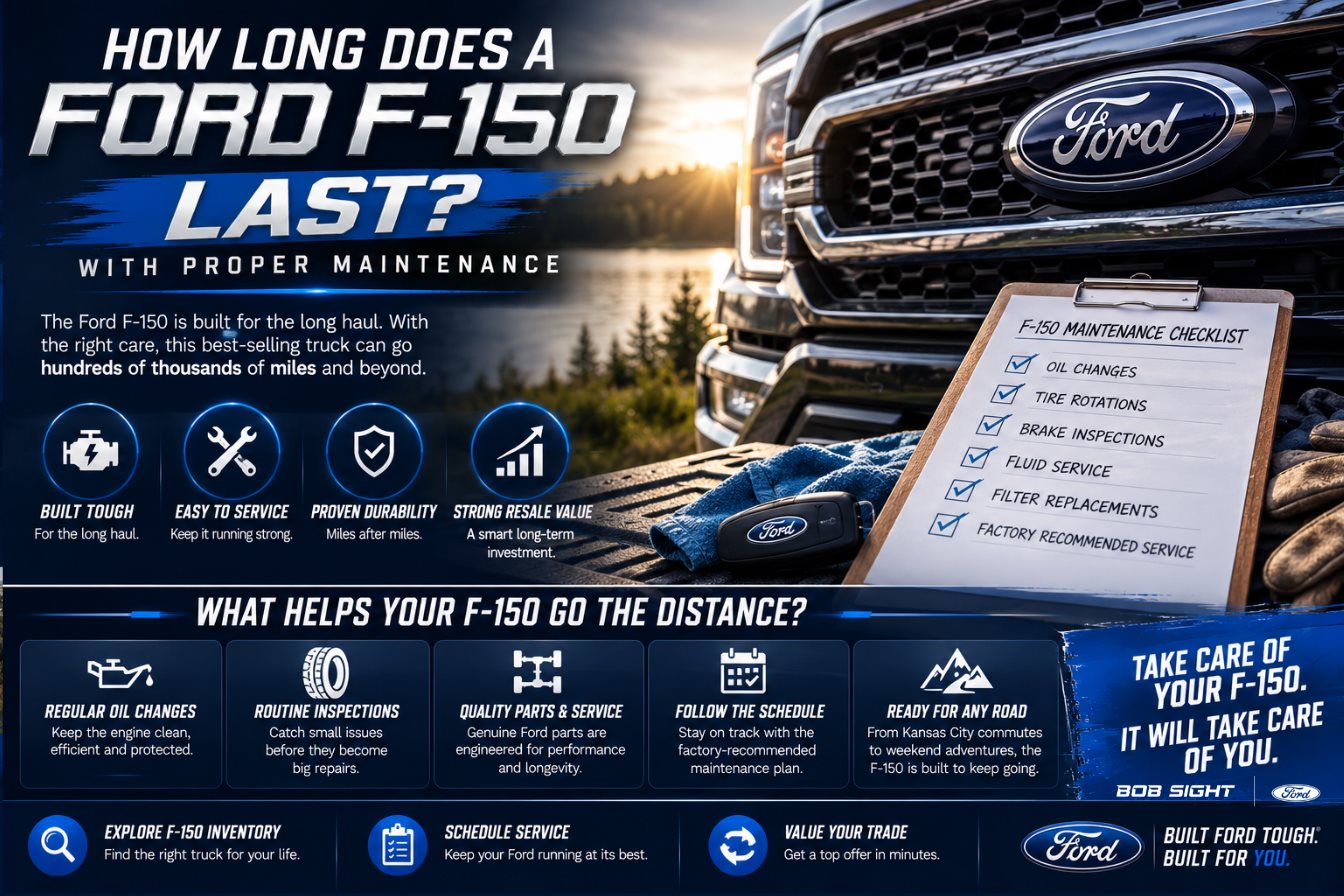
A well-maintained Ford F-150 can reliably last between 200,000 and 300,000 miles or more when adhering to a disciplined, factory-recommended maintenance schedule. At Bob Sight Ford in Lee's Summit, Missouri, we routinely service high-mileage F-150 trucks across Jackson County that continue to deliver exceptional performance well past the two-decade mark. Built with a high-strength, fully boxed steel frame and a military-grade aluminum-alloy body, the Ford F-150 is engineered for extreme long-term durability. Whether you commute daily along Interstate 470, haul heavy construction equipment across US Highway 50, or tow large campers near Longview Lake, understanding key maintenance milestones, engine longevity factors, fluid change protocols, and preventative ownership practices will ensure your truck remains a dependable, high-value asset for hundreds of thousands of miles.
Explore New and Pre-Owned Ford F-150 Truck Inventory at Bob Sight Ford
IN THIS GUIDE YOU'LL LEARN:
- The average lifespan expectations, realistic ownership years, and high-mileage potential of modern Ford F-150 trucks.
- How specific powertrains, including the 3.5L EcoBoost V6, 2.7L EcoBoost V6, 5.0L Coyote V8, and 3.5L PowerBoost Hybrid, compare in structural longevity.
- Critical mileage-based maintenance milestones from 5,000 miles to 150,000 miles required to prevent mechanical wear and component breakdown.
- How severe Midwest weather shifts, extreme humidity, freezing winter ice, and Jackson County road salt impact chassis and electrical health.
- Step-by-step fluid and filter care procedures that protect turbochargers, dual timing chains, intercoolers, and transmission valve bodies.
- Comprehensive guidance on high-mileage suspension refreshes, brake system management, and preventative spark plug care.
- How certified dealership service, genuine Motorcraft parts, and Ford Pick-Up & Delivery preserve your vehicle's resale value and trade-in return.
Expected Lifespan and High-Mileage Potential of the Ford F-150
With consistent maintenance and responsible driving habits, a Ford F-150 can easily provide 15 to 20 years of reliable service and cover over 250,000 miles. Modern automotive engineering has dramatically extended the operational life of full-size pickup trucks. Thanks to advanced metallurgy, high-precision electronic fuel injection, synthetic lubricants, and sophisticated electronic engine controls, reaching high mileage milestones no longer requires frequent major overhaul repairs or early engine replacements.
In the Greater Kansas City area, truck owners put their vehicles through rigorous, highly demanding driving conditions every single day. Daily stop-and-go commuting through Lee's Summit, heavy payload hauling on local residential jobsites, and towing heavy recreational trailers across Midwest highways subject drivetrain assemblies to heavy thermal loads. Trucks that receive timely fluid flushes, filter replacements, and regular multi-point vehicle health inspections comfortably surpass the 200,000-mile mark without experiencing catastrophic engine or transmission failures.
| Maintenance Discipline Level | Expected Mileage Range | Expected Ownership Lifespan | Primary Mechanical Outcome |
|---|---|---|---|
| Strict OEM Factory Schedule | 250,000 to 300,000+ Miles | 18 to 22+ Years | Optimal cylinder compression, minimal turbo wear, smooth 10-speed transmission shifting. |
| Moderate / Standard Maintenance | 180,000 to 220,000 Miles | 13 to 16 Years | Minor oil consumption, typical wear on suspension bushings, ignition coils, and wheel bearings. |
| Neglected / Delayed Maintenance | 100,000 to 140,000 Miles | 7 to 10 Years | Premature timing chain stretch, turbo bearing failure, severe transmission slipping, and valve sludge. |
Preventative maintenance is the single defining factor that separates an F-150 that reaches 300,000 miles from one that experiences premature mechanical breakdown. Investing in routine factory-certified care at Bob Sight Ford drastically reduces overall lifetime ownership expenses compared to dealing with unexpected, catastrophic component failures on the highway. Consistent, small maintenance investments over time insulate your budget from sudden multi-thousand-dollar repair bills.
Engine Durability Comparison: EcoBoost V6, 5.0L Coyote V8, and PowerBoost Hybrid
Every modern Ford F-150 engine option is engineered for high-mileage durability, but each mechanical architecture requires specific maintenance practices to maximize its lifespan. Ford offers a diverse lineup of powertrains designed for varied towing, payload, and fuel economy demands. Understanding the distinct mechanical traits of your specific powerplant allows you to tailor your service schedule accordingly and protect critical internal components.
The 3.5L EcoBoost V6 and 2.7L EcoBoost V6 utilize twin turbochargers and direct fuel injection to generate massive low-end torque. The 2.7L EcoBoost features a compacted graphite iron (CGI) engine block structure similar to commercial diesel engines, giving it extraordinary structural rigidity. Because turbochargers spin at speeds exceeding 100,000 RPM and operate under intense thermal energy, changing your engine oil strictly every 5,000 miles with Motorcraft full synthetic or synthetic blend oil is critical. Regular oil changes prevent carbon sludge buildup on turbocharger bearings and protect the dual timing chains from premature pin wear and elongation.
The naturally aspirated 5.0L Ti-VCT Coyote V8 offers traditional linear power delivery and a simplified mechanical footprint without turbocharging hardware. Known for exceptional high-RPM endurance and robust cylinder wall design, the 5.0L V8 can easily achieve 250,000+ miles when supplied with clean oil and fresh spark plugs. Meanwhile, the 3.5L PowerBoost Full Hybrid powertrain combines turbocharged power with an electric motor integrated directly into the transmission. The hybrid system actually reduces physical wear on the gas engine during stop-and-go driving while utilizing regenerative braking to double the operational life of brake pads and rotors.
Essential Ford F-150 Maintenance Schedule: 5,000 to 150,000 Miles
Following a structured, mileage-based maintenance schedule is the single most effective way to guarantee your F-150 reaches its maximum operational lifespan. Regular maintenance tasks are specifically engineered to replace wear items before they fail completely and refresh protective fluids before thermal breakdown and oxidation compromise mechanical assemblies.
Here is the comprehensive maintenance roadmap for Ford F-150 owners driving in Midwest road conditions:
- Every 5,000 to 7,500 Miles: Perform a Motorcraft synthetic blend or full synthetic oil change, replace the OEM oil filter, rotate all four tires to ensure even tread wear, inspect brake pads and rotors, top off windshield washer fluid, and complete a multi-point vehicle health check covering belts, hoses, and battery voltage.
- Every 15,000 to 20,000 Miles: Replace the cabin air filter to maintain HVAC performance and air quality, replace the engine air filter to protect intake sensors and maintain optimal fuel economy, inspect steering gear linkages, and check 4WD transfer case fluid levels.
- Every 30,000 to 40,000 Miles: Inspect accessory drive belts for surface cracking or tension loss, perform a comprehensive brake fluid flush to remove absorbed atmospheric moisture, inspect fuel lines and vapor hoses, and service front and rear differential gear oils if your truck is frequently used for heavy towing near Blue Springs or Independence.
- Every 50,000 to 60,000 Miles: Replace spark plugs (especially critical on turbocharged EcoBoost engines to prevent high-boost ignition misfires), flush engine coolant to maintain pH anti-corrosion balance, inspect wheel bearings, and test suspension shock dampening.
- Every 100,000 Miles: Perform a comprehensive transmission fluid and filter service on 6-speed or 10-speed automatic transmissions, replace spark plugs on V8 engines, inspect the PCV valve system, replace accessory drive belts, and test thermostat operation.
- Every 150,000 Miles: Complete a total cooling system flush, replace accessory drive belts, service 4WD transfer case fluid, replace front and rear differential fluids, and inspect engine mounts, timing chain tensioners, and suspension control arm bushings for rubber degradation.
Adhering strictly to these mileage intervals ensures that vital mechanical components remain fully lubricated, properly aligned, and free from thermal degradation throughout the truck's total operational life.
Protecting the Drivetrain, 10-Speed Transmission, and 4WD Systems
Maintaining clean transmission fluid and fresh differential lubricants is essential for preserving smooth gear shifting and heavy-duty towing capability over high mileage. Modern F-150 trucks utilize advanced 10-speed SelectShift automatic transmissions designed to keep the engine continuously in its optimal power band. However, the intricate electronic valve bodies, multi-plate clutch packs, and planetary gear sets in these transmissions require clean, thermally stable fluid to function properly.
While standard factory manuals may list long service intervals for automatic transmission fluid under ideal driving conditions, local Jackson County driving conditions fall squarely under the "severe duty" classification due to hot Midwest summer weather, freezing winter starts, hilly terrain, and frequent trailer towing demands. Servicing your 10-speed transmission fluid and filter every 50,000 to 60,000 miles removes microscopic metallic wear particles and prevents fluid oxidation. This proactive service protects sensitive shift solenoids and extends overall transmission life well past 200,000 miles without requiring costly rebuilds.
Four-wheel-drive models require additional maintenance attention for the front differential, rear differential, and transfer case. Driving through deep snow drifts or launching boats at local lake ramps can occasionally introduce moisture into axle housings through vent tubes. Changing differential lubricants at recommended milestones prevents gear tooth pitting, bearing whine, and transfer case drive chain slippage, guaranteeing seamless 4WD engagement when sudden winter storms hit Lee's Summit.
Combating Midwest Weather, Road Salt, and Chassis Corrosion
Protecting your F-150's frame, suspension components, and electrical connectors against seasonal road salt is vital for long-term structural integrity. While modern 2015 and newer Ford F-150 models feature high-strength aluminum-alloy body panels that will never develop traditional body rust, the underlying fully boxed steel frame, steel suspension control arms, driveshafts, and exhaust mounts remain vulnerable to environmental chemical corrosion.
During severe Missouri winters, municipal road crews treat highways like I-470, MO-7, and US-50 with liquid calcium chloride and rock salt. These heavy chemical de-icers cling to the undercarriage, accelerating surface rust on steel frame rails, brake lines, electrical grounds, and exhaust hangers. Performing routine undercarriage rinses at a car wash during winter months removes salt deposits before chemical oxidation can take hold. Applying a professional undercoating or lanolin-based rust inhibitor provides an extra layer of barrier protection for high-mileage frame longevity.
Additionally, sub-zero winter temperatures put immense physical stress on suspension rubber bushings, ball joints, and gas-charged shock absorbers. Cold weather hardens rubber bushings, making them prone to cracking over rough Jackson County road expansion joints and potholes. Inspecting suspension components annually and replacing worn shocks or struts prevents uneven tire tread wear, reduces body roll, and maintains precise steering control at highway speeds.
Deep Dive into Turbocharger Care, Intercoolers, and Timing Chains
Turbocharged EcoBoost engines require specific operational habits and preventative care to keep the turbo bearings, intercooler piping, and timing chains operating flawlessly for over two decades. Turbochargers are engineering marvels that utilize hot exhaust gases to force fresh air into the combustion chambers. However, because turbos operate at extreme thermal temperatures, engine oil acts as both their primary lubricant and crucial cooling fluid.
When an EcoBoost engine is driven hard under heavy load or while towing a heavy trailer along US-50, the turbocharger housings become extremely hot. Shutting the engine off immediately after heavy pulling can cause static oil inside the turbo oil lines to "coke," turning into hard carbon deposits that starve the bearings of oil during subsequent starts. Allowing the engine to idle for 30 to 60 seconds after heavy towing lets fresh oil circulate and cool the turbo center housing, significantly extending turbocharger seal and bearing life.
Furthermore, maintaining clean engine oil is directly tied to timing chain longevity on EcoBoost engines. The long primary timing chain relies on hydraulic tensioners powered by engine oil pressure. Small carbon particles in dirty, old engine oil act like an abrasive compound, causing micro-wear on the hundreds of individual timing chain pins and links. This micro-wear causes the chain to slowly stretch over time, resulting in timing misalignment, engine noise, and check engine lights. Changing synthetic oil strictly at 5,000-mile intervals completely eliminates this abrasive wear, preserving factory timing alignment for the life of the vehicle.
High-Mileage Suspension Refreshes, Brake System Management, and Electrical Health
Refreshing key chassis components around the 100,000-mile mark restores factory ride quality, stopping distance, and electronic module stability. As an F-150 accumulates high mileage, components that wear gradually can subtly degrade handling safety and driving comfort without the driver immediately noticing.
Suspension shock absorbers and struts typically lose their dampening effectiveness after 80,000 to 100,000 miles of driving over Midwest roads. Worn shocks allow the tires to bounce excessively over bumps, increasing stopping distances and accelerating uneven tire tread cupping. Replacing shocks and struts at this milestone restores firm, controlled vehicle handling, reduces body lean in corners, and protects steering tie rods and ball joints from excessive vibration stress.
Brake system management involves more than simply replacing friction pads when they wear thin. Over time, brake fluid absorbs atmospheric moisture through flexible rubber brake hoses. This water content lowers the boiling point of the fluid and causes internal corrosion inside expensive anti-lock brake (ABS) hydraulic pumps and brake calipers. Flushing the brake fluid every 30,000 to 40,000 miles maintains firm brake pedal feel and prevents ABS valve corrosion. Furthermore, maintaining clean electrical grounds and testing the battery load annually prevents voltage drops that can trigger false trouble codes in the vehicle's complex onboard computer modules.
Step-by-Step Guide to Maintaining a High-Mileage Ford F-150
Executing a proactive maintenance routine as your F-150 passes the 100,000-mile mark keeps performance sharp and prevents unexpected roadside breakdowns. As internal mechanical components age, shifting from basic maintenance to a high-mileage preservation strategy ensures long-term reliability and low operating costs.
- Transition to High-Mileage Motorcraft Synthetic Blend or Full Synthetic Oil: Once your truck reaches 75,000 to 100,000 miles, switch to a high-mileage synthetic oil formulation containing specialized seal conditioners that keep internal rubber gaskets pliable and prevent minor valve cover or oil pan leaks.
- Replace Spark Plugs and Inspect Ignition Coil Boots Proactively: Fresh spark plugs ensure complete fuel combustion, preventing unburnt fuel from damaging expensive catalytic converters, maintaining smooth idle quality, and restoring peak fuel economy.
- Perform Annual Battery and Alternator Health Load Tests: Sub-zero winter mornings test your electrical system; testing battery cold-cranking amps annually and replacing aging batteries every 3 to 4 years prevents unexpected non-start situations in your driveway.
- Service Cooling System and Thermostat Assemblies: Flush old anti-freeze to refresh anti-corrosion chemical additives, replacing the thermostat and water pump if any signs of bearing play, shaft weeping, or cooling temperature fluctuations appear.
- Inspect Driveshaft U-Joints, CV Axles, and Wheel Bearings: Listen for subtle humming noises or driveshaft vibrations during highway acceleration, replacing worn wheel hub assemblies and universal joints before total physical failure occurs.
- Perform Complete Drivetrain Fluid Refresh: Replace the fluid in the front differential, rear differential, and 4WD transfer case to remove metallic sheer particles and protect internal gears from high-torque friction wear.
Following this structured approach allows you to address mechanical wear methodically, maintaining smooth, factory-like driving dynamics across hundreds of thousands of miles without experiencing major unexpected breakdowns.
Quick Facts: Ford F-150 Longevity and Reliability
Here is a fast-reference overview highlighting key longevity metrics and maintenance facts for the Ford F-150:
- Average Lifespan Potential: 200,000 to 300,000+ miles with strict adherence to factory-recommended maintenance schedules.
- Aluminum Body Advantage: Military-grade aluminum alloy body panels eliminate traditional rust concerns on cab, bed, and tailgate surfaces.
- Oil Change Interval: Every 5,000 miles for turbocharged EcoBoost engines; 5,000 to 7,500 miles for naturally aspirated V8 engines.
- Motorcraft Component Protection: OEM Motorcraft replacement parts installed at Bob Sight Ford carry a 2-year/unlimited-mileage warranty covering parts and labor.
- Resale Value Retention: Well-documented dealership maintenance records significantly increase trade-in value and buyer demand on the pre-owned market.
- 10-Speed Transmission Care: Servicing transmission fluid and filter every 50,000 to 60,000 miles prevents shift solenoid wear and extends valve body life.
Reviewing these quick facts confirms why the Ford F-150 remains America's best-selling truck for decades. Outstanding engineering quality combined with proper preventative care creates an unbeatable long-term vehicle ownership proposition.
Ownership Planning: Maximizing Resale Value and Ownership ROI
Maintaining detailed, centralized service records at an authorized Ford dealership maximizes your truck's operational reliability and preserves top-tier trade-in value. When the time eventually comes to upgrade to a newer model, a fully documented vehicle history log serves as tangible physical proof of superior maintenance and mechanical care.
Buyers in the pre-owned truck market and dealership appraisers at Bob Sight Ford place an exceptionally high financial premium on trucks that show consistent, complete maintenance records. Having a verified digital record of oil changes, transmission services, brake flushes, spark plug swaps, and differential maintenance proves that internal engine and drivetrain components were continuously protected against thermal wear. This thorough documentation can add thousands of dollars to your truck's trade-in appraisal compared to similar vehicles with missing or incomplete service histories.
Utilizing convenience programs like Ford Pick-Up & Delivery or Ford Mobile Service makes maintaining a perfect service record completely effortless. Our team at Bob Sight Ford handles routine upkeep while you remain at home or work in Lee's Summit, Blue Springs, or Independence, ensuring your F-150 receives continuous expert care without disrupting your busy daily routine.
Frequently Asked Questions About Ford F-150 Longevity
How many miles can a Ford F-150 EcoBoost engine last?
A Ford F-150 EcoBoost engine can comfortably exceed 200,000 to 250,000 miles when oil changes are performed strictly every 5,000 miles using full synthetic oil. The 2.7L and 3.5L EcoBoost engines are engineered with heavy-duty internal components, including forged steel crankshafts, deep-skirt engine blocks, and graphite-iron block structures, designed specifically for extreme durability under high turbo boost pressures.
The primary key to EcoBoost longevity is frequent, high-quality lubrication changes. Turbochargers rely on engine oil for cooling and lubrication while spinning at speeds over 100,000 RPM. Clean synthetic oil prevents carbon deposits from cooking onto turbo shaft bearings and protects the primary timing chains from pin wear and elongation over time. Combining frequent oil changes with timely spark plug replacements every 40,000 to 50,000 miles ensures your EcoBoost V6 delivers powerful, trouble-free service for decades across the Midwest.
At Bob Sight Ford, our factory-trained technicians inspect turbo oil feed lines, intercooler connections, and PCV valves during routine service visits to keep your EcoBoost engine operating at peak factory efficiency across high mileage milestones.
Is the Ford 5.0L V8 more reliable than the EcoBoost engines over 200,000 miles?
Both the 5.0L Coyote V8 and EcoBoost V6 engines offer comparable long-term mechanical reliability over 200,000 miles, though they feature different design philosophies. The naturally aspirated 5.0L V8 features a simpler overall design without turbochargers or intercoolers, which appeals to owners who prefer traditional engine architecture, simple maintenance, and linear throttle response.
The EcoBoost engines, however, generate higher low-RPM torque for heavy towing while offering superior overall fuel economy during light empty commuting. In terms of overall block durability, cylinder wall strength, and crankshaft robustness, both engine families are built to exceptionally high commercial standards. Provided you follow proper maintenance protocols, such as changing oil frequently on EcoBoost models and keeping spark plugs fresh on the 5.0L V8, either powerplant will easily deliver 250,000+ miles of dependable performance across Jackson County.
Our sales and service specialists at Bob Sight Ford can walk you through the specific maintenance requirements for both engine options to help you choose the ideal powertrain for your long-term driving goals and towing needs.
What are the first signs that a Ford F-150 needs transmission fluid service?
The earliest signs that your F-150 needs transmission service include delayed gear engagement, hesitation during shifts, harsh clunking downshifts, or subtle gear slipping during hard acceleration. Modern 10-speed automatic transmissions rely on precise hydraulic pressure delivered through complex electronic valve bodies to execute smooth, rapid gear changes.
As transmission fluid ages, thermal heat degrades its viscosity and friction modifiers, causing shift solenoids to respond sluggishly. Addressing these early symptoms by performing a fluid and filter refresh at Bob Sight Ford removes microscopic metallic particles and restores proper hydraulic pressure before internal clutch plates suffer permanent physical wear. We recommend servicing transmission fluid every 50,000 to 60,000 miles for trucks used in heavy commuting, city traffic, or towing operations.
Ignoring early transmission warning signs can lead to severe thermal damage and costly internal valve body or clutch pack repairs. Bringing your truck to our Lee's Summit service drive at the first sign of unusual shift behavior protects your drivetrain investment and avoids major repair bills.
Does frequent heavy towing shorten the lifespan of a Ford F-150?
Heavy towing increases thermal and mechanical stress on engine, transmission, and braking components, but adhering to a "severe duty" maintenance schedule fully offsets this wear. Ford engineers design the F-150 from the ground up to pull heavy trailers, haul maximum payloads, and work on construction jobsites without compromising structural integrity.
When regularly pulling heavy loads down US-50 or I-470, engine oil, transmission fluid, and differential gear lubricants operate at elevated temperatures. Heat accelerates fluid oxidation and viscosity breakdown. By shortening fluid change intervals, such as changing engine oil every 5,000 miles and differential and transmission fluids every 45,000 to 50,000 miles, you maintain vital fluid film strength and prevent metal-on-metal component wear.
Equipping your F-150 with factory towing upgrades, such as auxiliary transmission coolers, heavy-duty radiators, and integrated trailer brake controllers, further protects your truck against heat buildup. With proper severe-duty maintenance, a working F-150 can tow heavy loads for hundreds of thousands of miles without sacrificing overall vehicle longevity.
Why Kansas City Truck Owners Trust Bob Sight Ford for F-150 Maintenance
Bob Sight Ford is dedicated to helping local truck owners maximize the performance, reliability, and lifespan of their Ford F-150 pickups. Conveniently located at 610 NW Blue Parkway in Lee's Summit, Missouri, our family-owned dealership has served generations of drivers across Lee's Summit, Kansas City, Blue Springs, Independence, and Raytown for over a century.
Our modern service center is staffed by factory-trained, ASE-certified Ford technicians who know every generation of the F-150 inside and out. We utilize specialized Ford diagnostic equipment, computerized alignment bays, and genuine OEM Motorcraft replacement parts to ensure every service meets strict factory specifications. Furthermore, our flexible convenience options, including Ford Mobile Service, Pick-Up & Delivery, comfortable lounge amenities, and regular service coupons, make keeping up with factory maintenance completely stress-free.
When you trust your F-150 to Bob Sight Ford, you are partnering with a local team genuinely invested in keeping your truck running safely for decades. Visit our Lee's Summit service center today or schedule your maintenance appointment online to keep your F-150 performing at its absolute best.
Helpful Links
Explore these useful resources on the official Bob Sight Ford website to schedule certified service, order OEM parts, or browse new truck inventory:
- Schedule Service Online for Your Ford F-150
- View Current Ford Service Specials and Maintenance Coupons
- Learn About Ford Pick-Up & Delivery Service in Lee's Summit
- Order Genuine OEM Motorcraft Replacement Parts
- Browse New Ford F-150 Inventory in Lee's Summit
Proud to Be Part of the Bob Sight Auto Group
Bob Sight Ford is a proud member of the Bob Sight Auto Group, serving automotive customers across Missouri and Kansas with dedicated sales, service, and financing expertise. For decades, our dealership family has remained committed to providing exceptional customer care, transparent pricing, and trusted vehicle maintenance across the entire Kansas City Metro area and beyond. Whether you require certified Ford service in Lee's Summit, Chrysler Dodge Jeep Ram expertise in Lawrence, or Honda and Kia care in nearby markets, our auto group stands ready to assist you.