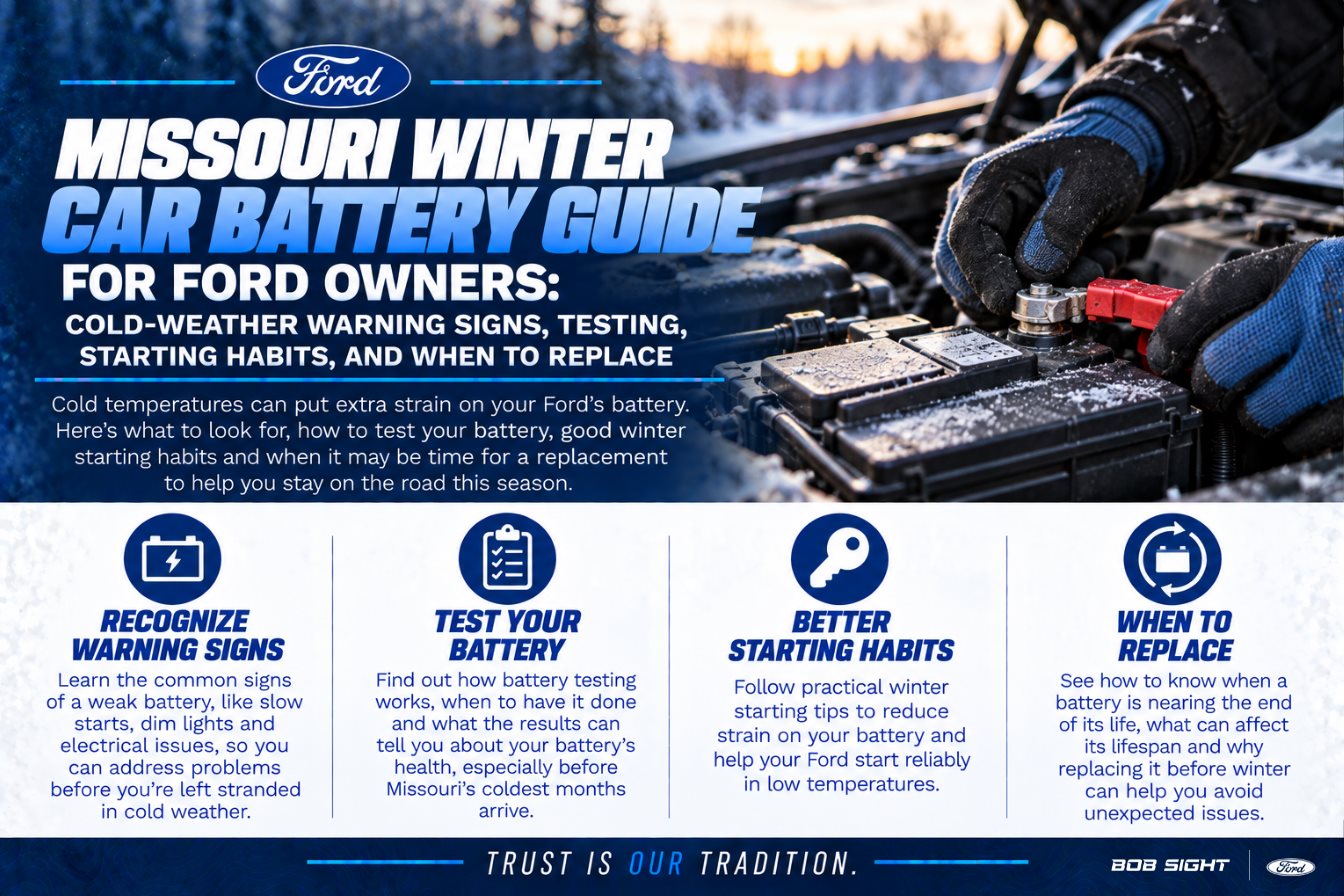
Missouri Winter Car Battery Guide for Ford Owners: Cold-Weather Warning Signs, Testing, Starting Habits, and When to Replace
Schedule Ford Battery Service in Lee’s Summit
Missouri winter weather can expose a weak vehicle battery quickly, which is why Ford owners should pay close attention to slow starts, dim lights, warning messages, repeated jump-starts, and changes in electrical performance as temperatures fall. For drivers in Lee’s Summit, Blue Springs, Independence, Raytown, Grandview, Belton, Liberty, and across the Kansas City Metro, cold mornings can place extra demand on a battery that seemed perfectly normal during warmer weather. A battery does not need to be completely dead to be a problem. It may still start the vehicle while showing early signs that its reserve capacity or cold-weather performance is declining.
In This Guide You’ll Learn
This guide explains how Ford owners can recognize battery problems early, prepare for Missouri winter weather, and make better decisions about battery testing and replacement.
- Why cold temperatures make battery problems more noticeable
- Which warning signs may point to a weak Ford battery
- How battery testing differs from simply checking whether the vehicle starts
- Why cold cranking amps matter in winter
- How short trips and daily driving habits can affect battery charge
- What Ford owners should know before attempting a jump-start
- When battery replacement may be appropriate
- How to prepare a Ford battery before a major Kansas City cold snap
Why Does Cold Weather Put More Stress on a Ford Battery?
Cold weather can reduce the battery’s ability to deliver starting power at the same time the engine requires more effort to crank. That combination is why a marginal battery may seem acceptable in October but struggle during the first freezing mornings of December or January. The colder the temperature becomes, the more noticeable an existing battery weakness can become. Missouri’s rapid temperature swings can make this especially obvious when a mild afternoon is followed by a much colder overnight low.
A vehicle battery supplies the burst of electrical energy needed to operate the starter and begin the engine-starting process. When temperatures fall, the chemical reactions inside a conventional automotive battery slow down. At the same time, engine oil is colder and internal engine components require more effort to begin moving. The battery therefore has a more difficult job under conditions where it may already be providing less available power.
This is why cold weather often exposes battery problems rather than creating them from nothing. A battery may have been losing capacity gradually throughout the summer and fall while still producing enough power for normal starts. Once a Ford sits outside overnight in Lee’s Summit during a hard freeze, the margin between “still starts” and “does not start” becomes smaller. That first slow crank can be an early warning rather than a random winter inconvenience.
Ford owners should also remember that modern vehicles rely on electrical power for far more than the starter. Modules, safety systems, infotainment, lighting, climate controls, sensors, and other electronics all depend on the vehicle’s electrical system. A battery problem can sometimes create odd electrical behavior before it causes a complete no-start condition. Paying attention to changes can help owners schedule testing before the battery fails entirely.
What Are the Most Common Signs of a Weak Ford Battery in Winter?
The most common winter battery warning signs include slow cranking, repeated clicking, dimming lights during startup, intermittent starting, electrical warnings, and needing a jump-start after the vehicle sits. One symptom alone does not prove the battery is the cause, but a pattern becomes more meaningful when it appears mainly during cold weather. Ford owners should note exactly what happens when the vehicle is started rather than simply describing the problem as “it wouldn’t start.”
Slow cranking is one of the easiest changes to notice. If your Ford normally starts with a quick, strong crank but begins turning over more slowly on cold mornings, the battery should be considered during diagnosis. Rapid clicking can also suggest that the starting system is not receiving enough electrical power, although connections, cables, or other components can contribute to similar symptoms.
Lights and electronics can provide additional clues. Headlights or interior lights that become noticeably dim while the starter is engaged may indicate a voltage drop under load. Dashboard displays that reset, flicker, or behave differently during starting attempts can also be useful information. These symptoms do not automatically mean the battery needs replacement, but they justify inspection if they recur.
A driver leaving a neighborhood near Summit Fair may notice that the Ford starts normally in the afternoon but cranks much more slowly after sitting outside overnight. Another driver commuting from Blue Springs may need a jump-start after the vehicle sits through a freezing weekend but experience no issues during warmer weather. Those temperature-related patterns are worth documenting because they can help a technician evaluate the battery and charging system more efficiently.
| Battery-Related Symptom | What It May Suggest | What to Do Next |
|---|---|---|
| Slow cranking | Reduced battery output or starting-system resistance | Schedule battery and starting-system testing |
| Rapid clicking | Insufficient electrical power or connection issue | Check battery condition and electrical connections |
| Repeated jump-starts | Battery weakness, charging issue, or parasitic drain | Have the full charging system evaluated |
| Lights dim heavily during startup | Voltage drop under starting load | Battery load testing may be appropriate |
| Intermittent winter starting | Temperature-sensitive battery or electrical issue | Document conditions and schedule diagnosis |
What Does a Ford Battery Test Actually Check?
A battery test evaluates more than whether the vehicle starts because a battery can still crank the engine while having reduced capacity or poor cold-weather performance. Proper testing can help determine whether the battery is healthy, weak, discharged, or approaching replacement. It can also provide clues about whether another part of the starting or charging system needs attention.
A technician may evaluate battery voltage, conductance, available cranking performance, terminal condition, cable connections, and charging-system behavior. The exact process can vary depending on the vehicle and test equipment. The goal is to determine how the battery performs under realistic electrical load rather than relying on a simple visual inspection.
This distinction matters in winter because a battery may appear normal after the engine has been running. The alternator can replenish charge while driving, and warmer daytime temperatures can temporarily make the vehicle easier to start. A proper battery test can reveal whether the battery still has enough reserve and starting capacity to handle future cold mornings.
For Ford owners driving around Lee’s Summit, Independence, and eastern Jackson County, testing before the coldest part of winter can be more useful than waiting for a no-start event. A vehicle may be parked at home when the battery first shows weakness, but the next failure could happen after work, school, shopping, or an appointment. Preventive testing can help identify a developing issue before it becomes a roadside inconvenience.
- Describe any recent slow-start or no-start symptoms.
- Note whether the problem appears mainly during cold weather.
- Have the battery’s condition and starting capacity evaluated.
- Inspect accessible terminals and connections for corrosion or looseness.
- Check charging-system operation if the battery repeatedly loses charge.
- Review battery age and service history if known.
- Replace the battery only when testing and condition support that decision.
What Are Cold Cranking Amps and Why Do They Matter?
Cold cranking amps, commonly called CCA, measure a battery’s ability to deliver starting current under cold conditions and are an important specification for winter performance. Ford owners should use the battery specification intended for their specific vehicle rather than choosing a replacement based only on physical size or price. Correct fitment matters because battery requirements can vary by model, engine, electrical system, and equipment.
A higher CCA rating does not automatically mean that any battery with a larger number is the correct choice. The battery must meet the electrical and dimensional requirements for the exact Ford. Modern Ford vehicles can also use battery-management strategies and electrical systems that make proper replacement and installation important. This is one reason professional battery replacement can be useful on newer models.
CCA becomes easier to understand when thinking about a cold morning. If a battery has lost capacity over time, it may still provide enough current to start the vehicle in mild weather. Once the temperature drops significantly, the same battery may no longer deliver sufficient starting current. The problem often appears first after an overnight cold soak rather than after the engine has been running.
Drivers in Belton, Grandview, Raytown, and Lee’s Summit may experience this after the first hard freeze of the season. If the vehicle begins cranking more slowly at the same time temperatures fall, the battery should be evaluated before assuming that the behavior is simply normal for winter. A healthy, correctly specified battery should still provide reliable starting performance under normal cold-weather conditions.
Can Short Trips Make Battery Problems Worse During Winter?
Frequent short trips can contribute to winter battery problems because the vehicle may use significant electrical energy during startup without spending enough time driving to replenish that energy fully. This does not mean every short commute will damage a battery, but driving patterns can matter when a battery is already weak or partially discharged. Winter accessory use can add further demand.
Cold-weather trips often involve headlights, heated seats, heated steering wheels, rear defrosters, windshield wipers, blowers, and other electrical systems operating at the same time. If a driver starts the vehicle, travels only a short distance, shuts it off, and repeats that pattern several times, the charging system may have fewer opportunities to restore energy used during each start.
Consider a Ford owner who works from home in Lee’s Summit and mostly makes five- or ten-minute trips for errands. That pattern is very different from a commuter who drives from Lee’s Summit to downtown Kansas City each morning. The longer highway commute generally gives the charging system more operating time after startup, while frequent short trips create repeated starting cycles.
Battery condition still determines whether short-trip driving becomes a problem. A healthy system may handle the routine without issue, while an aging battery may struggle sooner. If a Ford repeatedly needs a jump after short-trip use, the solution should not be to keep jump-starting it indefinitely. Battery condition, charging performance, and any potential electrical draw should be evaluated.
What Starting Habits Can Help During a Missouri Cold Snap?
The best cold-weather starting habit is to avoid adding unnecessary electrical load before starting and to respond early if the engine begins cranking differently than normal. Modern Ford vehicles are designed to manage startup automatically, so owners generally should not rely on outdated techniques such as repeatedly pumping the accelerator. Follow the owner information for the specific Ford.
Before starting on a very cold morning, make sure unnecessary accessories are not creating additional demand. Some vehicle systems manage this automatically, but there is no benefit in adding avoidable electrical load when the battery is already being asked to deliver high starting current. Once the engine starts, allow the vehicle to stabilize briefly before driving normally and gently.
Extended idling is generally not necessary simply because it is cold. Modern engines are designed to warm through normal operation, and Ford owners should follow their vehicle-specific recommendations. Driving gently until the powertrain reaches normal operating temperature is a more useful habit than aggressive acceleration immediately after startup.
If the engine cranks slowly, clicks, or fails to start, repeated long starting attempts are not helpful. Multiple prolonged attempts can further discharge the battery and place additional stress on the starter. Instead, stop and evaluate the situation. If the vehicle needs a jump-start, follow the Ford-specific procedure in the owner’s information or use roadside assistance if there is uncertainty.
- Turn off unnecessary accessories before another starting attempt.
- Listen to whether the engine cranks normally, slowly, or not at all.
- Watch for dashboard warnings or unusual electrical behavior.
- Avoid repeated prolonged starting attempts.
- If the vehicle starts after a jump, do not assume the underlying issue is solved.
- Schedule battery and charging-system testing if the condition repeats.
When Should a Ford Battery Be Replaced?
A Ford battery should be replaced when testing shows that it no longer provides reliable capacity or starting performance, or when its physical condition indicates failure. Age can be useful context, but it should not be the only reason to replace a battery. Batteries can fail at different rates depending on climate, driving habits, vehicle use, charging conditions, and electrical demands.
This is why a universal replacement interval can be misleading. One battery may remain healthy longer than another used under different conditions. A vehicle that experiences extreme heat, frequent short trips, extended storage, or repeated deep discharge can place different demands on the battery than a vehicle driven regularly on longer trips. Testing provides more useful information than age alone.
Physical condition matters too. A battery with swelling, leakage, damaged terminals, or other visible concerns should be evaluated promptly. Corrosion around terminals may affect electrical connections even when the battery itself is not yet at the end of its usable life. Connection problems can mimic some of the same starting symptoms as a weak battery.
For Ford owners in Lee’s Summit, a good time to discuss replacement is when winter testing indicates reduced capacity or when repeated symptoms appear. If the vehicle needs multiple jump-starts, has inconsistent cold-weather cranking, or repeatedly loses charge, diagnosis should extend beyond simply installing another battery. The charging system or another electrical issue may also need attention.
Can a Bad Alternator Look Like a Bad Battery?
Yes, a charging-system problem can create symptoms that appear to be battery failure because the battery may become discharged if it is not being replenished correctly while the engine runs. This is why repeated battery problems should trigger a broader electrical evaluation rather than a cycle of replacement and jump-starting.
The battery and alternator perform different jobs. The battery provides stored electrical energy, including the high current needed to start the engine. Once the engine is running, the charging system supports the vehicle’s electrical needs and replenishes the battery. If charging output is insufficient, even a relatively healthy battery can become discharged over time.
Symptoms may include repeated dead-battery situations, dimming or flickering lights, charging-system warnings, unusual electrical behavior, or a battery that tests low again soon after being charged. These signs do not prove that the alternator is at fault, but they justify charging-system testing.
A Kansas City commuter who jump-starts a Ford in Independence and successfully drives to Lee’s Summit may assume the issue is resolved because the vehicle ran normally on the highway. If the battery is discharged again later, that repeat pattern should be investigated. Recharging a battery treats the immediate symptom. Diagnosis determines why the battery became discharged.
Quick Facts About Ford Batteries and Missouri Winter Weather
Cold weather does not automatically mean a Ford battery will fail, but freezing temperatures can expose batteries and electrical systems that are already becoming weak. Knowing what to watch for can help owners respond before they are left with a no-start condition.
- Cold temperatures can reduce available battery performance.
- The engine also requires more starting effort when temperatures fall.
- Slow cranking is an early warning sign worth investigating.
- Repeated clicking can point toward battery or connection issues.
- A vehicle that starts successfully can still have a weak battery.
- Battery testing provides more useful information than age alone.
- Cold cranking amps are an important winter battery specification.
- The replacement battery should match Ford requirements for the exact vehicle.
- Short trips can make it harder to recover energy used during repeated starts.
- Repeated jump-starts warrant battery and charging-system diagnosis.
- A failing charging system can cause a healthy battery to become discharged.
- Winter electrical loads can include headlights, defrosters, heated features, and blowers.
- Corroded or loose electrical connections can create battery-like symptoms.
- Professional testing can help distinguish a weak battery from another starting-system problem.
These points are relevant whether you drive an F-150, Explorer, Escape, Bronco, Bronco Sport, Ranger, Maverick, Expedition, Mustang, Transit, or another Ford. The specific battery and electrical requirements vary by vehicle, but the winter warning signs remain useful across the lineup. If the way your Ford starts changes as temperatures fall, that change deserves attention.
How Should Ford Owners Plan for Winter Battery Reliability?
Winter battery planning works best when Ford owners combine preventive testing with attention to driving habits, maintenance history, and the way the vehicle behaves during cold starts. Waiting until a battery fails completely removes most of the opportunity for convenient planning. A seasonal check can help identify a weak battery before the coldest weather arrives.
Fall is a practical time to review battery condition because temperatures are falling but severe winter weather may not have arrived yet. A Ford owner can combine battery testing with other seasonal maintenance such as tire inspection, coolant checks, wiper replacement, lighting checks, and fluid service. That creates a more complete winter-readiness routine.
Drivers should also consider where the Ford is parked. A vehicle stored outside overnight may experience more extreme temperature swings than one kept in a garage. A Ford that sits unused for long periods has a different battery-use pattern from one driven every day. These details can help explain why two vehicles of similar age experience different battery performance.
For someone commuting between Lee’s Summit and Blue Springs, a battery failure may interrupt a normal workday. For a parent making school trips around Jackson County, it may create a problem during morning drop-off. For a driver heading toward Kansas City on I-470 before sunrise, it may mean discovering the issue at the least convenient time. Preventive battery testing is valuable because it allows maintenance to be scheduled rather than forced by a no-start.
Ford owners can review current Ford service and parts specials when planning winter maintenance at Bob Sight Ford. Service offers change over time, so checking the current page is more useful than relying on an older promotion. When battery performance is uncertain, testing can help determine whether maintenance, charging, electrical diagnosis, or replacement should be considered.
Frequently Asked Questions About Ford Batteries in Missouri Winter Weather
Why does my Ford battery seem weak only when it is cold?
A battery may seem weak only in cold weather because lower temperatures reduce available battery performance while the engine requires more effort to crank. A battery that still has enough capacity for mild-weather starts may struggle after sitting overnight during a Missouri freeze. Cold weather often exposes an existing weakness rather than creating a new problem instantly.
The exact symptom is important. Slow cranking, clicking, dim lights, or electrical resets can point toward the battery or starting circuit, while normal-speed cranking without startup may lead diagnosis in another direction. Battery testing helps determine whether the battery itself is still capable of delivering reliable starting power.
For Lee’s Summit drivers, this often becomes noticeable after the first strong cold front of the season. If the Ford starts normally when temperatures rise but struggles after freezing nights, do not assume that the pattern is harmless. Testing before the next major temperature drop can help identify whether the battery is nearing replacement.
How often should I have my Ford battery tested?
Battery testing is useful when symptoms appear, before severe winter weather, or anytime battery condition is uncertain. There is no need to wait for a complete failure before checking the battery. Seasonal inspection can be particularly helpful for an older battery or a vehicle that has already shown slow-start symptoms.
A test can provide information about battery condition that simple age estimates cannot. Vehicle use, heat exposure, short-trip driving, electrical demand, and charging conditions all affect battery life. Two batteries installed at the same time can age differently depending on how their vehicles are used.
Missouri drivers may find fall testing useful because it creates an opportunity to address weakness before freezing temperatures arrive. If your Ford already needed a jump-start during warmer weather, waiting until January is not a good diagnostic strategy. Repeated symptoms should be evaluated sooner.
Can short trips drain my Ford battery in winter?
Frequent short trips can contribute to a low state of charge because the battery uses substantial energy during startup and may not always have enough driving time to recover fully between starts. Winter electrical accessories can increase demand, making this pattern more noticeable when the battery is already weak.
This does not mean that every short commute will cause a battery failure. A healthy charging system is designed to support normal vehicle use. Problems are more likely to appear when the battery has reduced capacity, the charging system is not performing correctly, or the vehicle experiences many short trips with high electrical demand.
A Ford owner making repeated errands around Raytown or Grandview may experience a different charging pattern from someone who drives 30 minutes on US-50 each morning. If the vehicle repeatedly becomes difficult to start after short-trip use, battery and charging-system testing can help identify the underlying cause.
Should I replace my Ford battery just because it is a few years old?
Battery age is useful context, but condition and test results are more important than replacing a battery solely because it has reached a particular birthday. Battery lifespan varies with climate, use, maintenance, charging conditions, and electrical demand. A battery that tests healthy may not need immediate replacement simply because it is older.
At the same time, an older battery that begins cranking slowly, requires jump-starts, or tests weak should not be ignored. Winter is an inconvenient time to discover that the remaining capacity was lower than expected. Testing provides a more informed basis for replacement than guessing.
For drivers in Blue Springs, Independence, and Lee’s Summit, a battery evaluation before sustained freezing temperatures can make winter planning easier. If replacement is recommended, using the correct battery specification for the exact Ford helps maintain proper starting and electrical performance.
Where can I get my Ford battery tested near me in Lee’s Summit?
Ford owners can schedule battery and electrical-system service at Bob Sight Ford in Lee’s Summit. A service visit can help determine whether slow starting, clicking, repeated discharge, or other winter symptoms relate to the battery, charging system, connections, starter, or another electrical concern. Diagnosis is more useful than replacing parts based on symptoms alone.
When scheduling, describe exactly what the vehicle has been doing. Note whether the engine cranks slowly, whether the problem happens only after sitting overnight, whether a jump-start was required, and whether any warning messages appeared. Temperature and timing details can help technicians understand an intermittent concern.
Bob Sight Ford serves Ford owners throughout Lee’s Summit, Blue Springs, Independence, Raytown, Grandview, Belton, Liberty, and the Greater Kansas City Metro. If your Ford battery is showing signs of weakness before winter, addressing the issue early can help reduce the chance of an unexpected cold-weather no-start.
Prepare Your Ford Battery Before Missouri Winter Gets Colder
Ford owners do not need to wait for a dead battery to take winter battery health seriously. Slow starts, clicking, electrical changes, repeated jump-starts, or a battery that struggles after freezing nights can all provide advance warning. Testing can determine whether the battery still has reliable starting capacity and whether another electrical issue needs attention.
Winter battery reliability is also connected to how the vehicle is used. Short trips, frequent starts, extended parking, heavy electrical accessory use, and outdoor storage can all shape the way a battery performs. Knowing your driving pattern gives useful context when discussing symptoms with a technician.
For drivers throughout Lee’s Summit and the Kansas City Metro, preparing early is easier than dealing with a failure during a winter storm or before a morning commute. A seasonal inspection can combine battery testing with other cold-weather maintenance needs, creating a more complete picture of vehicle readiness before Missouri temperatures fall further.
Bob Sight Ford can help Ford owners evaluate winter starting concerns, battery condition, charging-system performance, and related electrical issues. If your Ford has begun starting differently as temperatures drop, that is the right time to investigate the change rather than waiting for the vehicle to stop starting altogether.
Helpful Links
- Schedule Ford Service
- Ford Service and Parts Specials
- Ford Pickup & Delivery
- Ford Parts Department
- Bob Sight Ford in Lee’s Summit
Proud to Be Part of the Bob Sight Auto Group
Bob Sight Ford is proud to be part of the Bob Sight Auto Group, serving drivers throughout the Kansas City Metro and surrounding communities with automotive sales, service, parts, financing, and collision repair resources. Our dealerships include Bob Sight Ford in Lee’s Summit, Bob Sight Kia in Independence, Bob Sight Honda in Lawrence, Bob Sight CDJR in Lawrence, and the Bob Sight Collision Center in Lee’s Summit. Whether you are preparing your Ford battery for another Missouri winter or planning routine maintenance throughout the year, our goal is to provide useful local automotive resources throughout your ownership journey.