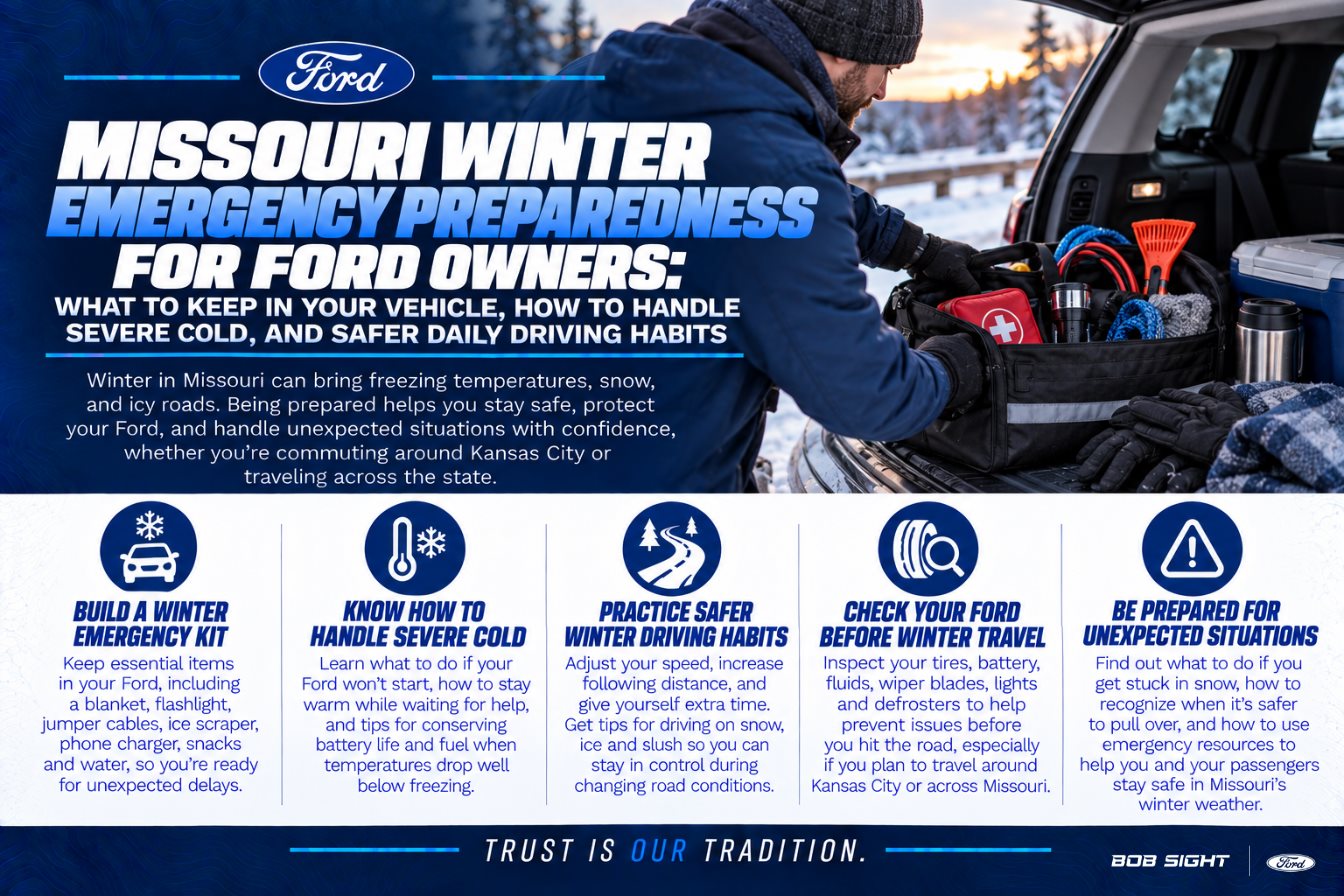
Missouri Winter Emergency Preparedness for Ford Owners: What to Keep in Your Vehicle, How to Handle Severe Cold, and Safer Daily Driving Habits
Schedule Ford Winter Service in Lee’s Summit
Missouri winter emergency preparedness means getting your Ford, your emergency supplies, and your daily driving habits ready before snow, ice, freezing temperatures, or a roadside delay creates an urgent situation. For Ford owners in Lee’s Summit, Blue Springs, Independence, Raytown, Grandview, Belton, Liberty, and throughout the Kansas City Metro, winter conditions can change quickly enough that a normal commute can become a much slower trip home. A practical emergency kit, adequate fuel or battery charge, clear visibility, working tires and lights, and a plan for what to do if travel becomes unsafe can make winter driving easier to manage. The goal is not to prepare for every imaginable emergency. It is to carry useful supplies and develop habits that help when a routine Missouri winter drive does not go according to plan.
In This Guide You’ll Learn
This guide focuses specifically on winter emergency preparedness and driving habits rather than repeating a full battery, tire, or seasonal maintenance checklist. Ford owners can use it as a practical companion to other winter vehicle preparation, with an emphasis on what belongs in the vehicle and what to do when conditions deteriorate.
- What to keep in a practical Missouri winter vehicle emergency kit
- Which supplies matter most during an unexpected roadside delay
- How to prepare before leaving during snow, ice, or severe cold
- What to do if your Ford becomes disabled during winter weather
- Why fuel level or EV battery charge matters during winter travel
- How to adjust speed, following distance, braking, and steering on slick roads
- Why snowplows, bridges, ramps, and shaded roads require extra attention
- How to tailor emergency supplies to children, older passengers, medications, and longer trips
What Should Ford Owners Keep in a Missouri Winter Emergency Kit?
A useful Missouri winter emergency kit should help occupants stay warm, visible, hydrated, connected, and reasonably comfortable if a vehicle becomes disabled or traffic stops for an extended period. The best kit is not necessarily the largest one. It should contain supplies that match the number of passengers, typical trip length, medical needs, and the types of roads you use during winter.
Start with warmth and communication. Blankets, gloves, hats, extra socks, and an additional warm outer layer can be valuable if the cabin becomes colder during a prolonged delay. A working flashlight provides light around the vehicle after dark, while a phone charging cable and charged portable battery pack can help preserve communication and navigation. Keeping emergency contact information accessible is also useful if a phone battery is low or a situation becomes stressful.
Food and water can help during a longer-than-expected delay. Shelf-stable snacks that tolerate vehicle storage are easier to manage than items that spoil quickly. Bottled water can also be carried, although freezing temperatures may affect stored containers during extended cold periods. Check emergency supplies periodically rather than loading them into the Ford in November and forgetting about them until spring.
Basic vehicle-related supplies can include a snow brush, automotive ice scraper, small shovel, reflective warning equipment, and basic first-aid supplies. Some drivers also carry traction material for situations where a tire needs additional grip on packed snow. Jumper cables or an appropriate portable jump-start device may be useful for drivers who know how to use them correctly, although vehicle-specific jump-start procedures should always be followed.
| Emergency Supply | Purpose | Planning Consideration |
|---|---|---|
| Blankets and warm clothing | Helps occupants stay warmer during a delay | Pack enough for regular passengers |
| Flashlight | Provides light around the vehicle | Check batteries throughout winter |
| Phone charger or battery pack | Supports communication and navigation | Keep the battery pack charged |
| Water and shelf-stable food | Helps during extended delays | Refresh supplies periodically |
| Snow brush and ice scraper | Restores visibility before driving | Use automotive-safe tools |
| Small shovel | Can help clear snow near tires | Choose a compact vehicle-friendly size |
| Reflective warning equipment | Improves vehicle visibility when safe to deploy | Store where it is easy to reach |
| Basic first-aid supplies | Helps address minor immediate needs | Review expiration dates |
A commuter driving between Blue Springs and Lee’s Summit may never use most of the kit, but winter preparation is designed for the unusual day rather than the normal one. A crash ahead, sudden freezing rain, road closure, disabled vehicle, or heavy snowfall can turn a familiar commute into a prolonged delay. Having practical supplies already in the Ford eliminates the need to improvise after conditions have deteriorated.
How Should You Customize a Winter Emergency Kit for Your Household?
Winter emergency supplies should reflect who normally rides in your Ford because a single commuter, a family with children, and a household transporting older adults may need different items. Generic winter-kit lists provide a starting point, but personalizing the contents makes the supplies much more useful during a real delay. Review passenger needs before the season begins and again before longer winter travel.
Families with young children may want additional clothing, age-appropriate snacks, wipes, diapers where applicable, and other everyday necessities that become more important when travel time doubles unexpectedly. Children can become uncomfortable in cold conditions more quickly than an adult who packed only for a short commute. Extra clothing can also help when snow-covered shoes or wet outerwear make normal winter travel messy.
Drivers who regularly transport an older family member should consider mobility needs, medication schedules, hearing or vision needs, and warmth. Necessary medications should not be forgotten simply because the intended trip is short. Anyone who depends on medical equipment or time-sensitive medication should plan winter travel with those requirements in mind and reconsider unnecessary trips when severe weather is expected.
Pet owners should also account for animals that frequently travel in the vehicle. Water, a leash or carrier, and appropriate cold-weather considerations may belong in the travel plan. A roadside delay becomes more complicated when a household packed emergency supplies for people but forgot the dog riding in the cargo area.
Keep the kit accessible. Emergency supplies buried beneath luggage, work tools, or a full cargo area can become difficult to reach if the liftgate is blocked or the vehicle is stopped near traffic. A clearly marked tote or soft-sided bag can keep the most important items together without consuming excessive space in an Explorer, Escape, Bronco Sport, Expedition, F-150, Ranger, Maverick, or another Ford.
What Should You Check Before Leaving During Severe Cold or Snow?
Before leaving during Missouri winter weather, check road and weather conditions, clear the Ford completely, confirm visibility and tire condition, review dashboard warnings, and make sure you have enough fuel or battery charge for delays. Winter travel should begin with the question of whether the trip needs to happen at all. When conditions are severe, postponing unnecessary travel can be the safest and simplest option.
If you do need to leave, walk around the vehicle before pulling away. Remove snow and ice from the windshield, side windows, mirrors, lights, roof, hood, cameras, and other areas that affect visibility or vehicle systems. Do not drive with only a small opening cleared in the windshield. Snow left on the roof can move forward under braking or blow backward once the vehicle reaches highway speed.
Check whether the tires appear normally inflated and respond to any tire-pressure warning before the trip. Cold temperatures can reduce tire pressure, but a puncture or slow leak can occur at the same time. Verify that windshield washers and wipers function, confirm the defrost system can maintain a clear windshield, and make sure exterior lighting is usable.
Look at the fuel gauge or available EV charge before leaving. A winter trip may require more time than expected because of slower speeds, traffic, detours, plowing operations, or road closures. Starting a difficult trip with very little remaining range reduces your options if the route changes or traffic stops.
- Review the weather and expected road conditions for the full route.
- Decide whether the trip can reasonably be postponed.
- Clear snow and ice from the Ford before moving.
- Check visibility through the windshield, windows, mirrors, lights, and cameras.
- Review tire-pressure and other dashboard warnings.
- Confirm wipers, washer fluid, defrost, and exterior lighting are functional.
- Make sure fuel or battery charge provides reasonable margin for delays.
- Check that your phone is charged and the emergency kit is in the vehicle.
- Tell someone your route when severe weather makes longer travel uncertain.
This type of pre-trip routine is useful before heading from Lee’s Summit toward Independence, Kansas City, Liberty, or another part of the metro. Major roads and residential streets may be in very different condition, so a clear driveway does not guarantee that every part of the route will be equally manageable.
How Should Driving Habits Change on Missouri Snow and Ice?
Safer winter driving requires slower speeds, longer following distances, earlier braking, gentler acceleration, and smoother steering because snow and ice reduce the amount of traction available to the tires. AWD, 4x4, traction control, stability control, and selectable drive modes can assist the driver, but none of them can restore dry-pavement grip when the road is slick.
Increase space between your Ford and the vehicle ahead so you have more time to respond. A normal following distance may not provide enough room if traffic slows suddenly on packed snow or a glazed section of pavement. Looking farther ahead also helps you recognize red lights, stopped traffic, snowplows, crashes, and changing road surfaces early enough to respond gradually.
Acceleration should be gentle. Applying power aggressively can overwhelm available tire traction and trigger wheelspin. Steering should also be smooth because sudden lane changes can shift vehicle weight quickly on a low-grip surface. Brake earlier than you would on dry pavement and allow the vehicle to slow progressively whenever circumstances permit.
Do not let other traffic pressure you into driving faster than conditions allow. A driver following closely behind does not change the amount of traction available to your Ford. Maintain a speed that allows you to respond safely to the road you can see, and move aside when a safe opportunity allows faster traffic to pass.
A morning commute along I-470 or US-50 may include stretches that appear nearly dry followed by ramps, bridges, or shaded areas that remain slick. Adjusting continuously to the surface is more effective than selecting one speed and assuming conditions will remain consistent for the entire trip.
Why Do Bridges, Ramps, and Shaded Roads Need Extra Winter Caution?
Bridges, overpasses, ramps, shaded areas, and untreated local streets can become slippery before surrounding pavement or remain icy after other roads have improved. These localized changes are one reason Missouri winter driving can be deceptive. A route may seem manageable for several miles before the vehicle reaches one colder or less-treated section.
Elevated road surfaces can cool differently from pavement resting directly on the ground. Drivers should approach bridges and overpasses with extra caution when temperatures are near freezing or precipitation is occurring. Reducing speed before reaching a potentially slick area is generally more controlled than waiting until the vehicle is already on the questionable surface to make a major correction.
Ramps create another challenge because they combine turning forces with potential elevation changes. A curved ramp that feels normal on wet pavement can require much more caution when ice is present. Brake before the turn when possible, enter at a reasonable speed for the conditions, and avoid abrupt steering or throttle inputs through the curve.
Shaded residential roads and parking areas can also stay icy longer because direct sunlight reaches them later or not at all. A subdivision in Lee’s Summit may have sunny streets that appear clear while one tree-lined hill remains glazed. The same can happen near buildings, parking garages, and commercial areas where shadows keep pavement colder.
This variability matters for drivers traveling between Blue Springs, Independence, Raytown, and Lee’s Summit because road treatment and clearing schedules can differ from one jurisdiction or street type to another. Major highways may improve faster than side streets. The last mile of a trip can sometimes require more patience than the previous twenty.
How Should Ford Owners Drive Around Snowplows and Road-Clearing Equipment?
Give snowplows and road-treatment equipment substantial space because their drivers need room to clear lanes, spread material, change position, and operate equipment that may extend beyond the normal truck width. Following too closely also places your Ford in a cloud of snow, salt, spray, and debris that can sharply reduce visibility.
Resist the urge to pass a snowplow simply because traffic behind it is moving slowly. The pavement immediately ahead of the plow may be in worse condition than the surface behind it. Snowplows can also operate in groups, change lanes, or use equipment extending from the side of the truck. Patience is more useful than trying to save a few minutes during poor weather.
Visibility can deteriorate dramatically behind a plow. Snow thrown from the roadway may create a temporary whiteout, while spreaders can distribute salt, sand, or other treatment material. Leave enough distance that you can see what is happening ahead and respond if the plow slows unexpectedly.
Drivers should also avoid positioning themselves beside road-clearing equipment for extended periods. Large trucks have substantial blind spots, and winter spray can make surrounding traffic harder for everyone to see. If traffic conditions require you to remain near a plow, stay alert and avoid unnecessary lane changes around it.
For commuters in Jackson County, snowplow encounters are often part of the first trips after a winter storm. Treat the slower pace as part of the trip rather than an obstacle to overcome. Building extra time into the schedule makes it easier to stay behind clearing equipment without feeling pressured to make an unnecessary pass.
What Should You Do if Your Ford Becomes Disabled During Severe Winter Weather?
If your Ford becomes disabled during severe winter weather, prioritize personal safety, communication, visibility, and protection from the cold rather than immediately trying to solve a mechanical problem beside moving traffic. The safest response depends on where the vehicle stops, traffic conditions, weather, and whether the vehicle can be moved out of an active lane.
If the Ford can be moved safely to an appropriate location away from moving traffic, do so according to the circumstances. Activate hazard lights and contact roadside assistance or emergency services as appropriate. Avoid standing beside a disabled vehicle near high-speed traffic, where low visibility and slick roads can make the roadside itself dangerous.
In severe cold or blowing snow, remaining with the vehicle can provide shelter and make it easier for responders to locate you. If the engine is running while you wait, snow accumulation around the exhaust area can create a serious concern. Keep the exhaust outlet clear and remain alert to changing conditions. If there is any reason to suspect exhaust gases are entering the cabin, stop running the engine and seek emergency assistance.
Use emergency supplies to preserve warmth rather than running every electrical accessory continuously if the vehicle is not operating normally. Put on extra clothing before you become extremely cold. Keep your phone available for necessary communication instead of using battery-intensive entertainment while waiting. If several people are in the vehicle, sharing blankets and minimizing unnecessary door opening can help retain cabin warmth.
- Move to a safer location if the vehicle can be moved safely.
- Activate hazard lights.
- Contact appropriate roadside or emergency assistance.
- Remain protected from traffic and severe weather.
- Use warm clothing and blankets from the emergency kit.
- Conserve phone battery while maintaining communication.
- Monitor snow accumulation around the vehicle and exhaust area.
- Avoid attempting repairs beside fast-moving traffic when conditions are unsafe.
- Follow instructions from emergency responders or roadside personnel when they arrive.
A breakdown along a busy Kansas City Metro highway presents different hazards from becoming stuck on a quiet neighborhood street. Use judgment based on traffic, visibility, temperature, and location. Emergency preparation gives you more options while professional help is on the way.
How Should Severe Cold Change Fuel, Charging, and Daily Planning?
Severe cold makes it useful to maintain more fuel or battery-charge margin than you might during mild weather because slower traffic, detours, cabin heating, and unexpected delays can change the amount of time spent on the road. The goal is not to keep every Ford completely full at all times. It is to avoid beginning difficult winter travel with little remaining range.
Gasoline-powered Ford owners should pay attention to fuel level before winter storms or long trips. A route that normally takes thirty minutes can take much longer when traffic slows behind plows or crashes close lanes. Additional fuel provides flexibility if you need to reroute, wait in traffic, or reach a different destination.
Ford EV owners should account for the fact that cold weather can affect energy use and available driving range. Cabin heating and battery temperature management can increase energy demand. When supported by the specific Ford, preconditioning while the vehicle is connected to power can help prepare the cabin and battery before departure. Owners should follow the vehicle-specific guidance for cold-weather charging and range planning.
Regardless of powertrain, avoid letting range planning become another source of stress during a storm. If the expected route is close to the limits of available fuel or charge under ideal conditions, winter weather provides a reason to create additional margin before leaving. A closed exit or lengthy traffic backup should not immediately create a range emergency.
For drivers traveling from Lee’s Summit toward Overland Park, Olathe, Liberty, or other parts of the metro, this planning can be as simple as refueling or charging earlier than usual when significant weather is forecast. Winter preparedness often consists of small decisions made before the trip rather than dramatic actions after a problem occurs.
Quick Facts About Missouri Winter Emergency Preparedness for Ford Owners
A strong winter emergency plan combines useful supplies, a winter-ready Ford, extra travel time, and driving habits that respond to available traction rather than normal dry-road expectations. Emergency preparation should make winter travel calmer and more deliberate, not create the impression that any road condition can be safely driven simply because the vehicle is equipped.
- Carry warm clothing or blankets for regular passengers.
- Keep a flashlight and check its batteries during the winter.
- Carry phone charging equipment or a charged portable battery pack.
- Include water, shelf-stable snacks, and basic first-aid supplies.
- Keep an automotive snow brush and ice scraper accessible.
- Customize emergency supplies for children, older adults, pets, and medical needs.
- Check weather and road conditions before leaving.
- Postpone unnecessary travel when conditions become severe.
- Clear snow and ice from the Ford before driving.
- Begin winter trips with adequate fuel or battery-charge margin.
- Reduce speed and increase following distance on slick roads.
- Use gentle acceleration, braking, and steering inputs.
- Give snowplows and road-treatment equipment plenty of space.
- Expect bridges, ramps, shaded areas, and local roads to have different traction conditions.
- AWD and 4x4 assist with traction but do not eliminate the limitations of snow and ice.
- If disabled, prioritize personal safety and communication before attempting roadside repairs.
These principles work across Ford models because winter preparedness is primarily about planning for people, roads, and changing conditions. A Bronco with 4x4, an AWD Explorer, an F-150, a Maverick, an Escape, a Mustang Mach-E, or a front-wheel-drive vehicle can all encounter conditions where postponing a trip is more appropriate than relying on vehicle technology.
Ownership Planning for the Entire Missouri Winter Season
Winter emergency preparedness should be maintained throughout the season because supplies get used, batteries discharge, passenger needs change, and Missouri weather can remain unpredictable for months. Treat the emergency kit as part of normal vehicle ownership rather than something assembled once and forgotten in the cargo area.
Review the kit after anything is used. Recharge portable battery packs, replace snacks or water, restock first-aid supplies, and return gloves or blankets that were brought into the house. Check the flashlight periodically because discovering dead batteries during a roadside delay defeats the purpose of carrying it.
Combine emergency planning with routine Ford maintenance. A well-stocked winter kit does not replace proper tires, a healthy battery, functional wipers, working lights, appropriate fluids, or a dependable charging system. Emergency supplies are a backup for unexpected events. Preventive maintenance reduces the likelihood that a preventable vehicle problem creates the emergency in the first place.
Your driving routine should shape your level of preparation. Someone making short trips around Lee’s Summit may carry a compact emergency kit, while a driver routinely traveling rural Missouri roads or long distances during early morning hours may want additional supplies. A work truck traveling jobsites throughout the Kansas City Metro may need a different setup from a household SUV primarily used for school and grocery trips.
Ford owners can schedule service at Bob Sight Ford if winter preparation reveals a battery, tire, fluid, wiper, brake, lighting, or other vehicle concern. Preparing both the people and the vehicle creates a more complete approach to winter ownership than relying on emergency supplies alone.
Frequently Asked Questions About Missouri Winter Emergency Preparedness
What are the most important items to keep in my Ford during a Missouri winter?
The most useful items include warm clothing or blankets, a flashlight, phone charging equipment, water, shelf-stable food, basic first-aid supplies, a snow brush, an ice scraper, and reflective warning equipment. A small shovel and other traction-related supplies may also make sense depending on where you drive. The exact kit should reflect your regular passengers and routes.
A winter emergency kit should support the first needs that appear during a delay: staying warm, communicating with help, maintaining visibility, and remaining reasonably comfortable. Avoid filling the vehicle with equipment you do not know how to use. Simple, familiar supplies are more valuable than complicated emergency gear that has never been tested.
A Lee’s Summit commuter may never need the same amount of equipment as someone traveling rural roads several times a week, but even local trips can be delayed by crashes or changing weather. A compact kit stored in the Ford throughout winter creates useful backup without taking over the cargo area.
How much fuel should I keep in my Ford during winter?
Ford owners should avoid routinely entering winter weather with very little fuel because unexpected traffic, detours, road closures, and longer travel times can reduce available range. Keeping a reasonable reserve provides more flexibility if the normal trip takes much longer than expected.
The appropriate amount depends on trip length and conditions rather than one universal rule for every driver. Before significant winter weather or longer travel, check the fuel level and think about what would happen if the route doubled in duration. Refueling before conditions deteriorate can be easier than trying to find fuel after a storm begins.
Drivers traveling between Blue Springs, Independence, and Lee’s Summit may normally pass many fuel stations, but closures, power outages, heavy traffic, or route changes can affect availability during severe weather. Additional range is useful because it provides options rather than because every winter trip will become an emergency.
Is AWD or 4x4 enough for safe driving in Missouri snow?
No, AWD or 4x4 can assist with moving the vehicle when traction is limited, but it does not create normal dry-pavement braking or cornering grip on snow and ice. Tires, vehicle speed, following distance, steering inputs, braking technique, and road conditions remain critical.
Drivers may notice that an AWD or 4x4 Ford accelerates confidently from a snowy stop, which can create a false sense that overall traction is better than it actually is. The vehicle still has to stop and turn using the grip available at the tires. Ice can sharply reduce that available grip regardless of drivetrain.
Ford Bronco, Bronco Sport, Explorer, Expedition, F-150, Ranger, Maverick, Escape, and Super Duty owners should all adjust their driving to conditions. Capability is useful, but the safest decision may still be to postpone travel when Missouri roads become severely covered or icy.
What should I do if I become stranded in my Ford during extreme cold?
If you become stranded during extreme cold, prioritize shelter, communication, warmth, and visibility while arranging appropriate assistance. The exact response depends on the location, traffic, weather, and whether the vehicle is safely out of an active travel lane. A Ford can provide shelter from wind and precipitation while help is being arranged.
Use the emergency clothing and blankets before you become extremely cold, conserve phone battery, and keep emergency contacts informed. If the engine is being operated while snow is accumulating, remain aware of the exhaust area and prevent snow from blocking the outlet. Exhaust entering the cabin can create a dangerous situation.
If the vehicle is disabled along a busy Kansas City Metro highway, avoid unnecessary exposure to moving traffic. A roadside repair that might be simple on a warm afternoon can become much more dangerous in darkness, blowing snow, or freezing rain. Professional roadside or emergency assistance may be the safer option.
Where can I prepare my Ford for winter driving near me in Lee’s Summit?
Ford owners can schedule winter service at Bob Sight Ford in Lee’s Summit to address vehicle concerns before colder temperatures and winter precipitation become more disruptive. A winter maintenance visit can be based on the specific Ford’s condition, maintenance history, model, powertrain, and symptoms rather than relying on a generic replacement list.
Tell the service team about problems such as slow starting, tire-pressure changes, worn wipers, weak washer spray, brake concerns, fluid warnings, lighting issues, or other changes you have noticed. Emergency supplies are valuable, but they should accompany a vehicle that is maintained for the season rather than compensate for known mechanical problems.
Bob Sight Ford serves Ford owners from Lee’s Summit, Blue Springs, Independence, Raytown, Grandview, Belton, Liberty, and throughout the Greater Kansas City Metro. Preparing before severe winter weather gives drivers more time to address maintenance needs while also organizing the supplies and travel habits that support cold-weather ownership.
Build a Winter Plan Before You Need It
The best time to prepare for a Missouri winter driving emergency is before the forecast becomes urgent. A practical kit, adequate fuel or charge, clear visibility, a maintained Ford, and safer winter driving habits create several layers of preparation. None of them guarantees that a winter trip will be problem-free, but together they give drivers more options when conditions change unexpectedly.
Start with the people who normally ride in your Ford. Pack enough warmth, food, water, medication, and charging capability for those passengers. Then consider the vehicle itself. Tires, battery condition, brakes, wipers, washer fluid, lights, and defrost performance should be maintained before the weather becomes severe.
Finally, adjust the way you drive. Missouri winter roads can change between Lee’s Summit, Blue Springs, Independence, Raytown, and Kansas City within the same trip. Reduce speed, leave more room, avoid abrupt control inputs, respect snowplows, and assume bridges or shaded surfaces may have less traction than the roads around them.
Bob Sight Ford in Lee’s Summit can help Ford owners prepare their vehicles for winter while serving communities throughout Jackson County and the Greater Kansas City Metro. Emergency preparedness starts in the cargo area with the supplies you carry, but it becomes most effective when combined with a maintained vehicle and driving habits that reflect the conditions outside.
Helpful Links
- Schedule Ford Service
- Ford Service and Parts Specials
- Ford Pickup & Delivery
- Ford Parts Department
- Bob Sight Ford in Lee’s Summit
Proud to Be Part of the Bob Sight Auto Group
Bob Sight Ford is proud to be part of the Bob Sight Auto Group, serving drivers throughout the Kansas City Metro and surrounding communities with automotive sales, service, parts, financing, and collision repair resources. Our dealerships include Bob Sight Ford in Lee’s Summit, Bob Sight Kia in Independence, Bob Sight Honda in Lawrence, Bob Sight CDJR in Lawrence, and the Bob Sight Collision Center in Lee’s Summit. Whether you are assembling a winter emergency kit, preparing your Ford for colder weather, or managing routine vehicle maintenance throughout the year, our goal is to provide useful local automotive resources throughout your ownership journey.