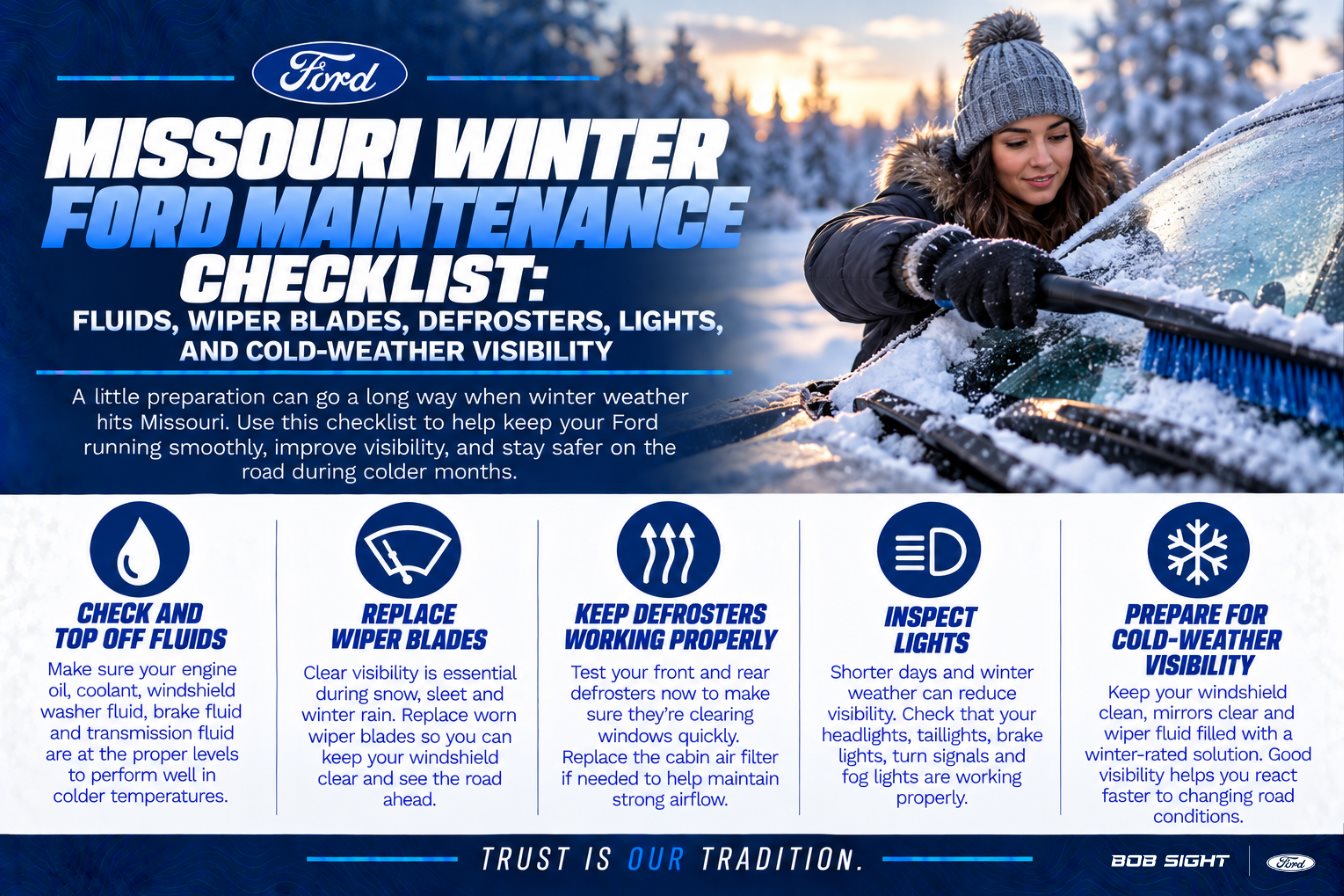
Missouri Winter Ford Maintenance Checklist: Fluids, Wiper Blades, Defrosters, Lights, and Cold-Weather Visibility
Schedule Ford Winter Maintenance in Lee’s Summit
Preparing your Ford for a Missouri winter means checking more than the battery and tires. Fluids, windshield-washer performance, wiper blades, front and rear defrosters, exterior lights, and overall visibility all become more important when temperatures fall and Kansas City roads turn wet, icy, snowy, or covered with road spray. For Ford owners in Lee’s Summit, Blue Springs, Independence, Raytown, Grandview, Belton, Liberty, and across the Kansas City Metro, winter weather can shift quickly from rain to freezing temperatures. A seasonal maintenance check can help identify worn wipers, low fluids, weak lighting, or visibility problems before a dark morning commute or winter storm makes them harder to ignore.
In This Guide You’ll Learn
This Missouri winter Ford maintenance checklist focuses on the vehicle systems that help you see clearly, keep essential fluids functioning, and maintain dependable everyday operation during cold weather. It complements battery and tire maintenance by looking at the systems Ford owners may overlook until snow, freezing rain, road salt, or a fogged windshield creates an immediate problem.
- Which vehicle fluids deserve attention before freezing weather
- Why windshield-washer fluid matters during Missouri winters
- How to tell when Ford wiper blades are ready for replacement
- Why front defrost and rear-window defogging systems should be checked early
- How headlights, brake lights, and other exterior lighting support winter visibility
- Why road salt and winter grime can reduce visibility quickly
- How short winter trips and repeated freeze-thaw cycles affect maintenance planning
- What Ford owners can inspect at home before scheduling professional service
Winter readiness is not a one-time task. Missouri weather can move through warm afternoons, overnight freezes, rain, slush, snow, wind, and bright winter sun within a short period. Drivers who monitor these systems throughout the season are better prepared for changing conditions than those who perform one inspection in fall and assume everything will remain unchanged through February.
Which Fluids Should Ford Owners Check Before Missouri Winter?
Ford owners should make sure engine oil, engine coolant, windshield-washer fluid, brake fluid, and other vehicle-specific fluids are at the proper level and maintained according to the requirements for the exact model, engine, and model year. Winter does not create a separate universal fluid schedule, but colder temperatures can make existing maintenance issues more noticeable. The most reliable approach is to follow Ford’s requirements for the specific vehicle rather than applying one generic recommendation to every Ford.
Engine oil is important during cold starts because the lubricant must circulate as the engine begins operating. Ford vehicles can require different oil viscosities and specifications depending on engine design, so owners should not change oil grade simply because winter has arrived unless the vehicle-specific information supports that choice. The correct oil specification helps support lubrication during both cold starts and normal operating temperatures. If an oil change is due, handling it before the coldest part of winter can help keep maintenance on schedule rather than waiting until poor weather makes a service visit more inconvenient.
Engine coolant deserves attention as well. Coolant helps regulate engine temperature and provides freeze protection when the cooling system contains the correct fluid mixture and specification. Low coolant, visible leaks, repeated coolant warnings, or an unusual sweet smell should be investigated rather than corrected repeatedly without determining the cause. A cooling-system concern that is minor in mild weather can become more disruptive during freezing conditions.
Windshield-washer fluid is often one of the most frequently used fluids during a Kansas City winter. Road spray, salt residue, grime, and slush can quickly coat the windshield on I-470, US-50, Route 291, and other heavily traveled roads. The reservoir should contain washer fluid designed for temperatures appropriate to winter use rather than plain water. Water can freeze in cold conditions and does not provide the same cleaning performance against oily winter road film.
Brake fluid, transmission fluid, transfer-case fluid, and differential fluids are also part of the vehicle’s broader maintenance picture where applicable. These systems should be serviced according to Ford’s guidance for the specific vehicle and use pattern. A Ford F-150 used for towing, a Bronco Sport used on unpaved roads, and an Escape used primarily for commuting may have different operating demands. Seasonal preparation is a good opportunity to review the vehicle’s maintenance history and determine whether any scheduled fluid service is approaching.
Why Is Windshield-Washer Fluid So Important in Missouri Winter?
Windshield-washer fluid becomes a major winter safety and visibility item because road salt, slush, dirty water, and traffic spray can cover the windshield quickly even when snow is not actively falling. A clear windshield can become streaked within minutes when traffic moves through wet winter roads. If the washer reservoir is empty or the fluid is not suitable for freezing temperatures, the driver may lose one of the easiest ways to restore visibility while traveling.
Winter washer fluid should be selected for cold-weather conditions and used according to the vehicle and product instructions. Using plain water in freezing weather is not a practical substitute because it can freeze. Ford owners who have been topping off a reservoir with water during warmer months should make sure the system is prepared before sustained freezing temperatures arrive. If the reservoir was recently filled with another product, avoid guessing about compatibility and follow the appropriate guidance for the vehicle and fluid being used.
The washer nozzles should also produce an even spray pattern. If one side of the windshield receives little or no fluid, the nozzle may be blocked, frozen, misaligned, or affected by another problem. Owners should also pay attention to whether the washer pump can be heard when activated. A reservoir that is full but produces no spray needs more investigation than simply adding fluid.
Consider a driver leaving Blue Springs before sunrise after crews have treated roads overnight. The pavement may be clear enough for normal travel, but passing vehicles can throw a mixture of water, salt, and road grime onto the windshield. Without functional washer fluid and effective wiper blades, visibility can deteriorate quickly even though there is no active snowstorm. This is one reason washer-fluid maintenance belongs in every Missouri winter vehicle checklist.
- Check the windshield-washer fluid reservoir before sustained cold weather.
- Use washer fluid appropriate for winter temperatures.
- Test the front washer nozzles and confirm the spray reaches the intended windshield area.
- Check the rear washer system if the Ford is equipped with one.
- Look for weak spray, leaks, or a pump that operates without delivering fluid.
- Refill before long winter trips rather than waiting for the low-fluid warning.
- Keep the windshield itself clean so wiper performance can be evaluated accurately.
How Do You Know When Ford Wiper Blades Need Replacement?
Ford wiper blades should be replaced when they streak, chatter, skip, leave unwiped areas, smear water instead of clearing it, or show visible deterioration in the rubber wiping edge. Winter exposes marginal wipers quickly because the blades must handle cold glass, road film, snow residue, freezing rain, and repeated washer-fluid use. A blade that seemed acceptable during light summer rain may become frustrating once winter precipitation begins.
Start with a simple visual inspection. Lift the wiper arms carefully when appropriate for the vehicle and examine the rubber edge for cracks, splitting, uneven wear, or sections pulling away from the frame. Some modern Ford wiper systems may have vehicle-specific service positions or procedures, so owners should follow the instructions for their model before forcing the arms away from the windshield.
Then evaluate performance during actual use. A blade that leaves a consistent line across the glass may have a damaged section. Chattering can be related to the blade, windshield contamination, or other conditions. Smearing may occur when the rubber no longer conforms properly to the glass or when oil and road film are present. Cleaning the windshield and blade surface may improve performance in some cases, but worn rubber still needs replacement.
Winter also creates a temptation to use the wipers as ice scrapers. That can damage the blade edge, wiper mechanism, or both. If the windshield is covered in ice, clear the glass appropriately before operating the wipers. Likewise, do not activate wipers that are frozen to the windshield. Allow the defrost system and proper ice-removal methods to free them first.
A Lee’s Summit commuter may leave home with a dry windshield and encounter light freezing drizzle near the I-470 and US-50 interchange. That is not the time to discover the driver-side wiper leaves a broad streak directly in the line of sight. Replacing worn blades before the season begins is a small maintenance step with a direct impact on everyday winter visibility.
| Wiper Symptom | What It May Indicate | Winter Impact |
|---|---|---|
| Streaking | Worn blade edge or dirty glass | Reduced visibility in rain, spray, and snow |
| Chattering | Blade wear, contamination, or poor contact | Intermittent clearing across the windshield |
| Skipping | Blade no longer contacting glass evenly | Uncleared sections in the driver’s view |
| Cracked rubber | Physical deterioration | Rapid performance loss in freezing weather |
| Frozen blade | Ice binding the blade to glass | Potential blade or wiper-system damage |
Why Should Ford Owners Test the Front Defrost and Rear Defogger Before Winter?
The front defrost and rear-window defogger should be tested before severe winter weather because they help manage interior condensation, frost, and reduced visibility when temperatures fall. A defroster problem can remain unnoticed during warm weather because the system may not be used regularly. The first freezing morning is a poor time to discover that air is not reaching the windshield properly or that the rear-window heating grid is not functioning as expected.
The front defrost system typically uses the vehicle’s climate-control system to direct air toward the windshield. Depending on the Ford and selected settings, air conditioning may also operate to help dehumidify the cabin even when heat is requested. This can help remove moisture from the air and clear fog from the glass. Owners should test whether airflow reaches the windshield, whether the fan operates across its range, and whether warm air becomes available once the powertrain reaches operating temperature.
Rear-window defogging works differently. Many vehicles use electrically heated grid lines embedded in or attached to the rear glass. If part of that grid is damaged, only certain areas may clear. Owners should avoid scraping or attaching items in ways that could damage those fine electrical elements. If the rear glass remains fogged or frosted after the system has been operating as intended, inspection may be needed.
Interior moisture can make winter visibility problems worse. Wet boots, snow-covered coats, damp floor mats, and several passengers can add moisture to the cabin. When warm, humid interior air contacts cold glass, condensation can form rapidly. A family traveling from Lee’s Summit to a school event in Independence may see the windows fog more quickly once multiple passengers climb into a warm vehicle with wet clothing.
Keep air vents clear of objects, brush snow away from exterior air-intake areas when appropriate, and make sure floor mats are not trapping excessive standing water. If the windows fog heavily even when the climate system is being used correctly, investigate the cause. Clear glass is not only a comfort issue. It is a basic requirement for seeing pedestrians, lane markings, traffic signals, and surrounding vehicles during Missouri winter driving.
Which Exterior Lights Should Be Checked Before Winter?
Ford owners should check headlights, high beams, daytime running lights where equipped, turn signals, brake lights, taillights, hazard lights, license-plate lights, and other exterior lamps before winter because shorter daylight hours and poor weather increase reliance on lighting. A burned-out or obscured lamp becomes more significant when commuting before sunrise, driving home after dark, or traveling through snow, rain, fog, and road spray.
Lighting serves two purposes: helping the driver see and helping other road users see the vehicle. Headlights illuminate the road and nearby hazards, while taillights and marker lights make the vehicle easier to identify from behind or from an angle. Brake lights communicate deceleration, and turn signals communicate intended direction changes. Winter weather can reduce contrast and visibility, making each of these functions more valuable.
A practical inspection can be performed with another person or by carefully using reflections from a garage door or nearby surface when appropriate. Confirm that both low beams operate, then check high beams and turn signals. Ask someone to observe the rear of the vehicle while the brake pedal is applied. Test hazard lights as well. If the Ford displays a lamp warning or lighting-related message, address it rather than waiting for the next service visit.
Lens cleanliness matters too. Road salt and dirty spray can coat headlights and taillights, reducing how effectively light passes through the lens. A vehicle driven between Raytown and Lee’s Summit on heavily treated roads may accumulate a visible film in only a few trips. Cleaning the lights when cleaning the windshield and mirrors can help maintain better visibility.
Some modern Ford vehicles use LED lighting systems or assemblies that are serviced differently from older replaceable-bulb designs. The exact repair approach depends on the vehicle and lighting system. If a light is not operating correctly, use the vehicle-specific information or professional service rather than assuming every lamp can be repaired with a simple bulb replacement.
How Can Road Salt, Snow, and Winter Grime Reduce Visibility?
Road salt and winter grime can reduce visibility by coating the windshield, side glass, mirrors, headlights, taillights, cameras, and sensors with a film that builds gradually during wet winter driving. The effect may be subtle at first, but glare from headlights or low winter sun can make dirty glass dramatically harder to see through. Keeping exterior viewing surfaces clean is one of the simplest winter ownership habits.
The windshield often gets the most attention, but side windows and mirrors deserve regular cleaning as well. Salt residue can dry into a hazy film that becomes difficult to see through when bright light hits it. The rear window may also accumulate grime from airflow behind SUVs, crossovers, trucks, and hatchbacks, making rear washers and wipers valuable where equipped.
Cameras and driver-assistance sensors can also become obstructed. Ford vehicles may use cameras, radar, ultrasonic sensors, or other components to support available driver-assistance features. Snow, ice, salt, dirt, or heavy road spray can reduce system availability or performance. The exact sensor locations vary by model, so follow the owner information for cleaning guidance rather than scraping or using harsh chemicals on sensitive components.
A driver traveling along US-50 after a snow event may experience mostly dry pavement but still pick up a constant mist of salt-laden water from vehicles ahead. Within a relatively short trip, the windshield and headlights can become coated. At night, that film can create glare that makes lane markings and roadside details harder to distinguish. Cleaning the vehicle’s glass and lighting surfaces periodically during winter can restore clarity.
Snow should also be removed from the vehicle before driving. Clearing only a small area of the windshield is not enough. Windows, mirrors, lights, and other viewing areas need to remain usable, and loose snow on the vehicle can shift or blow during travel. Taking a few additional minutes before leaving a Blue Springs driveway can create better visibility for the entire trip rather than trying to manage obstructed views once the vehicle is moving.
What Should You Check Before a Winter Commute or Road Trip?
Before a Missouri winter commute or longer trip, Ford owners should confirm visibility, washer-fluid availability, tire condition, exterior lighting, fuel or charge level, weather conditions, and whether the vehicle is showing any unresolved warning messages. The objective is not to perform a full mechanical inspection before every drive. It is to catch obvious problems before they become more difficult to manage away from home.
Start with the windshield, mirrors, and windows. Remove snow, frost, or ice completely enough to provide clear visibility in all required directions. Test the wipers and washers if conditions call for them. If the washer reservoir is nearly empty before a longer trip, refill it rather than assuming the remaining amount will be enough. Winter road spray can require frequent cleaning.
Next look at the exterior lights and tires. A quick walk around the Ford can reveal a visibly low tire, damaged sidewall, or lamp that is not operating. If a Tire Pressure Monitoring System warning appeared overnight, measure the tires before assuming the cold temperature is the only cause. A major temperature change can reduce pressure, but a puncture can occur at the same time.
Check the weather and route before leaving. Missouri winter conditions can vary substantially across the Kansas City Metro, and a route that looks clear in Lee’s Summit may encounter freezing precipitation elsewhere. Major highways may be treated before side streets, parking lots, rural roads, or bridges. Adjusting departure time or route can sometimes reduce exposure to the worst conditions.
- Clear snow, frost, and ice from the windshield, windows, mirrors, and lights.
- Confirm the windshield washers and wipers operate correctly.
- Check for tire-pressure warnings or visibly low tires.
- Verify headlights, taillights, brake lights, and turn signals are functioning.
- Review dashboard warnings before leaving.
- Make sure fuel or battery charge is appropriate for the planned trip.
- Check weather and road conditions for the entire route.
- Allow extra travel time so poor conditions do not encourage rushed driving.
This routine can be useful whether the trip is five miles across Lee’s Summit or a longer drive from the Kansas City Metro toward another part of Missouri. Winter preparation works best when small checks become normal habits rather than emergency reactions.
Quick Facts About Missouri Winter Ford Maintenance
A useful Missouri winter maintenance routine combines fluid checks, functional wipers, clear glass, working defrosters, dependable lighting, and ongoing visibility maintenance throughout the season. These systems may seem simple compared with major mechanical components, but they have a direct effect on how well the driver can see and respond to changing winter conditions.
- Use the engine oil specification required for the exact Ford engine and model year.
- Do not change oil viscosity solely because winter arrives unless Ford specifies that option.
- Low coolant or recurring coolant loss should be investigated rather than repeatedly topped off.
- Use windshield-washer fluid appropriate for freezing temperatures.
- Test washer nozzles before snow and road salt become common.
- Replace wipers that streak, chatter, skip, crack, or leave large unwiped areas.
- Do not operate wipers that are frozen to the windshield.
- Test front defrost operation before the first hard freeze.
- Make sure the rear-window defogger clears the glass as intended.
- Check headlights, brake lights, taillights, turn signals, and hazard lights.
- Clean road salt and grime from headlight and taillight lenses.
- Keep camera and sensor areas clean according to Ford guidance.
- Remove snow and ice from viewing areas before driving.
- Check weather and road conditions before longer winter trips.
- Combine visibility maintenance with tire and battery checks for a more complete winter inspection.
These winter-maintenance basics apply broadly across Ford trucks, SUVs, crossovers, performance vehicles, and commercial models, but the exact fluid specifications, component designs, and maintenance requirements vary by vehicle. An F-150, Bronco Sport, Explorer, Escape, Maverick, Ranger, Expedition, Mustang, and Transit should each be maintained according to the information for that specific vehicle rather than a one-size-fits-all checklist.
Ownership Planning for a Full Missouri Winter
The most effective winter ownership plan is one that addresses maintenance before severe weather, monitors changes throughout the season, and responds quickly when visibility or fluid-related systems stop working as expected. Winter conditions are not static. A vehicle that is fully prepared in November can still develop worn wipers, low washer fluid, tire-pressure changes, lighting problems, or other maintenance needs by January.
Driving patterns should shape that plan. A Ford owner who commutes daily from Liberty or Blue Springs to Lee’s Summit may accumulate significant winter mileage and use washer fluid frequently. A remote worker may drive less often but leave the vehicle parked outside for longer periods. A contractor in an F-150 may travel through muddy jobsites and salted highways, while a family in an Explorer may make repeated school, grocery, and activity trips around Jackson County.
Keep simple maintenance supplies available at home where appropriate, such as a tire-pressure gauge, ice scraper, snow brush, and approved windshield-washer fluid. That makes routine checks easier before a storm. Vehicle-specific maintenance and repairs should still follow Ford guidance, and warning messages should not be ignored simply because the vehicle appears to drive normally.
Winter is also a good time to maintain a basic service record. Note when wipers were replaced, when tires were rotated, when the battery was tested, and when fluids were serviced. Knowing what has already been addressed makes future maintenance decisions easier and reduces the temptation to guess about component age or condition.
Ford owners can review current Ford service and parts specials when planning winter maintenance. Bob Sight Ford also offers Ford Pickup & Delivery availability for eligible service situations. For drivers balancing work, school, and winter weather, planning maintenance before a problem becomes urgent can make ownership considerably more convenient.
Frequently Asked Questions About Ford Winter Maintenance in Missouri
What fluids should I check before winter in my Ford?
Ford owners should review engine oil, engine coolant, windshield-washer fluid, brake fluid, and any other vehicle-specific fluids required by the maintenance schedule before winter. The exact specifications and service requirements depend on the model, engine, drivetrain, and model year. Use Ford’s vehicle-specific information rather than a generic fluid chart.
Engine oil and coolant deserve particular attention because both support normal engine operation during cold weather. Washer fluid is equally important for winter visibility because salty road spray can cover the windshield rapidly. If any fluid level repeatedly drops, investigate the cause rather than treating repeated topping-off as normal maintenance.
For Lee’s Summit drivers, fall is a convenient time to review these items before overnight freezes become common. If scheduled maintenance is approaching, completing it before the coldest weather can reduce the chance that a routine service need becomes more inconvenient during a winter storm.
Why do my windows keep fogging during winter?
Windows fog when moisture inside the cabin condenses on colder glass, which is common when wet clothing, snowy shoes, damp floor mats, and passengers add humidity to the interior. Using the vehicle’s defrost and climate-control system correctly can help reduce that moisture and clear the glass.
Make sure airflow reaches the windshield and that climate-control functions operate normally. Do not block dashboard vents with objects. If the floor mats are holding substantial water, drying them can reduce cabin moisture. A dirty interior windshield can also make fogging appear worse and create more glare at night.
If the windshield remains difficult to clear despite proper climate-control use, additional inspection may be appropriate. A driver traveling through Independence or Raytown during freezing rain needs clear glass continuously, not just at the beginning of the trip. Persistent fogging should not be accepted as an unavoidable part of winter driving.
How do I know if my Ford wiper blades need to be replaced?
Wiper blades are candidates for replacement when they streak, skip, chatter, smear, leave sections of glass uncleared, or show visible cracking or deterioration. Wipers should clear water cleanly without requiring repeated passes to restore visibility. Winter usually makes existing blade wear easier to notice.
Before replacing a blade, make sure the windshield itself is clean because road film can cause smearing. If the blade continues performing poorly after the glass is cleaned, inspect the rubber edge. Also check whether ice has damaged the blade or whether the wiper arm is contacting the glass correctly.
Missouri road salt and winter spray can require frequent washer and wiper use during drives between Blue Springs, Lee’s Summit, and Kansas City. Replacing marginal blades before the season is often more convenient than discovering the problem during freezing precipitation or a nighttime commute.
Should I test my Ford defroster before winter?
Yes, testing the front defrost and rear-window defogger before freezing weather helps confirm that both systems can clear moisture, frost, and condensation when you need them. These systems may receive little attention during warm months, making an early-season test useful.
Run the front defrost and verify that airflow reaches the windshield appropriately. Test the rear defogger and observe whether the rear glass clears when conditions allow. If only part of the rear window clears, the heating grid or another component may need inspection.
This matters for Kansas City Metro commuters because winter visibility can deteriorate quickly when a warm vehicle is filled with passengers wearing wet coats or carrying snow into the cabin. Working defrost systems help keep the driver’s view clear when conditions outside are already challenging.
Where can I schedule Ford winter maintenance near me in Lee’s Summit?
Ford owners can schedule winter maintenance at Bob Sight Ford in Lee’s Summit for help evaluating fluids, wipers, lighting, visibility concerns, tires, batteries, and other seasonal maintenance needs. The exact service performed should be based on the vehicle’s condition, maintenance history, model, powertrain, and any symptoms the owner has noticed.
When scheduling, mention specific concerns such as streaking wipers, weak washer spray, a defroster that takes unusually long to clear the glass, exterior lighting issues, fluid warnings, or repeated visibility problems. Specific symptoms give the service team more useful information than requesting a generic winter check without context.
Bob Sight Ford serves Ford owners throughout Lee’s Summit, Blue Springs, Independence, Raytown, Grandview, Belton, Liberty, and the Greater Kansas City Metro. Addressing small visibility and maintenance issues before severe weather arrives can make winter driving more predictable and reduce the chance of discovering a problem during a storm.
Prepare Your Ford for Clearer, More Predictable Missouri Winter Driving
A complete Missouri winter maintenance plan should protect both the vehicle and the driver’s ability to see what is happening around it. Correct fluids, effective wiper blades, functioning defrosters, clean glass, working exterior lights, and usable washer systems are basic maintenance items with a direct effect on winter driving. They support the driver every time darkness, precipitation, salt spray, fog, or freezing temperatures reduce visibility.
For Lee’s Summit drivers, winter conditions are often less about one dramatic snowstorm and more about repeated smaller challenges. A cold morning can create frost, a warm afternoon can melt snow into dirty road spray, and another overnight freeze can produce slick patches by morning. Maintaining visibility systems throughout these cycles is more useful than waiting for a major storm to think about them.
Use the season as a reason to review the Ford as a complete system. Battery health supports starting. Tires support traction. Fluids support vehicle operation. Wipers, defrosters, washers, lighting, and clean glass support visibility. Each category serves a different purpose, and winter reliability improves when they are addressed together.
Bob Sight Ford in Lee’s Summit provides a local resource for Ford owners throughout Jackson County and the Greater Kansas City Metro who want to prepare for cold-weather driving. Whether you commute daily on I-470, travel US-50 from Blue Springs, make frequent neighborhood trips in Raytown, or drive throughout the region for work, handling winter maintenance before a problem becomes urgent can make the season easier to manage.
Helpful Links
- Schedule Ford Service
- Ford Service and Parts Specials
- Ford Pickup & Delivery
- Ford Parts Department
- Bob Sight Ford in Lee’s Summit
Proud to Be Part of the Bob Sight Auto Group
Bob Sight Ford is proud to be part of the Bob Sight Auto Group, serving drivers throughout the Kansas City Metro and surrounding communities with automotive sales, service, parts, financing, and collision repair resources. Our dealerships include Bob Sight Ford in Lee’s Summit, Bob Sight Kia in Independence, Bob Sight Honda in Lawrence, Bob Sight CDJR in Lawrence, and the Bob Sight Collision Center in Lee’s Summit. Whether you are preparing your Ford for another Missouri winter, planning seasonal maintenance, or managing everyday ownership needs, our goal is to provide useful local automotive resources throughout your ownership journey.