Choosing between the Ford F-150 and Chevrolet Silverado 1500 is an important decision for Kansas City Metro contractors, skilled trades, small businesses, and work crews that depend on a full-size pickup every day. Both trucks are established options in the full-size pickup segment, but the better choice depends on how the truck will actually be used. From carrying tools and materials around Lee’s Summit to towing equipment between Independence, Blue Springs, and communities throughout the Kansas City Metro, work-focused buyers should compare capability, configuration, everyday usability, technology, maintenance access, and long-term ownership needs. At Bob Sight Ford in Lee’s Summit, Missouri, drivers can evaluate the Ford F-150 based on the demands their work places on a truck.
Ford F-150 vs. Chevy Silverado for Kansas City Metro Work Crews
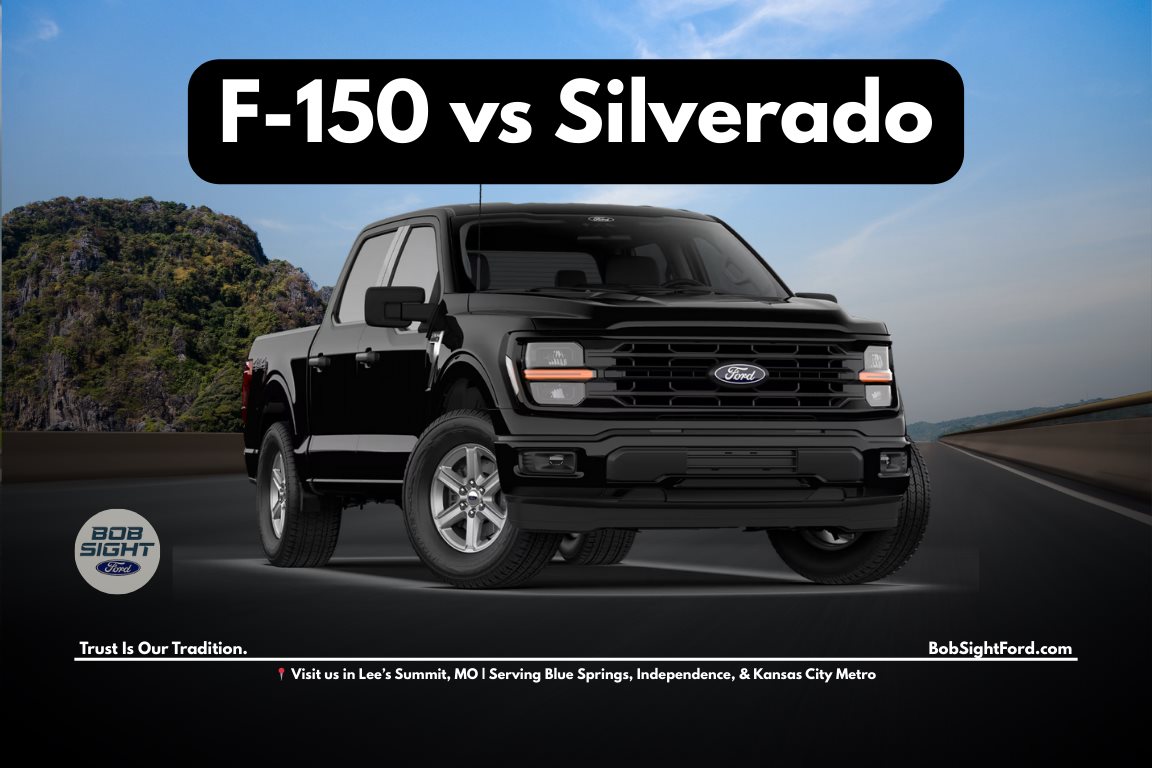
Explore New Ford F-150 Inventory at Bob Sight Ford
In This Guide You’ll Learn
- How the Ford F-150 and Chevrolet Silverado 1500 compare for work-focused use
- What Kansas City Metro contractors should consider before choosing a full-size truck
- How towing and payload needs affect the decision
- Why cab, bed, crew, and equipment requirements matter
- How everyday driving around Lee’s Summit and Kansas City affects truck selection
- Why long-term ownership and service access should be part of the comparison
- How to decide whether the F-150 fits your particular trade or business
Ford F-150 vs. Chevy Silverado: Which Is Better for Work?
There is no single full-size truck that is best for every contractor or work crew. The Ford F-150 and Chevrolet Silverado 1500 are both designed to serve drivers who need passenger space, open-bed utility, towing capability, and the versatility of a full-size pickup. The right choice depends on the configuration and the work being performed.
For a Kansas City Metro crew, the decision should start with everyday use rather than brand familiarity alone. Think about the equipment that remains in the truck, how often a trailer is attached, how many employees ride together, the type of roads you travel, and whether the truck also serves as personal transportation.
A general contractor moving between residential job sites may prioritize different features than a landscaping crew pulling equipment throughout the week. Likewise, an electrician carrying organized tools may have different truck requirements than a business moving heavy building materials.
That is why comparing the F-150 and Silverado should go beyond asking which truck is stronger. The better question is: Which truck and configuration fit the way your business actually operates?
What Kansas City Metro Work Crews Need From a Full-Size Truck
Work trucks have to perform consistently across a wide variety of conditions. Crews throughout Lee’s Summit, Blue Springs, Independence, Raytown, Grandview, and the broader Kansas City Metro may spend part of the day on highways and another part navigating neighborhoods, parking areas, gravel surfaces, or active job sites.
That mixed environment makes several factors important. A truck has to provide enough capability for the job while remaining manageable during daily driving. It also needs to accommodate the people, equipment, and materials that move with the crew.
Before comparing trucks, work-focused buyers should consider:
- How much equipment normally stays in the truck
- Whether materials are carried in the bed
- How frequently a trailer is used
- The type of trailer and equipment being moved
- How many passengers regularly ride in the truck
- Whether the vehicle is also a daily driver
- How often the truck operates on unfinished or uneven surfaces
- How much highway and stop-and-go driving the truck experiences
These details help determine which truck platform and configuration make sense before focusing on individual features.
Ford F-150 for Kansas City Metro Job Sites
The Ford F-150 is designed to combine full-size truck capability with the everyday usability many Missouri contractors need. That balance is useful for business owners who need a truck for work during the week but also drive it to appointments, supply stores, estimates, or personal activities.
The F-150 lineup offers multiple configurations, allowing buyers to consider cab size, bed setup, drivetrain, equipment, and other factors based on how the truck will be used. Rather than treating every F-150 as interchangeable, work-focused buyers should evaluate the specific configuration they are considering.
Towing technology can also play an important role for crews that frequently move trailers and equipment. Contractors researching that part of the truck can review our Ford F-150 towing guide for a closer look at towing considerations and proper planning.
Drivers who depend on their trucks specifically for construction, skilled trades, landscaping, HVAC, electrical work, property maintenance, and similar jobs can also explore our guide to the best Ford trucks for construction and trades in Missouri.
When you are ready to compare available trucks, browse the new Ford F-150 inventory at Bob Sight Ford.
Chevy Silverado 1500 for Work-Focused Buyers
The Chevrolet Silverado 1500 is another established full-size pickup used by contractors, businesses, and work crews. Like the F-150, the Silverado is offered in multiple configurations and can support a range of towing, hauling, commuting, and job-site needs depending on how it is equipped.
For buyers comparing the two trucks, it is important not to treat every Silverado or every F-150 as having identical capability. Cab style, bed configuration, drivetrain, engine, equipment, and other factors can change what a particular truck is suited to do.
Some buyers may prefer the Silverado based on previous ownership experience, familiarity with Chevrolet, or the configuration that best fits their needs. Others may find that Ford’s F-150 lineup, technology, dealership support, or available configurations fit their operation more closely.
A useful comparison should therefore focus on the specific trucks being considered rather than relying only on broad assumptions about either brand.
F-150 vs. Silverado for Towing and Trailering
Work crews that tow regularly should evaluate the specific truck, trailer, cargo, and configuration together. Maximum advertised towing numbers do not tell the entire story of how a truck will be used on a normal workday.
A landscaping business pulling equipment several days per week may approach the decision differently than a contractor who only occasionally uses a utility trailer. Trailer weight, cargo, passengers, equipment placed in the truck, hitch setup, and configuration all affect the overall towing picture.
The F-150 offers towing-focused technologies designed to help drivers manage trailers and monitor their setup. The usefulness of those features depends on the chosen truck and equipment, but they can be relevant for crews that routinely connect and maneuver trailers.
When towing is a major part of the job, compare the ratings and equipment of the individual F-150 and Silverado being considered rather than relying on a single headline capability figure.
Payload Matters Just as Much as Towing for Work Crews
A contractor can place significant demands on a truck even when no trailer is attached. Payload includes the weight carried by the truck itself, which can include passengers, tools, permanent toolboxes, equipment, supplies, and materials in the bed.
This is important for work crews because a truck can be loaded throughout the entire day. A crew cab filled with employees, tools in the cab, equipment in a toolbox, and materials in the bed all contribute to the load the truck is carrying.
When comparing the F-150 and Silverado, buyers should think about their normal loaded workday rather than focusing only on occasional towing. The correct truck is one whose specific configuration is suited to both the cargo it carries and the trailers it may pull.
Ford F-150 vs. Silverado for Contractors
General contractors often benefit from a truck that can adapt to many different tasks. One day may involve moving tools and employees between job sites, while another includes hauling materials or pulling a trailer.
For these buyers, the F-150’s flexibility can make it a strong candidate. It offers the utility of a full-size pickup while remaining suitable for commuting, appointments, supply runs, and personal driving.
Silverado shoppers may find comparable full-size utility depending on configuration. The deciding factors should include what the crew carries, trailer requirements, passenger needs, storage preferences, and access to ongoing service.
F-150 vs. Silverado for Landscaping and Property Maintenance
Landscaping and property-maintenance businesses should pay close attention to how their truck interacts with a trailer. Many crews transport mowers, lawn equipment, landscaping tools, or other machinery while also carrying supplies and materials in the pickup bed.
The truck may also spend much of the day navigating neighborhoods around Lee’s Summit, Blue Springs, Independence, and other Kansas City Metro communities. That makes maneuverability and everyday drivability relevant alongside towing capability.
When comparing an F-150 with a Silverado, look at the complete working setup rather than only the truck itself. Consider the trailer, equipment, bed cargo, passengers, and routes the crew travels each day.
F-150 vs. Silverado for Electricians, Plumbers, HVAC, and Service Trades
Not every skilled trade places the same demands on a pickup. Electricians, plumbers, HVAC technicians, inspectors, and mobile service professionals may use the bed primarily for tools, parts, organized storage, and smaller equipment rather than heavy materials.
For these professionals, cab space, bed organization, accessibility, maneuverability, technology, and daily comfort may matter as much as maximum towing capability.
The F-150 can work well for businesses that need full-size truck utility while spending significant time commuting between customer locations. Silverado configurations may also meet these needs. The decision should reflect the equipment and passengers carried on a normal service day.
Cab and Bed Configuration Can Change the Comparison
Choosing the right model is only part of choosing the right work truck. The cab and bed configuration can have a major impact on how useful an F-150 or Silverado is to a particular crew.
A larger cab may be valuable for businesses that routinely transport multiple employees. Crews that typically have one driver may place greater importance on bed space or storage solutions.
Consider the size and shape of the materials you regularly transport. Think about whether a toolbox will remain installed, whether equipment needs to stay protected, and whether longer items are commonly carried.
Job-site access matters too. A configuration that provides maximum passenger and cargo space may also require more room to maneuver. Kansas City Metro contractors working in residential neighborhoods should account for that in the buying decision.
F-150 vs. Silverado as a Daily Driver
Many work trucks spend far more time driving without a trailer than they do towing one. That makes everyday usability an important part of the comparison.
Work crews may drive from Lee’s Summit into Kansas City, make multiple supply runs, visit customers, travel between job sites, and then use the same vehicle outside working hours. Comfort, visibility, technology, parking, and overall driving feel can matter considerably over thousands of miles.
Buyers should test how each truck fits their normal routine. A truck that provides more theoretical capability than a business needs may not automatically be the most practical choice for everyday use.
Long-Term Ford F-150 Ownership in Missouri
For work crews, the purchase decision does not end when the truck leaves the dealership. A truck used for business becomes part of long-term operating planning, which makes maintenance, service access, and reliability important considerations.
High annual mileage, towing, hauling, job-site driving, extended idling, and Missouri seasonal conditions can all influence how a truck wears over time. Building maintenance into the ownership plan can help reduce unexpected interruptions.
Drivers who want to look beyond the initial purchase can explore our Ford F-150 ownership guide for Missouri drivers for more information about long-term ownership, local driving conditions, maintenance planning, and everyday use.
This is the key internal connection in our F-150 content cluster because it moves a reader from a competitive shopping comparison into a broader understanding of what owning the truck in Missouri actually involves.
How Missouri Driving Conditions Affect Work Trucks
Kansas City Metro work trucks face a mix of highway travel, stop-and-go traffic, changing weather, and job-site conditions. Those environments can place different types of stress on a vehicle over time.
Frequent urban driving may increase braking and stop-and-go cycles. Highway travel adds steady mileage. Towing and hauling increase vehicle workload, while unfinished sites may expose tires, suspension components, and other areas to rougher surfaces and debris.
Missouri weather adds another variable. Hot summers, cold winters, rain, and changing seasonal conditions make tire condition, battery health, fluids, brakes, and other maintenance items relevant throughout the year.
These realities apply whether a work crew chooses an F-150 or Silverado. They are part of the ownership environment that should be considered before and after the purchase.
Service Access Matters When a Truck Supports Your Business
Downtime can affect much more than transportation when a truck is used for work. If the vehicle carries tools, employees, equipment, or materials, an unexpected maintenance issue can affect schedules and customer commitments.
That makes convenient service access part of long-term ownership planning. Bob Sight Ford’s Ford Service Department in Lee’s Summit provides maintenance and repair support for Ford owners throughout the Kansas City Metro. Services include routine maintenance as well as brake, tire, diagnostic, transmission, cooling, electrical, suspension, and other vehicle needs. :contentReference[oaicite:3]{index=3}
Ford owners may also be able to use Ford Service Pick-Up and Delivery, which can help eligible customers arrange for their vehicle to be transported to Bob Sight Ford for service and returned afterward. Availability and eligibility should be confirmed when scheduling. :contentReference[oaicite:4]{index=4}
How to Compare an F-150 and Silverado for Your Crew
Use your real workload to guide the comparison instead of choosing based only on a spec sheet or brand reputation.
- List your everyday cargo. Include tools, materials, storage systems, equipment, and passengers.
- Identify your regular towing needs. Focus on the trailers you actually use during the work year.
- Consider crew size. Passenger requirements may influence the cab configuration you need.
- Evaluate bed requirements. Think about materials, toolboxes, equipment, and accessibility.
- Consider where you drive. Highway miles, neighborhoods, parking, and job-site terrain all matter.
- Think about long-term mileage. Work vehicles may accumulate miles quickly.
- Compare specific trucks. Capability can vary by configuration and equipment.
- Plan for service. Maintenance access matters when the truck is part of your business operation.
Quick F-150 vs. Silverado Work-Truck Comparison
- Ford F-150: A versatile full-size truck option for towing, hauling, commuting, construction, skilled trades, and mixed work/personal use.
- Chevrolet Silverado 1500: Another established full-size pickup with multiple configurations for work and everyday driving.
- Towing: Compare the ratings and equipment of the specific trucks under consideration.
- Payload: Account for passengers, tools, equipment, permanent accessories, and bed cargo.
- Cab and bed: Choose configurations based on the crew and materials the truck regularly carries.
- Ownership: Consider maintenance access and long-term use alongside initial capability.
FAQs About Ford F-150 vs. Chevy Silverado for Kansas City Work Crews
Is the Ford F-150 or Chevy Silverado better for contractors?
Either truck may fit contractor use depending on configuration and workload. Contractors should compare towing, payload, cab requirements, bed needs, equipment, daily driving, and service access. The F-150 can be a strong choice for crews seeking full-size capability with everyday usability.
Is the Ford F-150 reliable for construction and skilled trade work?
The F-150 is commonly used for construction, contracting, landscaping, service trades, and other work applications. Long-term results depend on configuration, workload, operating conditions, and maintenance. Work-focused buyers should choose a truck matched to the tasks it will routinely perform.
Should I compare towing capacity or payload first?
Consider both. Towing relates to the load being pulled behind the truck, while payload includes the weight carried by the truck itself. Contractors often need to account for passengers, tools, bed cargo, equipment, and trailers at the same time.
Is an F-150 good for landscaping crews?
An appropriately configured F-150 can work well for many landscaping businesses. The right setup depends on the trailer, equipment, materials, passenger load, and frequency of towing. Businesses with heavier demands should evaluate whether a heavier-duty truck would be more appropriate.
Is an F-150 good for electricians, plumbers, and HVAC technicians?
Yes, depending on workload. Many service trades value a full-size truck for tool storage, equipment, parts, passenger room, and everyday driving. Buyers should choose the cab and bed configuration around how their tools and equipment are actually carried.
How should Kansas City contractors choose between an F-150 and Silverado?
Start with your normal workday. Compare what you carry, what you tow, crew size, job-site access, annual mileage, and how the truck will be serviced over time. Then compare specific F-150 and Silverado configurations against those needs.
Where can I shop for a Ford F-150 near Kansas City?
Bob Sight Ford in Lee’s Summit serves F-150 shoppers throughout the Kansas City Metro, including drivers from Lee’s Summit, Blue Springs, Independence, Raytown, Grandview, and surrounding Missouri communities. Shoppers can browse current new Ford F-150 inventory online.
Why Kansas City Metro Work Crews Choose Bob Sight Ford
Bob Sight Ford in Lee’s Summit works with truck buyers whose vehicles serve both personal and professional roles. That includes contractors, skilled tradespeople, business owners, property-maintenance teams, and other Kansas City Metro drivers who depend on their trucks throughout the workweek.
The goal is not simply to choose the largest truck available. It is to find a Ford truck and configuration that match the workload, passenger needs, driving environment, towing requirements, and ownership expectations of the buyer.
For drivers comparing the Ford F-150 and Chevy Silverado, understanding those real-world needs creates a much more useful decision than comparing the trucks on brand name alone.
Explore current Ford F-150 inventory at Bob Sight Ford in Lee’s Summit to begin comparing available trucks.
Helpful Links
- Bob Sight Ford Homepage
- New Ford F-150 Inventory
- New Ford Inventory
- Pre-Owned Inventory
- Ford F-150 Ownership Guide
- Ford F-150 Towing Guide
- Ford Trucks for Construction and Trades
- Ford Service Department
- Ford Service Pick-Up and Delivery
- Get Pre-Approved
Proud to Be Part of the Bob Sight Auto Group
Bob Sight Ford in Lee’s Summit, Missouri is proud to be part of the Bob Sight Auto Group, serving drivers, businesses, and work crews throughout the Kansas City Metro. Our group is built around long-term relationships, knowledgeable local support, and the belief that Trust Is Our Tradition.