Used Ford F-150 Buying Guide: What Kansas City Truck Shoppers Should Look For
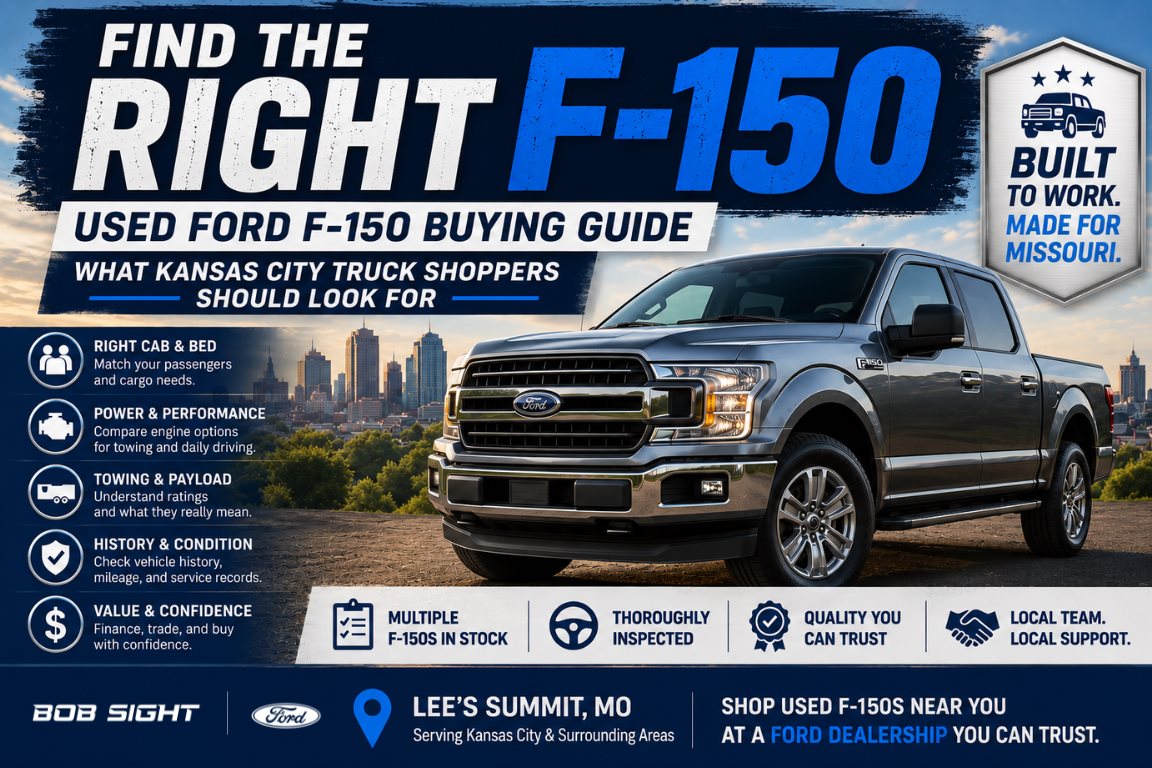
Shop used cars and used Ford trucks near Kansas City at Bob Sight Ford
A used Ford F-150 can be one of the best truck choices for Kansas City drivers who need towing strength, work capability, family comfort, and everyday dependability in one pickup. At Bob Sight Ford in Lee’s Summit, Missouri, shoppers from Kansas City, Blue Springs, Independence, Raytown, Grain Valley, and the surrounding Jackson County area can compare used F-150 trucks with a clearer process than guessing through private listings or scattered online results.
Many shoppers begin with searches like “used Ford F-150 for sale near me” because they already know they want a capable full-size truck. The real question is which used F-150 is the right one. Cab size, bed length, engine choice, mileage, towing package, payload rating, drivetrain, trim level, service history, and condition can all change how well a used F-150 fits your needs.
This buying guide explains what Kansas City truck shoppers should look for before choosing a used Ford F-150. Whether you need a truck for work, towing, family travel, home projects, or daily driving, the right F-150 should match your actual use, not just look good in photos.
In This Guide You’ll Learn
- How to choose the right used Ford F-150 for Kansas City driving
- Why cab size, bed length, engine, and drivetrain matter
- What to check before buying a used F-150
- How towing capacity and payload ratings work in plain language
- Why vehicle history and maintenance records matter for used trucks
- How dealership shopping can reduce used truck buying guesswork
- Which Bob Sight Ford tools help with inventory, financing, trade-ins, and service
Why the Used Ford F-150 Is Popular With Kansas City Truck Shoppers
The used Ford F-150 is popular near Kansas City because it offers full-size truck capability while still being practical enough for daily driving, family use, work, towing, and weekend projects. It has long been one of the most recognizable pickup choices for drivers who need a truck that can do more than one job. For many Missouri shoppers, a used F-150 feels like the right balance between strength and everyday comfort.
Kansas City Metro drivers use trucks in many different ways. A homeowner in Lee’s Summit may want an F-150 for hauling mulch, moving furniture, and towing a small utility trailer. A contractor near Blue Springs may need a truck that can carry tools, supplies, and crew members during the week. A family in Independence may want a SuperCrew F-150 because it provides pickup utility with rear-seat space for kids, backpacks, sports gear, and road trips.
The F-150 also fits local driving patterns well. Drivers around US-50, I-470, MO-291, I-70, and the busy routes near Summit Fair and Independence Center often need a vehicle that can handle commuting, parking lots, traffic, and weekend travel. A used F-150 can feel refined enough for daily use while still offering the strength shoppers expect from a full-size truck.
The key is choosing the right used F-150 configuration. Not every F-150 is built for the same job. One truck may be ideal for towing a boat to Longview Lake, while another may be better as a comfortable commuter with occasional hauling needs. Understanding the differences before buying helps shoppers avoid overbuying, underbuying, or choosing a truck that does not match real ownership needs.
Choose the Right Cab Size for Your Passengers and Daily Routine
Cab size is one of the most important used Ford F-150 buying decisions because it affects passenger space, comfort, storage, parking, and daily usability. A truck that works for one driver may not work for a family, work crew, or carpool. Kansas City shoppers should think carefully about who rides in the truck and how often.
Depending on model year and availability, used F-150 shoppers may see Regular Cab, SuperCab, and SuperCrew configurations. A Regular Cab can be useful for drivers who prioritize work use, bed space, and a simpler layout. A SuperCab adds smaller rear seating and extra interior storage, which can help with occasional passengers or tools. A SuperCrew provides the most rear-seat space and is often the best fit for families, crews, and drivers who regularly carry passengers.
For daily Missouri driving, comfort matters. If you commute from Lee’s Summit to downtown Kansas City, spend time in school pickup lines, or take weekend trips with family, rear-seat space can make a big difference. SuperCrew models often feel more versatile because they can carry adults, kids, car seats, pets, luggage, or work gear inside the cabin.
Cab size also affects truck length, especially when combined with bed length. A larger cab may make parking more challenging in tight areas, older neighborhoods, downtown lots, or crowded shopping centers. That does not mean shoppers should avoid a larger cab. It simply means the test drive should include parking, turning, and visibility checks in conditions similar to your daily routine.
| F-150 Cab Style | Best For | What to Consider |
|---|---|---|
| Regular Cab | Work use, basic hauling, fewer passengers | Limited interior passenger and storage space |
| SuperCab | Occasional passengers, extra cabin storage | Rear-seat access and space may be limited |
| SuperCrew | Families, crews, daily passenger use | Longer overall truck length depending on bed |
If you are searching used Ford F-150 for sale near me, do not skip the cab comparison. Sit in every row, test the doors, check car-seat fit if needed, and think about real passengers. The right cab makes the truck easier to live with every day.
Understand Bed Length and How You Will Use the Truck
Bed length matters because it determines how well a used Ford F-150 can handle tools, materials, equipment, camping gear, furniture, and weekend project loads. A truck bed is one of the main reasons shoppers choose an F-150, so the bed size should match your actual hauling needs. Bigger is not always better if it makes the truck harder to park or drive daily.
Depending on model year and cab configuration, F-150 trucks may be available with different bed lengths. Shorter beds are common on family-friendly SuperCrew trucks because they help keep the overall length more manageable. Longer beds may be better for work use, larger materials, tools, ladders, and frequent hauling. The best choice depends on what you carry most often.
A homeowner in Lee’s Summit may only need a bed for mulch bags, lawn equipment, weekend DIY projects, coolers, bikes, and small furniture. A contractor in Grain Valley may need more bed length for tools, lumber, ladders, and jobsite supplies. A driver who tows often may care more about cab comfort and towing equipment than maximum bed length. The use case should guide the decision.
Truck shoppers should also check bed condition. Scratches are common and not automatically a problem, but heavy dents, damaged tie-downs, rust, holes, or signs of severe abuse deserve attention. A spray-in bedliner, drop-in liner, tonneau cover, bed step, tie-down system, or cargo management features can add usefulness depending on your needs.
- List what you carry most often. Include tools, sports gear, home supplies, luggage, equipment, or trailer accessories.
- Measure large items if needed. Ladders, lumber, equipment cases, and furniture may require more bed space.
- Check bed condition closely. Look for dents, rust, liner condition, tie-down wear, and tailgate operation.
- Consider parking and turning. A longer truck may be harder to maneuver in tight Kansas City lots.
- Think about accessories. Bed covers, liners, steps, and cargo systems can improve daily usability.
A used F-150 should make your life easier, not create new inconveniences. If the truck will be a daily driver, bed length should be balanced with cab size, parking comfort, and turning space. If the truck will be a work tool, bed usefulness may carry more weight in the decision.
Compare Used Ford F-150 Engine Options Carefully
Engine choice affects how a used Ford F-150 feels during towing, commuting, hauling, passing, and everyday driving. Different engines can deliver different combinations of power, torque, efficiency, sound, maintenance expectations, and towing confidence. Kansas City shoppers should compare the engine in the exact truck they are considering.
Depending on model year, used F-150 shoppers may encounter engines such as the 3.3L Ti-VCT V6, 2.7L EcoBoost V6, 3.5L EcoBoost V6, 5.0L V8, 3.0L Power Stroke diesel in certain older model years, or PowerBoost Hybrid on newer models. Availability will vary by inventory, model year, and trim. Each engine can make sense for different drivers.
EcoBoost engines use turbocharging to help deliver strong torque from smaller displacement engines. Torque is the twisting force that helps a truck accelerate, climb grades, and move weight. This matters when merging onto I-470, towing a trailer, or carrying a loaded bed. The 5.0L V8 appeals to drivers who like traditional V8 power delivery and strong truck character. PowerBoost Hybrid models can appeal to shoppers who want strong torque and hybrid efficiency benefits, depending on availability.
Engine choice should match your real use. If you mostly commute and occasionally haul light loads, you may not need the strongest towing-focused setup. If you regularly tow boats, campers, equipment, or heavier trailers, you should review the engine, axle ratio, towing package, and payload rating together. The engine is only one part of the truck’s capability.
| Engine Type | Potential Strength | Best Fit |
|---|---|---|
| V6 options | Practical daily driving and lighter-duty needs | Commuters and general truck use |
| EcoBoost V6 options | Strong torque and confident acceleration | Towing, passing, mixed work and daily driving |
| 5.0L V8 | Traditional V8 feel and strong capability | Drivers who prefer V8 power delivery |
| PowerBoost Hybrid | Hybrid efficiency potential with strong torque | Drivers wanting modern capability and efficiency |
During the test drive, pay attention to smoothness, acceleration, shifting, noise, idle quality, and how confident the truck feels. Ask about maintenance history, oil change records, and any completed service. A well-matched engine can make the difference between a good truck and the right truck.
Know the Difference Between Towing Capacity and Payload
Towing capacity and payload are different ratings, and both matter when buying a used Ford F-150. Towing capacity refers to how much weight a truck can pull when properly equipped. Payload refers to how much weight the truck can carry in or on the vehicle, including passengers, cargo, tools, bed loads, and trailer tongue weight.
This distinction is important because truck shoppers often focus only on towing capacity. A used F-150 may have impressive towing potential, but payload can become the limiting factor once people, gear, and trailer tongue weight are added. For example, a family towing a camper may load the truck with passengers, luggage, coolers, bikes, and supplies. All of that weight matters before the trailer even starts moving.
Kansas City drivers who tow boats, campers, utility trailers, lawn equipment, or work trailers should review ratings carefully. A driver heading to Longview Lake or Lake Jacomo with a boat needs the right hitch setup, trailer wiring, braking confidence, mirror visibility, tire condition, and payload capacity. A contractor pulling equipment around Lee’s Summit, Independence, or Blue Springs needs a truck that can safely handle repeated loads.
Not every used F-150 has the same towing rating. Capacity depends on engine, axle ratio, cab size, bed length, drivetrain, wheelbase, payload package, towing package, and other equipment. That is why shoppers should check the exact truck’s door sticker, owner information, and equipment details rather than assuming based on model name.
- Know your trailer’s loaded weight. Include gear, tools, fuel, supplies, water, and cargo.
- Check the truck’s payload rating. Remember that passengers, cargo, and tongue weight count.
- Confirm towing equipment. Look for hitch equipment, trailer wiring, trailer brake controller, and tow mirrors if needed.
- Review axle ratio and drivetrain. These details can affect towing confidence and capability.
- Ask about the truck’s exact configuration. The specific vehicle matters more than general F-150 claims.
For shoppers searching used Ford F-150 for sale near me, towing research should happen before purchase. Buying the right configuration helps protect safety, confidence, and long-term satisfaction. A strong truck is only the right truck if it is equipped for the job you need it to do.
Check Vehicle History, Maintenance, and Prior Use
Vehicle history, maintenance records, and prior use can reveal whether a used Ford F-150 was cared for properly and whether it fits your reliability expectations. Trucks are often used harder than cars or crossovers, so shoppers should look closely at how the vehicle may have been driven. A clean exterior alone does not tell the full story.
Start with the vehicle history report when available. Look for ownership patterns, title status, reported accidents, mileage consistency, and service records. A truck used as a personal commuter may have a different condition profile than a truck used for commercial work, towing, farming, or construction. None of those uses automatically disqualify a truck, but they should guide your inspection.
Maintenance matters for engines, transmissions, brakes, tires, suspension, four-wheel-drive systems, cooling systems, and towing components. A used F-150 that was regularly serviced may be a stronger candidate than one with unknown history. Ask about oil changes, tire rotations, brake work, fluid services, recalls, and reconditioning completed before the truck was listed.
Missouri conditions can influence used truck condition. Winter road treatments can affect underbody areas. Potholes around Jackson County can impact alignment, wheels, tires, and suspension. Summer heat can stress batteries, cooling systems, and air conditioning. Heavy traffic near Kansas City can increase brake wear. These are normal ownership realities, but they make inspection more important.
| Item to Review | Why It Matters | What to Watch For |
|---|---|---|
| Vehicle history | Shows ownership, title, and reported events | Accidents, title concerns, mileage gaps |
| Service records | Shows maintenance care | Missing oil changes, limited records, overdue services |
| Bed condition | Shows hauling use | Heavy dents, rust, damaged tie-downs |
| Hitch wear | Can indicate towing history | Excessive wear, wiring issues, missing equipment |
| Underbody condition | Shows exposure and hard use | Rust, leaks, damage, worn suspension parts |
A used F-150 can be an excellent value when the condition supports the purchase. The goal is not to find a truck that has never worked. The goal is to find one that was used appropriately, maintained well, and matches your ownership plan.
Inspect Tires, Brakes, Suspension, and 4WD Components
Tires, brakes, suspension, and four-wheel-drive components are critical inspection points when buying a used Ford F-150. These systems affect safety, comfort, towing confidence, traction, and long-term ownership costs. They also reveal how the truck may have been used before you buy it.
Start with the tires. Check tread depth, sidewall condition, tire age, load rating, and wear pattern. Uneven tire wear can point to alignment issues, worn suspension parts, improper inflation, or inconsistent rotation history. Truck tires can be more expensive than car tires, so their condition should be part of the value comparison. For Missouri weather, tire quality also affects wet-road, winter, and gravel-road confidence.
Brakes should feel smooth and predictable. During the test drive, pay attention to pedal feel, vibration, squealing, grinding, pulling, or soft response. Trucks that tow or carry loads may wear brakes differently than trucks used mostly for commuting. If you plan to tow, brake condition becomes even more important because stopping confidence matters as much as pulling power.
Suspension inspection is important because trucks handle weight, potholes, rough roads, and jobsite surfaces. Listen for clunks, rattles, bouncing, pulling, or uneven ride height. Look at shocks, struts, leaf springs, control arms, and visible underbody components when possible. A truck that has spent time on rough roads or under heavy loads may show wear in these areas.
If the truck has four-wheel drive, test it according to proper procedure. Make sure the system engages, indicators work, and there are no unusual noises. Four-wheel drive can be helpful for snow, gravel, muddy areas, boat ramps, and job sites, but it should be functioning correctly before purchase.
- Inspect tire wear. Look for even tread, good sidewalls, proper load rating, and matching tires.
- Test braking feel. Watch for vibration, noise, pulling, or soft pedal response.
- Listen to suspension behavior. Pay attention over bumps, turns, and uneven pavement.
- Check underbody condition. Look for rust, leaks, damage, or worn visible components.
- Test four-wheel drive if equipped. Confirm engagement and smooth operation.
This inspection step is important for Kansas City truck shoppers because local roads can be tough on trucks. Potholes, construction zones, winter salt, gravel lots, and heavy use can all leave signs. A careful review helps shoppers understand what they are buying before making a decision.
Compare Trim Levels, Technology, and Comfort Features
Trim level and equipment matter because a used Ford F-150 can range from a practical work truck to a highly comfortable daily driver with advanced technology. Shoppers should compare features based on how they plan to use the truck. The best value is not always the highest trim. It is the trim that fits your needs.
Depending on model year, used F-150 trims may include work-focused, mid-level, luxury-oriented, off-road-oriented, and appearance-focused options. Shoppers may see features such as cloth or leather seating, heated seats, ventilated seats, large touchscreens, navigation, Apple CarPlay, Android Auto, trailer backup features, bed lighting, power outlets, remote start, upgraded audio, and Ford Co-Pilot360 driver-assist features.
Technology should be tested before buying. Use the touchscreen, backup camera, Bluetooth, USB ports, climate controls, steering wheel buttons, power seats, windows, locks, and trailer-related features if equipped. If you tow, camera clarity and trailer tools can be helpful. If you commute, comfort features and driver-assist technology may matter more. If you use the truck for work, durable materials and easy-clean surfaces may be more important than luxury features.
Families should pay close attention to rear-seat space, storage, cupholders, charging ports, and cabin comfort. A SuperCrew F-150 can be a strong family vehicle if the interior layout supports daily life. Contractors may care more about vinyl floors, storage options, bed access, and practical equipment. Outdoor drivers may prioritize four-wheel drive, off-road packages, skid plates, or all-terrain tires depending on the model.
| Feature Category | Helpful For | What to Test |
|---|---|---|
| Cabin comfort | Commuting and family use | Seats, climate, visibility, noise level |
| Technology | Daily convenience | Touchscreen, camera, Bluetooth, charging ports |
| Towing features | Trailer confidence | Trailer brake controller, camera views, hitch setup |
| Work features | Jobsites and hauling | Bed lighting, outlets, floors, storage, tie-downs |
| Safety features | Family and commute confidence | Blind spot monitoring, lane support, emergency braking |
When shopping for a used F-150, avoid paying for features you do not need while also avoiding a truck that feels too basic for your daily life. A test drive and feature check can reveal whether a truck’s equipment matches your routine. That is where dealership comparison can be very helpful.
Why Dealership Shopping Helps With Used F-150 Confidence
Buying a used Ford F-150 from a dealership can give shoppers more confidence because they can compare inventory, ask questions, review vehicle details, explore financing, value a trade, and plan service in one place. Private sellers may offer individual trucks, but buyers often have to manage more research and paperwork independently. For a truck purchase, that added structure matters.
A private seller may not know the truck’s exact towing package, payload rating, service history, or equipment details. The buyer may need to arrange an inspection, verify title status, coordinate payment, manage paperwork, and arrange financing separately. That can create uncertainty, especially when buying a truck that may have been used for towing, hauling, or work.
Bob Sight Ford gives Kansas City Metro shoppers a local dealership resource for used F-150 research. Shoppers can review pre-owned inventory, browse the Used Cars for Sale Near Kansas City pillar page, use Value Your Trade, and begin with Get Pre-Approved. These tools help connect the truck search to the full buying process.
Dealership shopping also helps when comparing multiple F-150 configurations. A shopper may start by wanting the biggest engine available but realize a different cab, bed, or drivetrain better fits daily life. Another shopper may prioritize towing but need to focus more on payload and hitch equipment. A dealership setting makes it easier to ask those questions and compare real trucks.
For shoppers searching used Ford F-150 for sale near me, the dealership advantage is not only about finding a truck nearby. It is about getting a clearer path to the right truck. That clarity can make the difference between buying quickly and buying wisely.
Quick Facts About Buying a Used Ford F-150 Near Kansas City
A used Ford F-150 should be compared by cab size, bed length, engine, drivetrain, towing package, payload rating, mileage, condition, and maintenance history. The right F-150 is the one that fits your work, towing, family, and daily driving needs. Model name alone is not enough.
- SuperCrew models are popular for families, crews, and daily passenger use.
- Bed length should match what you actually haul most often.
- Engine choice affects towing, efficiency, acceleration, and ownership feel.
- Towing capacity depends on the exact truck configuration.
- Payload includes passengers, cargo, tools, bed loads, and trailer tongue weight.
- Vehicle history and maintenance records help reduce buying guesswork.
- Tires, brakes, suspension, and 4WD components deserve close inspection.
- Technology and trim features should match your daily routine.
- Dealership shopping helps compare multiple used F-150 trucks in one place.
These quick facts help shoppers avoid common used truck mistakes. A truck may look strong online but still need to be evaluated for real ownership. A used F-150 should fit your commute, parking, passengers, towing needs, work use, and long-term maintenance expectations.
Bob Sight Ford helps Lee’s Summit and Kansas City Metro shoppers compare used Ford trucks with more confidence. For drivers from Blue Springs, Independence, Raytown, Grain Valley, and nearby Missouri communities, having a local dealership resource can make the process easier from start to finish.
Ownership Planning for Used Ford F-150 Buyers
Ownership planning helps used Ford F-150 buyers protect long-term reliability by preparing for maintenance, tires, brakes, fluids, towing needs, and Missouri driving conditions. Buying the truck is only the beginning. Keeping it ready for work, family driving, towing, and daily use requires consistent care.
Maintenance needs vary based on how the truck is used. A commuter F-150 may need routine oil changes, tire rotations, brake inspections, filters, battery checks, and fluid maintenance. A towing-focused F-150 may need closer attention to transmission behavior, cooling systems, trailer wiring, brakes, tires, and hitch components. A work truck may need more frequent inspections because tools, cargo, and jobsite conditions add wear.
Missouri weather should be part of ownership planning. Summer heat can affect batteries, cooling systems, tires, and air conditioning. Winter cold can reduce tire pressure and make weak batteries more noticeable. Road salt and moisture can affect underbody areas. Potholes can impact tires, wheels, alignment, and suspension. Reliable truck ownership means staying ahead of these conditions.
Bob Sight Ford supports used truck ownership through local service resources. Shoppers and owners can use Schedule Service, review Service and Parts Specials, and access the Parts Department. Having service support in Lee’s Summit is helpful for drivers who rely on their truck every week.
A used F-150 can be a strong long-term vehicle when it is chosen carefully and maintained consistently. The best purchase is not only the truck that looks good on day one. It is the truck that continues to fit your work, towing, family, and daily driving needs over time.
Frequently Asked Questions About Buying a Used Ford F-150
What should I look for when buying a used Ford F-150?
When buying a used Ford F-150, look for the right cab size, bed length, engine, drivetrain, towing package, payload rating, mileage, condition, and maintenance history. You should also review vehicle history, inspect tires and brakes, test technology, and take a thorough test drive. A used F-150 should match the way you actually plan to use it.
Truck shoppers should pay close attention to signs of heavy towing, hauling, or commercial use. Bed dents, hitch wear, uneven tire wear, suspension noise, and underbody condition can all reveal important information. These signs do not always mean the truck should be avoided, but they should be evaluated before purchase.
For Kansas City Metro drivers, local conditions matter too. Potholes, traffic, winter road treatments, summer heat, and highway commuting can all affect truck wear. Buying from a dealership gives shoppers a better setting to compare trucks and ask questions.
Is a used Ford F-150 good for towing?
Yes, a properly equipped used Ford F-150 can be a strong towing truck, but capacity depends on the exact configuration. Engine, axle ratio, drivetrain, cab size, bed length, payload rating, and towing package all affect what the truck can safely handle. Shoppers should review the specific truck’s ratings before buying.
Towing capacity is not the only number that matters. Payload is also important because passengers, cargo, tools, and trailer tongue weight count against the truck’s carrying capacity. A truck that can pull a trailer still needs enough payload for the total load.
For Missouri drivers towing boats, campers, utility trailers, or work equipment, the right setup matters. Check hitch equipment, trailer wiring, trailer brake controller, mirrors, tires, brakes, and cooling system condition. A dealership can help shoppers evaluate these details more clearly.
Which used Ford F-150 engine is best?
The best used Ford F-150 engine depends on how you plan to drive, tow, haul, and maintain the truck. EcoBoost engines can offer strong torque and confident acceleration. The 5.0L V8 appeals to drivers who prefer traditional V8 power. Other V6 and hybrid options may fit commuters, light-duty users, or shoppers wanting different efficiency and capability balances.
There is no single best engine for every buyer. A driver towing often may prioritize torque and towing equipment. A commuter may care more about smoothness and fuel economy. A homeowner may want balanced everyday power for light hauling and weekend projects.
Kansas City shoppers should test drive the exact truck they are considering. Pay attention to acceleration, shifting, noise, idle quality, and service history. The engine should fit your needs and feel confident during real driving.
Should I buy a used F-150 with 4WD?
A used F-150 with 4WD can be a good choice if you drive in snow, rain, gravel, muddy areas, boat ramps, rural roads, or jobsite conditions. Four-wheel drive can add traction confidence, but it may not be necessary for every shopper. The right choice depends on your driving environment and ownership goals.
Drivers who stay mostly on paved city and suburban roads may be comfortable with two-wheel drive. Drivers who tow, work outdoors, visit rural properties, or travel during winter weather may prefer 4WD. Missouri weather can change quickly, so added traction can be useful for some households.
If you buy a used F-150 with 4WD, test the system before purchase. Make sure it engages correctly and listen for unusual noises. Also consider maintenance history because four-wheel-drive components should be cared for properly.
Where can I shop used Ford F-150 trucks near me?
You can shop used Ford F-150 trucks near Kansas City at Bob Sight Ford in Lee’s Summit, Missouri. The dealership serves shoppers from Lee’s Summit, Kansas City, Blue Springs, Independence, Raytown, Grain Valley, and surrounding Jackson County communities. Shoppers can browse used inventory online and visit for a test drive.
Bob Sight Ford offers used truck inventory, trade-in tools, financing resources, and service support. This helps shoppers move from research to ownership with a clearer process. Instead of guessing through private listings, buyers can compare multiple used Ford trucks through a local dealership.
For shoppers searching used Ford F-150 for sale near me, local support matters. A dealership can help you compare cab styles, bed lengths, engines, towing setups, and condition. That makes the buying process more useful and more confidence-focused.
Find the Right Used Ford F-150 at Bob Sight Ford
Bob Sight Ford helps Kansas City Metro shoppers find used Ford F-150 trucks that fit work, towing, family life, daily driving, and long-term ownership goals. A used F-150 is a major decision because it may serve as your commuter, work tool, family vehicle, and weekend hauler. Choosing carefully helps protect your satisfaction after the purchase.
For some shoppers, the right F-150 will be a SuperCrew with comfort features and family-ready space. For others, it will be a work-focused truck with the right bed length, payload rating, and towing equipment. Some drivers may prioritize 4WD for Missouri weather, while others may focus on engine choice and daily driving comfort.
Bob Sight Ford’s Lee’s Summit location is convenient for shoppers from Kansas City, Blue Springs, Independence, Raytown, Grain Valley, and surrounding Missouri communities. Shoppers can compare used inventory, value a trade, explore financing, ask questions, and plan future service with local dealership support. That makes the process easier than trying to evaluate one private listing at a time.
If you are searching for a used Ford F-150 for sale near me, start by deciding how you will use the truck. Think about passengers, towing, bed use, parking, weather, mileage, maintenance, and ownership plans. Then use Bob Sight Ford’s resources to compare used F-150 options near Kansas City with more confidence.
Helpful Links
- Used Cars for Sale Near Kansas City
- Pre-Owned Inventory
- Value Your Trade
- Get Pre-Approved
- Schedule Service
Proud to Be Part of the Bob Sight Auto Group
Bob Sight Ford is proud to be part of the Bob Sight Auto Group, serving drivers across Missouri and Kansas with trusted local dealership support. Whether you are shopping for a used Ford F-150 in Lee’s Summit, comparing used trucks near Kansas City, scheduling Ford service, or researching another Bob Sight location, the Bob Sight Auto Group gives regional drivers several convenient automotive resources across the metro and surrounding communities.